Dual-purpose model flies in CL Stunt or Scale


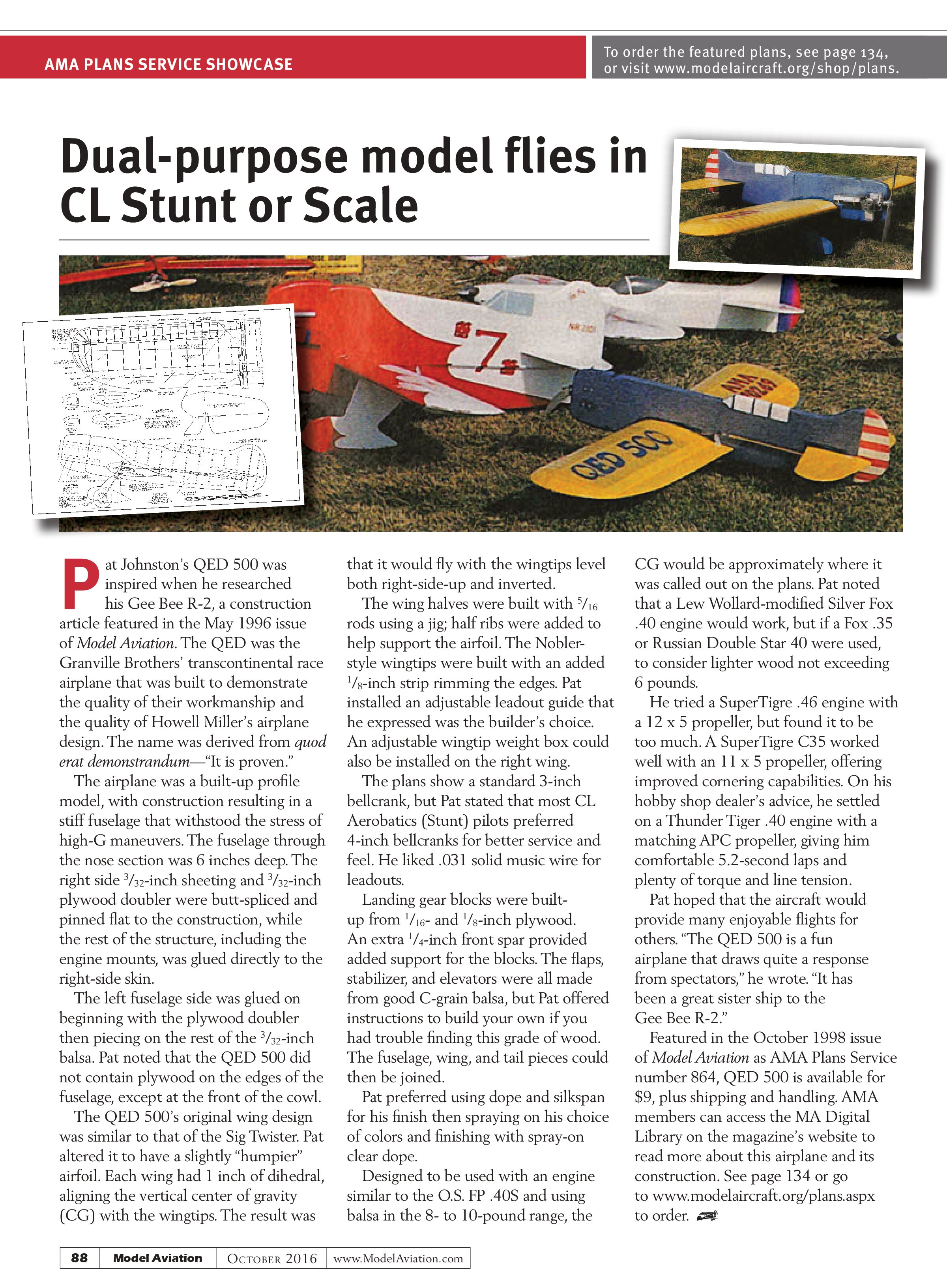
Pat Johnston’s QED 500 was inspired when he researched his Gee Bee R-2, a construction article featured in the May 1996 issue of Model Aviation. The QED was the Granville Brothers’ transcontinental race airplane that was built to demonstrate the quality of their workmanship and the quality of Howell Miller’s airplane design. The name was derived from quod erat demonstrandum—“It is proven.”
The airplane was a built-up profile model, with construction resulting in a stiff fuselage that withstood the stress of high-G maneuvers. The fuselage through the nose section was 6 inches deep. The right side ³⁄₃₂-inch sheeting and ³⁄₃₂-inch plywood doubler were butt-spliced and pinned flat to the construction, while the rest of the structure, including the engine mounts, was glued directly to the right-side skin.
The left fuselage side was glued on beginning with the plywood doubler then piecing on the rest of the ³⁄₃₂-inch balsa. Pat noted that the QED 500 did not contain plywood on the edges of the fuselage, except at the front of the cowl.
The QED 500’s original wing design was similar to that of the Sig Twister. Pat altered it to have a slightly “humpier” airfoil. Each wing had 1 inch of dihedral, aligning the vertical center of gravity (CG) with the wingtips. The result was that it would fly with the wingtips level both right-side-up and inverted.
The wing halves were built with ⁵⁄₁₆ rods using a jig; half ribs were added to help support the airfoil. The Nobler-style wingtips were built with an added ¹⁄₈-inch strip trimming the edges. Pat installed an adjustable leadout guide that he expressed was the builder’s choice. An adjustable wingtip weight box could also be installed on the right wing.
The plans show a standard 3-inch bellcrank, but Pat stated that most CL Aerobatics (Stunt) pilots preferred 4-inch bellcranks for better service and feel. He liked .031 solid music wire for leadouts.
Landing gear blocks were built-up from ¹⁄₁₆- and ¹⁄₈-inch plywood. An extra ¹⁄₄-inch front spar provided added support for the blocks. The flaps, stabilizer, and elevators were all made from good C-grain balsa, but Pat offered instructions to build your own if you had trouble finding this grade of wood. The fuselage, wing, and tail pieces could then be joined.
Pat preferred using dope and silkspan for his finish then spraying on his choice of colors and finishing with spray-on clear dope.
Designed to be used with an engine similar to the O.S. FP .40S and using balsa in the 8- to 10-pound range, the CG would be approximately where it was called out on the plans. Pat noted that a Lew Wollard-modified Silver Fox .40 engine would work, but if a Fox .35 or Russian Double Star 40 were used, to consider lighter wood not exceeding 6 pounds.
He tried a SuperTigre .46 engine with a 12 x 5 propeller, but found it to be too much. A SuperTigre C35 worked well with an 11 x 5 propeller, offering improved cornering capabilities. On his hobby shop dealer’s advice, he settled on a Thunder Tiger .40 engine with a matching APC propeller, giving him comfortable 5.2-second laps and plenty of torque and line tension.
Pat hoped that the aircraft would provide many enjoyable flights for others. “The QED 500 is a fun airplane that draws quite a response from spectators,” he wrote. “It has been a great sister ship to the Gee Bee R-2.”
Featured in the October 1998 issue of Model Aviation as AMA Plans Service number 864, QED 500 is available for $9, plus shipping and handling. AMA members can access the MA Digital Library on the magazine’s website to read more about this airplane and its construction. See page 134 or go to www.modelaircraft.org/plans.aspx to order.