Tools for the trade
by Don Slusarczyk
don@donsrc.com
In my preparations for the 2016 Indoor Free Flight (FF) Nats, I have been going through my toolboxes and equipment and have found that some of my items seem slightly outdated. I have a few stopwatches that are easily more than 20 years old. They do not always start or stop when pushed. My desktop digital scale takes up a large amount of space on my workbench. I decided to start looking online to try and update some of my equipment.
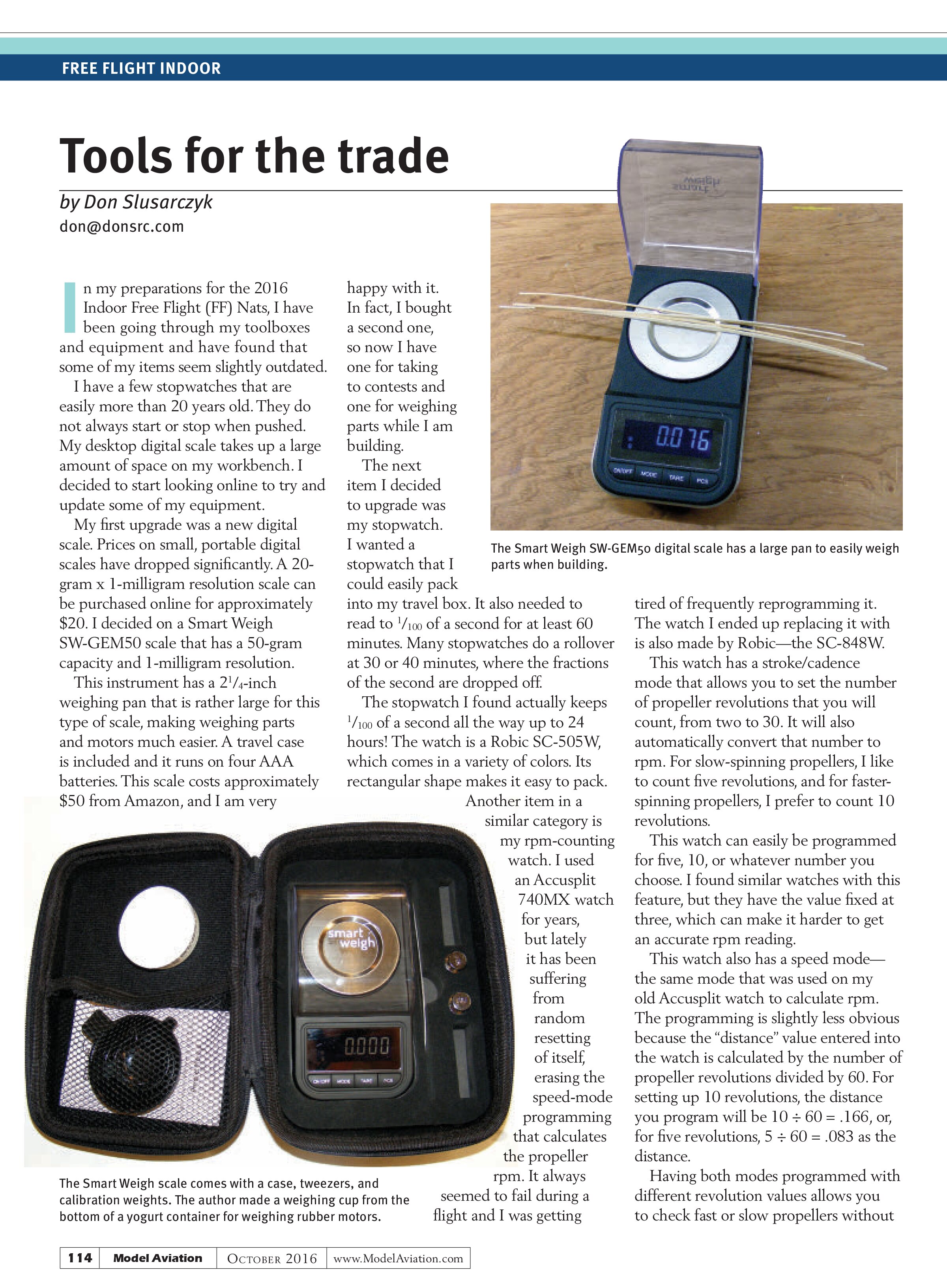
My first upgrade was a new digital scale. Prices on small, portable digital scales have dropped significantly. A 20-gram x 1-milligram resolution scale can be purchased online for approximately $20. I decided on a Smart Weigh SW-GEM50 scale that has a 50-gram capacity and 1-milligram resolution.
This instrument has a 2¼-inch weighing pan that is rather large for this type of scale, making weighing parts and motors much easier. A travel case is included and it runs on four AAA batteries. This scale costs approximately $50 from Amazon, and I am very happy with it. In fact, I bought a second one, so now I have one for taking to contests and one for weighing parts while I am building.
The next item I decided to upgrade was my stopwatch. I wanted a stopwatch that I could easily pack into my travel box. It also needed to read to ¹⁄₁₀₀ of a second for at least 60 minutes. Many stopwatches do a rollover at 30 or 40 minutes, where the fractions of the second are dropped off.
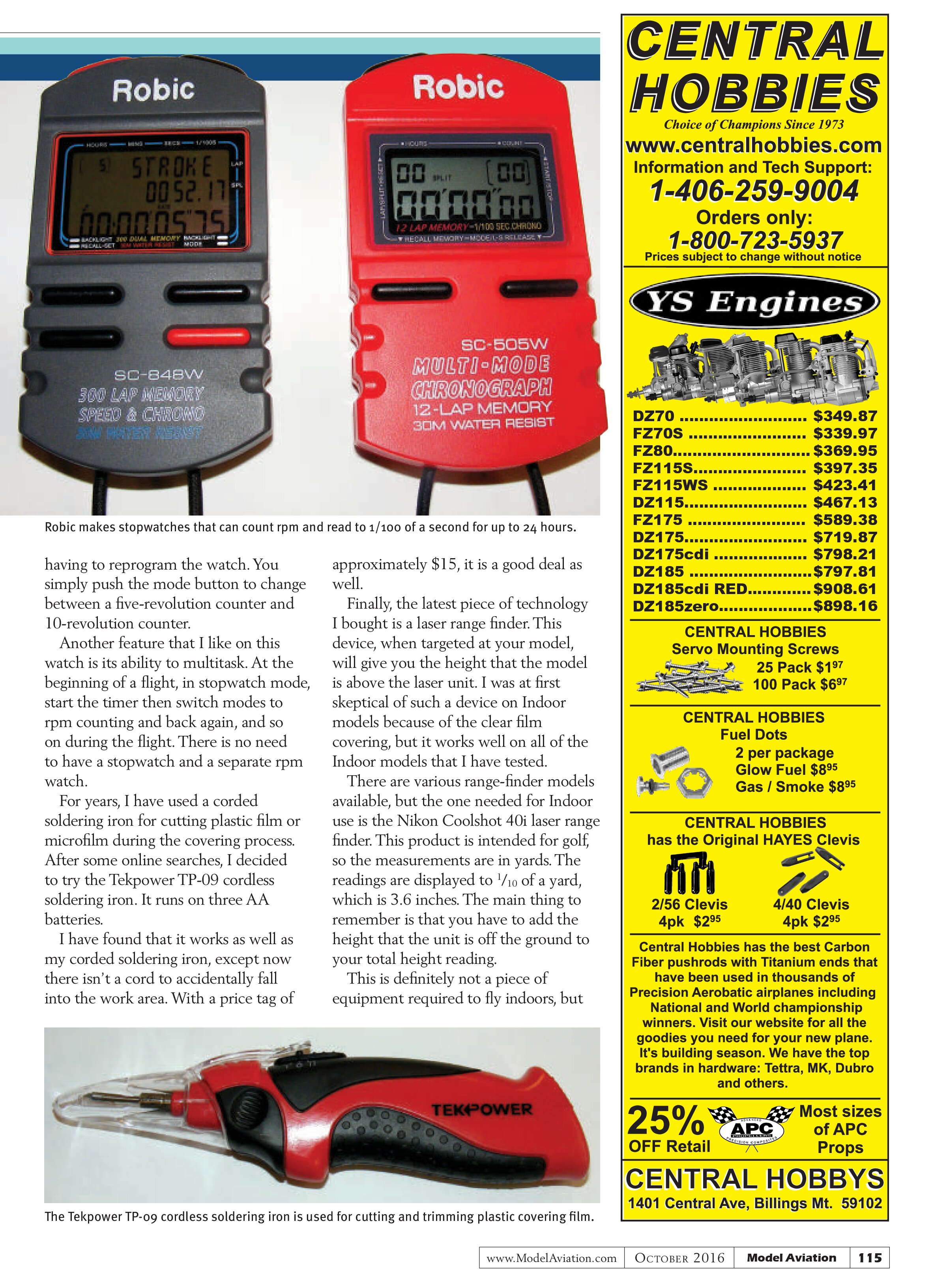
The stopwatch I found actually keeps ¹⁄₁₀₀ of a second all the way up to 24 hours! The watch is a Robic SC-505W, which comes in a variety of colors. Its rectangular shape makes it easy to pack.
Another item in a similar category is my rpm-counting watch. I used an Accusplit 740MX watch for years, but lately it has been suffering from random resetting of itself, erasing the speed-mode programming that calculates the propeller rpm. It always seemed to fail during a flight and I was getting tired of frequently reprogramming it. The watch I ended up replacing it with is also made by Robic—the SC-848W.
This watch has a stroke/cadence mode that allows you to set the number of propeller revolutions that you will count, from two to 30. It will also automatically convert that number to rpm. For slow-spinning propellers, I like to count five revolutions, and for faster-spinning propellers, I prefer to count 10 revolutions.
This watch can easily be programmed for five, 10, or whatever number you choose. I found similar watches with this feature, but they have the value fixed at three, which can make it harder to get an accurate rpm reading.
This watch also has a speed mode—the same mode that was used on my old Accusplit watch to calculate rpm. The programming is slightly less obvious because the “distance” value entered into the watch is calculated by the number of propeller revolutions divided by 60. For setting up 10 revolutions, the distance you program will be 10 ÷ 60 = .166, or, for five revolutions, 5 ÷ 60 = .083 as the distance.
Having both modes programmed with different revolution values allows you to check fast or slow propellers without

My first upgrade was a new digital scale. Prices on small, portable digital scales have dropped significantly. A 20-gram x 1-milligram resolution scale can be purchased online for approximately $20. I decided on a Smart Weigh SW-GEM50 scale that has a 50-gram capacity and 1-milligram resolution.
This instrument has a 2¼-inch weighing pan that is rather large for this type of scale, making weighing parts and motors much easier. A travel case is included and it runs on four AAA batteries. This scale costs approximately $50 from Amazon, and I am very

The stopwatch I found actually keeps ¹⁄₁₀₀ of a second all the way up to 24 hours! The watch is a Robic SC-505W, which comes in a variety of colors. Its rectangular shape makes it easy to pack.
Another item in a similar category is my rpm-counting watch. I used an Accusplit 740MX watch for years, but lately it has been suffering from random resetting of itself, erasing the speed-mode programming that calculates the propeller rpm. It always seemed to fail during a flight and I was getting tired of frequently reprogramming it. The watch I ended up replacing it with is also made by Robic—the SC-848W.
This watch has a stroke/cadence mode that allows you to set the number of propeller revolutions that you will count, from two to 30. It will also automatically convert that number to rpm. For slow-spinning propellers, I like to count five revolutions, and for faster-spinning propellers, I prefer to count 10 revolutions.
This watch can easily be programmed for five, 10, or whatever number you choose. I found similar watches with this feature, but they have the value fixed at three, which can make it harder to get an accurate rpm reading.
This watch also has a speed mode—the same mode that was used on my old Accusplit watch to calculate rpm. The programming is slightly less obvious because the “distance” value entered into the watch is calculated by the number of propeller revolutions divided by 60. For setting up 10 revolutions, the distance you program will be 10 ÷ 60 = .166, or, for five revolutions, 5 ÷ 60 = .083 as the distance.
Having both modes programmed with different revolution values allows you to check fast or slow propellers without
having to reprogram the watch. You simply push the mode button to change between a five-revolution counter and 10-revolution counter.
Another feature that I like on this watch is its ability to multitask. At the beginning of a flight, in stopwatch mode, start the timer then switch modes to rpm counting and back again, and so on during the flight. There is no need to have a stopwatch and a separate rpm watch.
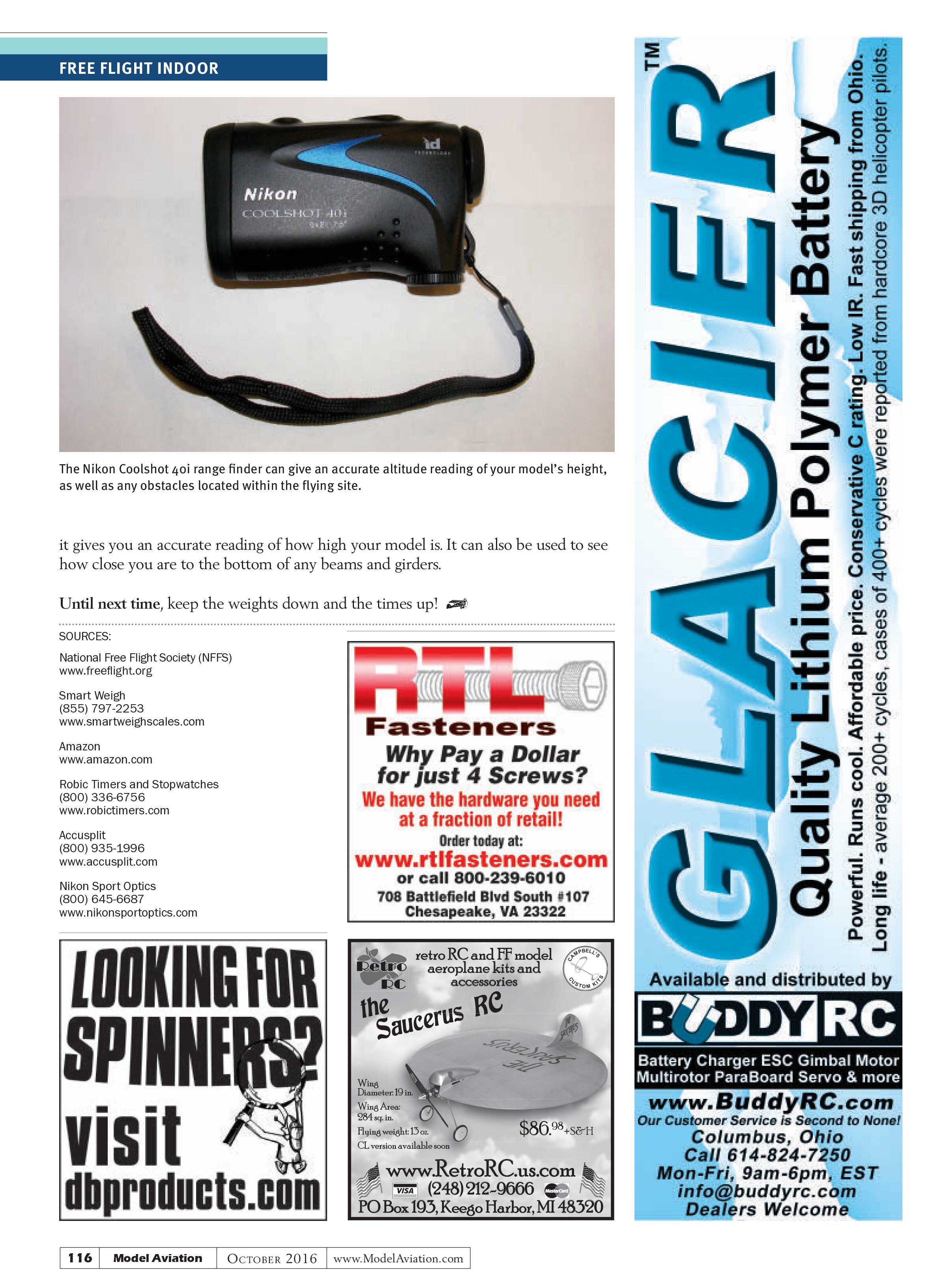
For years, I have used a corded soldering iron for cutting plastic film or microfilm during the covering process. After some online searches, I decided to try the Tekpower TP-09 cordless soldering iron. It runs on three AA batteries.
I have found that it works as well as my corded soldering iron, except now there isn’t a cord to accidentally fall into the work area. With a price tag of approximately $15, it is a good deal as well.
Finally, the latest piece of technology I bought is a laser range finder. This device, when targeted at your model, will give you the height that the model is above the laser unit. I was at first skeptical of such a device on Indoor models because of the clear film covering, but it works well on all of the Indoor models that I have tested.
There are various range-finder models available, but the one needed for Indoor use is the Nikon Coolshot 40i laser range finder. This product is intended for golf, so the measurements are in yards. The readings are displayed to ¹⁄₁₀ of a yard, which is 3.6 inches. The main thing to remember is that you have to add the height that the unit is off the ground to your total height reading.
This is definitely not a piece of equipment required to fly indoors, but


it gives you an accurate reading of how high your model is. It can also be used to see how close you are to the bottom of any beams and girders.
Until next time, keep the weights down and the times up!
SOURCES:
National Free Flight Society (NFFS)
www.freeflight.org
Smart Weigh
(855) 797-2253
www.smartweighscales.com
Amazon
www.amazon.com
Robic Timers and Stopwatches
(800) 336-6756
www.robictim ers.com
Accusplit
(800) 935-1996
www.accusplit.com
Nikon Sport Optics
(800) 645-6687
www.nikonsportoptics.com