eWeek is coming!
Greg Gimlick
maelectrics@gimlick.com
My favorite event of the year is upon us—eWeek at Triple Tree Aerodrome in Woodruff, South Carolina, also referred to as “The Electric Nall.” Whatever you choose to call it, it’s just the best week of electric flying anywhere ... assuming the weather doesn’t repeat its ugly performance of last year.
Flightline boss Jim Malek assured me that the weather will be great. The 2016 dates are September 28 through October 2, and you can register online or at the gate.
If you haven’t been to the Triple Tree Aerodrome, you owe it to yourself to see this magnificent facility and enjoy the hospitality of its incredible staff. On-site camping is encouraged and the facility rivals that of any camping resort you’ll find. I’ll have an AMA pit set up at center field, so stop by and say hello.
Graphene Batteries—Hype or Hope?
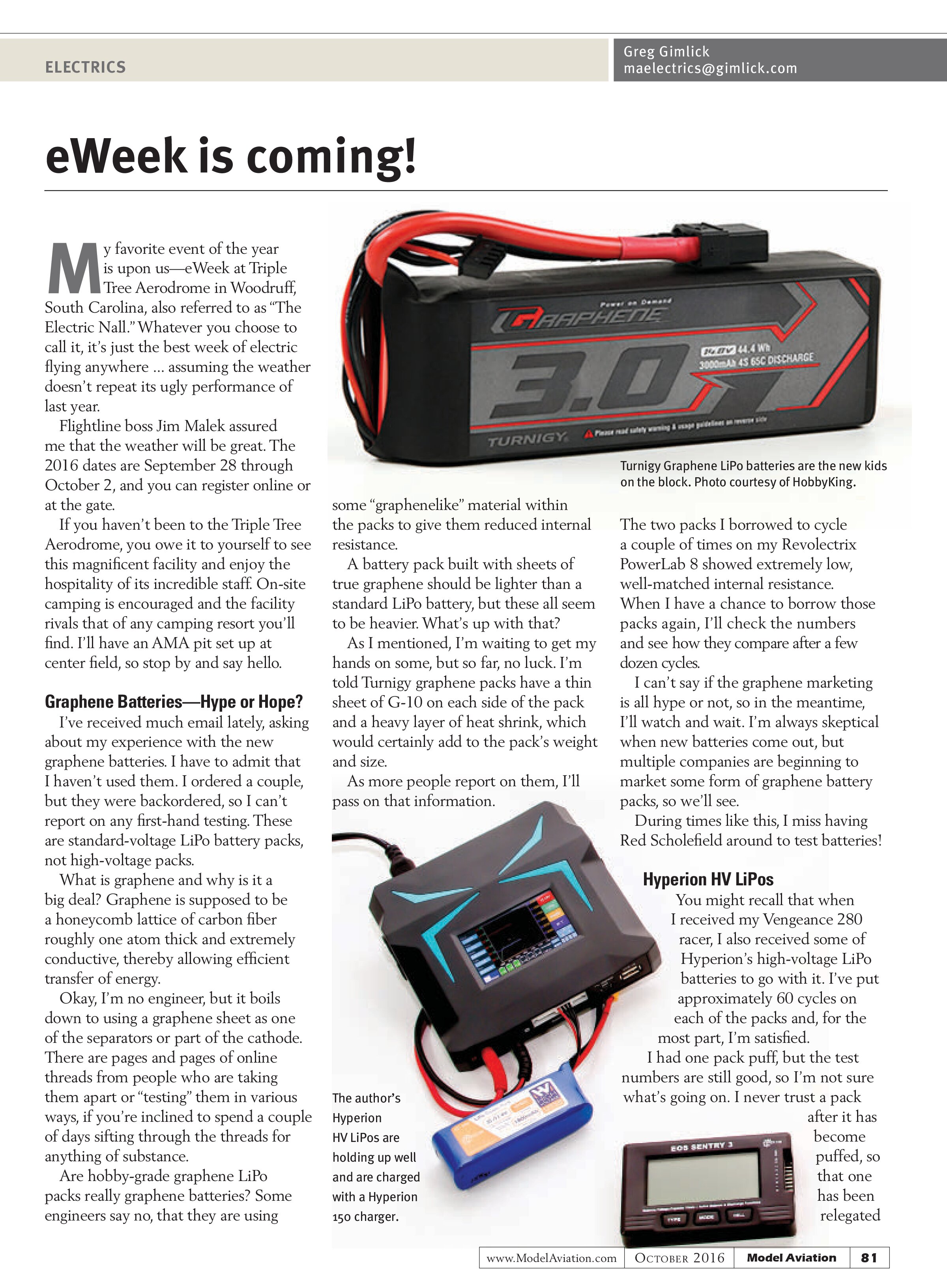
I’ve received much email lately, asking about my experience with the new graphene batteries. I have to admit that I haven’t used them. I ordered a couple, but they were backordered, so I can’t report on any first-hand testing. These are standard-voltage LiPo battery packs, not high-voltage packs.
What is graphene and why is it a big deal? Graphene is supposed to be a honeycomb lattice of carbon fiber roughly one atom thick and extremely conductive, thereby allowing efficient transfer of energy.
Okay, I’m no engineer, but it boils down to using a graphene sheet as one of the separators or part of the cathode. There are pages and pages of online threads from people who are taking them apart or “testing” them in various ways, if you’re inclined to spend a couple of days sifting through the threads for anything of substance.
Are hobby-grade graphene LiPo packs really graphene batteries? Some engineers say no, that they are using

A battery pack built with sheets of true graphene should be lighter than a standard LiPo battery, but these all seem to be heavier. What’s up with that?
As I mentioned, I’m waiting to get my hands on some, but so far, no luck. I’m told Turnigy graphene packs have a thin sheet of G-10 on each side of the pack and a heavy layer of heat shrink, which would certainly add to the pack’s weight and size.
As more people report on them, I’ll pass on that information.

The two packs I borrowed to cycle a couple of times on my Revolectrix PowerLab 8 showed extremely low, well-matched internal resistance. When I have a chance to borrow those packs again, I’ll check the numbers and see how they compare after a few dozen cycles.
I can’t say if the graphene marketing is all hype or not, so in the meantime, I’ll watch and wait. I’m always skeptical when new batteries come out, but multiple companies are beginning to market some form of graphene battery packs, so we’ll see.
During times like this, I miss having Red Scholefield around to test batteries!
Hyperion HV LiPos
You might recall that when I received my Vengeance 280 racer, I also received some of Hyperion’s high-voltage LiPo batteries to go with it. I’ve put approximately 60 cycles on each of the packs and, for the most part, I’m satisfied.
I had one pack puff, but the test numbers are still good, so I’m not sure what’s going on. I never trust a pack after it has become puffed, so that one has been relegated


to bench-testing.
There is certainly a difference in performance, particularly in the early portion of the flight when I use the 1,800 mAh HV pack compared with my regular LiPo. It’s smaller and lighter than a standard LiPo and has much more punch during the initial flight segment. The Hyperion HV batteries work great in my 280 racer, but I’m also working them well below the peak discharge rates.
My Battery Bottom Line
I don’t shop by name or price alone. I talk with many people, I listen to a number of readers, and I try to find what works best for my particular applications.
There are retailers, such as Pulse Batteries, from which I enjoy receiving good customer service from a person I can call on the telephone. The company backs up its battery packs with knowledgeable staff.
I’ve bought other high-priced, big-name packs that simply didn’t live up to the hype, so now I avoid those products. I’ve had some great Turnigy 3S LiPo packs that cost less than $10 and performed as well as the name-brand products that cost significantly more. I’ve also had some other brands of packs from HobbyKing that didn’t perform well, so I stick with what has worked.
The bottom line for me is finding battery packs that work well for my requirements and ignoring the advertising hype. I don’t fast-charge anything unless it is needed for a special event turnaround.
I size my packs so that I operate them well below their rated capacities, and I never store them fully charged for any length of time. I also charge them with quality charging equipment. Your mileage could vary.
Propellers Will Get You!
As I was wrapping up this column, I received an email from a club member with photos of a pilot’s hands that were all stitched up. I’ll save you the trauma of seeing the photos, but it was a stark reminder that we need to be more careful. The pilot accidentally hit the throttle stick while handling the airplane—and you can guess the rest.
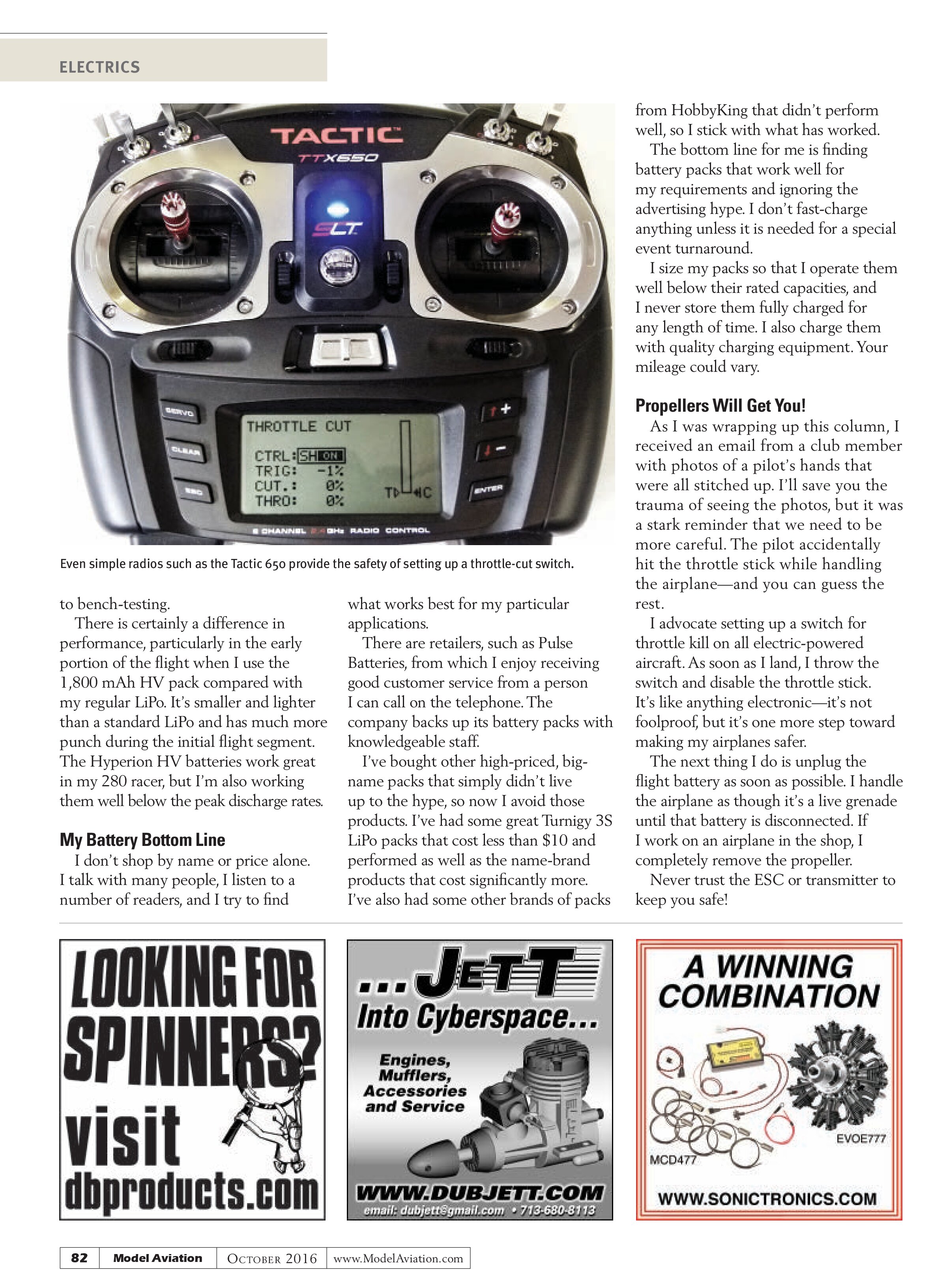
I advocate setting up a switch for throttle kill on all electric-powered aircraft. As soon as I land, I throw the switch and disable the throttle stick. It’s like anything electronic—it’s not foolproof, but it’s one more step toward making my airplanes safer.
The next thing I do is unplug the flight battery as soon as possible. I handle the airplane as though it’s a live grenade until that battery is disconnected. If I work on an airplane in the shop, I completely remove the propeller.
Never trust the ESC or transmitter to keep you safe!

Wrapping Up
We can revisit the programming of throttle-kill switches for various radios in another column. Be safe and I hope to see you at eWeek!
SOURCES:
eWeek
www.tripletreeaerodrome.com/
eweek-fly-in.php
Hyperion
www.hyperion-world.com
HobbyKing
www.hobbyking.com
Pulse Battery
(978) 206-6037
www.pulsebattery.com