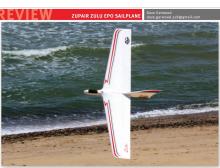
ZUPAIR ZULU EPO SAILPLANE
Dave Garwood
dave.garwood.518@gmail.com

A versatile glider with drooperons
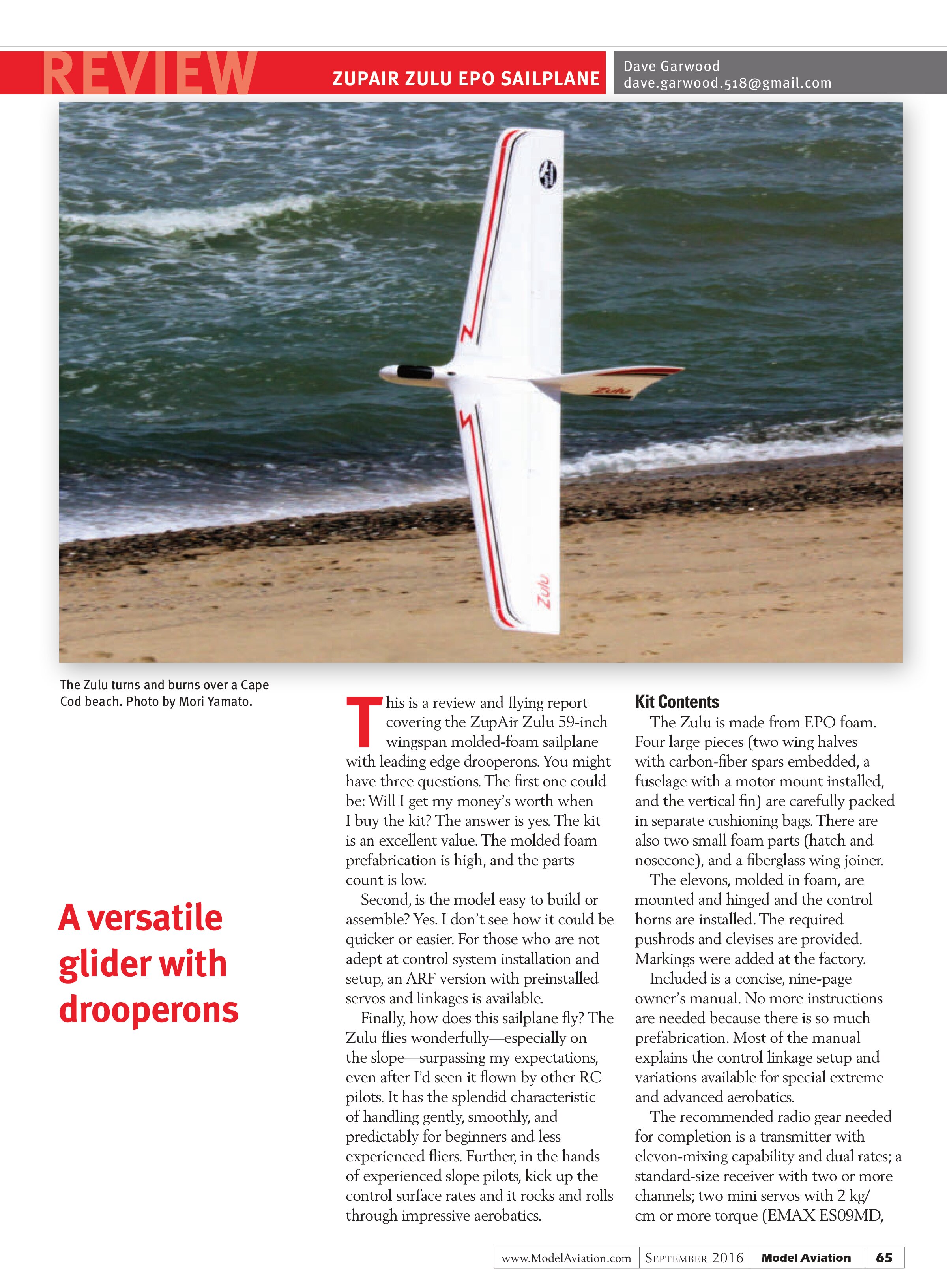
This is a review and flying report covering the ZupAir Zulu 59-inch wingspan molded-foam sailplane with leading edge drooperons. You might have three questions. The first one could be: Will I get my money’s worth when I buy the kit? The answer is yes. The kit is an excellent value. The molded foam prefabrication is high, and the parts count is low.
Second, is the model easy to build or assemble? Yes. I don’t see how it could be quicker or easier. For those who are not adept at control system installation and setup, an ARF version with preinstalled servos and linkages is available.
Finally, how does this sailplane fly? The Zulu flies wonderfully—especially on the slope—surpassing my expectations, even after I’d seen it flown by other RC pilots. It has the splendid characteristic of handling gently, smoothly, and predictably for beginners and less experienced fliers. Further, in the hands of experienced slope pilots, kick up the control surface rates and it rocks and rolls through impressive aerobatics.
Kit Contents
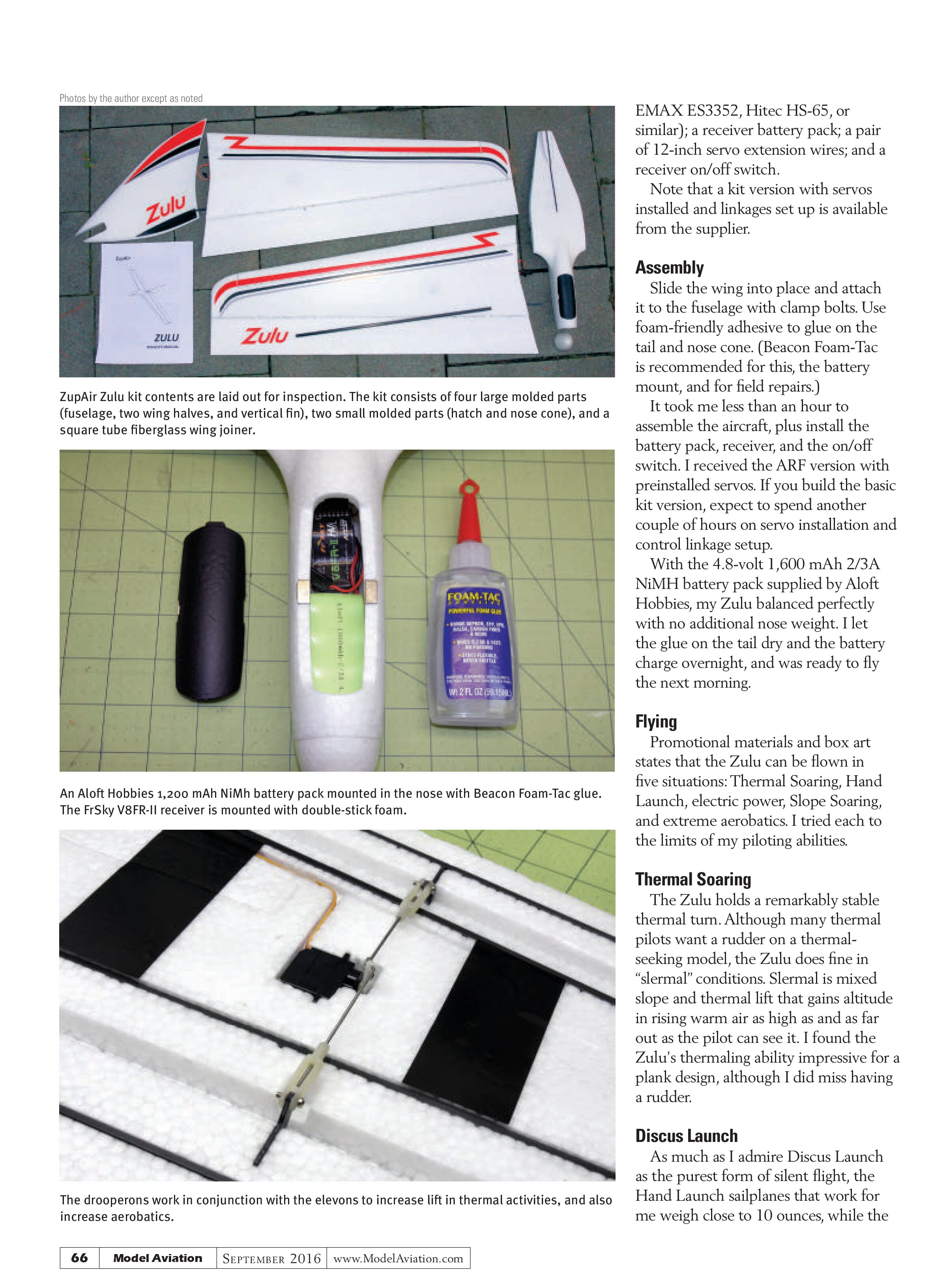
The Zulu is made from EPO foam. Four large pieces (two wing halves with carbon-fiber spars embedded, a fuselage with a motor mount installed, and the vertical fin) are carefully packed in separate cushioning bags. There are also two small foam parts (hatch and nosecone), and a fiberglass wing joiner.
The elevons, molded in foam, are mounted and hinged and the control horns are installed. The required pushrods and clevises are provided. Markings were added at the factory.
Included is a concise, nine-page owner’s manual. No more instructions are needed because there is so much prefabrication. Most of the manual explains the control linkage setup and variations available for special extreme and advanced aerobatics.
The recommended radio gear needed for completion is a transmitter with elevon-mixing capability and dual rates; a standard-size receiver with two or more channels; two mini servos with 2 kg/cm or more torque (EMAX ES09MD,

ZupAir Zulu kit contents are laid out for inspection. The kit consists of four large molded parts (fuselage, two wing halves, and vertical fin), two small molded parts (hatch and nose cone), and a square tube fiberglass wing joiner.

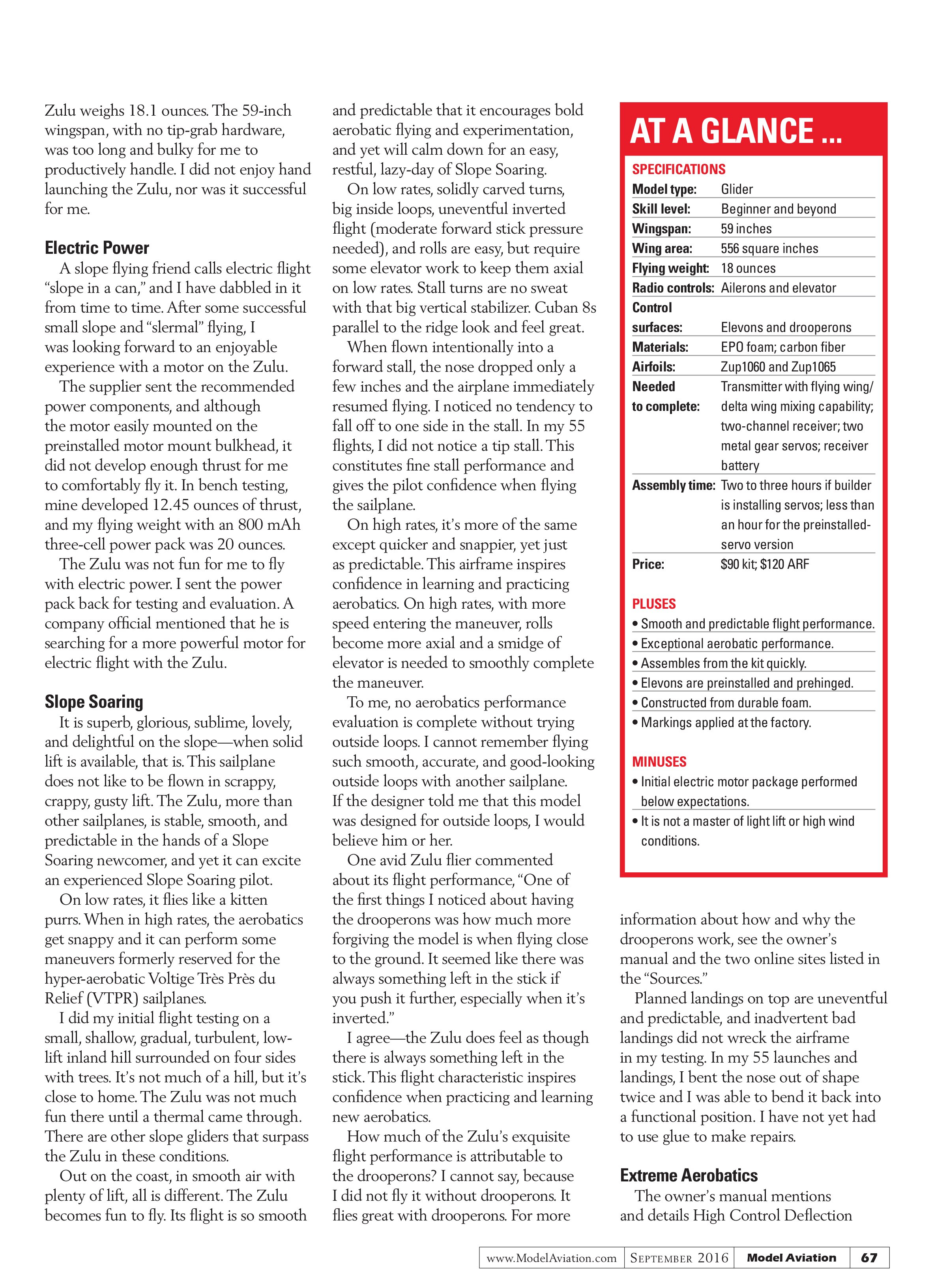
An Aloft Hobbies 1,200 mAh NiMH battery pack mounted in the nose with Beacon Foam-Tac glue. The FrSky V8FR-II receiver is mounted with double-stick foam.

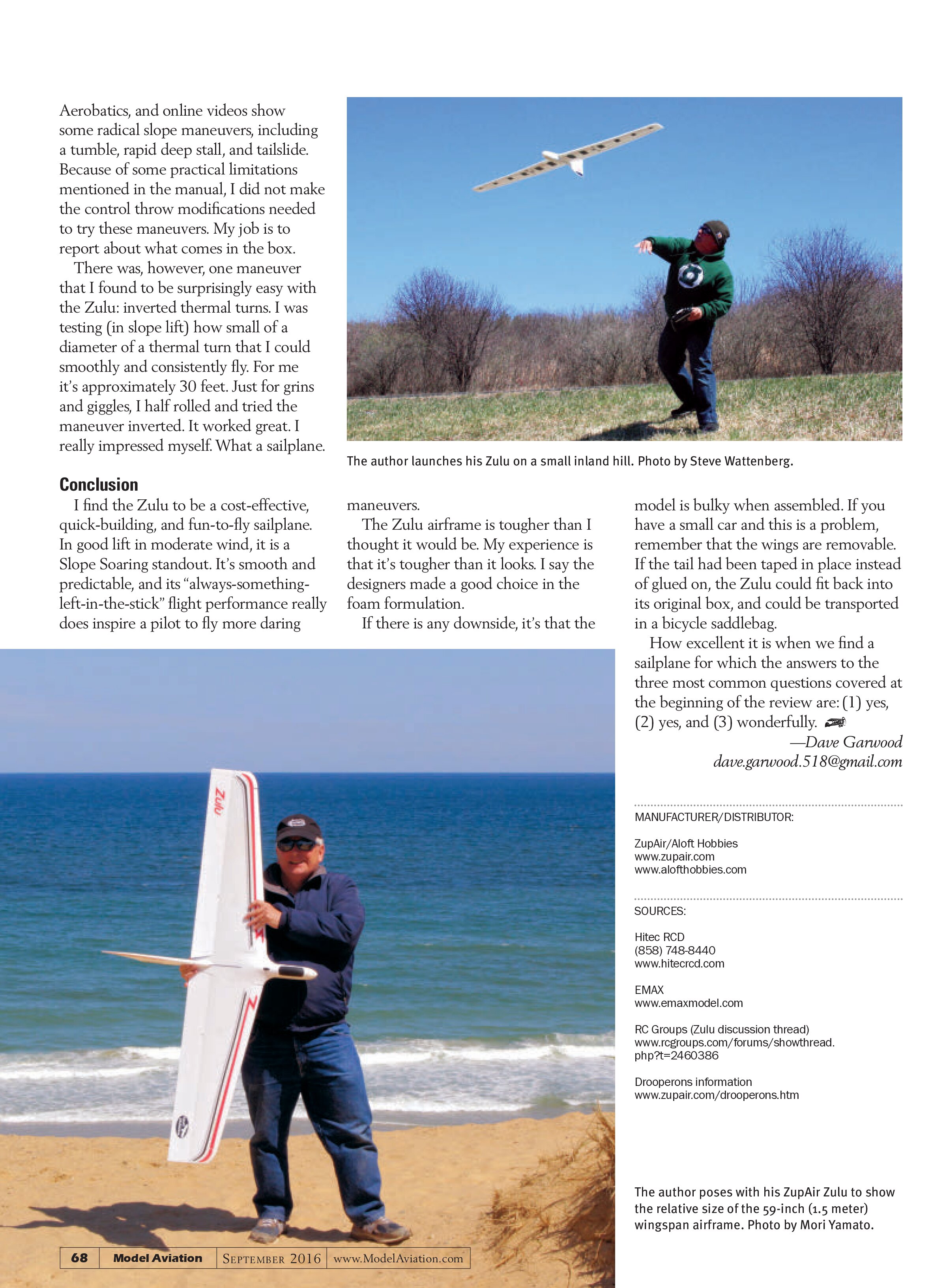
The drooperons work in conjunction with the elevons to increase lift in thermal activities, and also increase aerobatics.
EMAX ES3352, Hitec HS-65, or similar); a receiver battery pack; a pair of 12-inch servo extension wires; and a receiver on/off switch.
Note that a kit version with servos installed and linkages set up is available from the supplier.
Assembly
Slide the wing into place and attach it to the fuselage with clamp bolts. Use foam-friendly adhesive to glue on the tail and nose cone. (Beacon Foam-Tac is recommended for this, the battery mount, and for field repairs.)
It took me less than an hour to assemble the aircraft, plus install the battery pack, receiver, and the on/off switch. I received the ARF version with preinstalled servos. If you build the basic kit version, expect to spend another couple of hours on servo installation and control linkage setup.
With the 4.8-volt 1,600 mAh 2/3A NiMH battery pack supplied by Aloft Hobbies, my Zulu balanced perfectly with no additional nose weight. I let the glue on the tail dry and the battery charge overnight, and was ready to fly the next morning.
Flying
Promotional materials and box art states that the Zulu can be flown in five situations: Thermal Soaring, Hand Launch, electric power, Slope Soaring, and extreme aerobatics. I tried each to the limits of my piloting abilities.
Thermal Soaring
The Zulu holds a remarkably stable thermal turn. Although many thermal pilots want a rudder on a thermal-seeking model, the Zulu does fine in “siermal” conditions. Siermal is mixed slope and thermal lift that gains altitude in rising warm air as high as and as far out as the pilot can see it. I found the Zulu’s thermaling ability impressive for a plank design, although I did miss having a rudder.
Discus Launch
As much as I admire Discus Launch as the purest form of silent flight, the Hand Launch sailplanes that work for me weigh close to 10 ounces, while the
Zulu weighs 18.1 ounces. The 59-inch wingspan, with no tip-grab hardware, was too long and bulky for me to productively handle. I did not enjoy hand launching the Zulu, nor was it successful for me.
Electric Power
A slope flying friend calls electric flight “slope in a can,” and I have dabbled in it from time to time. After some successful small slope and “siermal” flying, I was looking forward to an enjoyable experience with a motor on the Zulu.
The supplier sent the recommended power components, and although the motor easily mounted on the preinstalled motor mount bulkhead, it did not develop enough thrust for me to comfortably fly it. In bench testing, mine developed 12.45 ounces of thrust, and my flying weight with an 800 mAh three-cell power pack was 20 ounces.
The Zulu was not fun for me to fly with electric power. I sent the power pack back for testing and evaluation. A company official mentioned that he is searching for a more powerful motor for electric flight with the Zulu.
Slope Soaring
It is superb, glorious, sublime, lovely, and delightful on the slope—when solid lift is available, that is. This sailplane does not like to be flown in scrappy, crappy, gusty lift. The Zulu, more than other sailplanes, is stable, smooth, and predictable in the hands of a Slope Soaring newcomer, and yet it can excite an experienced Slope Soaring pilot.
On low rates, it flies like a kitten purrs. When in high rates, the aerobatics get snappy and it can perform some maneuvers formerly reserved for the hyper-aerobatic Voltige Très Près du Relief (VTPR) sailplanes.
I did my initial flight testing on a small, shallow, gradual, turbulent, low-lift inland hill surrounded on four sides with trees. It’s not much of a hill, but it’s close to home. The Zulu was not much fun there until a thermal came through. There are other slope gliders that surpass the Zulu in these conditions.
Out on the coast, in smooth air with plenty of lift, all is different. The Zulu becomes fun to fly. Its flight is so smooth and predictable that it encourages bold aerobatic flying and experimentation, and yet will calm down for an easy, restful, lazy-day of Slope Soaring.
On low rates, solidly carved turns, big inside loops, uneventful inverted flight (moderate forward stick pressure needed), and rolls are easy, but require some elevator work to keep them axial on low rates. Stall turns are no sweat with that big vertical stabilizer. Cuban 8s parallel to the ridge look and feel great.
When flown intentionally into a forward stall, the nose dropped only a few inches and the airplane immediately resumed flying. I noticed no tendency to fall off to one side in the stall. In my 55 flights, I did not notice a tip stall. This constitutes fine stall performance and gives the pilot confidence when flying the sailplane.
On high rates, it’s more of the same except quicker and snappier, yet just as predictable. This airframe inspires confidence in learning and practicing aerobatics. On high rates, with more speed entering the maneuver, rolls become more axial and a smidge of elevator is needed to smoothly complete the maneuver.
To me, no aerobatics performance evaluation is complete without trying outside loops. I cannot remember flying such smooth, accurate, and good-looking outside loops with another sailplane. If the designer told me that this model was designed for outside loops, I would believe him or her.
One avid Zulu flier commented about its flight performance, “One of the first things I noticed about having the drooperons was how much more forgiving the model is when flying close to the ground. It seemed like there was always something left in the stick if you push it further, especially when it’s inverted.”
I agree—the Zulu does feel as though there is always something left in the stick. This flight characteristic inspires confidence when practicing and learning new aerobatics.
How much of the Zulu’s exquisite flight performance is attributable to the drooperons? I cannot say, because I did not fly it without drooperons. It flies great with drooperons. For more information about how and why the drooperons work, see the owner’s manual and the two online sites listed in the “Sources.”
Planned landings on top are uneventful and predictable, and inadvertent bad landings did not wreck the airframe in my testing. In my 55 launches and landings, I bent the nose out of shape twice and I was able to bend it back into a functional position. I have not yet had to use glue to make repairs.
Extreme Aerobatics
The owner’s manual mentions and details High Control Deflection
At a Glance ...
Specifications
Model type: Glider
Skill level: Beginner and beyond
Wingspan: 59 inches
Wing area: 556 square inches
Flying weight: 18 ounces
Radio controls: Ailerons and elevator
Control surfaces: Elevons and drooperons
Materials: EPO foam; carbon fiber
Airfoils: Zup1060 and Zup1065
Needed to complete: Transmitter with flying wing/delta wing mixing capability; two-channel receiver; two metal gear servos; receiver battery
Assembly time: Two to three hours if builder is installing servos; less than an hour for the preinstalled-servo version
Price: $90 kit; $120 ARF
Pluses
- Smooth and predictable flight performance.
- Exceptional aerobatic performance.
- Assembles from the kit quickly.
- Elevons are preinstalled and prehinged.
- Constructed from durable foam.
- Markings applied at the factory.
Minuses
- Initial electric motor package performed below expectations.
- It is not a master of light lift or high wind conditions.
Acrobatics, and online videos show some radical slope maneuvers, including a tumble, rapid deep stall, and tailslide. Because of some practical limitations mentioned in the manual, I did not make the control throw modifications needed to try these maneuvers. My job is to report about what comes in the box.
There was, however, one maneuver that I found to be surprisingly easy with the Zulu: inverted thermal turns. I was testing (in slope lift) how small of a diameter of a thermal turn that I could smoothly and consistently fly. For me it’s approximately 30 feet. Just for grins and giggles, I half rolled and tried the maneuver inverted. It worked great. I really impressed myself. What a sailplane.

Conclusion
I find the Zulu to be a cost-effective, quick-building, and fun-to-fly sailplane. In good lift in moderate wind, it is a Slope Soaring standout. It’s smooth and predictable, and its “always-something-left-in-the-stick” flight performance really does inspire a pilot to fly more daring maneuvers.
The Zulu airframe is tougher than I thought it would be. My experience is that it’s tougher than it looks. I say the designers made a good choice in the foam formulation.
If there is any downside, it’s that the model is bulky when assembled. If you have a small car and this is a problem, remember that the wings are removable. If the tail had been taped in place instead of glued on, the Zulu could fit back into its original box, and could be transported in a bicycle saddlebag.
How excellent it is when we find a sailplane for which the answers to the three most common questions covered at the beginning of the review are: (1) yes, (2) yes, and (3) wonderfully.
—Dave Garwood
dave.garwood.518@gmail.com
MANUFACTURER/DISTRIBUTOR:
ZupAir/Aloft Hobbies
www.zupair.com
www.aloftobbies.com
SOURCES:
Hitec RCD
(858) 748-8440
www.hitecrcd.com
RC Groups (Zulu discussion thread)
www.rcgroups.com/forums/showthread.php?t=2460386
Drooperons information
www.zupair.com/drooperons.htm