Early multichannel systems
Bob Noll
bobrc@aol.com
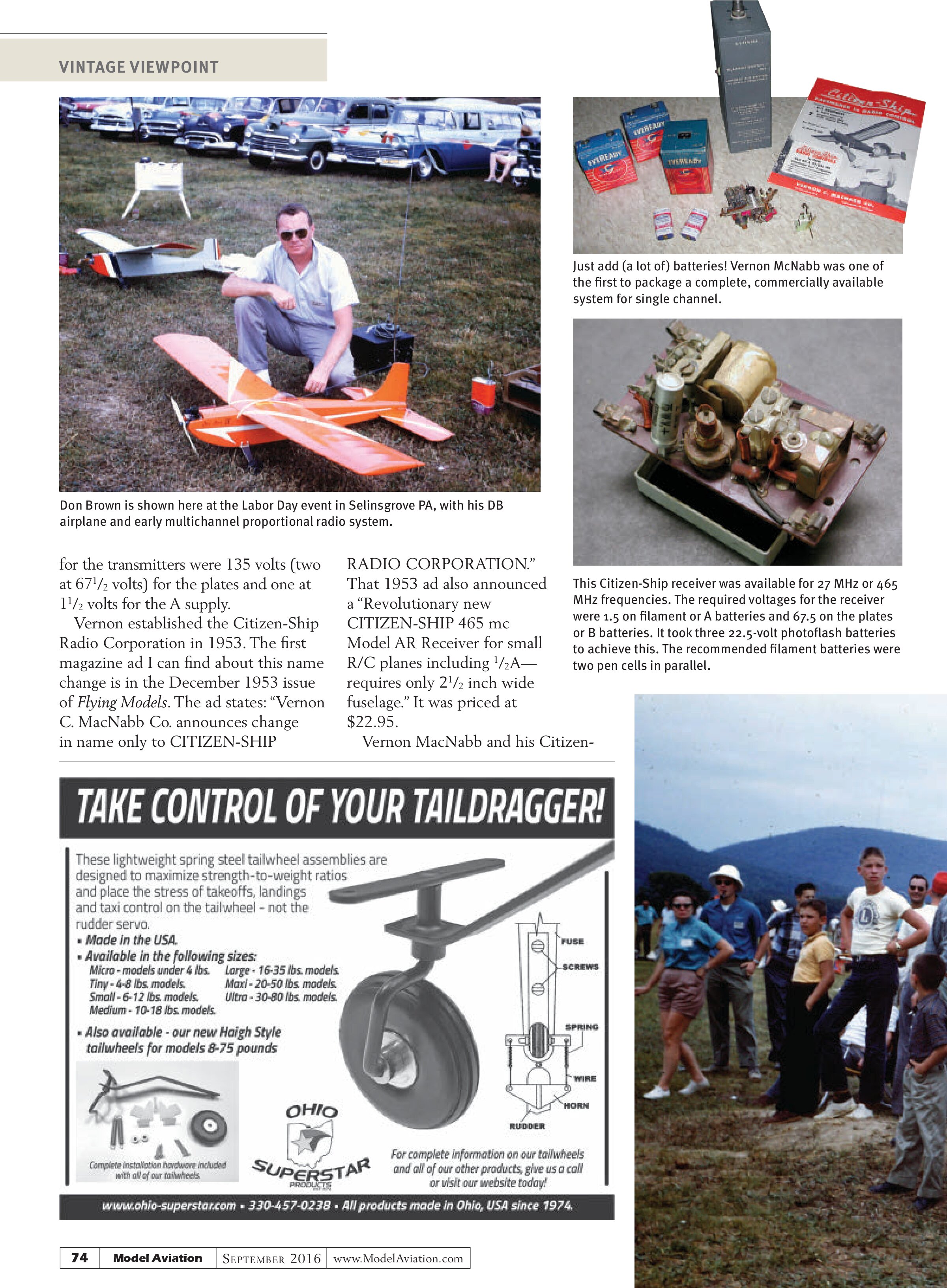
In 1953, a group of RC enthusiasts decided to gather in Selinsgrove, Pennsylvania, to show off their latest airplanes and equipment. This Labor Day weekend event was a must-see for those of us just getting into RC, with pioneers such as Walter Good, Howard McEntee, Don Brown, and others demonstrating their latest radio and airplane designs.
Most of the RC pilots in those days were ham radio operators, whose electronic expertise was put to good use developing better radio systems for those who were not-so-well educated in radio electronics.
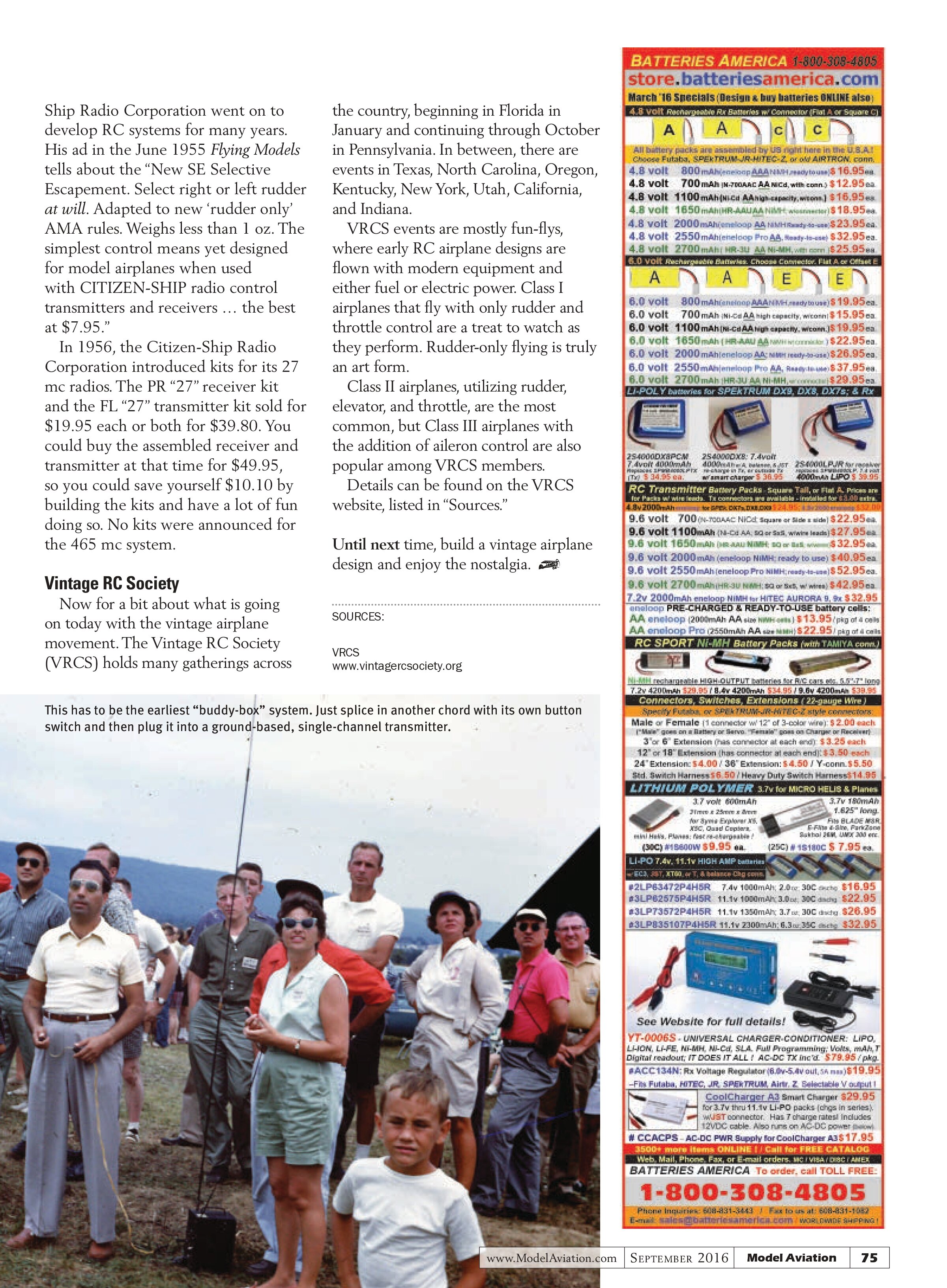
I have included several photos from the early Selinsgrove events. You will see the predominance of ground-based transmitters with heavy power supplies. Although single-channel systems were common, many of our pioneers were developing multichannel systems and replacing escapements with motorized actuators. These motorized actuators allowed larger airplanes and control of more than just rudder and throttle.
Walt Good had his TTPW system, which stood for Two-Tone Pulse Width. Don Brown was working on his Quadraplex system. Both of these methods provided multichannel proportional control, which was an extremely large improvement for the hobby.
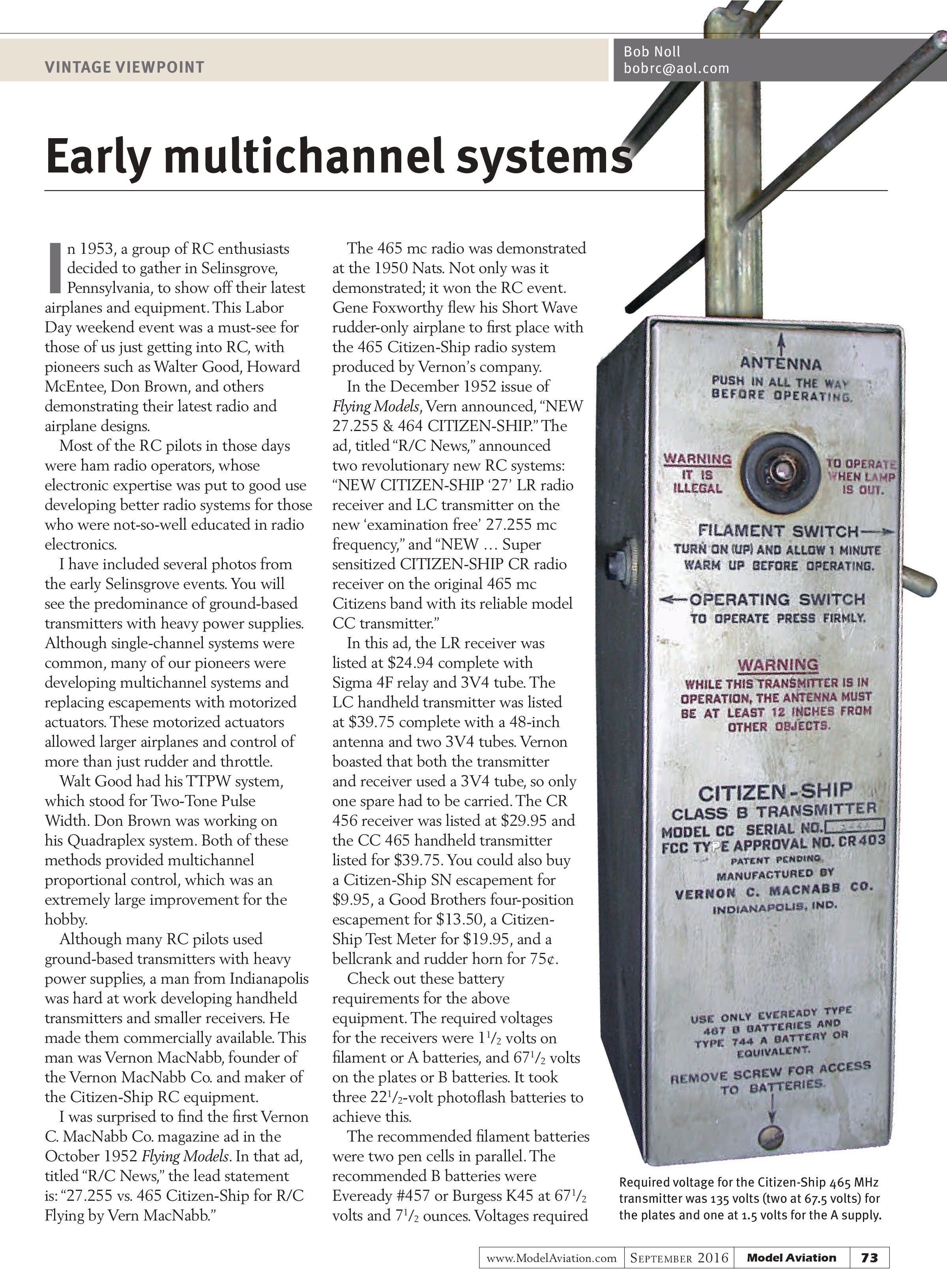
Although many RC pilots used ground-based transmitters with heavy power supplies, a man from Indianapolis was hard at work developing handheld transmitters and smaller receivers. He made them commercially available. This man was Vernon MacNabb, founder of the Vernon MacNabb Co. and maker of the Citizen-Ship RC equipment.
I was surprised to find the first Vernon C. MacNabb Co. magazine ad in the October 1952 Flying Models. In that ad, titled “R/C News,” the lead statement is: “27.255 vs. 465 Citizen-Ship for R/C Flying by Vern MacNabb.”
The 465 mc radio was demonstrated at the 1950 Nats. Not only was it demonstrated; it won the RC event. Gene Foxworthy flew his Short Wave rudder-only airplane to first place with the 465 Citizen-Ship radio system produced by Vernon’s company.
In the December 1952 issue of Flying Models, Vern announced, “NEW 27.255 & 464 CITIZEN-SHIP.” The ad, titled “R/C News,” announced two revolutionary new RC systems: “NEW CITIZEN-SHIP ‘27’ LR radio receiver and LC transmitter on the new ‘examination free’ 27.255 mc frequency,” and “NEW … Super sensitized CITIZEN-SHIP CR radio receiver on the original 465 mc Citizens band with its reliable model CC transmitter.”
In this ad, the LR receiver was listed at $24.94 complete with Sigma 4F relay and 3V4 tube. The LC handheld transmitter was listed at $39.75 complete with a 48-inch antenna and two 3V4 tubes. Vernon boasted that both the transmitter and receiver used a 3V4 tube, so only one spare had to be carried. The CR 456 receiver was listed at $29.95 and the CC 465 handheld transmitter listed for $39.75. You could also buy a Citizen-Ship SN escapement for $9.95, a Good Brothers four-position escapement for $13.50, a Citizen-Ship Test Meter for $19.95, and a bellcrank and rudder horn for 75¢.
Check out these battery requirements for the above equipment. The required voltages for the receivers were 1½ volts on filament or A batteries, and 67½ volts on the plates or B batteries. It took three 22½-volt photoflash batteries to achieve this.
The recommended filament batteries were two pen cells in parallel. The recommended B batteries were Eveready #457 or Burgess K45 at 67½ volts and 7½ ounces. Voltages required

for the transmitters were 135 volts (two at 67½ volts) for the plates and one at 1½ volts for the A supply.
Vernon established the Citizen-Ship Radio Corporation in 1953. The first magazine ad I can find about this name change is in the December 1953 issue of Flying Models. The ad states: “Vernon C. MacNabb Co. announces change in name only to CITIZEN-SHIP RADIO CORPORATION.” That 1953 ad also announced a “Revolutionary new CITIZEN-SHIP 465 mc Model AR Receiver for small R/C planes including ½A—requires only 2½ inch wide fuselage.” It was priced at $22.95.
Vernon MacNabb and his Citizen-Ship Radio Corporation went on to develop RC systems for many years. His ad in the June 1955 Flying Models tells about the “New SE Selective Escapement. Select right or left rudder at will. Adapted to new ‘rudder only’ AMA rules. Weighs less than 1 oz. The simplest control means yet designed for model airplanes when used with CITIZEN-SHIP radio control transmitters and receivers … the best at $7.95.”
In 1956, the Citizen-Ship Radio Corporation introduced kits for its 27 mc radios. The PR “27” receiver kit and the FL “27” transmitter kit sold for $19.95 each or both for $39.80. You could buy the assembled receiver and transmitter at that time for $49.95, so you could save yourself $10.10 by building the kits and have a lot of fun doing so. No kits were announced for the 465 mc system.
Vintage RC Society
Now for a bit about what is going on today with the vintage airplane movement. The Vintage RC Society (VRCS) holds many gatherings across the country, beginning in Florida in January and continuing through October in Pennsylvania. In between, there are events in Texas, North Carolina, Oregon, Kentucky, New York, Utah, California, and Indiana.
VRCS events are mostly fun-flys, where early RC airplane designs are flown with modern equipment and either fuel or electric power. Class I airplanes that fly with only rudder and throttle control are a treat to watch as they perform. Rudder-only flying is truly an art form.
Class II airplanes, utilizing rudder, elevator, and throttle, are the most common, but Class III airplanes with the addition of aileron control are also popular among VRCS members.
Details can be found on the VRCS website, listed in “Sources.”
Until next time, build a vintage airplane design and enjoy the nostalgia.
SOURCES: