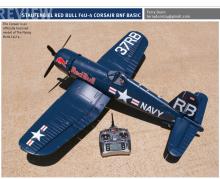
STAUFENBIEL RED BULL F4U-4 CORSAIR BNF BASIC
Terry Dunn
Put on your own air show with this large foam model

If you’ve never seen a full-scale F4U Corsair perform at an air show, you owe it to yourself to punch that ticket. There are often many impressive aircraft at any given air show. But for me, nothing quite matches the sight, sound, and visceral punch that a Corsair provides.
Of the more than 12,000 Corsairs produced, there are approximately two dozen that are airworthy today. One shining example of a surviving Corsair is part of the Flying Bulls Collection in Salzburg, Austria. This particular airplane was produced by Chance-Vought in 1945. It served the U.S. Navy and the Honduran Air Force before being passed into private ownership.
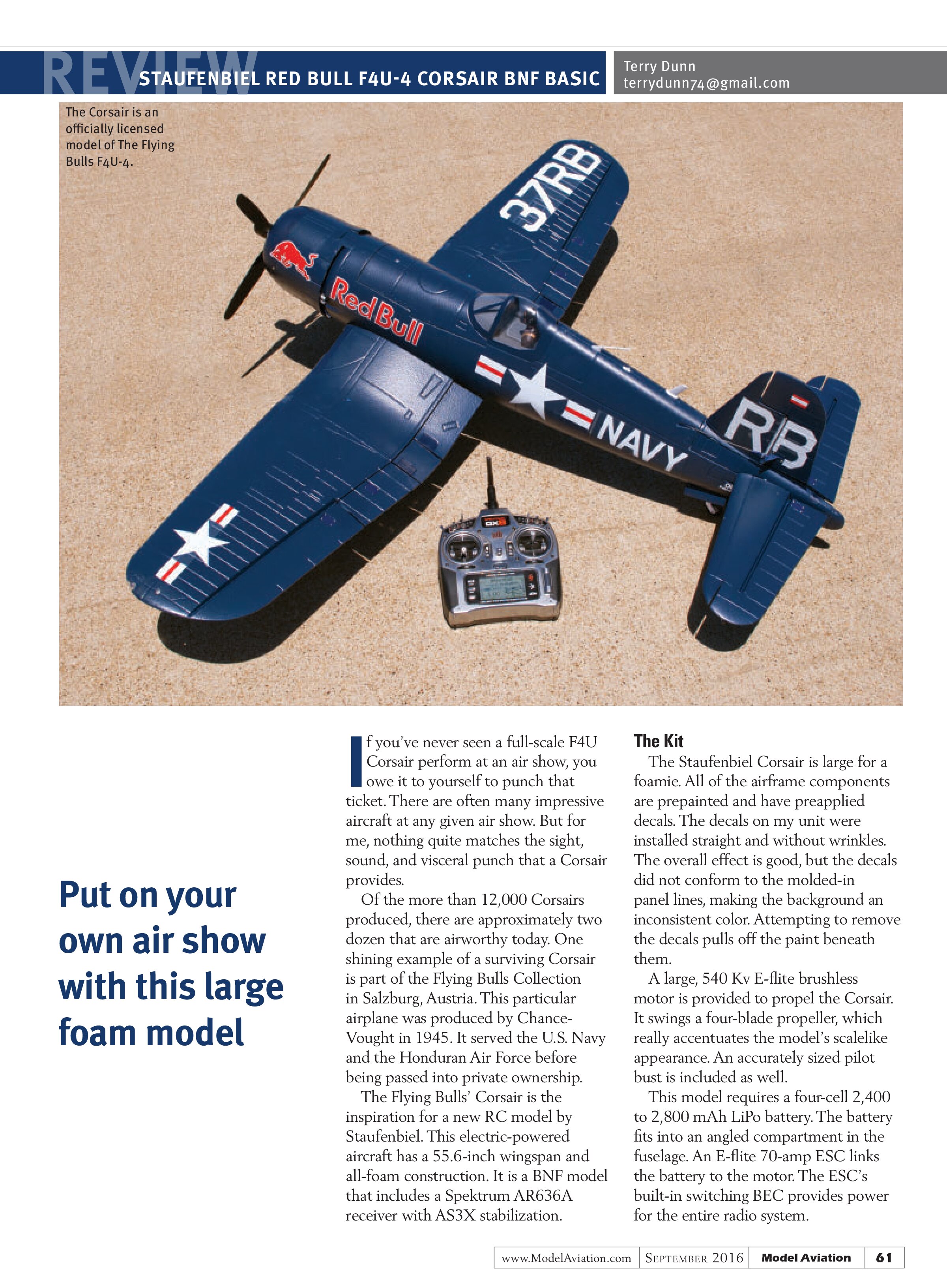
The Flying Bulls’ Corsair is the inspiration for a new RC model by Staufenbiel. This electric-powered aircraft has a 55.6-inch wingspan and all-foam construction. It is a BNF model that includes a Spektrum AR636A receiver with AS3X stabilization.
The Kit
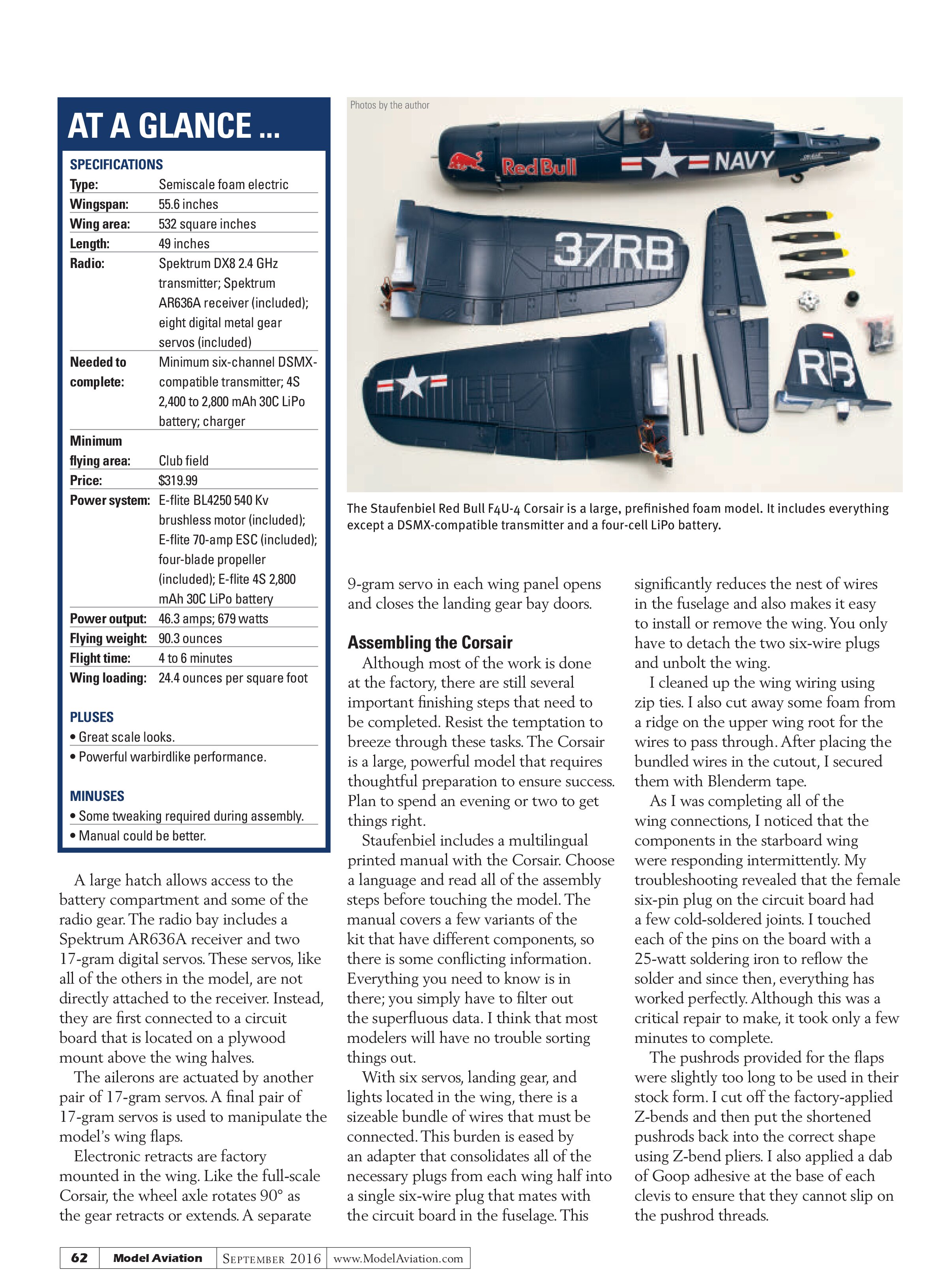
The Staufenbiel Corsair is large for a foamie. All of the airframe components are prepainted and have preapplied decals. The decals on my unit were installed straight and without wrinkles. The overall effect is good, but the decals did not conform to the molded-in panel lines, making the background an inconsistent color. Attempting to remove the decals pulls off the paint beneath them.
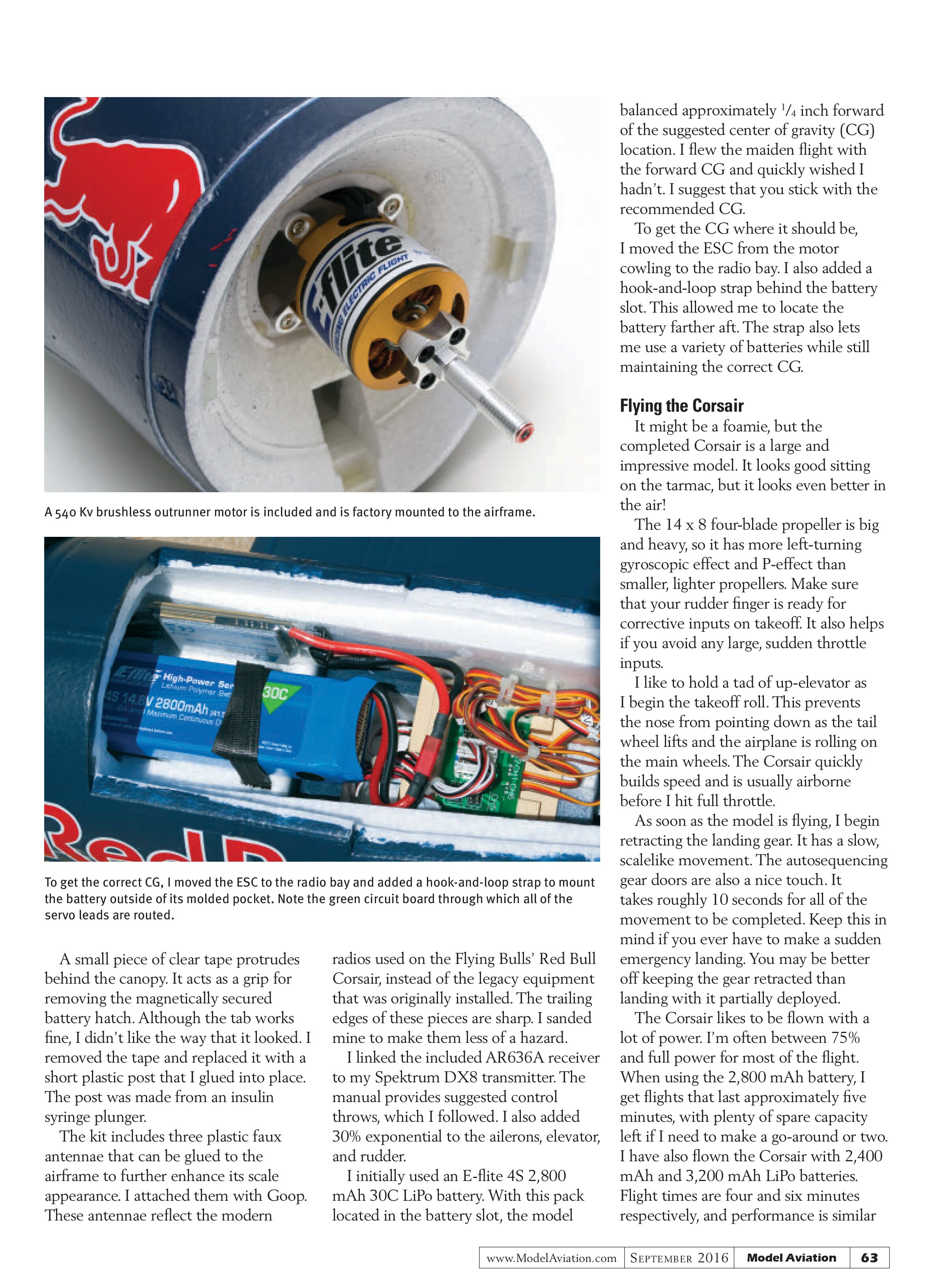
A large, 540 Kv E-flite brushless motor is provided to propel the Corsair. It swings a four-blade propeller, which really accentuates the model’s scalelike appearance. An accurately sized pilot bust is included as well.
This model requires a four-cell 2,400 to 2,800 mAh LiPo battery. The battery fits into an angled compartment in the fuselage. An E-flite 70-amp ESC links the battery to the motor. The ESC’s built-in switching BEC provides power for the entire radio system.
AT A GLANCE ...
SPECIFICATIONS
Type: Semiscale foam electric
Wingspan: 55.6 inches
Wing area: 532 square inches
Length: 49 inches
Radio: Spektrum DX8 2.4 GHz transmitter; Spektrum AR636A receiver (included); eight digital metal gear servos (included)
Needed to complete: Minimum six-channel DSMX-compatible transmitter; 4S 2,400 to 2,800 mAh 30C LiPo battery; charger
Minimum flying area: Club field
Price: $319.99
Power system: E-flite BL4250 540 Kv brushless motor (included); E-flite 70-amp ESC (included); four-blade propeller (included); E-flite 4S 2,800 mAh 30C LiPo battery
Power output: 46.3 amps; 679 watts
Flying weight: 90.3 ounces
Flight time: 4 to 6 minutes
Wing loading: 24.4 ounces per square foot
PLUSES
- Great scale looks.
- Powerful warbirdlike performance.
MINUSES
- Some tweaking required during assembly.
- Manual could be better.

A large hatch allows access to the battery compartment and some of the radio gear. The radio bay includes a Spektrum AR636A receiver and two 17-gram digital servos. These servos, like all of the others in the model, are not directly attached to the receiver. Instead, they are first connected to a circuit board that is located on a plywood mount above the wing halves.
The ailerons are actuated by another pair of 17-gram servos. A final pair of 17-gram servos is used to manipulate the model’s wing flaps.
Electronic retracts are factory mounted in the wing. Like the full-scale Corsair, the wheel axle rotates 90° as the gear retracts or extends. A separate 9-gram servo in each wing panel opens and closes the landing gear bay doors.
Assembling the Corsair
Although most of the work is done at the factory, there are still several important finishing steps that need to be completed. Resist the temptation to breeze through these tasks. The Corsair is a large, powerful model that requires thoughtful preparation to ensure success. Plan to spend an evening or two to get things right.
Staufenbiel includes a multilingual printed manual with the Corsair. Choose a language and read all of the assembly steps before touching the model. The manual covers a few variants of the kit that have different components, so there is some conflicting information. Everything you need to know is in there; you simply have to filter out the superfluous data. I think that most modelers will have no trouble sorting things out.
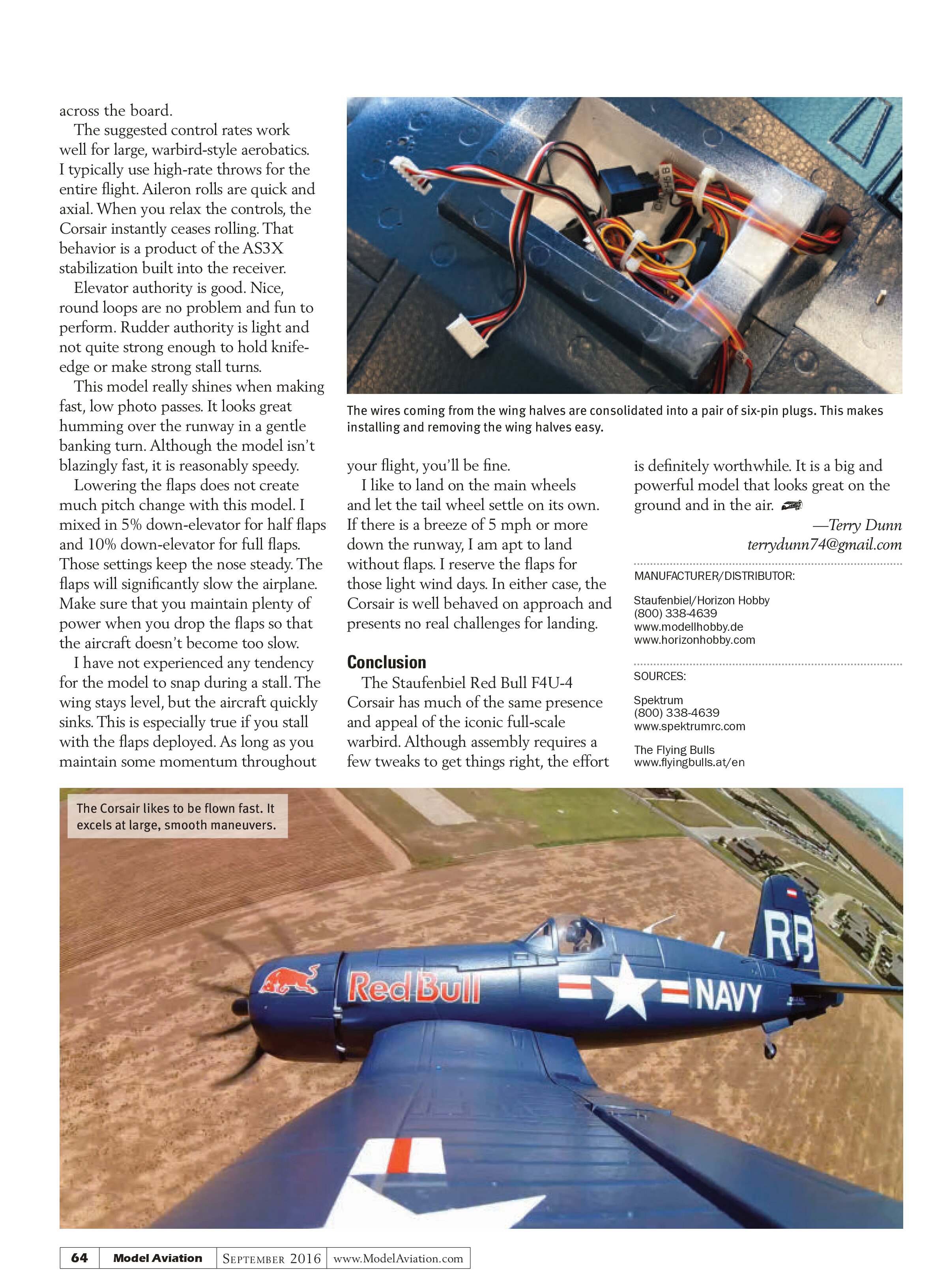
With six servos, landing gear, and lights located in the wing, there is a sizeable bundle of wires that must be connected. This burden is eased by an adapter that consolidates all of the necessary plugs from each wing half into a single six-wire plug that mates with the circuit board in the fuselage. This significantly reduces the nest of wires in the fuselage and also makes it easy to install or remove the wing. You only have to detach the two six-wire plugs and unbolt the wing.
I cleaned up the wing wiring using zip ties. I also cut away some foam from a ridge on the upper wing root for the wires to pass through. After placing the bundled wires in the cutout, I secured them with Blenderm tape.
As I was completing all of the wing connections, I noticed that the components in the starboard wing were responding intermittently. My troubleshooting revealed that the female six-pin plug on the circuit board had a few cold-soldered joints. I touched each of the pins on the board with a 25-watt soldering iron to reflow the solder and since then, everything has worked perfectly. Although this was a critical repair to make, it took only a few minutes to complete.
The pushrods provided for the flaps were slightly too long to be used in their stock form. I cut off the factory-applied Z-bends and then put the shortened pushrods back into the correct shape using Z-bend pliers. I also applied a dab of Goop adhesive at the base of each clevis to ensure that they cannot slip on the pushrod threads.


A small piece of clear tape protrudes behind the canopy. It acts as a grip for removing the magnetically secured battery hatch. Although the tab works fine, I didn’t like the way that it looked. I removed the tape and replaced it with a short plastic post that I glued into place. The post was made from an insulin syringe plunger.
The kit includes three plastic faux antennae that can be glued to the airframe to further enhance its scale appearance. I attached them with Goop. These antennae reflect the modern radios used on the Flying Bulls’ Red Bull Corsair, instead of the legacy equipment that was originally installed. The trailing edges of these pieces are sharp. I sanded mine to make them less of a hazard.
I linked the included AR636A receiver to my Spektrum DX8 transmitter. The manual provides suggested control throws, which I followed. I also added 30% exponential to the ailerons, elevator, and rudder.
I initially used an E-flite 4S 2,800 mAh 30C LiPo battery. With this pack located in the battery slot, the model balanced approximately ¼ inch forward of the suggested center of gravity (CG) location. I flew the maiden flight with the forward CG and quickly wished I hadn’t. I suggest that you stick with the recommended CG.
To get the CG where it should be, I moved the ESC from the motor cowling to the radio bay. I also added a hook-and-loop strap behind the battery slot. This allowed me to locate the battery farther aft. The strap also lets me use a variety of batteries while still maintaining the correct CG.
Flying the Corsair
It might be a foamie, but the completed Corsair is a large and impressive model. It looks good sitting on the tarmac, but it looks even better in the air!
The 14 x 8 four-blade propeller is big and heavy, so it has more left-turning gyroscopic effect and P-effect than smaller, lighter propellers. Make sure that your rudder finger is ready for corrective inputs on takeoff. It also helps if you avoid any large, sudden throttle inputs.
I like to hold a tad of up-elevator as I begin the takeoff roll. This prevents the nose from pointing down as the tail wheel lifts and the airplane is rolling on the main wheels. The Corsair quickly builds speed and is usually airborne before I hit full throttle.
As soon as the model is flying, I begin retracting the landing gear. It has a slow, scalelike movement. The autosequencing gear doors are also a nice touch. It takes roughly 10 seconds for all of the movement to be completed. Keep this in mind if you ever have to make a sudden emergency landing. You may be better off keeping the gear retracted than landing with it partially deployed.
The Corsair likes to be flown with a lot of power. I’m often between 75% and full power for most of the flight. When using the 2,800 mAh battery, I get flights that last approximately five minutes, with plenty of spare capacity left if I need to make a go-around or two. I have also flown the Corsair with 2,400 mAh and 3,200 mAh LiPo batteries. Flight times are four and six minutes respectively, and performance is similar
across the board. The suggested control rates work well for large, warbird-style aerobatics. I typically use high-rate throws for the entire flight. Aileron rolls are quick and axial. When you relax the controls, the Corsair instantly ceases rolling. That behavior is a product of the AS3X stabilization built into the receiver. Elevator authority is good. Nice, round loops are no problem and fun to perform. Rudder authority is light and not quite strong enough to hold knife-edge or make strong stall turns.
This model really shines when making fast, low photo passes. It looks great humming over the runway in a gentle banking turn. Although the model isn’t blazingly fast, it is reasonably speedy.
Lowering the flaps does not create much pitch change with this model. I mixed in 5% down-elevator for half flaps and 10% down-elevator for full flaps. Those settings keep the nose steady. The flaps will significantly slow the airplane. Make sure that you maintain plenty of power when you drop the flaps so that the aircraft doesn’t become too slow.
I have not experienced any tendency for the model to snap during a stall. The wing stays level, but the aircraft quickly sinks. This is especially true if you stall with the flaps deployed. As long as you maintain some momentum throughout your flight, you’ll be fine.

I like to land on the main wheels and let the tail wheel settle on its own. If there is a breeze of 5 mph or more down the runway, I am apt to land without flaps. I reserve the flaps for those light wind days. In either case, the Corsair is well behaved on approach and presents no real challenges for landing.
Conclusion
The Staufenbiel Red Bull F4U-4 Corsair has much of the same presence and appeal of the iconic full-scale warbird. Although assembly requires a few tweaks to get things right, the effort is definitely worthwhile. It is a big and powerful model that looks great on the ground and in the air.
—Terry Dunn
terrydunn74@gmail.com
MANUFACTURER/DISTRIBUTOR:
Staufenbiel/Horizon Hobby
(800) 338-4639
www modellhobby.de
www.horizonhobby.com
SOURCES:
Spektrum
(800) 338-4639
www.spektrumrc.com
The Flying Bulls
www.flyingbulls.at/en