A mini medical kit has many uses
Dave Gee
safetycolumn@cs.com

Do you keep medical supplies in your flight box? Not a standard first-aid kit from your car or the clubhouse—I’m referring to a few handy little items in a toolbox drawer. If you hang around the flying field long enough, someone will have a nicked finger or another minor wound. Sure, it’s usually me, but even a nonclumsy pilot should be ready to help someone out.
Legal disclaimer: I’m not a doctor, nor do I play one on TV, so don’t take this as actual medical advice. I only feel confident in offering my opinions because I’ve been involved in first-aid situations many times throughout the years (usually on the wrong side of the bandage, of course).
The products I will mention are available from many manufacturers, and I am not endorsing any brand. Choose your own favorites, please.
The most important thing to have with you is first-aid knowledge. You never know what the world has in store.
My ancient Boy Scout training has come in handy a few times. Medicine has advanced since those days (no more bloodletting and leeches), so I recently took a more modern first-aid course.
You can probably locate a free or inexpensive class in your town. I found the training empowering because I might have the chance to be useful in an emergency. That’s better than just standing there and wishing I knew how to help.
Keep It Small
The few medical supplies in my toolbox are not made for major injuries. I merely want to be able to handle little hurts that require minor treatment.
Forget the splints, big compresses, and arm slings. I figure if something big happens, there will soon be a well-equipped rescue squad on the scene. The EMTs usually greet me with, “You again?”
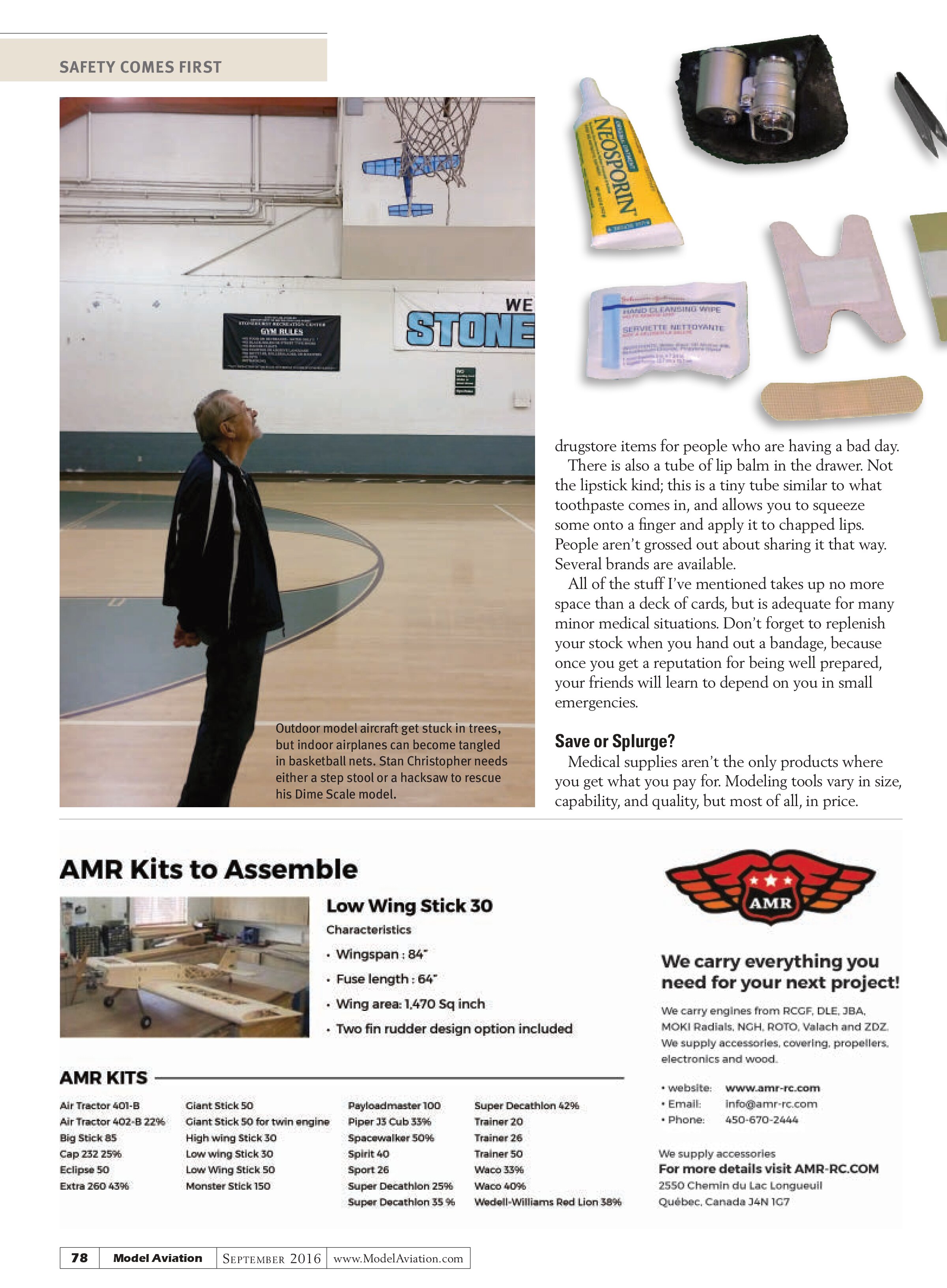
The toolbox minikit also avoids a strange mental quirk that makes us avoid getting the big medical kit out. Human nature sometimes makes us want to “save it for something serious” and not break a sealed kit open for a minor incident.
Sure, it sounds kooky, but I’ve seen it happen. A couple of loose items in your flight box seem more accessible.
Some basic adhesive-strip bandages are the most useful. I think it’s worth the extra few cents to get fancy cloth bandages that don’t leave a gummy residue on the skin. You’ll find that the packaging is better, too.
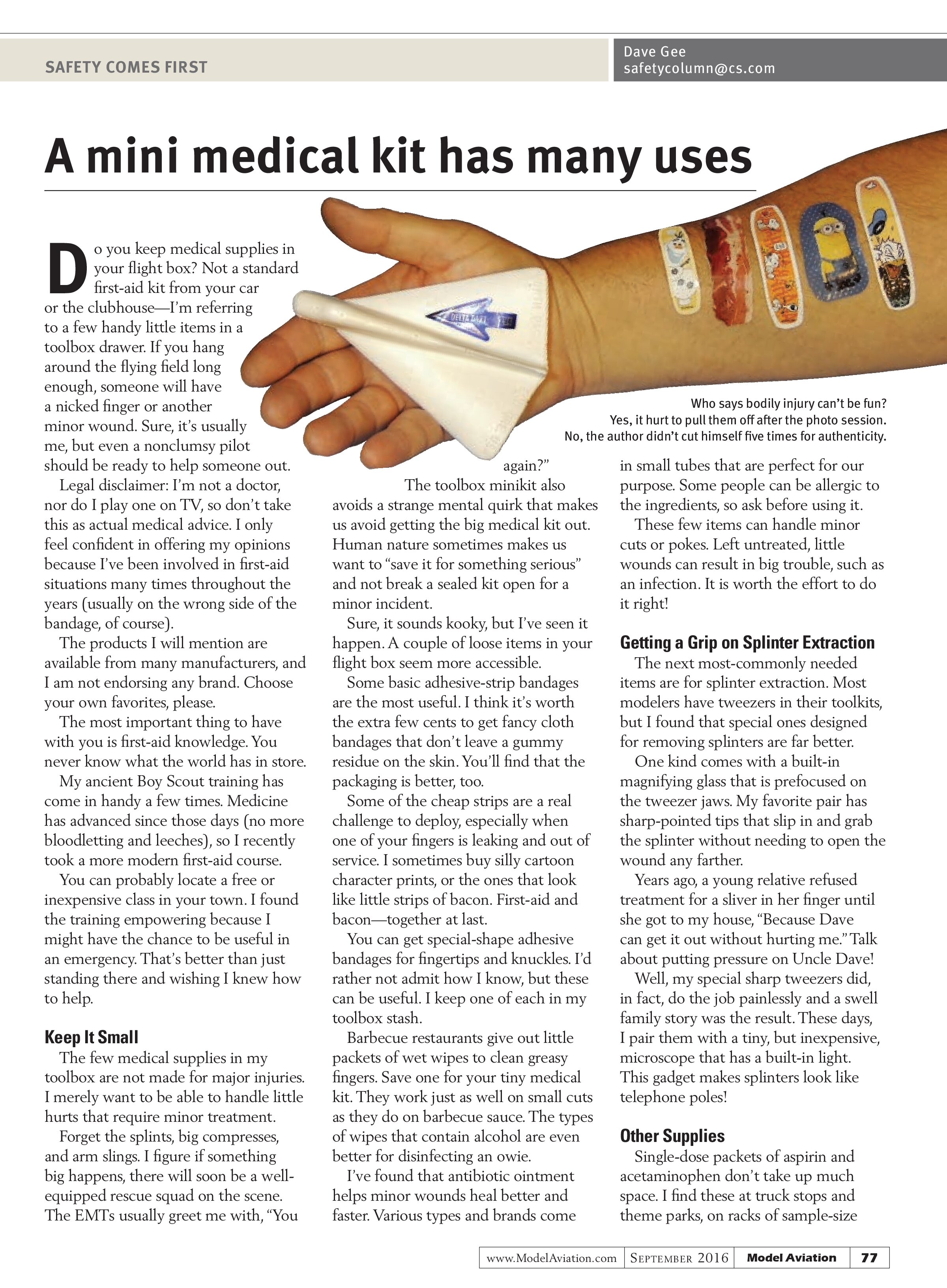
Some of the cheap strips are a real challenge to deploy, especially when one of your fingers is leaking and out of service. I sometimes buy silly cartoon character prints, or the ones that look like little strips of bacon. First-aid and bacon—together at last.
You can get special-shape adhesive bandages for fingertips and knuckles. I’d rather not admit how I know, but these can be useful. I keep one of each in my toolbox stash.
Barbecue restaurants give out little packets of wet wipes to clean greasy fingers. Save one for your tiny medical kit. They work just as well on small cuts as they do on barbecue sauce. The types of wipes that contain alcohol are even better for disinfecting an owie.
I’ve found that antibiotic ointment helps minor wounds heal better and faster. Various types and brands come in small tubes that are perfect for our purpose. Some people can be allergic to the ingredients, so ask before using it.
These few items can handle minor cuts or pokes. Left untreated, little wounds can result in big trouble, such as an infection. It is worth the effort to do it right!
Getting a Grip on Splinter Extraction
The next most-commonly needed items are for splinter extraction. Most modelers have tweezers in their toolkits, but I found that special ones designed for removing splinters are far better.
One kind comes with a built-in magnifying glass that is prefocused on the tweezer jaws. My favorite pair has sharp-pointed tips that slip in and grab the splinter without needing to open the wound any farther.
Years ago, a young relative refused treatment for a sliver in her finger until she got to my house, “Because Dave can get it out without hurting me.” Talk about putting pressure on Uncle Dave!
Well, my special sharp tweezers did, in fact, do the job painlessly and a swell family story was the result. These days, I pair them with a tiny, but inexpensive, microscope that has a built-in light. This gadget makes splinters look like telephone poles!
Other Supplies
Single-dose packets of aspirin and acetaminophen don’t take up much space. I find these at truck stops and theme parks, on racks of sample-size

drugstore items for people who are having a bad day. There is also a tube of lip balm in the drawer. Not the lipstick kind; this is a tiny tube similar to what toothpaste comes in, and allows you to squeeze some onto a finger and apply it to chapped lips. People aren’t grossed out about sharing it that way. Several brands are available.
All of the stuff I’ve mentioned takes up no more space than a deck of cards, but is adequate for many minor medical situations. Don’t forget to replenish your stock when you hand out a bandage, because once you get a reputation for being well prepared, your friends will learn to depend on you in small emergencies.
Save or Splurge?
Medical supplies aren’t the only products where you get what you pay for. Modeling tools vary in size, capability, and quality, but most of all, in price.

I’ve learned that sometimes the fanciest piece of gear is not always the best for my hobby workshop. Sure, a low-quality tool won’t last as long under heavy use and could possibly break in a hazardous way, but if it’s only being used to cut balsa or foam, it might last me a lifetime! My drill press is a cheap, imported unit, but it is satisfactory for the light work that I give it.
I learned a different lesson with wire cutters. After going through many pairs, and sometimes getting poked or pinched when they broke, I settled on the most expensive cutters available and have used them for two decades.
Cutting music wire can be hazardous and it’s nice to have a dependable tool in hand. Many of my other hand tools are imported cheapos that last, as long as I only use them on model airplane parts.
After trying various electric rotary tools, a top-of-the-line Dremel is my favorite. Spinning a cutting bit at high speeds calls for a well-made tool, and I gladly paid a little extra for it. The no-name motorized units were given away.
How about sanding tools? Inexpensive is usually best, but a few more robust (and costly) abrasives are useful for metal and hardwood parts.
Do you have the same mixture of fancy and cheap equipment? Maybe you prefer only the best (or the best priced). Please share your comments with me, and I’ll publish the results of this reader survey.