Polishing the Sportsman sequence
by Peter Vogel
vogel.peter@gmail.com
In my last column, I was beginning to address the finer points of the Sportsman sequence; I’ll continue through the next few maneuvers this month.
As a reminder, the Sportsman sequence consists of 17 maneuvers (counting takeoff and landing), with two “breaks” dividing the pattern into three groups of five maneuvers each (center, turnaround, center, turnaround, and center). This allows you a chance to exit the aerobatics box, get your airplane back into a good position, and return to the box for the next sequence of five maneuvers, all of which are ideally performed on the exact same “line” running parallel to the runway, approximately 150 meters out from where you stand.
1. Takeoff (upwind).
2. Straight flight out (upwind, center).
3. Half-Reverse Cuban 8 (turnaround).
4. Straight flight back (downwind, center).
5. Stall turn without rolls (turnaround).
6. Double Immelmann without rolls (upwind, center).
Break: Exit the box, free turnaround.
7. One horizontal roll (downwind, center).
8. Half-Reverse Cuban 8 (turnaround).
9. Cobra roll without rolls (upwind, center).
10. Immelmann turn (turnaround).
11. 45° downline on center (downwind, center).
Break: Exit the box, free turnaround.
12. 45° upline on center (upwind, center).
13. Split-S (turnaround).
14. Two-point roll, pause in center (downwind, center).
15. Half Cuban 8 (turnaround).
16. Two inside loops (upwind, center).
17. Landing.
In my previous column, I only looked at the takeoff, so let’s continue with the deceptively simple “Straight flight out.”

Straight Flight Out
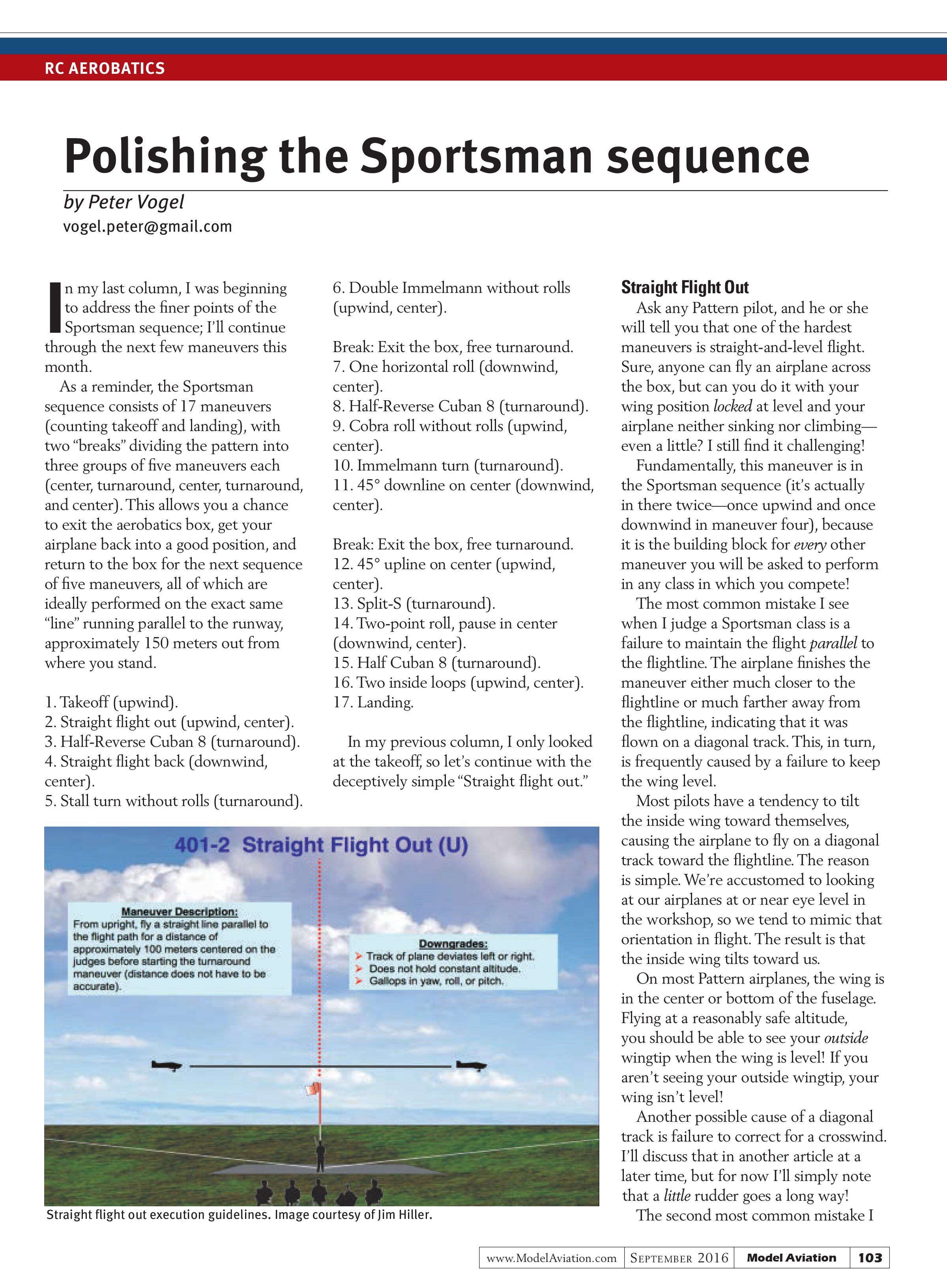
Ask any Pattern pilot, and he or she will tell you that one of the hardest maneuvers is straight-and-level flight. Sure, anyone can fly an airplane across the box, but can you do it with your wing position locked at level and your airplane neither sinking nor climbing—even a little? I still find it challenging!
Fundamentally, this maneuver is in the Sportsman sequence (it’s actually in there twice—once upwind and once downwind in maneuver four), because it is the building block for every other maneuver you will be asked to perform in any class in which you compete!
The most common mistake I see when I judge a Sportsman class is a failure to maintain the flight parallel to the flightline. The airplane finishes the maneuver either much closer to the flightline or much farther away from the flightline, indicating that it was flown on a diagonal track. This, in turn, is frequently caused by a failure to keep the wing level.
Most pilots have a tendency to tilt the inside wing toward themselves, causing the airplane to fly on a diagonal track toward the flightline. The reason is simple. We’re accustomed to looking at our airplanes at or near eye level in the workshop, so we tend to mimic that orientation in flight. The result is that the inside wing tilts toward us.
On most Pattern airplanes, the wing is in the center or bottom of the fuselage. Flying at a reasonably safe altitude, you should be able to see your outside wingtip when the wing is level! If you aren’t seeing your outside wingtip, your wing isn’t level!
Another possible cause of a diagonal track is failure to correct for a crosswind. I’ll discuss that in another article at a later time, but for now I’ll simply note that a little rudder goes a long way!
The second most common mistake I
see is a failure to maintain a consistent altitude. The airplane either climbs or sinks as it makes its 100-meter journey across the pilot’s centerline. This comes down to getting the airplane trimmed out! Your airplane should fly straight and level without sinking or climbing hands-off at anywhere from 25% to 100% throttle, assuming you start the line straight and level.
Bryan Hebert provides some excellent guides for trimming your airplane on the CK Aeropedia website. The link is listed in “Sources.”
Half-Reverse Cuban 8
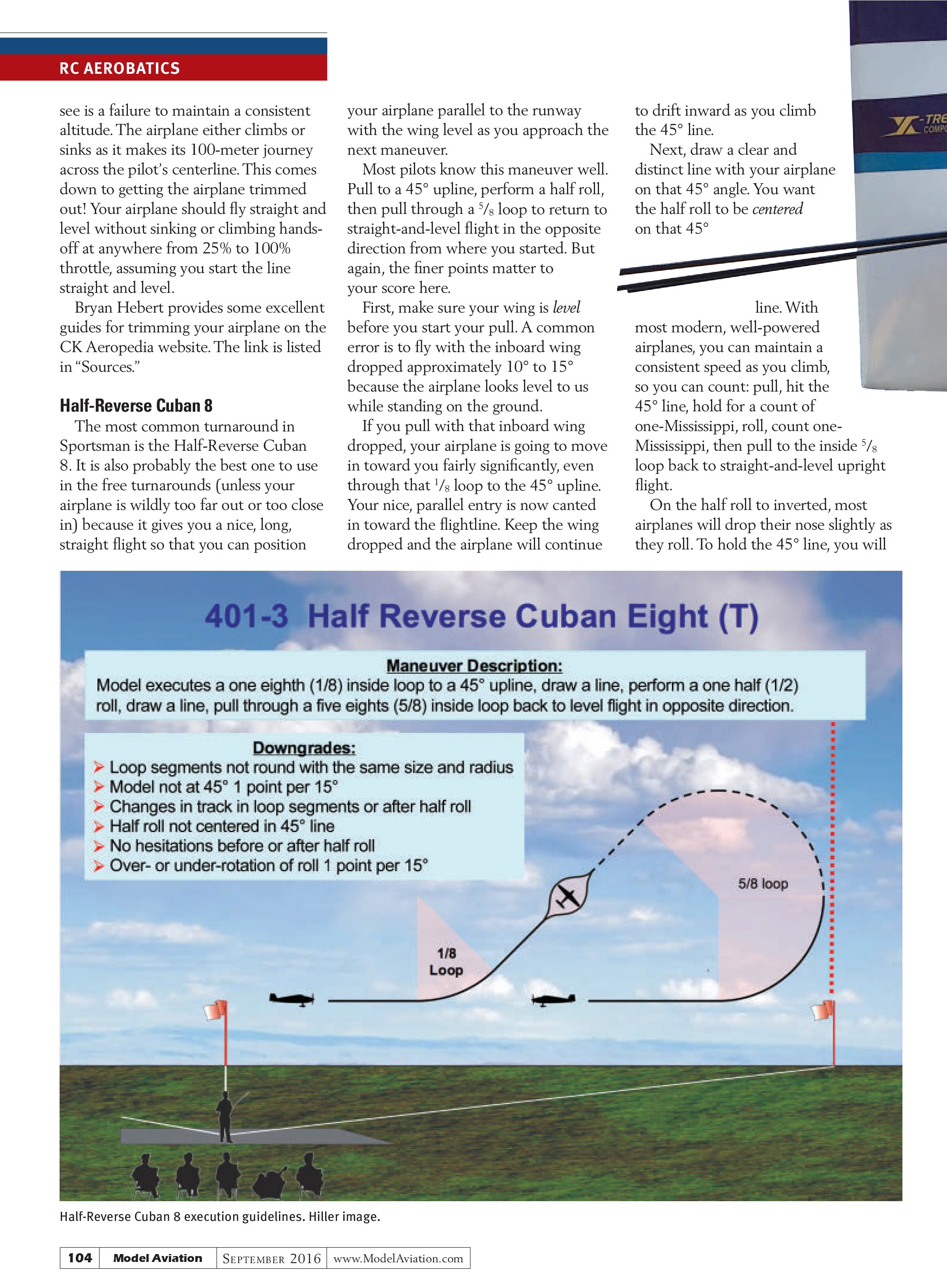
The most common turnaround in Sportsman is the Half-Reverse Cuban 8. It is also probably the best one to use in the free turnarounds (unless your airplane is wildly too far out or too close in) because it gives you a nice, long, straight flight so that you can position your airplane parallel to the runway with the wing level as you approach the next maneuver.
Most pilots know this maneuver well. Pull to a 45° upline, perform a half roll, then pull through a ⅝ loop to return to straight-and-level flight in the opposite direction from where you started. But again, the finer points matter to your score here.
First, make sure your wing is level before you start your pull. A common error is to fly with the inboard wing dropped approximately 10° to 15° because the airplane looks level to us while standing on the ground.
If you pull with that inboard wing dropped, your airplane is going to move in toward you fairly significantly, even through that ⅛ loop to the 45° upline. Your nice, parallel entry is now canted in toward the flightline. Keep the wing dropped and the airplane will continue to drift inward as you climb the 45° line.
Next, draw a clear and distinct line with your airplane on that 45° angle. You want the half roll to be centered on that 45° line. With most modern, well-powered airplanes, you can maintain a consistent speed as you climb, so you can count: pull, hit the 45° line, hold for a count of one-Mississippi, roll, count one-Mississippi, then pull to the inside ⅝ loop back to straight-and-level upright flight.
On the half roll to inverted, most airplanes will drop their nose slightly as they roll. To hold the 45° line, you will


probably want a breath of top rudder (if you roll right, rudder left; if you roll left, rudder right) as you roll through the knife-edge position to keep the airplane tracking on a 45° line.
After you hit the inverted, wing-level position, you’ll need a small amount of down-elevator to hold the line (unless your center of gravity is too far back, which will cause issues on other maneuvers). This is part of why you don’t want a huge amount of throw; you want the roll slow enough to give you time for that rudder and to catch the level inverted position without overshooting it.
I still struggle with the timing and execution of the top rudder on my rolls! Get into the habit of trying to do it here so that it’s more natural to also be doing it on the center rolls later in the sequence!
Again, if your wing isn’t perfectly level in that inverted 45° line when you pull through the ⅝ loop, you will corkscrew in or out instead of maintaining your parallel line. If you undershoot or overshoot level on the half roll, correct it as you continue to draw that 45° line and before you pull the loop segment.
New Setup Tool
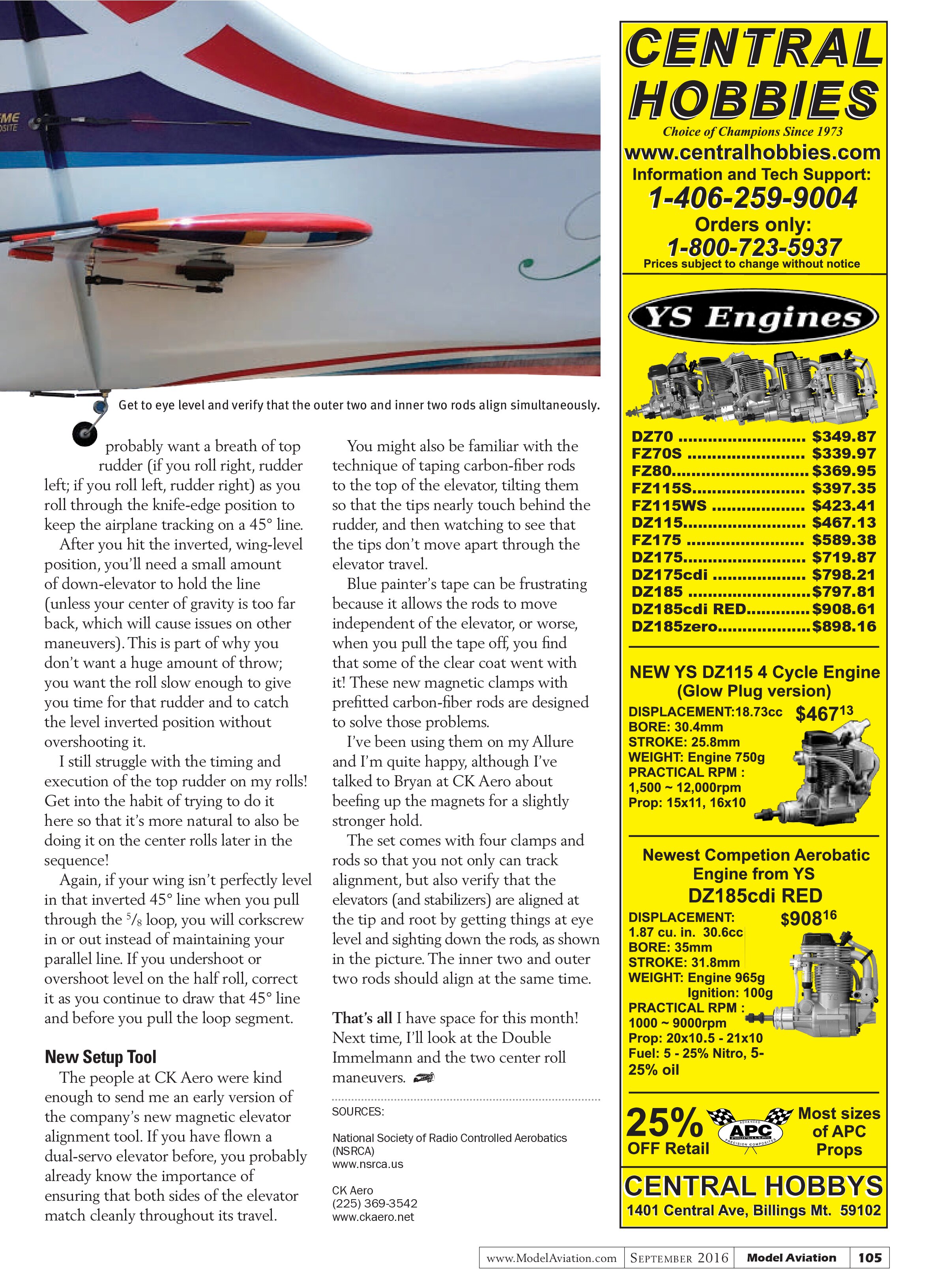
The people at CK Aero were kind enough to send me an early version of the company’s new magnetic elevator alignment tool. If you have flown a dual-servo elevator before, you probably already know the importance of ensuring that both sides of the elevator match cleanly throughout its travel.
You might also be familiar with the technique of taping carbon-fiber rods to the top of the elevator, tilting them so that the tips nearly touch behind the rudder, and then watching to see that the tips don’t move apart through the elevator travel.
Blue painter’s tape can be frustrating because it allows the rods to move independent of the elevator, or worse, when you pull the tape off, you find that some of the clear coat went with it! These new magnetic clamps with prefitted carbon-fiber rods are designed to solve those problems.
I’ve been using them on my Allure and I’m quite happy, although I’ve talked to Bryan at CK Aero about beefing up the magnets for a slightly stronger hold.
The set comes with four clamps and rods so that you not only can track alignment, but also verify that the elevators (and stabilizers) are aligned at the tip and root by getting things at eye level and sighting down the rods, as shown in the picture. The inner two and outer two rods should align at the same time.
That’s all I have space for this month! Next time, I’ll look at the Double Immelmann and the two center roll maneuvers.
SOURCES:
National Society of Radio Controlled Aerobatics (NSRCA)
www.nsrca.us
CK Aero
(225) 369-3542
www.ckaero.net