Durable Beginner’s Goat transitions from CL to RC
In the winter of 1946, Roy L. Clough Jr. finished applying the last coat of dope on his Control Line (CL) model called the Beginner’s Goat. It was published in the November 1947 Air Trails.
The name of the airplane came from the practice in the early days of making old Free Flight airplanes the “goats” of learning to fly on wires. Conversions were made in attempts to have something to practice with before designing a CL model from the ground up.
Discussions about these “goats” led to the decision that beginners would do better with a specially designed trainer, and the result—the Beginner’s Goat—was what Roy said was “arguably the only airplane I ever designed that did exactly what I hoped for the first time out.”
At least a dozen beginners learned to fly with it, and family and friends would keep it in the air for hours at a time. “It was the perfect answer to those who’d heard that you built model airplanes and wanted to see one fly,” he said.
In the February 1998 Model Aviation, Roy noted that the Beginner’s Goat had been durable and tractable for nearly 50 years, so he decided to build an exact copy as an RC sport model, named the Son of Goat. Unfortunately, the original aircraft’s wingnut assembly could not be used because all of the fuselage volume was needed to hold the servos, battery, and receiver. There was also no room for the wing’s massive anchor block. Roy added a modicum of dihedral for rudder-elevator operation, and replaced the tail wheel with a steerable wire skid.
The original unsheeted leading edge of the CL wing had been sheeted over, and Roy retained this for RC. A Cox .074 Queen Bee engine with a long mount approximated the original engine proportions; however, with the buyout of Cox by Estes, the question came up about availability of the engine.
Roy decided to rework the front end to accept other engines. The new plywood motor bearer was cut to fit any of the Cox Tee Dee or Medallion .049s. If the builder wanted throttle control, the front fuselage could be squared off and a Cox Black Widow could be mounted.
Roy did not include all of the construction information in his article, noting that particularly detailed instructions were needed and anyone wanting to duplicate the CL version would find all of the information on the plans sheet.
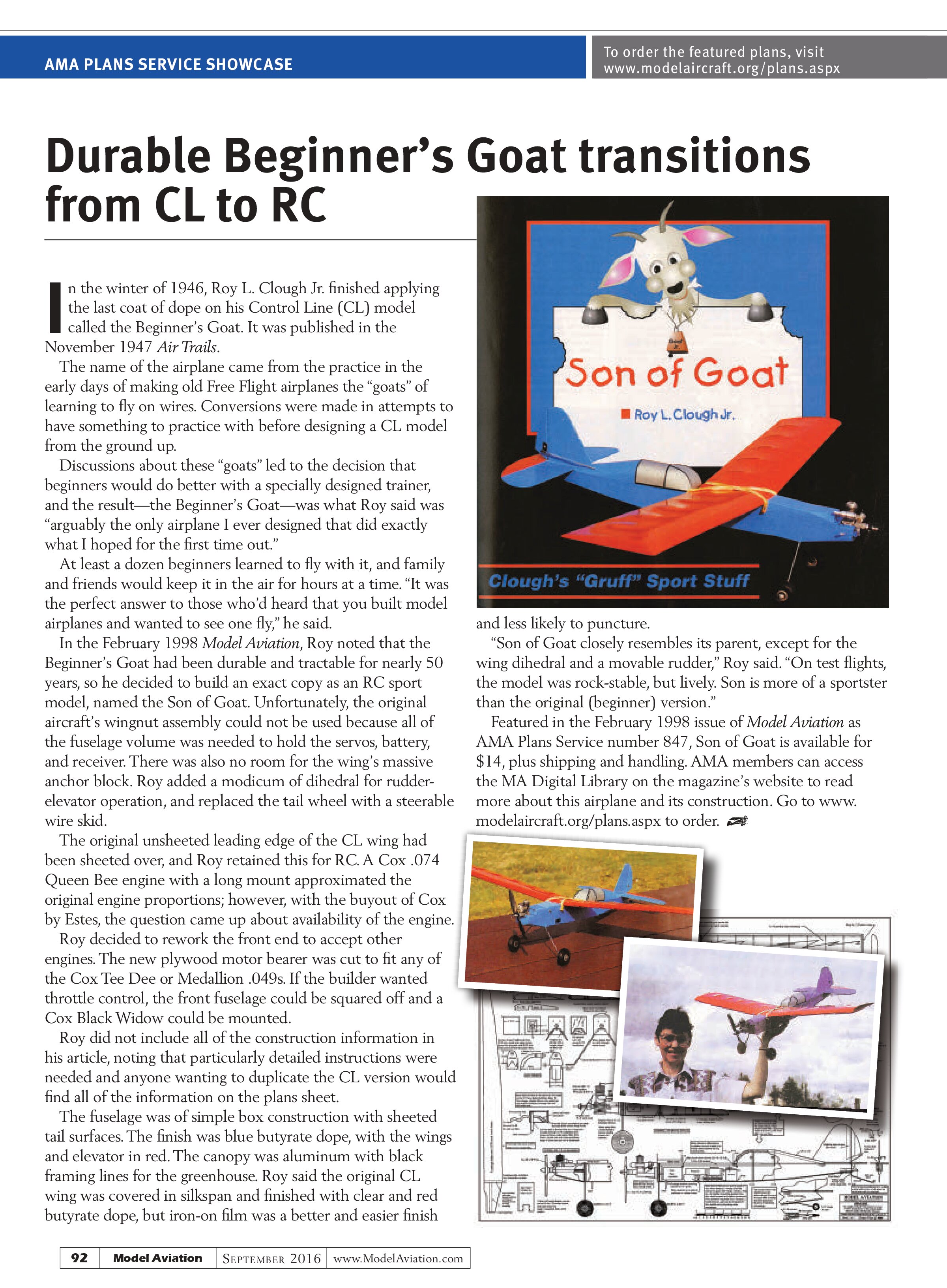
The fuselage was of simple box construction with sheeted tail surfaces. The finish was blue butyrate dope, with the wings and elevator in red. The canopy was aluminum with black framing lines for the greenhouse. Roy said the original CL wing was covered in silkspan and finished with clear and red butyrate dope, but iron-on film was a better and easier finish and less likely to puncture.
“Son of Goat closely resembles its parent, except for the wing dihedral and a movable rudder,” Roy said. “On test flights, the model was rock-stable, but lively. Son is more of a sportster than the original (beginner) version.”
Featured in the February 1998 issue of Model Aviation as AMA Plans Service number 847, Son of Goat is available for $14, plus shipping and handling. AMA members can access the MA Digital Library on the magazine’s website to read more about this airplane and its construction. Go to www.modelaircraft.org/plans.aspx to order.