Using commercial or homemade propellers
Joe Malinchak
joemal@echoes.net
Finding the right propeller for your custom-built micro aircraft can be challenging. Some commercially available propellers are good options, but they don’t always fit the project that you are working on. Size and weight can be a factor, as well as blade pitch. If you can’t find the right commercially available propeller, you can make your own out of several materials.

Commercial Propellers
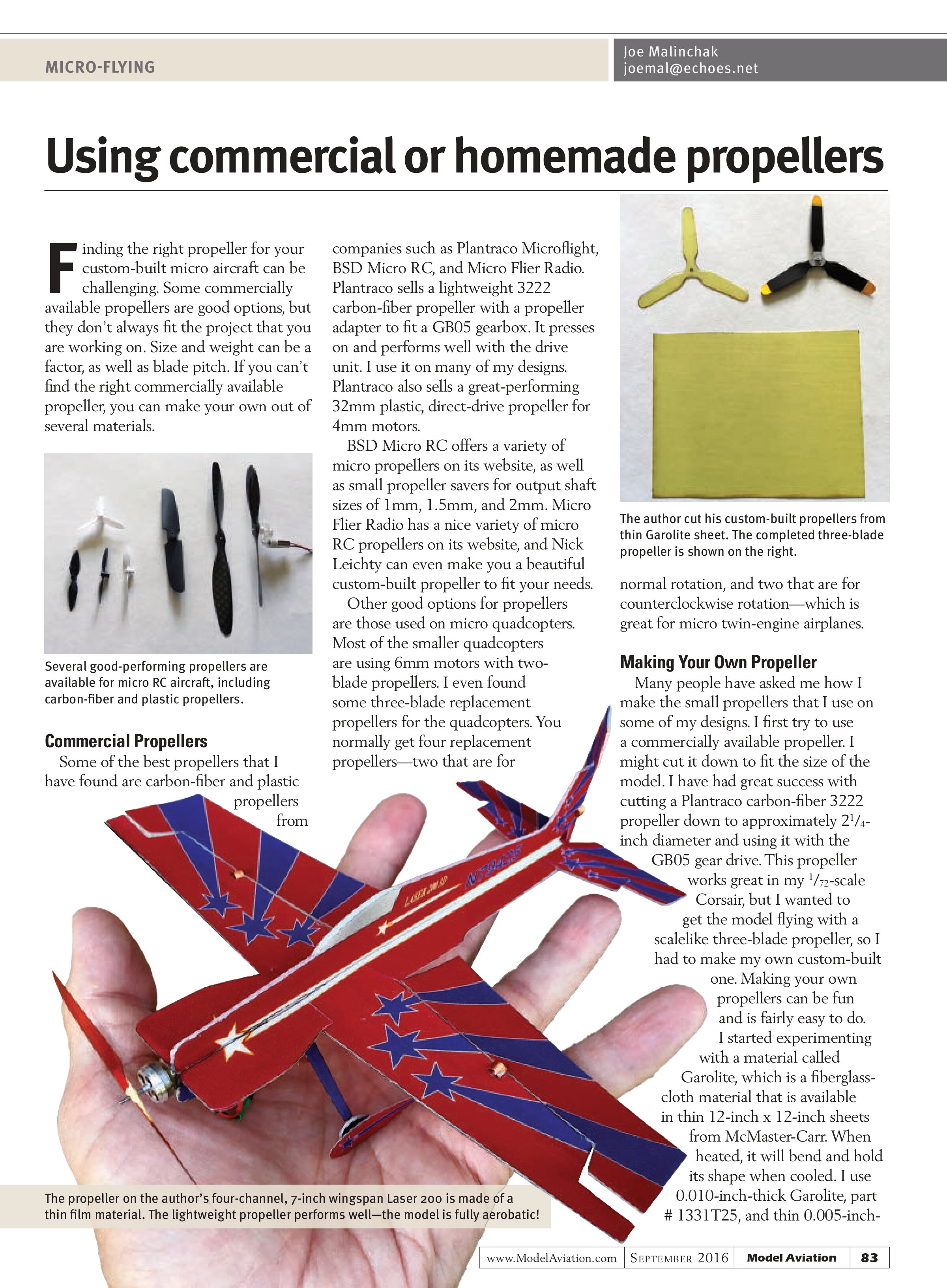
Some of the best propellers that I have found are carbon-fiber and plastic propellers from companies such as Plantraco Microflight, BSD Micro RC, and Micro Flier Radio. Plantraco sells a lightweight 3222 carbon-fiber propeller with a propeller adapter to fit a GB05 gearbox. It presses on and performs well with the drive unit. I use it on many of my designs. Plantraco also sells a great-performing 32mm plastic, direct-drive propeller for 4mm motors.
BSD Micro RC offers a variety of micro propellers on its website, as well as small propeller savers for output shaft sizes of 1mm, 1.5mm, and 2mm. Micro Flier Radio has a nice variety of micro RC propellers on its website, and Nick Leichty can even make you a beautiful custom-built propeller to fit your needs.
Other good options for propellers are those used on micro quadcopters. Most of the smaller quadcopters are using 6mm motors with two-blade propellers. I even found some three-blade replacement propellers for the quadcopters. You normally get four replacement propellers—two that are for

normal rotation, and two that are for counterclockwise rotation—which is great for micro twin-engine airplanes.
Making Your Own Propeller
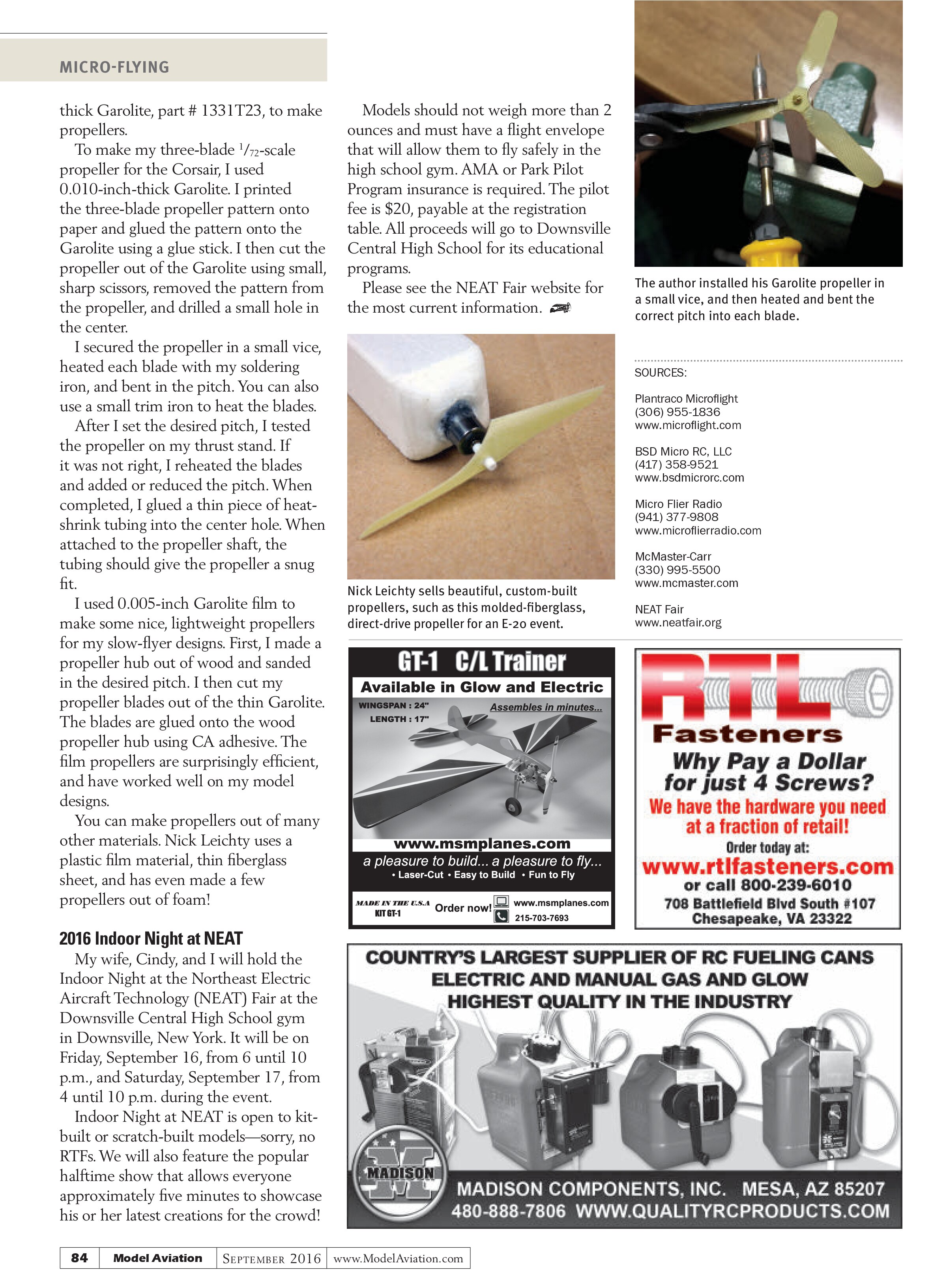
Many people have asked me how I make the small propellers that I use on some of my designs. I first try to use a commercially available propeller. I might cut it down to fit the size of the model. I have had great success with cutting a Plantraco carbon-fiber 3222 propeller down to approximately 2¼-inch diameter and using it with the GB05 gear drive. This propeller works great in my 1/72-scale Corsair, but I wanted to get the model flying with a scalelike three-blade propeller, so I had to make my own custom-built one. Making your own propellers can be fun and is fairly easy to do. I started experimenting with a material called Garolite, which is a fiberglass-cloth material that is available in thin 12-inch x 12-inch sheets from McMaster-Carr. When heated, it will bend and hold its shape when cooled. I use 0.010-inch-thick Garolite, part # 1331T25, and thin 0.005-inch-

thick Garolite, part # 1331T23, to make propellers.
To make my three-blade 1/72-scale propeller for the Corsair, I used 0.010-inch-thick Garolite. I printed the three-blade propeller pattern onto paper and glued the pattern onto the Garolite using a glue stick. I then cut the propeller out of the Garolite using small, sharp scissors, removed the pattern from the propeller, and drilled a small hole in the center.
I secured the propeller in a small vice, heated each blade with my soldering iron, and bent in the pitch. You can also use a small trim iron to heat the blades.
After I set the desired pitch, I tested the propeller on my thrust stand. If it was not right, I reheated the blades and added or reduced the pitch. When completed, I glued a thin piece of heat-shrink tubing into the center hole. When attached to the propeller shaft, the tubing should give the propeller a snug fit.
I used 0.005-inch Garolite film to make some nice, lightweight propellers for my slow-flyer designs. First, I made a propeller hub out of wood and sanded in the desired pitch. I then cut my propeller blades out of the thin Garolite. The blades are glued onto the wood propeller hub using CA adhesive. The film propellers are surprisingly efficient, and have worked well on my model designs.
You can make propellers out of many other materials. Nick Leichty uses a plastic film material, thin fiberglass sheet, and has even made a few propellers out of foam!
2016 Indoor Night at NEAT
My wife, Cindy, and I will hold the Indoor Night at the Northeast Electric Aircraft Technology (NEAT) Fair at the Downsville Central High School gym in Downsville, New York. It will be on Friday, September 16, from 6 until 10 p.m., and Saturday, September 17, from 4 until 10 p.m. during the event.
Indoor Night at NEAT is open to kit-built or scratch-built models—sorry, no RTFs. We will also feature the popular halftime show that allows everyone approximately five minutes to showcase his or her latest creations for the crowd!
Models should not weigh more than 2 ounces and must have a flight envelope that will allow them to fly safely in the high school gym. AMA or Park Pilot Program insurance is required. The pilot fee is $20, payable at the registration table. All proceeds will go to Downsville Central High School for its educational programs.
Please see the NEAT Fair website for the most current information.


SOURCES:
Plantraco Microflight
(306) 955-1836
www.microflight.com
BSD Micro RC, LLC
(417) 358-9521
www.bsdmicrorc.com
Micro Flier Radio
(941) 377-9808
www.microflierradio.com
McMaster-Carr
(330) 995-5500
www.mcmaster.com
NEAT Fair
www.neatfair.org