Focal Point
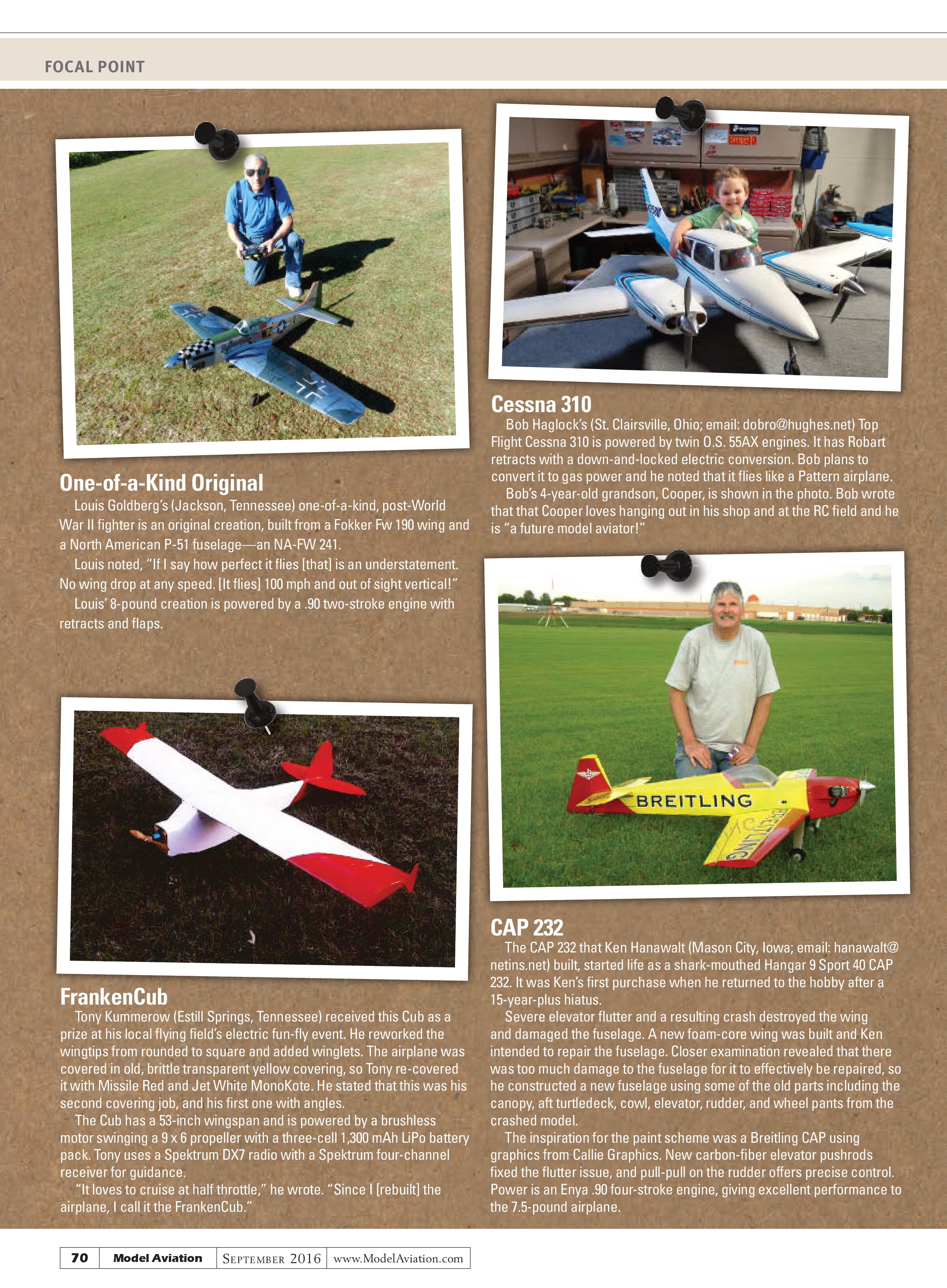
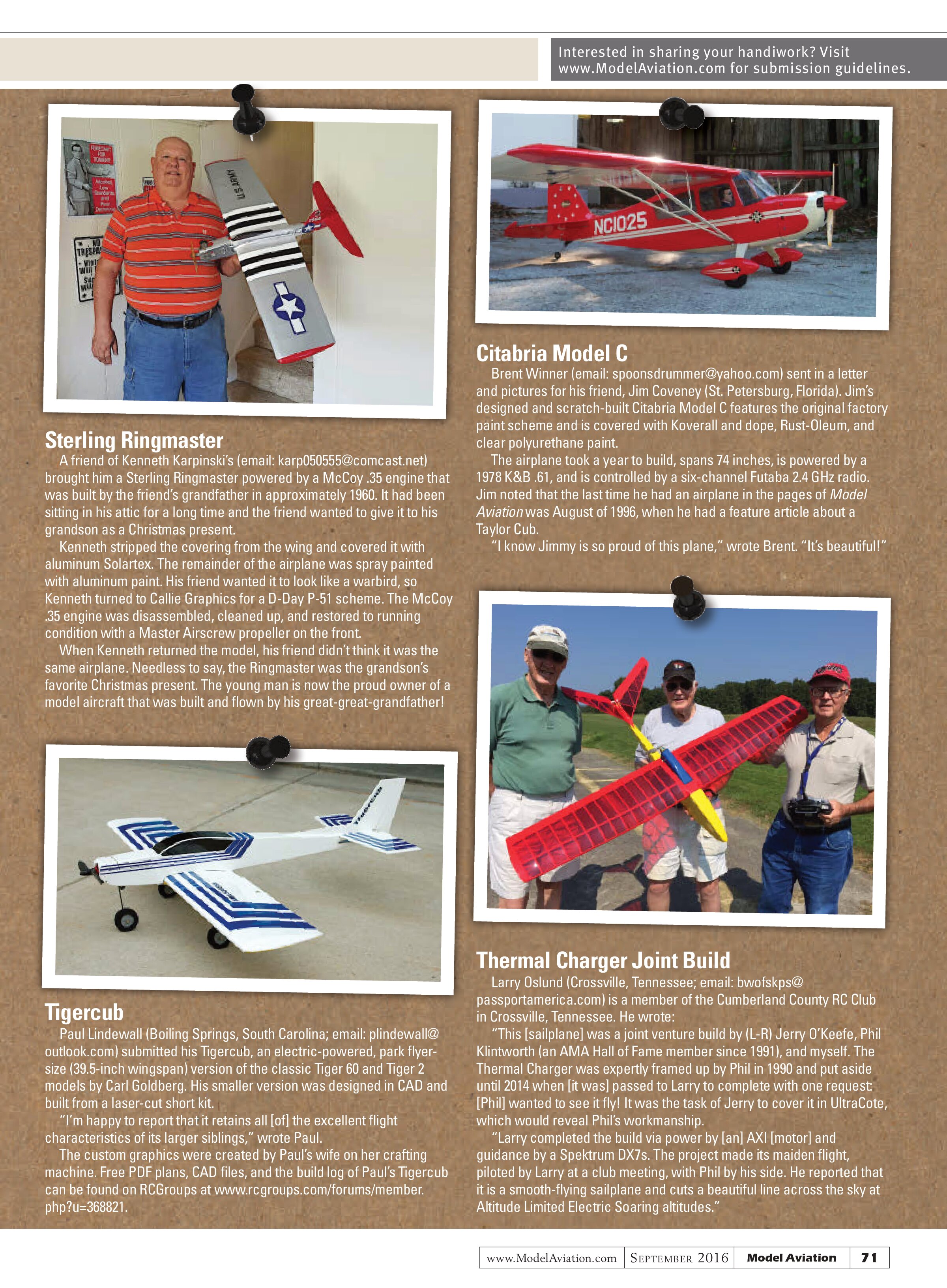
One-of-a-Kind Original
Louis Goldberg’s (Jackson, Tennessee) one-of-a-kind, post-World War II fighter is an original creation, built from a Fokker Fw 190 wing and a North American P-51 fuselage—an NA-FW 241.
Louis noted, “If I say how perfect it flies [that] is an understatement. No wing drop at any speed. [It flies] 100 mph and out of sight vertical!”
Louis’ 8-pound creation is powered by a .90 two-stroke engine with retracts and flaps.

FrankenCub
Tony Kummerow (Estill Springs, Tennessee) received this Cub as a prize at his local flying field’s electric fun-fly event. He reworked the wingtips from rounded to square and added winglets. The airplane was covered in old, brittle transparent yellow covering, so Tony re-covered it with Missile Red and Jet White MonoKote. He stated that this was his second covering job, and his first one with angles.
The Cub has a 53-inch wingspan and is powered by a brushless motor swinging a 9 x 6 propeller with a three-cell 1,300 mAh LiPo battery pack. Tony uses a Spektrum DX7 radio with a Spektrum four-channel receiver for guidance.
“It loves to cruise at half throttle,” he wrote. “Since I [rebuilt] the airplane, I call it the FrankenCub.”

Cessna 310
Bob Haglock’s (St. Clairsville, Ohio; email: dobro@hughes.net) Top Flight Cessna 310 is powered by twin O.S. 55AX engines. It has Robart retracts with a down-and-locked electric conversion. Bob plans to convert it to gas power and he noted that it flies like a Pattern airplane.
Bob’s 4-year-old grandson, Cooper, is shown in the photo. Bob wrote that that Cooper loves hanging out in his shop and at the RC field and he is “a future model aviator!”

CAP 232
The CAP 232 that Ken Hanawalt (Mason City, Iowa; email: hanawalt@netins.net) built, started life as a shark-mouthed Hangar 9 Sport 40 CAP 232. It was Ken’s first purchase when he returned to the hobby after a 15-year-plus hiatus.
Severe elevator flutter and a resulting crash destroyed the wing and damaged the fuselage. A new foam-core wing was built and Ken intended to repair the fuselage. Closer examination revealed that there was too much damage to the fuselage for it to effectively be repaired, so he constructed a new fuselage using some of the old parts including the canopy, aft turtledeck, cowl, elevator, rudder, and wheel pants from the crashed model.
The inspiration for the paint scheme was a Breitling CAP using graphics from Callie Graphics. New carbon-fiber elevator pushrods fixed the flutter issue, and pull-pull on the rudder offers precise control. Power is an Enya .90 four-stroke engine, giving excellent performance to the 7.5-pound airplane.

Sterling Ringmaster
A friend of Kenneth Karpinski’s (email: karn050555@comcast.net) brought him a Sterling Ringmaster powered by a McCoy .35 engine that was built by the friend’s grandfather in approximately 1960. It had been sitting in his attic for a long time and the friend wanted to give it to his grandson as a Christmas present.
Kenneth stripped the covering from the wing and covered it with aluminum Solartex. The remainder of the airplane was spray painted with aluminum paint. His friend wanted it to look like a warbird, so Kenneth turned to Callie Graphics for a D-Day P-51 scheme. The McCoy .35 engine was disassembled, cleaned up, and restored to running condition with a Master Airscrew propeller on the front.
When Kenneth returned the model, his friend didn’t think it was the same airplane. Needless to say, the Ringmaster was the grandson’s favorite Christmas present. The young man is now the proud owner of a model aircraft that was built and flown by his great-great-grandfather!

Tigercub
Paul Lindewall (Boiling Springs, South Carolina; email: plindewall@outlook.com) submitted his Tigercub, an electric-powered, park flyer-size (39.5-inch wingspan) version of the classic Tiger 60 and Tiger 2 models by Carl Goldberg. His smaller version was designed in CAD and built from a laser-cut short kit.
“I’m happy to report that it retains all [of] the excellent flight characteristics of its larger siblings,” wrote Paul.
The custom graphics were created by Paul’s wife on her crafting machine. Free PDF plans, CAD files, and the build log of Paul’s Tigercub can be found on RCGroups at www.rcgroups.com/forums/member.php?u=368821.

Citabria Model C
Brent Winner (email: spoonsdrummer@yahoo.com) sent in a letter and pictures for his friend, Jim Coveney (St. Petersburg, Florida). Jim’s designed and scratch-built Citabria Model C features the original factory paint scheme and is covered with Koverall and dope, Rust-Oleum, and clear polyurethane paint.
The airplane took a year to build, spans 74 inches, is powered by a 1978 K&B .61, and is controlled by a six-channel Futaba 2.4 GHz radio. Jim noted that the last time he had an airplane in the pages of Model Aviation was August of 1996, when he had a feature article about a Taylor Cub.
“I know Jimmy is so proud of this plane,” wrote Brent. “It’s beautiful!”

Thermal Charger Joint Build
Larry Oslund (Crossville, Tennessee; email: bwofsks@passportamerica.com) is a member of the Cumberland County RC Club in Crossville, Tennessee. He wrote:
“This [sailplane] was a joint venture build by (L-R) Jerry O’Keefe, Phil Klintworth (an AMA Hall of Fame member since 1991), and myself. The Thermal Charger was expertly framed up by Phil in 1990 and put aside until 2014 when [it was] passed to Larry to complete with one request: [Phil] wanted to see it fly! It was the task of Jerry to cover it in UltraCote, which would reveal Phil’s workmanship.
“Larry completed the build via power by [an] AXI [motor] and guidance by a Spektrum DX7s. The project made its maiden flight, piloted by Larry at a club meeting, with Phil by his side. He reported that it is a smooth-flying sailplane and cuts a beautiful line across the sky at Altitude Limited Electric Soaring altitudes.”