Cross-pollination: A key to modeling success
by Dennis Norman
dennis@airacemodels.com
Cross-pollination is usually associated with bees transferring pollen from the flower of one plant to another that is of a differing genetic makeup. In doing so, bees contribute to the health and growth of both plants. In a non-botanical sense, cross-pollination refers to the sharing of knowledge, ideas, etc. for the mutual benefit of persons with similar interests.
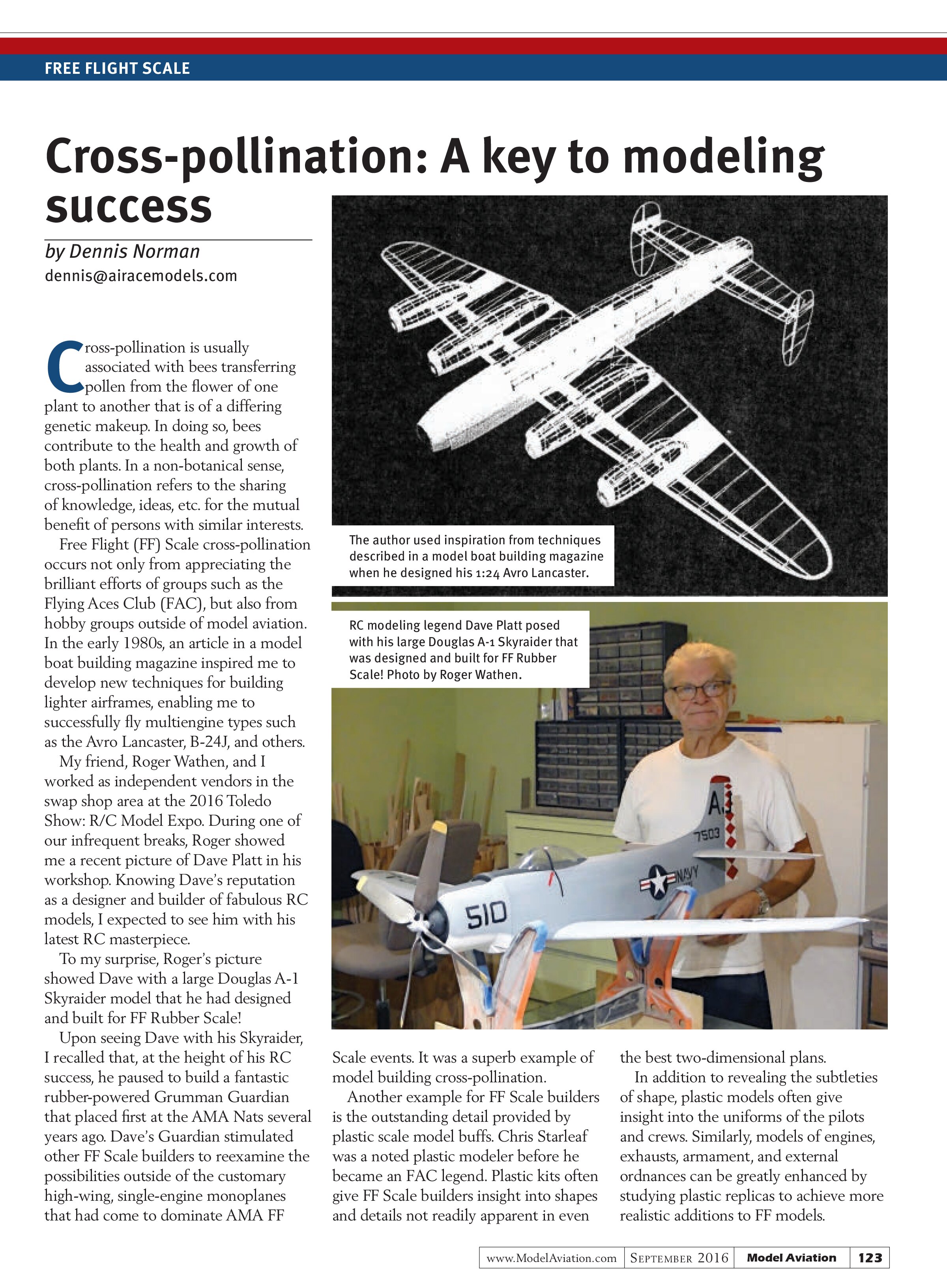
Free Flight (FF) Scale cross-pollination occurs not only from appreciating the brilliant efforts of groups such as the Flying Aces Club (FAC), but also from hobby groups outside of model aviation. In the early 1980s, an article in a model boat building magazine inspired me to develop new techniques for building lighter airframes, enabling me to successfully fly multiengine types such as the Avro Lancaster, B-24J, and others.
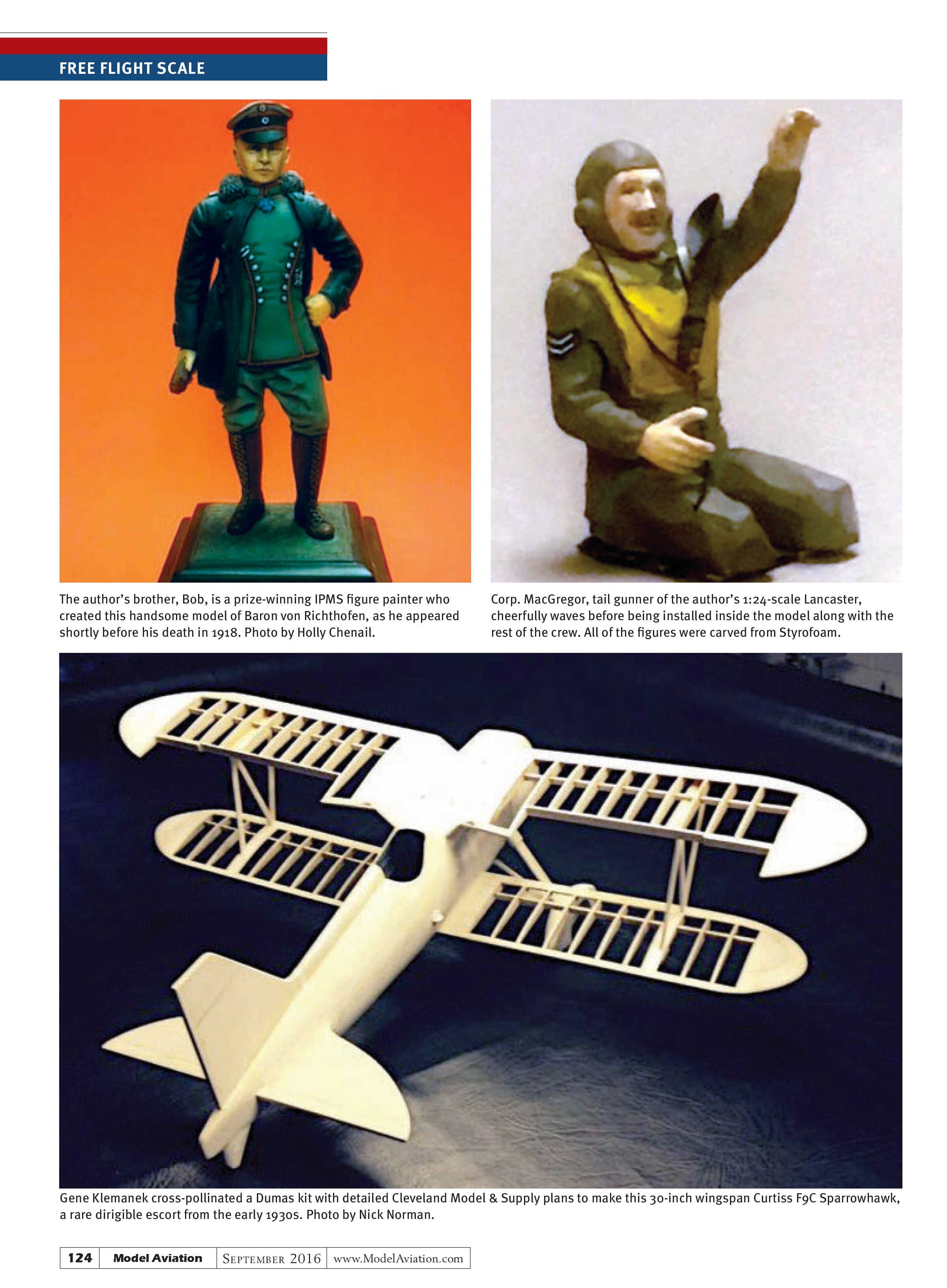
My friend, Roger Wathen, and I worked as independent vendors in the swap shop area at the 2016 Toledo Show: R/C Model Expo. During one of our infrequent breaks, Roger showed me a recent picture of Dave Platt in his workshop. Knowing Dave’s reputation as a designer and builder of fabulous RC models, I expected to see him with his latest RC masterpiece.
To my surprise, Roger’s picture showed Dave with a large Douglas A-1 Skyraider model that he had designed and built for FF Rubber Scale!
Upon seeing Dave with his Skyraider, I recalled that, at the height of his RC success, he paused to build a fantastic rubber-powered Grumman Guardian that placed first at the AMA Nats several years ago. Dave’s Guardian stimulated other FF Scale builders to reexamine the possibilities outside of the customary high-wing, single-engine monoplanes that had come to dominate AMA FF


Scale events. It was a superb example of model building cross-pollination.
Another example for FF Scale builders is the outstanding detail provided by plastic scale model buffs. Chris Starleaf was a noted plastic modeler before he became an FAC legend. Plastic kits often give FF Scale builders insight into shapes and details not readily apparent in even the best two-dimensional plans.
In addition to revealing the subtleties of shape, plastic models often give insight into the uniforms of the pilots and crews. Similarly, models of engines, exhausts, armament, and external ordnances can be greatly enhanced by studying plastic replicas to achieve more realistic additions to FF models.


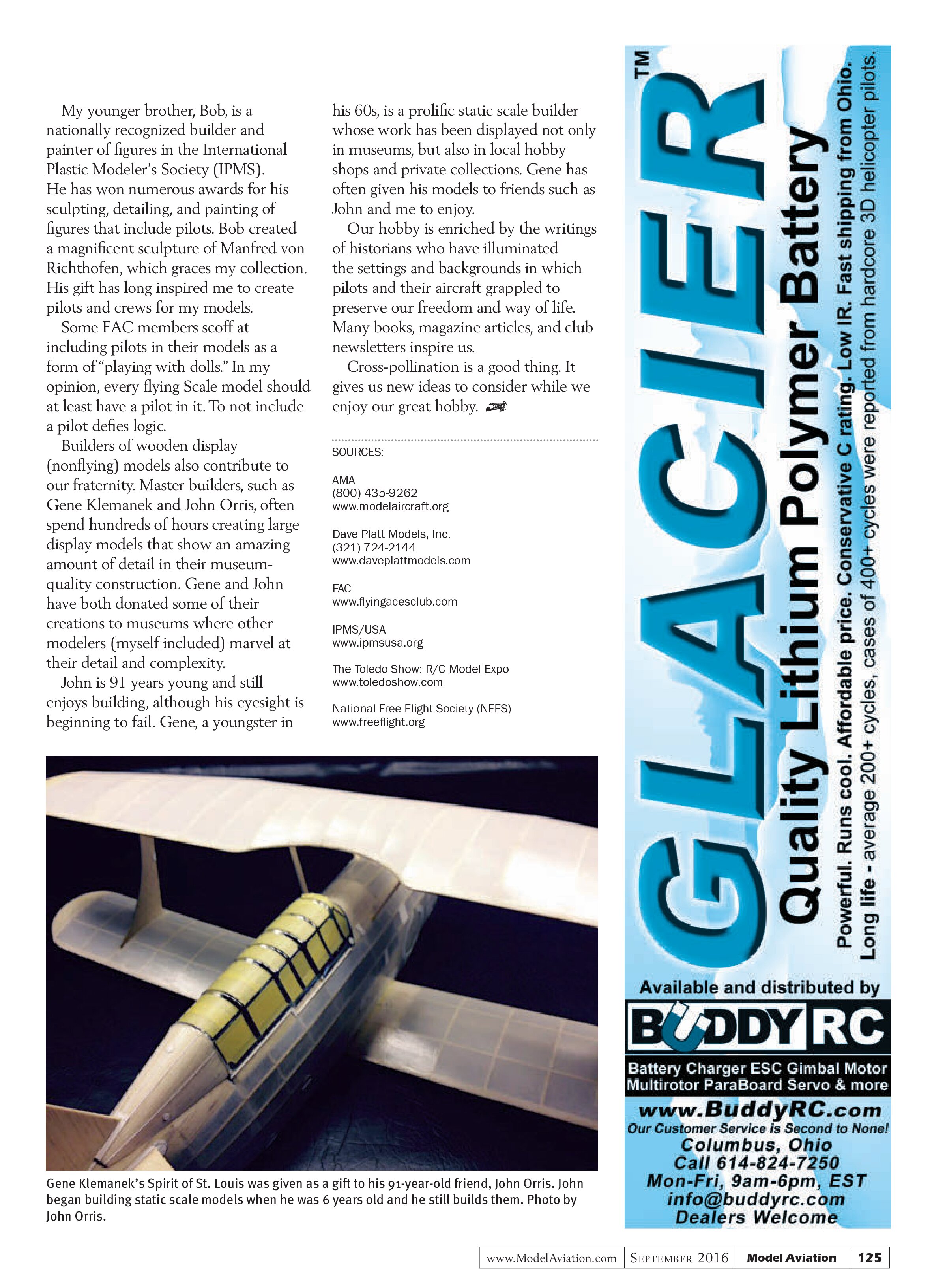
My younger brother, Bob, is a nationally recognized builder and painter of figures in the International Plastic Modeler’s Society (IPMS). He has won numerous awards for his sculpting, detailing, and painting of figures that include pilots. Bob created a magnificent sculpture of Manfred von Richthofen, which graces my collection. His gift has long inspired me to create pilots and crews for my models.
Some FAC members scoff at including pilots in their models as a form of “playing with dolls.” In my opinion, every flying Scale model should at least have a pilot in it. To not include a pilot defies logic.
Builders of wooden display (nonflying) models also contribute to our fraternity. Master builders, such as Gene Klemanek and John Orris, often spend hundreds of hours creating large display models that show an amazing amount of detail in their museum-quality construction. Gene and John have both donated some of their creations to museums where other modelers (myself included) marvel at their detail and complexity.
John is 91 years young and still enjoys building, although his eyesight is beginning to fail. Gene, a youngster in his 60s, is a prolific static scale builder whose work has been displayed not only in museums, but also in local hobby shops and private collections. Gene has often given his models to friends such as John and me to enjoy.
Our hobby is enriched by the writings of historians who have illuminated the settings and backgrounds in which pilots and their aircraft grappled to preserve our freedom and way of life. Many books, magazine articles, and club newsletters inspire us.
Cross-pollination is a good thing. It gives us new ideas to consider while we enjoy our great hobby.
SOURCES:
AMA
(800) 435-9262
www.modelaircraft.org
Dave Platt Models, Inc.
(321) 724-2144
www.daveplattmodels.com
IPMS/USA
www.ipmsusa.org
The Toledo Show: R/C Model Expo
www.toledoshow.com
National Free Flight Society (NFFS)
www.freeflight.org