CL World Championships report
by Bob Hunt
robinhunt@rcn.com
Jim Aron reported on the 2016 Control Line (CL) World Championships.
I am Jim Aron, and I was the assistant team manager and de facto coach for the 2016 US F2B CL Precision Aerobatics team. The 2016 CL World Championships, held in Perth, Australia, recently concluded and I am happy to report that the US F2B Team did exceedingly well.
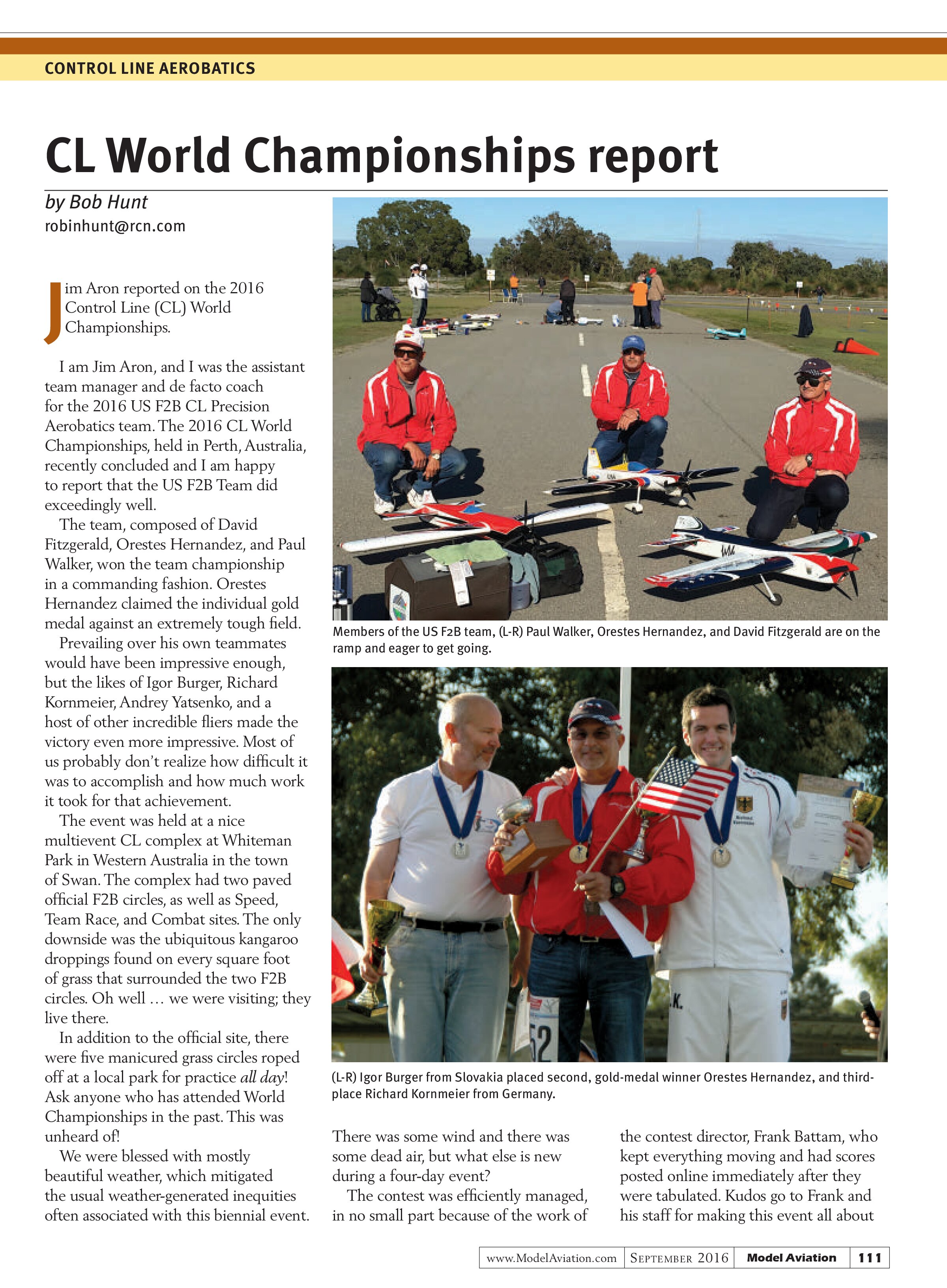
The team, composed of David Fitzgerald, Orestes Hernandez, and Paul Walker, won the team championship in a commanding fashion. Orestes Hernandez claimed the individual gold medal against an extremely tough field.
Prevailing over his own teammates would have been impressive enough, but the likes of Igor Burger, Richard Kornmeier, Andrey Yatsenko, and a host of other incredible fliers made the victory even more impressive. Most of us probably don’t realize how difficult it was to accomplish and how much work it took for that achievement.
The event was held at a nice multievent CL complex at Whiteman Park in Western Australia in the town of Swan. The complex had two paved official F2B circles, as well as Speed, Team Race, and Combat sites. The only downside was the ubiquitous kangaroo droppings found on every square foot of grass that surrounded the two F2B circles. Oh well … we were visiting; they live there.
In addition to the official site, there were five manicured grass circles roped off at a local park for practice all day! Ask anyone who has attended World Championships in the past. This was unheard of!
We were blessed with mostly beautiful weather, which mitigated the usual weather-generated inequities often associated with this biennial event.


There was some wind and there was some dead air, but what else is new during a four-day event?
The contest was efficiently managed, in no small part because of the work of the contest director, Frank Battam, who kept everything moving and had scores posted online immediately after they were tabulated. Kudos go to Frank and his staff for making this event all about
the flying and not about administrative hiccups.
All three of our fliers came prepared. Paul and Dave spent more than a week working together in Napa, California, before departing. Orestes is well known for his arduous practice schedule, and the weeks leading up to the contest were certainly no exception.
It was clear to me that these men wanted to win the team gold as much as the individual honors. It showed in how they supported each other throughout the week and in how they celebrated afterward. All three men are class acts. It was a treat to hang out with them and help where I could.
The first two days were qualifying rounds. Each contestant flew twice on each circle in front of two sets of judges. The contestants’ high score from each circle was combined to create the individual qualifying scores. The 15 contenders with the highest scores moved on to the finals.
The finals included three rounds throughout two days on one circle in front of one panel of judges. The two highest scores for each contestant were combined for the final placings.
The intrigue lies in the flight order, the time of day you fly, and trying to decipher what the judges are looking for—not to mention the inevitable associated mind games with which each flier must contend.
No matter how much you prepare, there are always elements of your pattern that can be improved and our contestants were no exception. What
is remarkable to me is the openness to constructive criticism that they each embodied. There was relatively little to say, but when it was said, they listened.
It was apparent to me that there would be roughly 10 pilots to watch, including our three fliers: Igor Burger from Slovakia, Richard Kornmeier from Germany, Marco Valliera from Italy, and a few others. It was very interesting to watch the contest unfold. Although each of these pilots brought something unique to the table, a common thread was hard corners and bottoms that were never above 5 feet, and often substantially lower.
It appeared to me that technology advances with the electric crowd, including the use of accelerometers, has resulted in a pattern that is changing

All three of our fliers came prepared. Paul and Dave spent more than a week working together in Napa, California, before departing. Orestes is well known for his arduous practice schedule, and the weeks leading up to the contest were certainly no exception.
It was clear to me that these men wanted to win the team gold as much as the individual honors. It showed in how they supported each other throughout the week and in how they celebrated afterward. All three men are class acts. It was a treat to hang out with them and help where I could.
The first two days were qualifying rounds. Each contestant flew twice on each circle in front of two sets of judges. The contestants’ high score from each circle was combined to create the individual qualifying scores. The 15 contenders with the highest scores moved on to the finals.
The finals included three rounds throughout two days on one circle in front of one panel of judges. The two highest scores for each contestant were combined for the final placings.
The intrigue lies in the flight order, the time of day you fly, and trying to decipher what the judges are looking for—not to mention the inevitable associated mind games with which each flier must contend.
No matter how much you prepare, there are always elements of your pattern that can be improved and our contestants were no exception. What is remarkable to me is the openness to constructive criticism that they each embodied. There was relatively little to say, but when it was said, they listened.
It was apparent to me that there would be roughly 10 pilots to watch, including our three fliers: Igor Burger from Slovakia, Richard Kornmeier from Germany, Marco Valliera from Italy, and a few others. It was very interesting to watch the contest unfold. Although each of these pilots brought something unique to the table, a common thread was hard corners and bottoms that were never above 5 feet, and often substantially lower.
It appeared to me that technology advances with the electric crowd, including the use of accelerometers, has resulted in a pattern that is changing the look of the event. It should be noted, however, that the high single-flight score for the contest belonged to Dave Fitzgerald, who kept the internal-combustion faith with his PA 75. There is no question that an internal-combustion setup is competitive, but I think the writing is on the wall. It’s all subjective, but the top four flew with electric power.
After watching the qualifying rounds, I thought that Orestes, Paul, Igor, and Richard were the ones to beat—and that is how it played out. Igor and Richard were leading through the first two rounds of the finals and appeared to be the favorites, but Paul and Orestes were improving as the rounds progressed. It was probably going to come down to the final round and, in Paul’s case, the final flight of the day.
Orestes smoked his final flight, and as his score hit the internet, there were commotions across the field as everyone, buried in their smartphones, realized that Orestes had just taken the lead. An American was going to win gold. With Paul flying last, you never want to count him out, but he would have needed a monstrous score.
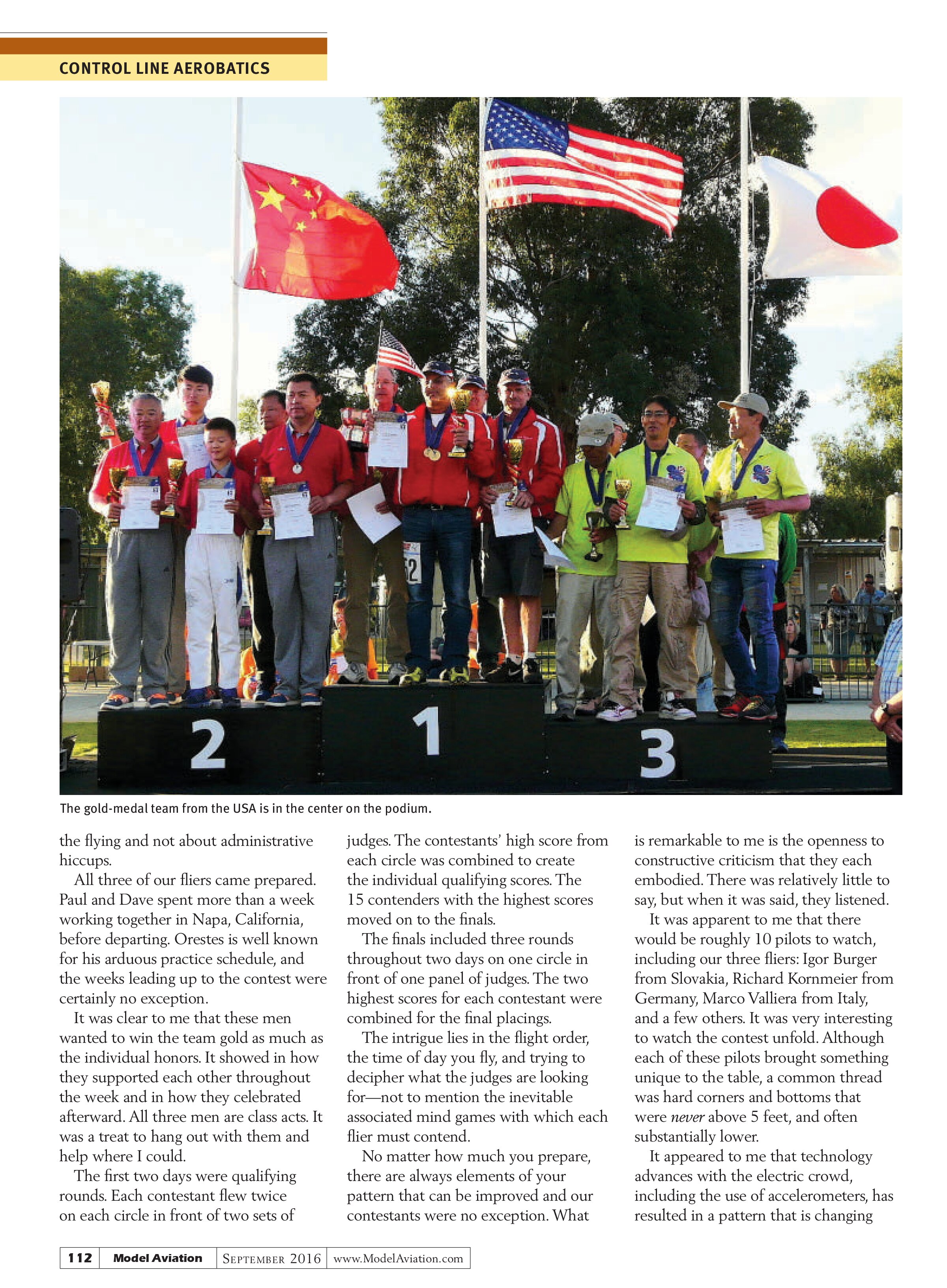
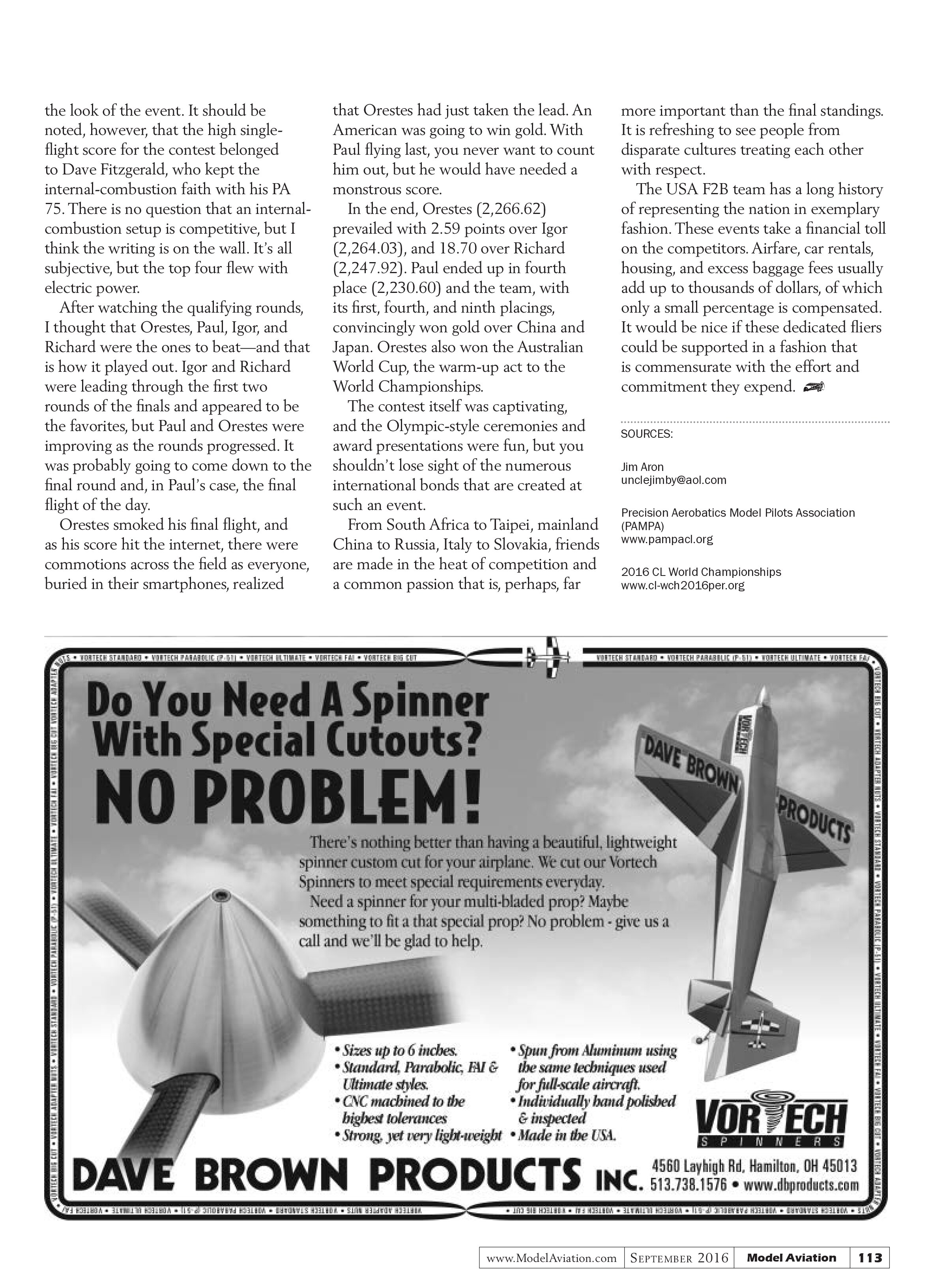
In the end, Orestes (2,266.62) prevailed with 2.59 points over Igor (2,264.03), and 18.70 over Richard (2,247.92). Paul ended up in fourth place (2,230.60) and the team, with its first, fourth, and ninth placings, convincingly won gold over China and Japan. Orestes also won the Australian World Cup, the warm-up act to the World Championships.
The contest itself was captivating, and the Olympic-style ceremonies and award presentations were fun, but you shouldn’t lose sight of the numerous international bonds that are created at such an event.
From South Africa to Taipei, mainland China to Russia, Italy to Slovakia, friends are made in the heat of competition and a common passion that is, perhaps, far more important than the final standings. It is refreshing to see people from disparate cultures treating each other with respect.
The USA F2B team has a long history of representing the nation in exemplary fashion. These events take a financial toll on the competitors. Airfare, car rentals, housing, and excess baggage fees usually add up to thousands of dollars, of which only a small percentage is compensated. It would be nice if these dedicated fliers could be supported in a fashion that is commensurate with the effort and commitment they expend.
SOURCES:
Jim Aron
unclejimby@aol.com
Precision Aerobatics Model Pilots Association (PAMPA)
www.pampacl.org
2016 CL World Championships
www.cl-wch2016per.org