The wild world of micro FPV quadcopters
Jim T. Graham
As many of us progress in our RC aspirations, we tend to go big—bigger airplanes, bigger helicopters, bigger radio, bigger everything! I started in the world of .40-size airplanes and progressively went bigger. My FPV quadcopters got bigger. My FPV foam airplanes started to have 60-inch and larger wingspans. Then one day it happened—I went too big. I realized that I spent half of my time taking airplanes apart to load them in my truck, only to put them back together then take them apart again to go home. I state all of that to ask: Why not fly small?

I’ll first review my reasons for going small, which include smaller LiPo batteries (less cost), the ability to fly in a backyard, and less breakage loading aircraft in and out for transport.
I realized that if I’m wearing FPV goggles, I don’t really recognize how small or large the multirotor actually is! After all of this reasoning, my aircraft started decreasing in size.
Now that I have walked you along my path to downsizing, let’s discuss my discovery of small quadcopters. I have a wooded half-acre backyard, complete with a beautiful creek. My dream has always been to have something that would allow me to sit on my picnic table and fly FPV.
I needed something that had good motors, a good flight board, and was sturdy enough to fly into branches, trees,

and fences and take a fall. The flip side is that I needed something unintimidating that would not make my neighbors put the FAA’s telephone number on speed dial.
While I am on that three-letter acronym, it would also be great if my FPV quadcopter was below the weight set by the FAA. A few years ago this would have been a lot to ask, but I’m happy to report that I have a few versions of my dream quadcopter flying!
The Walkera Rodeo 150
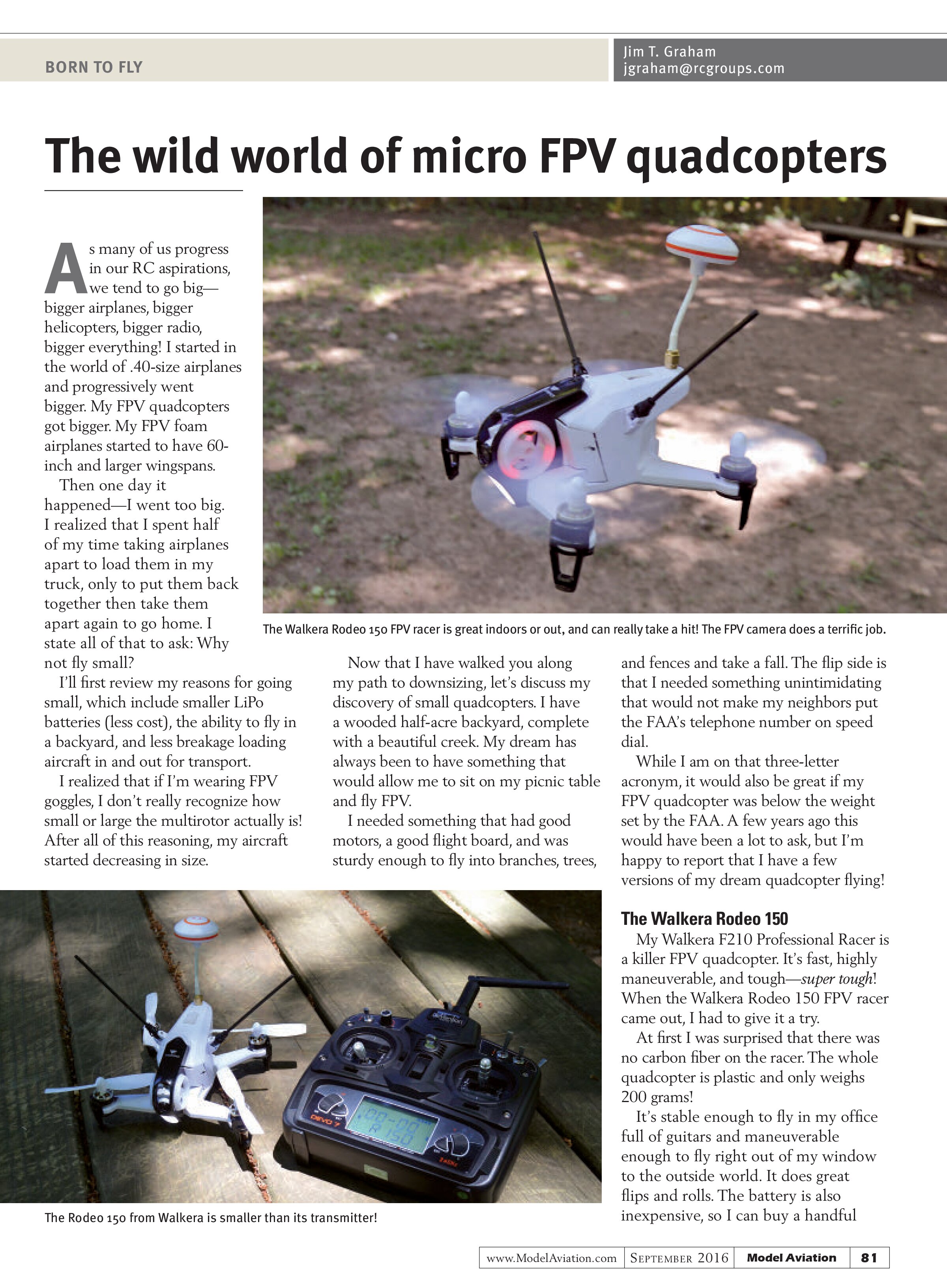
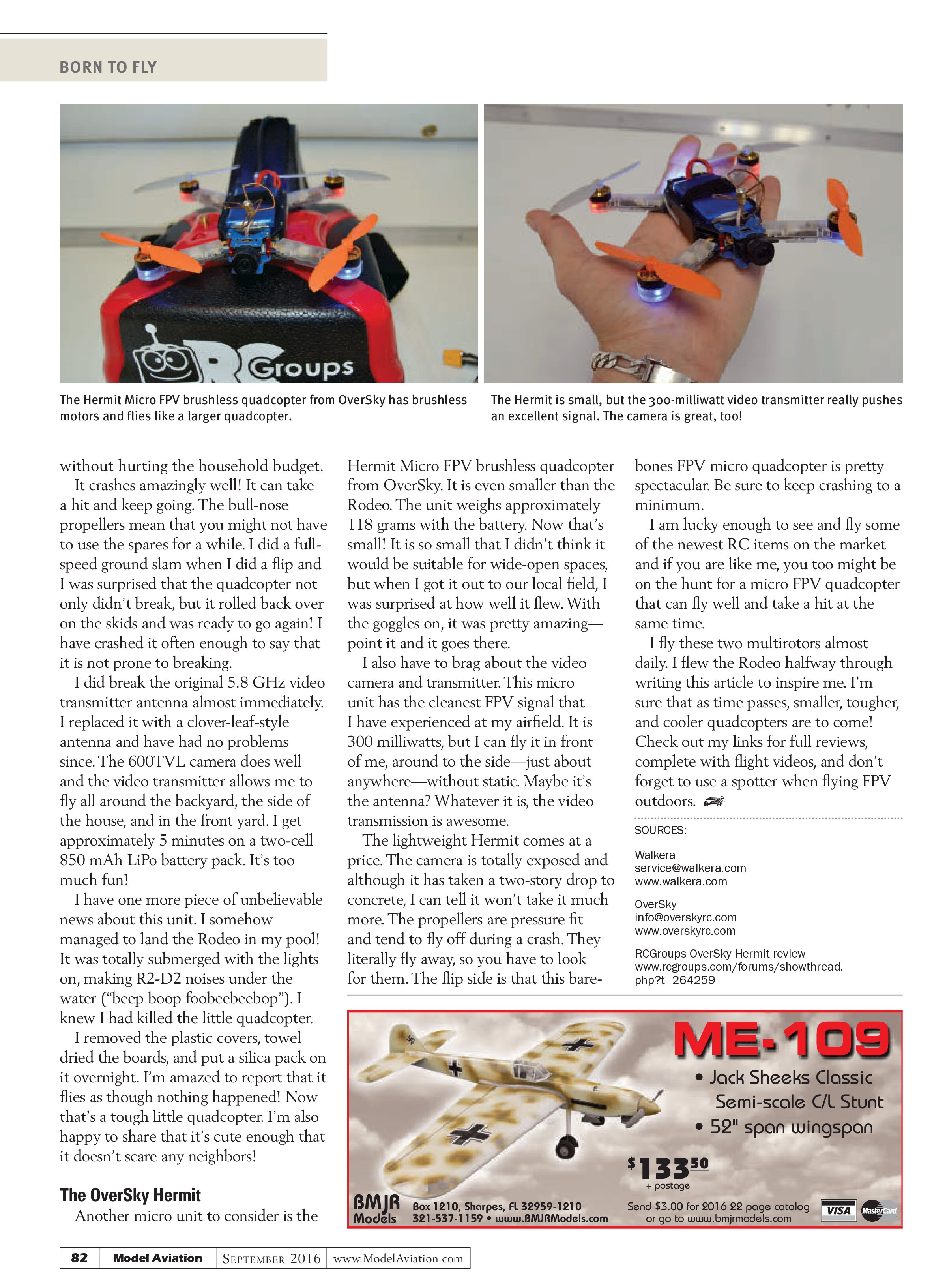
My Walkera F210 Professional Racer is a killer FPV quadcopter. It’s fast, highly maneuverable, and tough—super tough! When the Walkera Rodeo 150 FPV racer came out, I had to give it a try.
At first I was surprised that there was no carbon fiber on the racer. The whole quadcopter is plastic and only weighs 200 grams!
It’s stable enough to fly in my office full of guitars and maneuverable enough to fly right out of my window to the outside world. It does great flips and rolls. The battery is also inexpensive, so I can buy a handful
without hurting the household budget.
It crashes amazingly well! It can take a hit and keep going. The bull-nose propellers mean that you might not have to use the spares for a while. I did a full-speed ground slam when I did a flip and I was surprised that the quadcopter not only didn’t break, but it rolled back over on the skids and was ready to go again! I have crashed it often enough to say that it is not prone to breaking.
I did break the original 5.8 GHz video transmitter antenna almost immediately. I replaced it with a clover-leaf-style antenna and have had no problems since. The 600TVL camera does well and the video transmitter allows me to fly all around the backyard, the side of the house, and in the front yard. I get approximately 5 minutes on a two-cell 850 mAh LiPo battery pack. It’s too much fun!
I have one more piece of unbelievable news about this unit. I somehow managed to land the Rodeo in my pool! It was totally submerged with the lights on, making R2-D2 noises under the water (“beep boop foobeebeebop”). I knew I had killed the little quadcopter.
I removed the plastic covers, towel dried the boards, and put a silica pack on it overnight. I’m amazed to report that it flies as though nothing happened! Now that’s a tough little quadcopter. I’m also happy to share that it’s cute enough that it doesn’t scare any neighbors!
The OverSky Hermit
Another micro unit to consider is the


Hermit Micro FPV brushless quadcopter from OverSky. It is even smaller than the Rodeo. The unit weighs approximately 118 grams with the battery. Now that’s small! It is so small that I didn’t think it would be suitable for wide-open spaces, but when I got it out to our local field, I was surprised at how well it flew. With the goggles on, it was pretty amazing—point it and it goes there.
I also have to brag about the video camera and transmitter. This micro unit has the cleanest FPV signal that I have experienced at my airfield. It is 300 milliwatts, but I can fly it in front of me, around to the side—just about anywhere—without static. Maybe it’s the antenna? Whatever it is, the video transmission is awesome.
The lightweight Hermit comes at a price. The camera is totally exposed and although it has taken a two-story drop to concrete, I can tell it won’t take it much more. The propellers are pressure fit and tend to fly off during a crash. They literally fly away, so you have to look for them. The flip side is that this bare-bones FPV micro quadcopter is pretty spectacular. Be sure to keep crashing to a minimum.
I am lucky enough to see and fly some of the newest RC items on the market and if you are like me, you too might be on the hunt for a micro FPV quadcopter that can fly well and take a hit at the same time.
I fly these two multirotors almost daily. I flew the Rodeo halfway through writing this article to inspire me. I’m sure that as time passes, smaller, tougher, and cooler quadcopters are to come! Check out my links for full reviews, complete with flight videos, and don’t forget to use a spotter when flying FPV outdoors.
SOURCES:
Walkera
service@walkera.com
www.walkera.com
OverSky
info@overskyrc.com
www.overskyrc.com
RCGroups OverSky Hermit review
www.rcgroups.com/forums/showthread.php?t=264259