Special Rule for Model Aircraft Remains Law
After nearly a year of work, we are happy to announce that both the U.S. Senate and House of Representatives have passed a 14-month FAA extension, and President Obama has signed the bill into law.
We are pleased that the FAA extension affirms our right to continue to fly within AMA’s community-based safety program and free from additional government regulations. Congress continues to recognize the importance of AMA and our strong commitment to safety.
As you know, AMA aggressively engaged with Congress to achieve the best possible result for our members. It was through these advocacy efforts that we were able to achieve our goal of maintaining the Special Rule for Model Aircraft and protecting our hobby. This victory adds to AMA’s history of successfully advocating for our members at the federal level, including with the Federal Communications Commission, the Department of Commerce, the EPA, the Department of the Interior, the U.S. Forest Service, the Department of Homeland Security, the FAA, and Congress.
There are two important things for AMA members to know about the extension. The first—and most important for our hobby—is that the extension preserves the Special Rule for Model Aircraft (Section 336 of the 2012 FAA Modernization and Reform Act) through September 2017. And second, although this bill does not address the regulatory requirement to register model aircraft, we are pleased to share that the problematic language that existed in earlier versions of the FAA bill has been removed.
Our advocacy efforts are not over. We are continuing to work with the FAA to reduce the burden of the registration requirement on AMA members. Throughout the next 14 months, we will continue to work with Congress on a long-term reauthorization bill that will further strengthen the Special Rule for Model Aircraft and advance other protections of our longstanding hobby.
We extend our appreciation to all of our members and donors for your support throughout this process.
FAA Announces Final Rule on sUAS
In 2008, the AMA was invited to assist in developing recommendations for new regulations addressing the operation of sUAS. During the past eight years, we have consistently espoused our view that there should be both a regulatory path and a community-based approach to the operation of recreational sUAS (model aircraft).
The AMA has been steadfast in its position that any FAA rules exclude recreational model aviation activities occurring within AMA’s community-based safety program. AMA has also made it clear that to operate within our safety program, you must join the AMA and affirm your willingness to comply with the AMA Safety Code and related safety guidelines.
After years of work, the FAA released its final sUAS rule on June 21, 2016. The rule will become effective on August 29, 2016.
We are pleased to share that this rule maintains the exemption for recreational model aircraft operators provided by Congress in Section 336 of the 2012 FAA Modernization and Reform Act, and codifies the Special Rule for Model Aircraft into regulation. In fact, the rule affirms Congress’ intent that the FAA not promulgate any regulations on modelers who satisfy the criteria in the Special Rule.
Essentially this rule excludes AMA members operating within our safety program, while providing a regulatory approach under 14 CFR Part 107 for sUAS operators who do not choose or are not authorized to operate under Section 336 or the Special Rule for Model Aircraft.
Although the rule does not change operations for AMA members, it affirms our operation under the Special Rule for Model Aircraft and the requirement to fully comply with AMA’s Safety Code, related safety guidelines, and all of the criteria in Section 336, including the 5-mile airport notification requirement.
Keep in mind that the new rule does not preclude the federal registration requirement for model aircraft weighing more than 1/2 pound. This is something the AMA is still working to address.
Overall, we believe these rules will be highly beneficial to the industry. I encourage our members to become familiar with the rule, especially if you are interested in commercial or civil operations. When this rule goes into effect on August 29, the FAA will make it safer and easier for commercial and civil pilots.
Following are some frequently asked questions about the FAA final rule.
Q: Where can I read FAA’s final rule for small unmanned aircraft systems (Part 107)?
A: You can read the 624-page rule at www.modelaircraft.org/gov or at www.faa.gov/uas/media/RIN_2120-AJ60_Clean_Signed.pdf.
Q: How does the new rule affect me as a member? Do I have to take a special test, receive certification, be capped at 400 feet, etc.?
A: The FAA final rule generally applies to all commercial and civil sUAS operations and any recreational activity that does not “satisfy all of the criteria specified in section 336.” If you are an AMA member operating within our community-based safety program and are not conducting commercial operations, you are exempt from this rule.
Q: Do I still need to notify airports within 5 miles of my modeling activities?
A: Yes. This rule does not nullify the airport notification requirement.
Q: Do I still have to register with the FAA?
A: Yes, if you operate models that weigh more than 250 grams, you will need to register. There are some exemptions for pilots who exclusively fly Free Flight, Control Line, indoor models, or aircraft less than 250 grams.
Although the FAA codifies parts of Section 336, the new rule does not preclude the registration requirement. We are addressing this issue, including advocating to allow members to exclusively use their AMA numbers. We believe an AMA membership already meets the intent of registration. At this time, pilots are still advised to register.
Q: Where do I go to register?
A: You can register at http://registermyuas.faa.gov.
Wildfire Advisory Notice
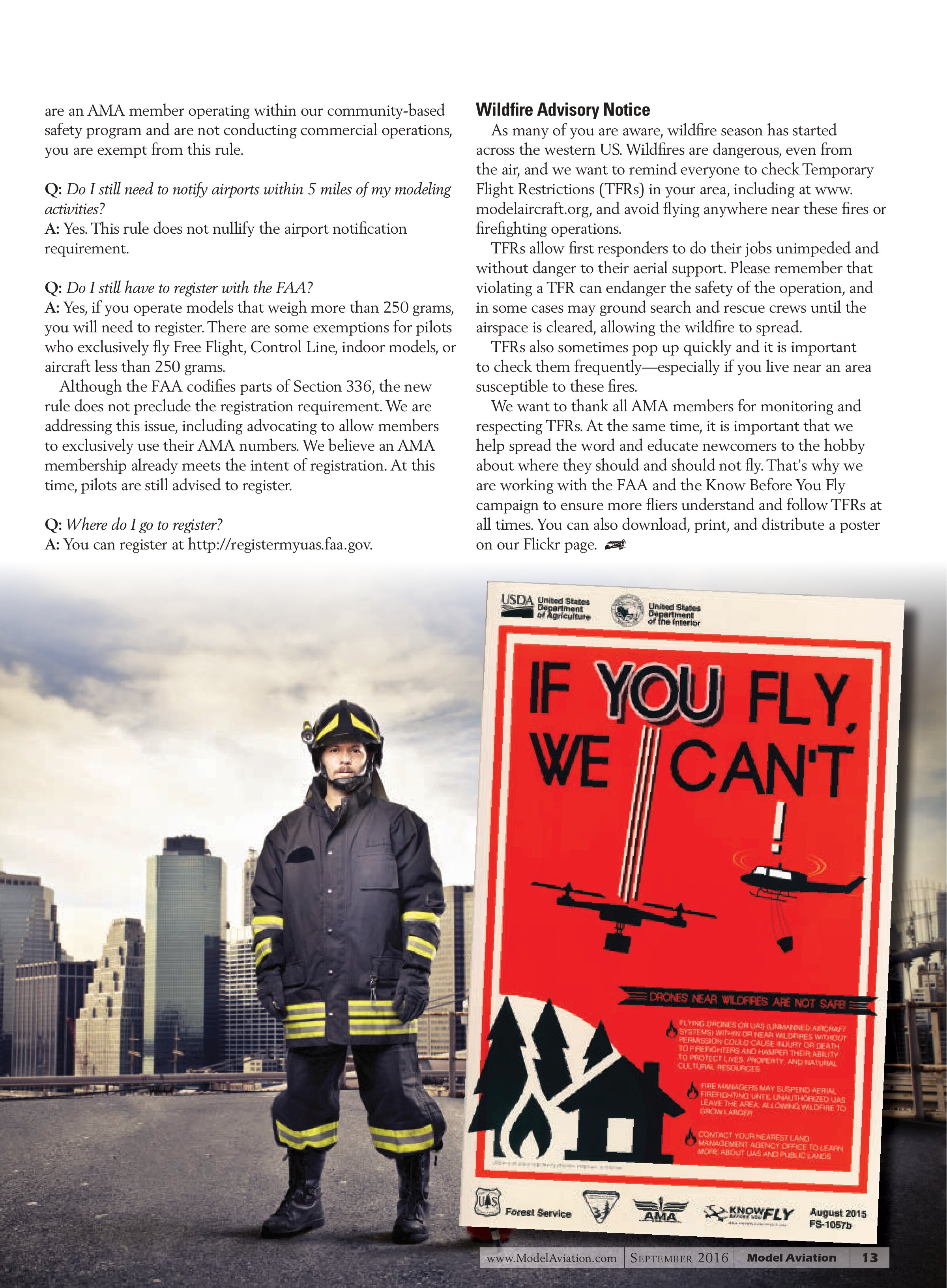
As many of you are aware, wildfire season has started across the western US. Wildfires are dangerous, even from the air, and we want to remind everyone to check Temporary Flight Restrictions (TFRs) in your area, including at www.modelaircraft.org, and avoid flying anywhere near these fires or firefighting operations.
TFRs allow first responders to do their jobs unimpeded and without danger to their aerial support. Please remember that violating a TFR can endanger the safety of the operation, and in some cases may ground search and rescue crews until the airspace is cleared, allowing the wildfire to spread.
TFRs also sometimes pop up quickly and it is important to check them frequently—especially if you live near an area susceptible to these fires.
We want to thank all AMA members for monitoring and respecting TFRs. At the same time, it is important that we help spread the word and educate newcomers to the hobby about where they should and should not fly. That’s why we are working with the FAA and the Know Before You Fly campaign to ensure more fliers understand and follow TFRs at all times. You can also download, print, and distribute a poster on our Flickr page.