Off to the races
Patrick Sherman
lucidity@roswellflighttestcrew.com
FPV racing has, in the space of a single year, established itself as one of the most widely recognized form of RC flying competition in the world. If you have any doubts, look no further than the Drone Sports Association’s (DSA) US National Drone Racing Championships, which received extensive coverage on ESPN in August 2015.
The action will continue at the next World Drone Racing Championships, to be held October 17-22, 2016, at Kualoa Ranch on the Hawaiian island of Oahu—with a $200,000 purse at stake. Because AMA pilots are some of the best RC pilots anywhere, I figured you might want to get in on the action, so I asked two of the top FPV racing pilots to tell me about their favorite machines and share some insights.
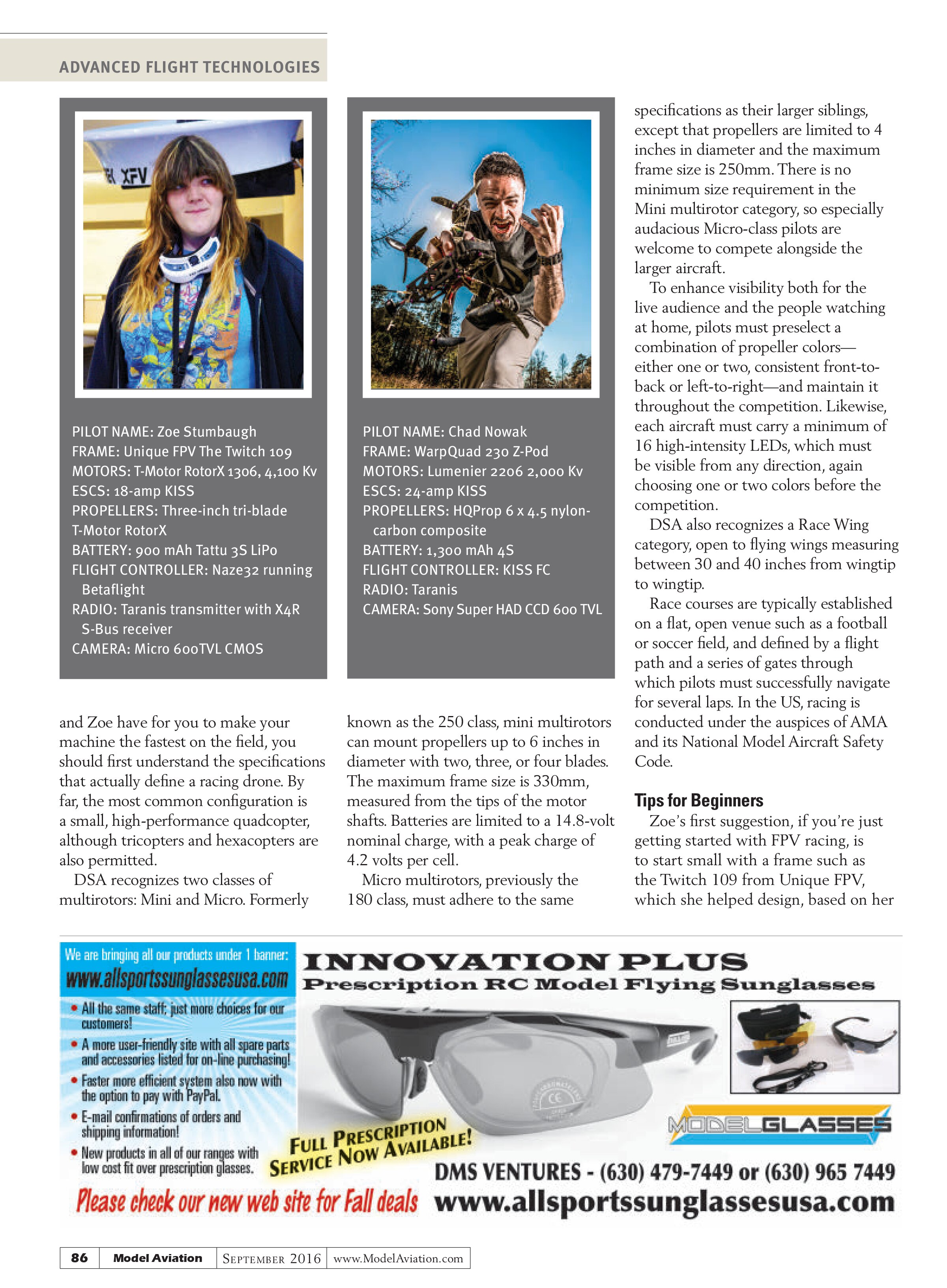
I met Chad Nowak and Zoe

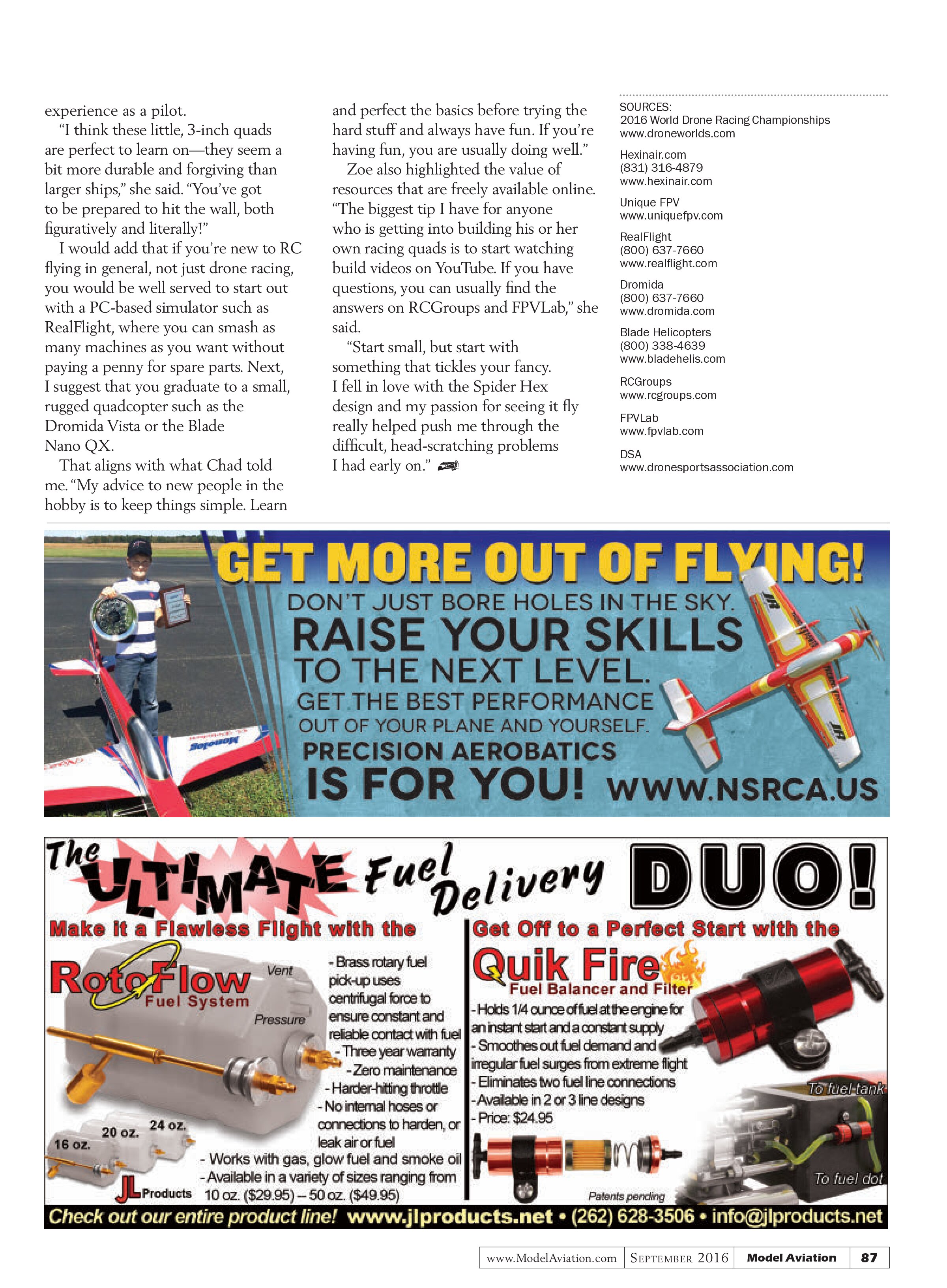
Stumbaugh while hosting the online coverage of the 2015 US National Drone Racing Championships last summer in Sacramento, California, and caught up with them again in New York. Chad, who hails from Australia and uses the online moniker FinalGlideAUS, was crowned the champion at the 2015
event. Zoe is the world’s top-rated female FPV racing and freestyle pilot. She lives in Santa Cruz, California, and runs the website Hexinair.com to keep her fans up-to-date on her activities.
By Any Other Name
Before revealing the advice that Chad


PILOT NAME: Zoe Stumbaugh
FRAME: Unique FPV The Twitch 109
MOTORS: T-Motor RotorX 1306, 4,100 Kv
ESCS: 18-amp KISS
PROPELLERS: Three-inch tri-blade T-Motor RotorX
BATTERY: 900 mAh Tattu 3S LiPo
FLIGHT CONTROLLER: Naze32 running Betaflight
RADIO: Taranis transmitter with X4R S-Bus receiver
CAMERA: Micro 600TVL CMOS
and Zoe have for you to make your machine the fastest on the field, you should first understand the specifications that actually define a racing drone. By far, the most common configuration is a small, high-performance quadcopter, although tricopters and hexacopters are also permitted.
DSA recognizes two classes of multirotors: Mini and Micro. Formerly

PILOT NAME: Chad Nowak
FRAME: WarpQuad 230 Z-Pod
MOTORS: Lumenier 2206 2,000 Kv
ESCS: 24-amp KISS
PROPELLERS: HQProp 6 x 4.5 nylon-carbon composite
BATTERY: 1,300 mAh 4S
FLIGHT CONTROLLER: KISS FC
RADIO: Taranis
CAMERA: Sony Super HAD CCD 600 TVL
known as the 250 class, mini multirotors can mount propellers up to 6 inches in diameter with two, three, or four blades. The maximum frame size is 330mm, measured from the tips of the motor shafts. Batteries are limited to a 14.8-volt nominal charge, with a peak charge of 4.2 volts per cell.
Micro multirotors, previously the 180 class, must adhere to the same specifications as their larger siblings, except that propellers are limited to 4 inches in diameter and the maximum frame size is 250mm. There is no minimum size requirement in the Mini multirotor category, so especially audacious Micro-class pilots are welcome to compete alongside the larger aircraft.
To enhance visibility both for the live audience and the people watching at home, pilots must preselect a combination of propeller colors—either one or two, consistent front-to-back or left-to-right—and maintain it throughout the competition. Likewise, each aircraft must carry a minimum of 16 high-intensity LEDs, which must be visible from any direction, again choosing one or two colors before the competition.
DSA also recognizes a Race Wing category, open to flying wings measuring between 30 and 40 inches from wingtip to wingtip.
Race courses are typically established on a flat, open venue such as a football or soccer field, and defined by a flight path and a series of gates through which pilots must successfully navigate for several laps. In the US, racing is conducted under the auspices of AMA and its National Model Aircraft Safety Code.
Tips for Beginners
Zoe’s first suggestion, if you’re just getting started with FPV racing, is to start small with a frame such as the Twitch 109 from Unique FPV, which she helped design, based on her experience as a pilot.
“I think these little, 3-inch quads are perfect to learn on—they seem a bit more durable and forgiving than larger ships,” she said. “You’ve got to be prepared to hit the wall, both figuratively and literally!”
I would add that if you’re new to RC flying in general, not just drone racing, you would be well served to start out with a PC-based simulator such as RealFlight, where you can smash as many machines as you want without paying a penny for spare parts. Next, I suggest that you graduate to a small, rugged quadcopter such as the Dromida Vista or the Blade Nano QX.
That aligns with what Chad told me. “My advice to new people in the hobby is to keep things simple. Learn and perfect the basics before trying the hard stuff and always have fun. If you’re having fun, you are usually doing well.”
Zoe also highlighted the value of resources that are freely available online. “The biggest tip I have for anyone who is getting into building his or her own racing quads is to start watching build videos on YouTube. If you have questions, you can usually find the answers on RCGroups and FPVLab,” she said.
“Start small, but start with something that tickles your fancy. I fell in love with the Spider Hex design and my passion for seeing it fly really helped push me through the difficult, head-scratching problems I had early on.”
SOURCES:
2016 World Drone Racing Championships
www.droneworlds.com
Hexinair.com
(831) 316-4879
www.hexinair.com
Unique FPV
www.uniquefpv.com
RealFlight
(800) 637-7660
www.realflight.com
Dromida
(800) 637-7660
www.dromida.com
Blade Helicopters
(800) 338-4639
www.bladehelis.com
RCGroups
www.rcgroups.com
FPVLab
www.fpvlab.com