Building the model you fly
Paul Bradley
bradleyep@ix.netcom.com
Although the hobby has evolved since its beginning, building the model you fly continues to be a passion for many participants. I know that building an aircraft is not for everyone. Time constraints and a lack of interest in building things are two reasons why some people prefer to buy ready-to-fly aircraft, or those that only require the assembly of prebuilt major components.
Building your airplane can lead to a sense of pride and individuality. For that reason, I would like to focus on some nice examples of reader-built, small-field models.
Sheet Foam and Imagination
A contributor to this column, Jack Pignolo, is a fan of sheet-foam models. He likes the material’s properties and the ease of transferring his concept doodles to foam to cut out the required parts. Some of my past columns have

provided a look at his interesting creations.
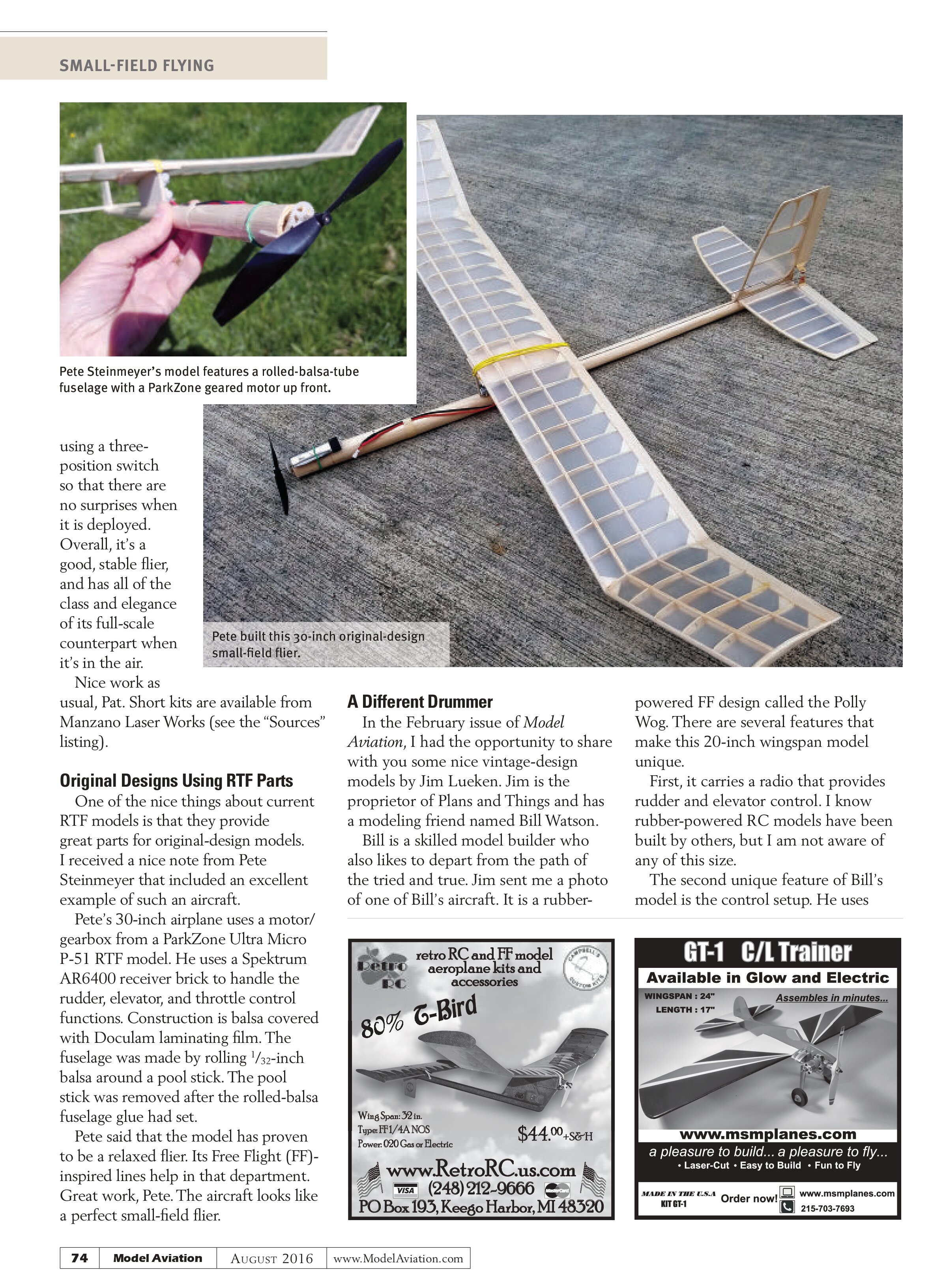
This time around, Jack has developed a model suitable for flying in his front yard. It has a 26-inch wingspan and a flying weight of 3.8 ounces. It’s powered by a Turnigy 1811 2,900 Kv brushless motor that turns a 6 x 3 propeller. Energizing the system is a two-cell
300 mAh LiPo battery pack. Control is provided by a HobbyKing Orange receiver that handles throttle, rudder, and elevator control.
Jack reported that the model is a terrific flier and it has met all of his goals. In addition to flying it in his front yard, he also enjoys flying the aircraft while at his summer home, with the Downeast Soaring Club of Maine. See the “Sources” listing for club contact information.
Pat Tritle Laser-Cut Kit
Pat Tritle is a friend to small-field fliers who likes to design and build these aircraft. His designs are perfectly suited to small-field flying venues. They are lightweight, a size that is easy to see in the air, and behave well in flight.
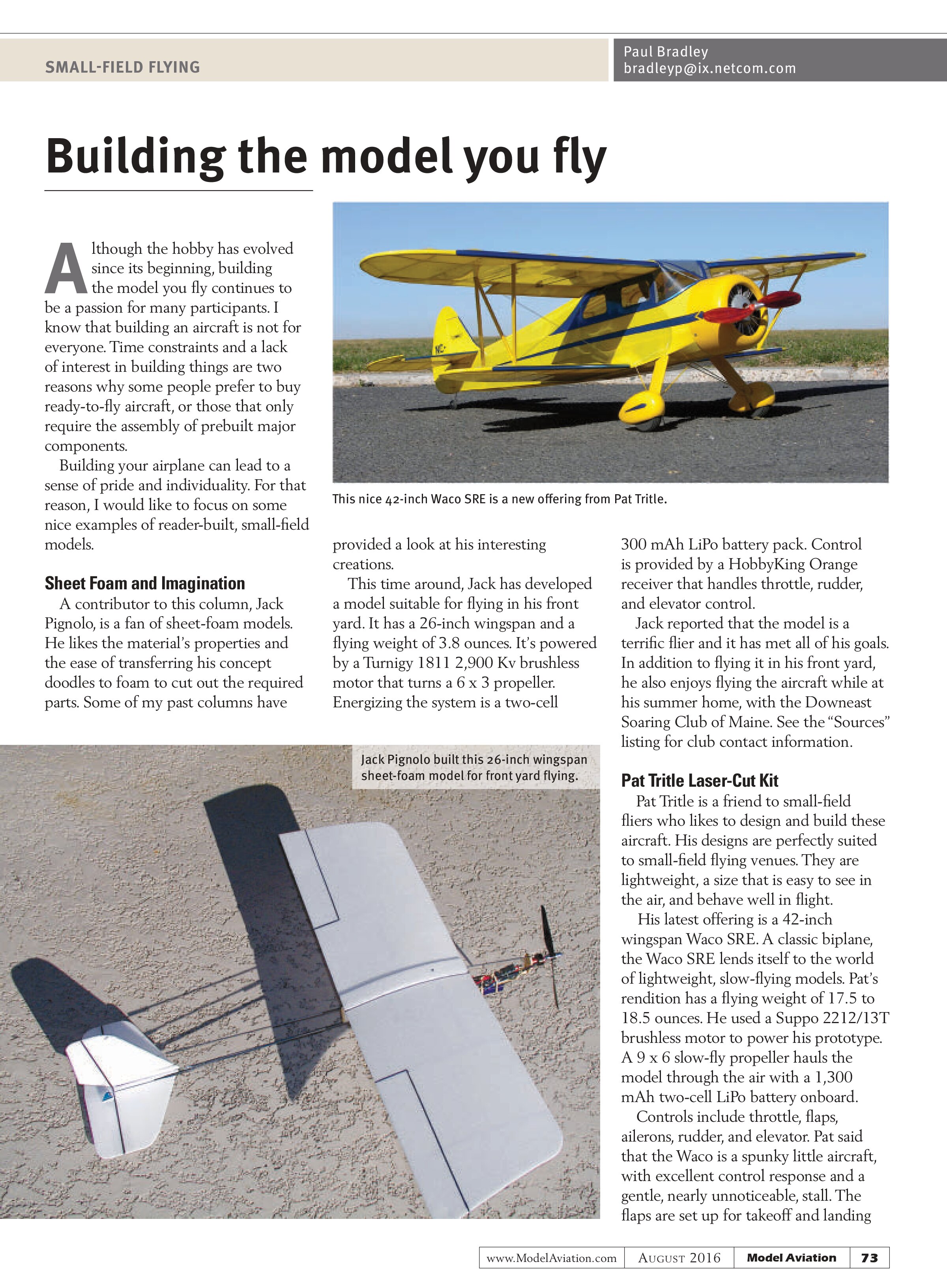
His latest offering is a 42-inch wingspan Waco SRE. A classic biplane, the Waco SRE lends itself to the world of lightweight, slow-flying models. Pat’s rendition has a flying weight of 17.5 to 18.5 ounces. He used a Suppo 2212/13T brushless motor to power his prototype. A 9 x 6 slow-fly propeller hauls the model through the air with a 1,300 mAh two-cell LiPo battery onboard.
Controls include throttle, flaps, ailerons, rudder, and elevator. Pat said that the Waco is a spunky little aircraft, with excellent control response and a gentle, nearly unnoticeable, stall. The flaps are set up for takeoff and landing
This nice 42-inch Waco SRE is a new offering from Pat Tritle.


using a three-position switch so that there are no surprises when it is deployed. Overall, it’s a good, stable flier, and has all of the class and elegance of its full-scale counterpart when it’s in the air.
Nice work as usual, Pat. Short kits are available from Manzano Laser Works (see the “Sources” listing).
Original Designs Using RTF Parts
One of the nice things about current RTF models is that they provide great parts for original-design models. I received a nice note from Pete Steinmeyer that included an excellent example of such an aircraft.
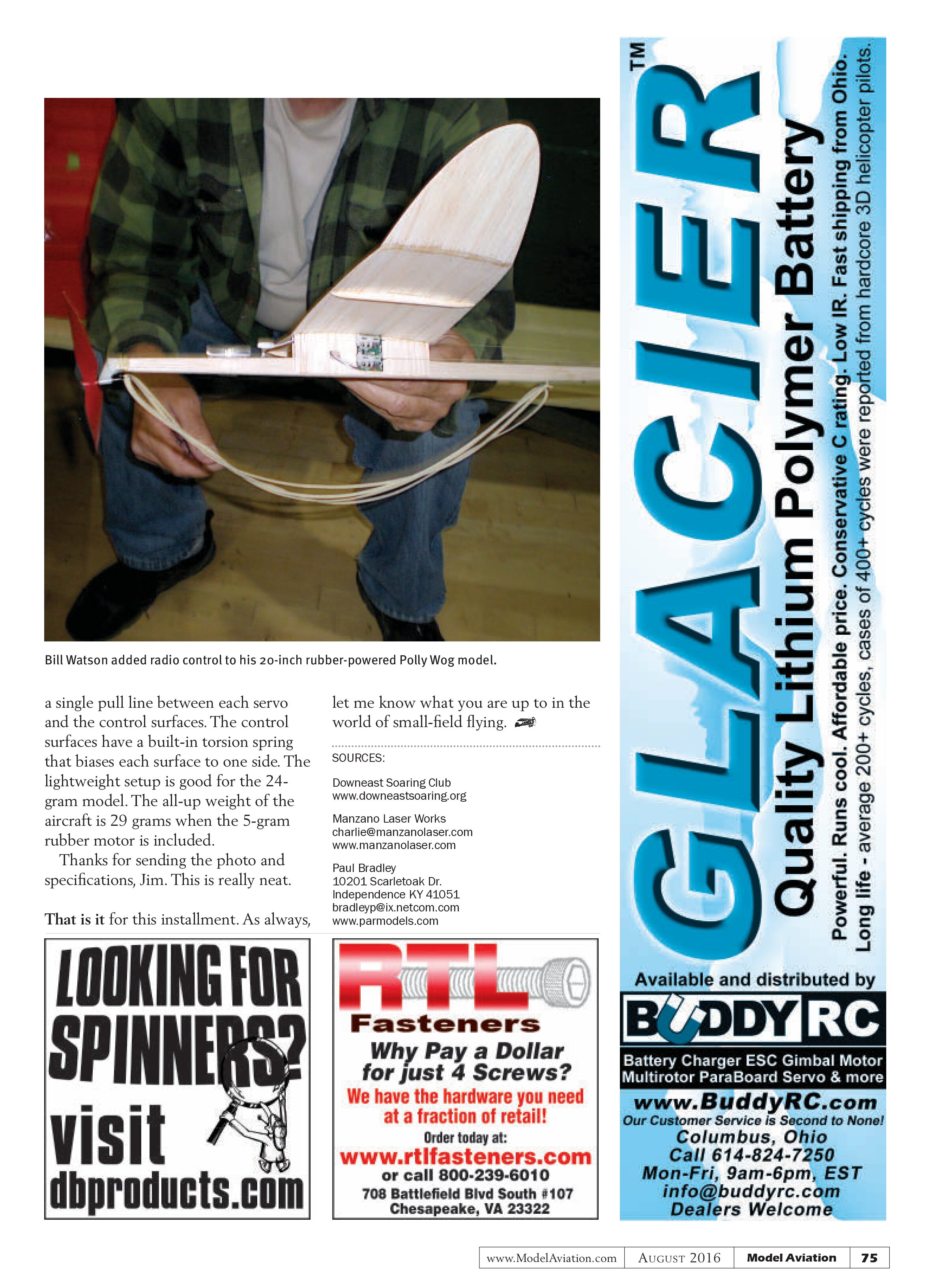
Pete’s 30-inch airplane uses a motor/gearbox from a ParkZone Ultra Micro P-51 RTF model. He uses a Spektrum AR6400 receiver brick to handle the rudder, elevator, and throttle control functions. Construction is balsa covered with Doculam laminating film. The fuselage was made by rolling 1/32-inch balsa around a pool stick. The pool stick was removed after the rolled-balsa fuselage glue had set.
Pete said that the model has proven to be a relaxed flier. Its Free Flight (FF)-inspired lines help in that department. Great work, Pete. The aircraft looks like a perfect small-field flier.
A Different Drummer
In the February issue of Model Aviation, I had the opportunity to share with you some nice vintage-design models by Jim Lueken. Jim is the proprietor of Plans and Things and has a modeling friend named Bill Watson.
Bill is a skilled model builder who also likes to depart from the path of the tried and true. Jim sent me a photo of one of Bill’s aircraft. It is a rubber-powered FF design called the Polly Wog. There are several features that make this 20-inch wingspan model unique.
First, it carries a radio that provides rudder and elevator control. I know rubber-powered RC models have been built by others, but I am not aware of any of this size.
The second unique feature of Bill’s model is the control setup. He uses

Thanks for sending the photo and specifications, Jim. This is really neat.
That is it for this installment. As always, let me know what you are up to in the world of small-field flying.
SOURCES:
Downeast Soaring Club
www.downeastsoaring.org
Manzano Laser Works
charlie@manzanolaser.com
www.manzanolaser.com
Paul Bradley
10201 Scarlatoak Dr.
Independence KY 41051
bradley@ix.netcom.com
www.parmodels.com