Negative perception is not reality
Dave Gee
safetycolumn@cs.com
Have you ever witnessed a newsworthy event in person, and then later been shocked by erroneous news reports? “Hey, I was there, and that’s not how it was!” You can’t blame people for believing an inaccurate news story because they have no way to tell the difference.
It happened in my city recently with a minor “drone incident.” The reporter was not an aviation expert, and I thought that the published piece was far off the mark. It was sad to see our sport unfairly cast in a bad light because one person allegedly broke the law.
Perception is reality, but a negative perception of aeromodeling is not reality. The truth is that we participate in a safe and beneficial hobby that is suitable for all ages, and has enough variety for a lifetime of delight. Think about how many hundreds of thousands of successful flights are made each year by AMA members, with models
AMA leadership is working to educate lawmakers and the public about model aircraft. We need to do our part by contacting our senators. I think that aer modelers should act as public relations representatives.
We can support the hobby just by “putting one up.” Conducting safe flight operations is a great way to show how much fun our models are. Upload a video to the internet of you and your friends at the field that shows how seriously we take our flight-preparation routine, and what a big payoff there is when a model takes to the sky. Let’s make public

ranging from Giant Scale to sailplanes to the latest tiny RC indoor aircraft. Even multirotors …
The danger we face is not from our aircraft. We know how to operate them safely. The hazard is that, because of incorrect public perceptions, we can lose flying sites and be unfairly restricted by poorly written laws and regulations.

perception reflect our hobby’s true reality.
Preflight Procedures
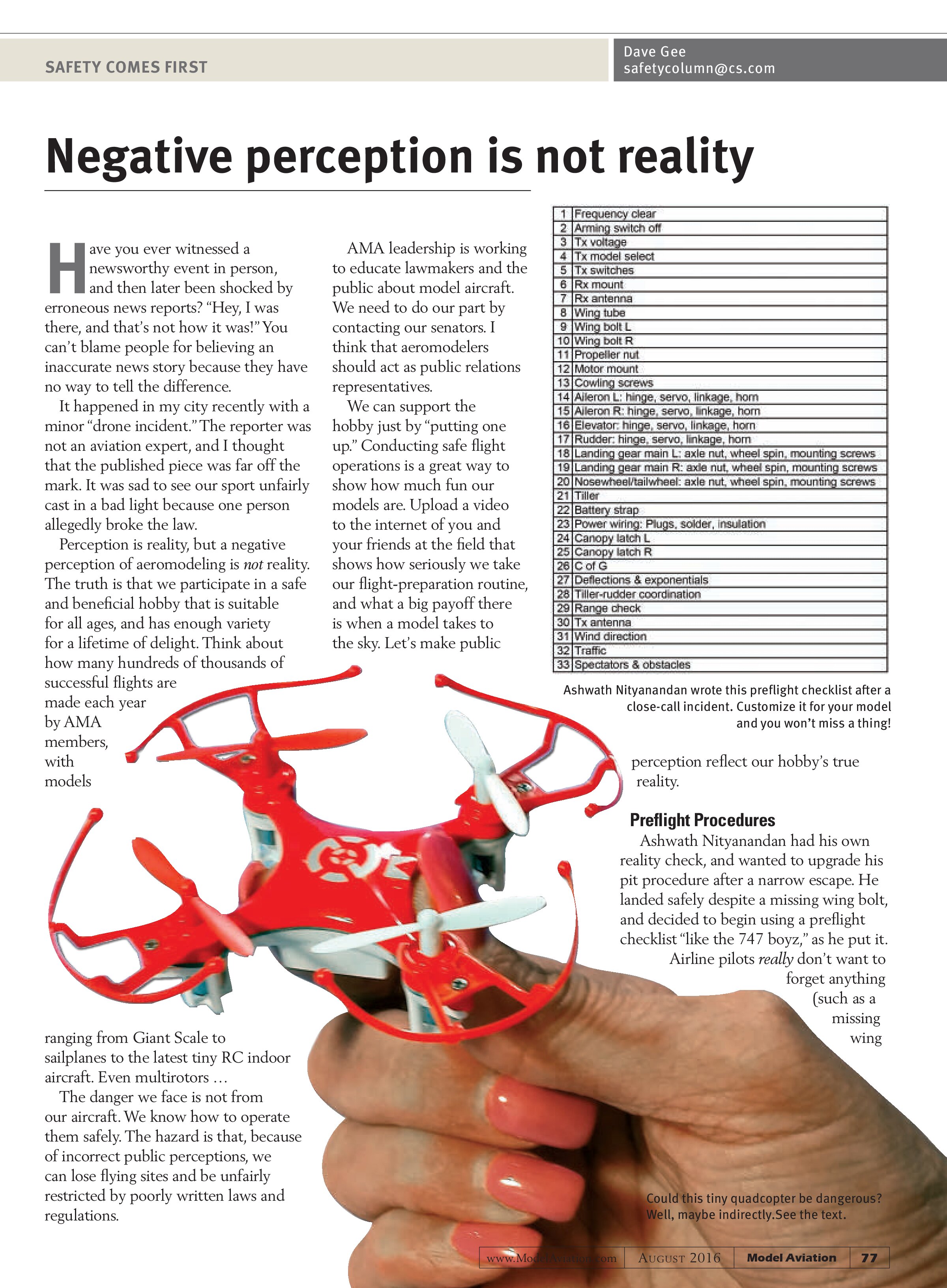
Ashwath Nityanandan had his own reality check, and wanted to upgrade his pit procedure after a narrow escape. He landed safely despite a missing wing bolt, and decided to begin using a preflight checklist “like the 747 boyz,” as he put it. Airline pilots really don’t want to forget anything (such as a missing wing

bolt), and checklists are how it’s done in full-scale aviation. Some of us have witnessed safety incidents or crashes that could have been prevented by a proper preflight inspection.
Ashwath’s list is customized for his situation, so don’t hesitate to tweak it to suit your aircraft and flying site. A preflight inspection list for a helicopter will have different items on it than a list for a Control Line Precision Aerobatics model.
I’ve been working on a version for my rubber-powered Peanut Scale models. Cold root beer? Check. Lawn chair? Check. Ready to launch!
Peanut Scale
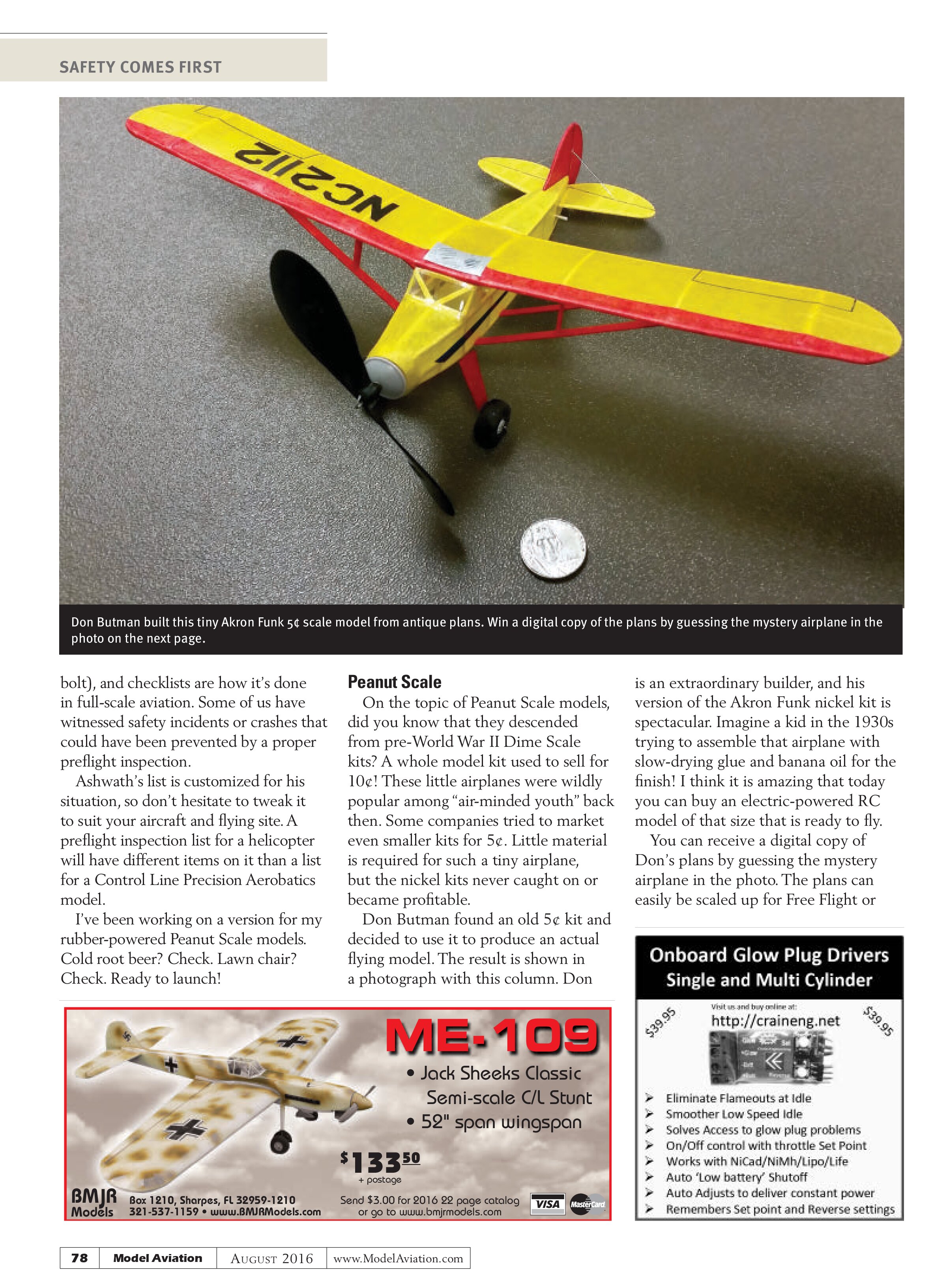
On the topic of Peanut Scale models, did you know that they descended from pre-World War II Dime Scale kits? A whole model kit used to sell for 10¢! These little airplanes were wildly popular among “air-minded youth” back then. Some companies tried to market even smaller kits for 5¢. Little material is required for such a tiny airplane, but the nickel kits never caught on or became profitable.
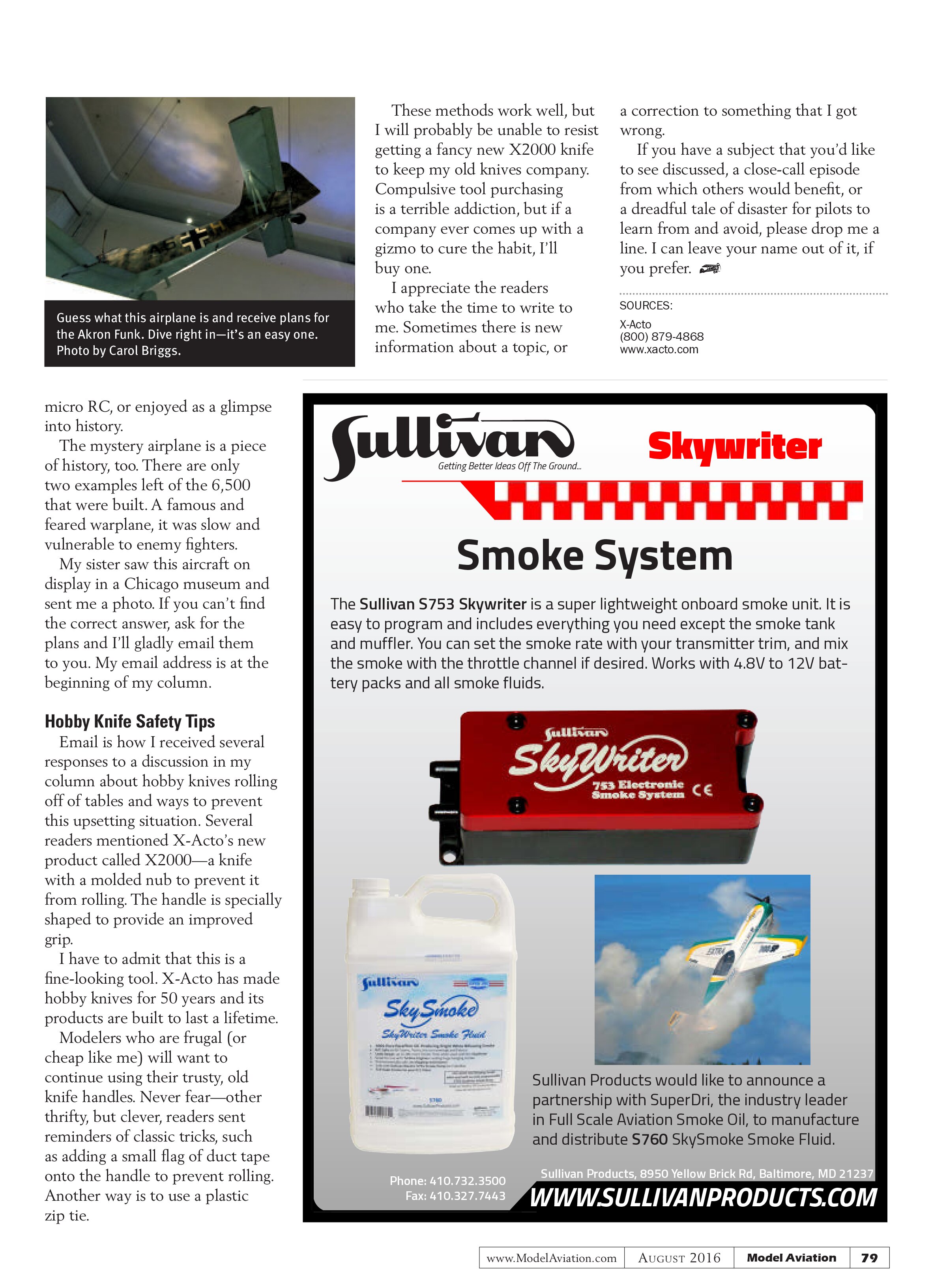
Don Butman found an old 5¢ kit and decided to use it to produce an actual flying model. The result is shown in a photograph with this column. Don is an extraordinary builder, and his version of the Akron Funk nickel kit is spectacular. Imagine a kid in the 1930s trying to assemble that airplane with slow-drying glue and banana oil for the finish! I think it is amazing that today you can buy an electric-powered RC model of that size that is ready to fly. You can receive a digital copy of Don’s plans by guessing the mystery airplane in the photo. The plans can easily be scaled up for Free Flight or

micro RC, or enjoyed as a glimpse into history.
The mystery airplane is a piece of history, too. There are only two examples left of the 6,500 that were built. A famous and feared warplane, it was slow and vulnerable to enemy fighters.
My sister saw this aircraft on display in a Chicago museum and sent me a photo. If you can’t find the correct answer, ask for the plans and I’ll gladly email them to you. My email address is at the beginning of my column.
Hobby Knife Safety Tips
Email is how I received several responses to a discussion in my column about hobby knives rolling off of tables and ways to prevent this upsetting situation. Several readers mentioned X-Acto’s new product called X2000—a knife with a molded nub to prevent it from rolling. The handle is specially shaped to provide an improved grip.
I have to admit that this is a fine-looking tool. X-Acto has made hobby knives for 50 years and its products are built to last a lifetime.
Modelers who are frugal (or cheap like me) will want to continue using their trusty, old knife handles. Never fear—other thrifty, but clever, readers sent reminders of classic tricks, such as adding a small flag of duct tape onto the handle to prevent rolling. Another way is to use a plastic zip tie.
These methods work well, but I will probably be unable to resist getting a fancy new X2000 knife to keep my old knives company. Compulsive tool purchasing is a terrible addiction, but if a company ever comes up with a gizmo to cure the habit, I’ll buy one.
I appreciate the readers who take the time to write to me. Sometimes there is new information about a topic, or a correction to something that I got wrong.
If you have a subject that you’d like to see discussed, a close-call episode from which others would benefit, or a dreadful tale of disaster for pilots to learn from and avoid, please drop me a line. I can leave your name out of it, if you prefer.
SOURCES:
X-Acto
(800) 879-4868
www.xacto.com