What makes a great Slope sailplane?
by Dave Garwood
dave.garwood.518@gmail.com
I asked sailplane designers what makes a great Slope sailplane, and what they strive for in their design work. I also asked which sailplanes they’ve flown that meet their criteria. Here are their replies:
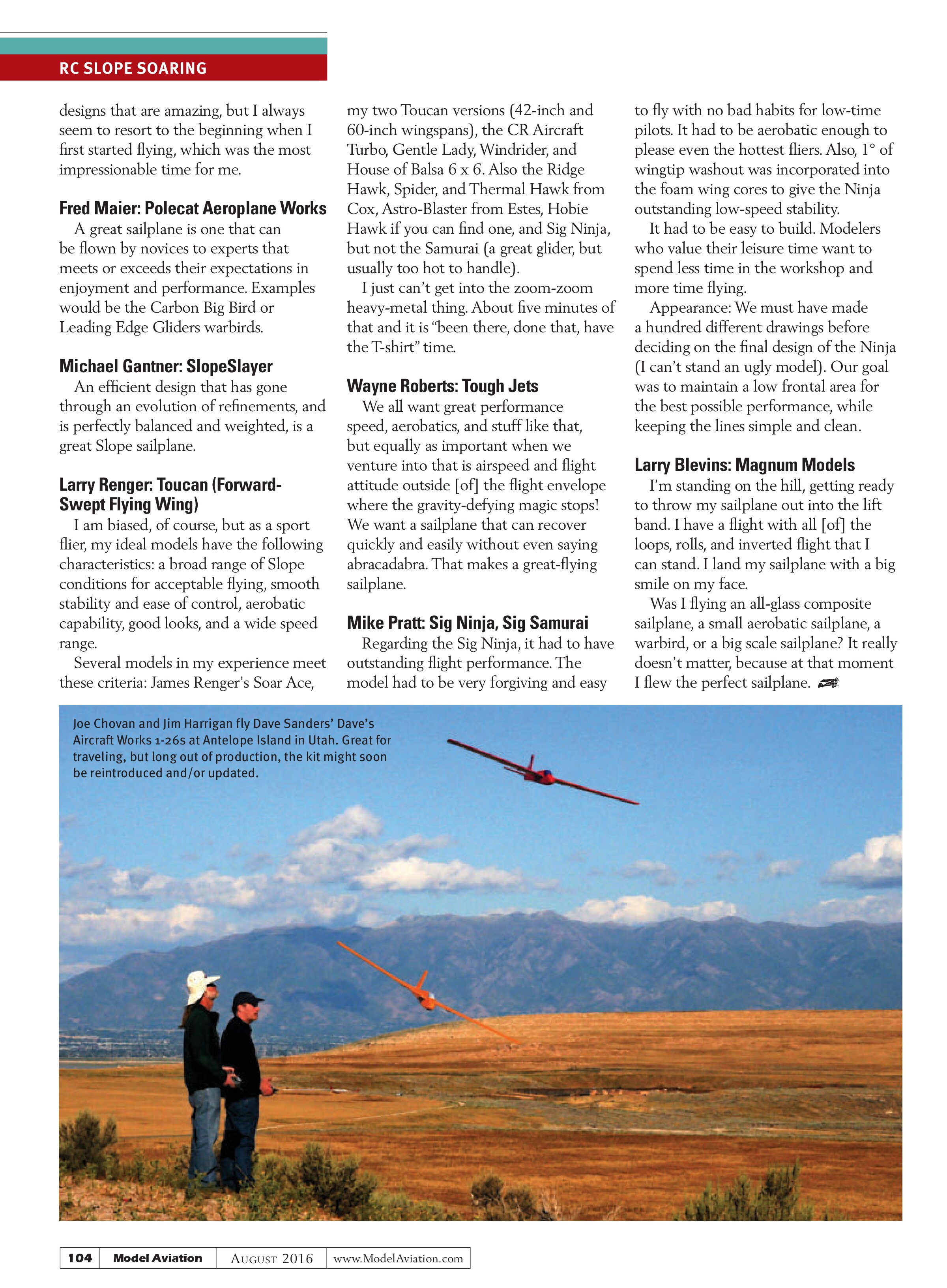
Dave Sanders: Dave’s Aircraft Works: Schweizer 1-26
I want aerobatic capability in light lift. I want a low wing loading. It’s easy to make the sailplane heavier, but when you’re too heavy to fly, you’re just stuck with shopworn jokes to pass the day.
I can still see the name Ken Williams on the drawings for the K&A Models Mini-1, in that old-school Leroy Lettering. Good times! If you built it light and used mini gears, that thing would tear it up, even in really weak lift. The roll rate was insane!
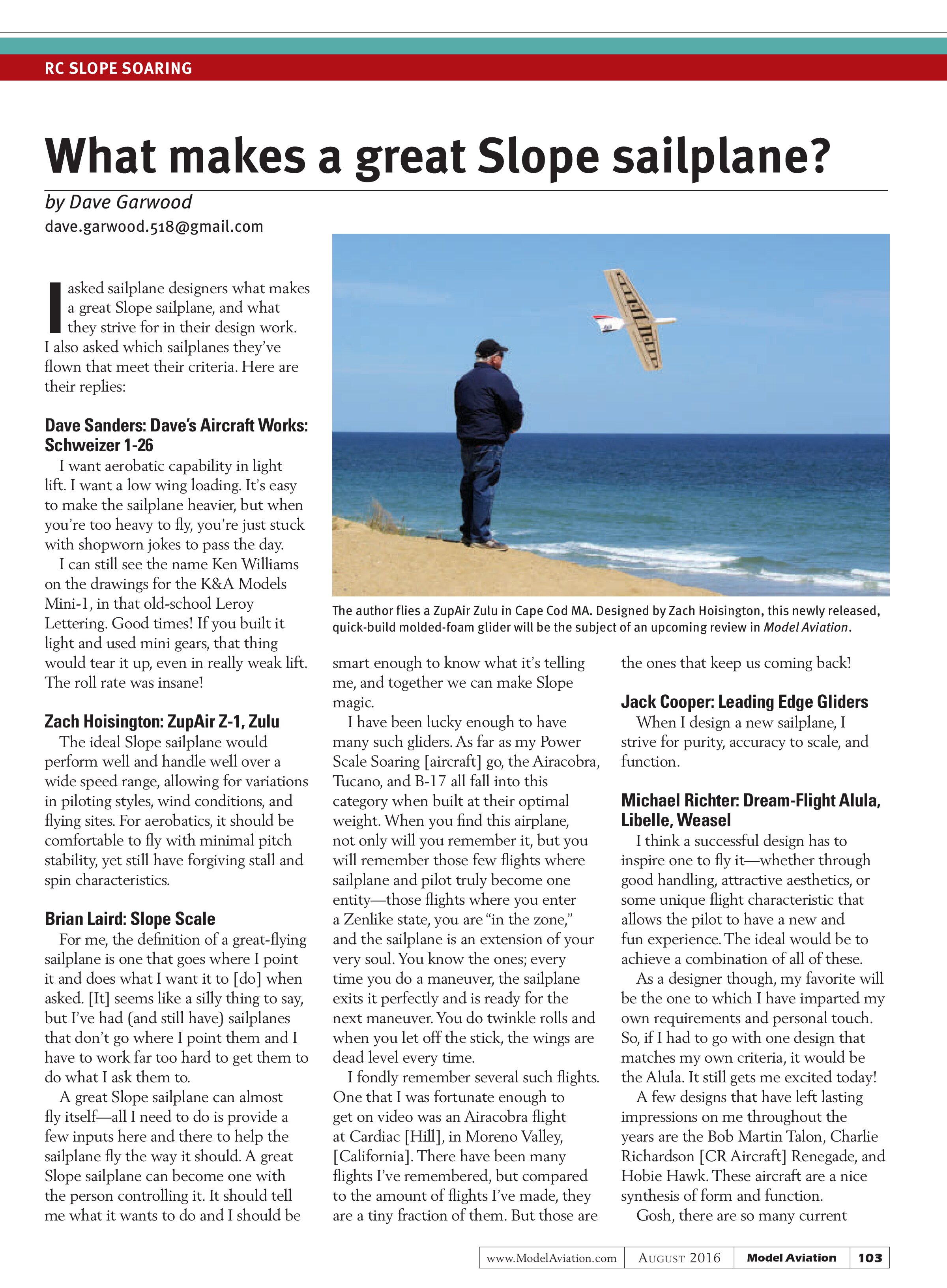
Zach Hoisington: ZupAir Z-1, Zulu
The ideal Slope sailplane would perform well and handle well over a wide speed range, allowing for variations in piloting styles, wind conditions, and flying sites. For aerobatics, it should be comfortable to fly with minimal pitch stability, yet still have forgiving stall and spin characteristics.
Brian Laird: Slope Scale
For me, the definition of a great-flying sailplane is one that goes where I point it and does what I want it to [do] when asked. [It] seems like a silly thing to say, but I’ve had (and still have) sailplanes that don’t go where I point them and I have to work far too hard to get them to do what I ask them to.
A great Slope sailplane can almost fly itself—all I need to do is provide a few inputs here and there to help the sailplane fly the way it should. A great Slope sailplane can become one with the person controlling it. It should tell me what it wants to do and I should be

I have been lucky enough to have many such gliders. As far as my Power Scale Soaring [aircraft] go, the Airacobra, Tucano, and B-17 all fall into this category when built at their optimal weight. When you find this airplane, not only will you remember it, but you will remember those few flights where sailplane and pilot truly become one entity—those flights where you enter a Zenlike state, you are “in the zone,” and the sailplane is an extension of your very soul. You know the ones; every time you do a maneuver, the sailplane exits it perfectly and is ready for the next maneuver. You do twinkle rolls and when you let off the stick, the wings are dead level every time.
I fondly remember several such flights. One that I was fortunate enough to get on video was an Airacobra flight at Cardiac [Hill], in Moreno Valley, [California]. There have been many flights I’ve remembered, but compared to the amount of flights I’ve made, they are a tiny fraction of them. But those are the ones that keep us coming back!
Jack Cooper: Leading Edge Gliders
When I design a new sailplane, I strive for purity, accuracy to scale, and function.
Michael Richter: Dream-Flight Alula, Libelle, Weasel
I think a successful design has to inspire one to fly it—whether through good handling, attractive aesthetics, or some unique flight characteristic that allows the pilot to have a new and fun experience. The ideal would be to achieve a combination of all of these.
As a designer though, my favorite will be the one to which I have imparted my own requirements and personal touch. So, if I had to go with one design that matches my own criteria, it would be the Alula. It still gets me excited today!
A few designs that have left lasting impressions on me throughout the years are the Bob Martin Talon, Charlie Richardson [CR Aircraft] Renegade, and Hobie Hawk. These aircraft are a nice synthesis of form and function.
Gosh, there are so many current
designs that are amazing, but I always seem to resort to the beginning when I first started flying, which was the most impressionable time for me.
Fred Maier: Polecat Aeroplane Works
A great sailplane is one that can be flown by novices to experts that meets or exceeds their expectations in enjoyment and performance. Examples would be the Carbon Big Bird or Leading Edge Gliders warbirds.
Michael Gantner: SlopeSlayer
An efficient design that has gone through an evolution of refinements, and is perfectly balanced and weighted, is a great Slope sailplane.
Larry Renger: Toucan (Forward-Swept Flying Wing)
I am biased, of course, but as a sport flier, my ideal models have the following characteristics: a broad range of Slope conditions for acceptable flying, smooth stability and ease of control, aerobatic capability, good looks, and a wide speed range.
Several models in my experience meet these criteria: James Renger’s Soar Ace,
my two Toucan versions (42-inch and 60-inch wingspans), the CR Aircraft Turbo, Gentle Lady, Windrider, and House of Balsa 6 x 6. Also the Ridge Hawk, Spider, and Thermal Hawk from Cox, Astro-Blaster from Estes, Hobie Hawk if you can find one, and Sig Ninja, but not the Samurai (a great glider, but usually too hot to handle).
I just can’t get into the zoom-zoom heavy-metal thing. About five minutes of that and it is “been there, done that, have the T-shirt” time.
Wayne Roberts: Tough Jets
We all want great performance speed, aerobatics, and stuff like that, but equally as important when we venture into that is airspeed and flight attitude outside [of] the flight envelope where the gravity-defying magic stops! We want a sailplane that can recover quickly and easily without even saying abracadabra. That makes a great-flying sailplane.
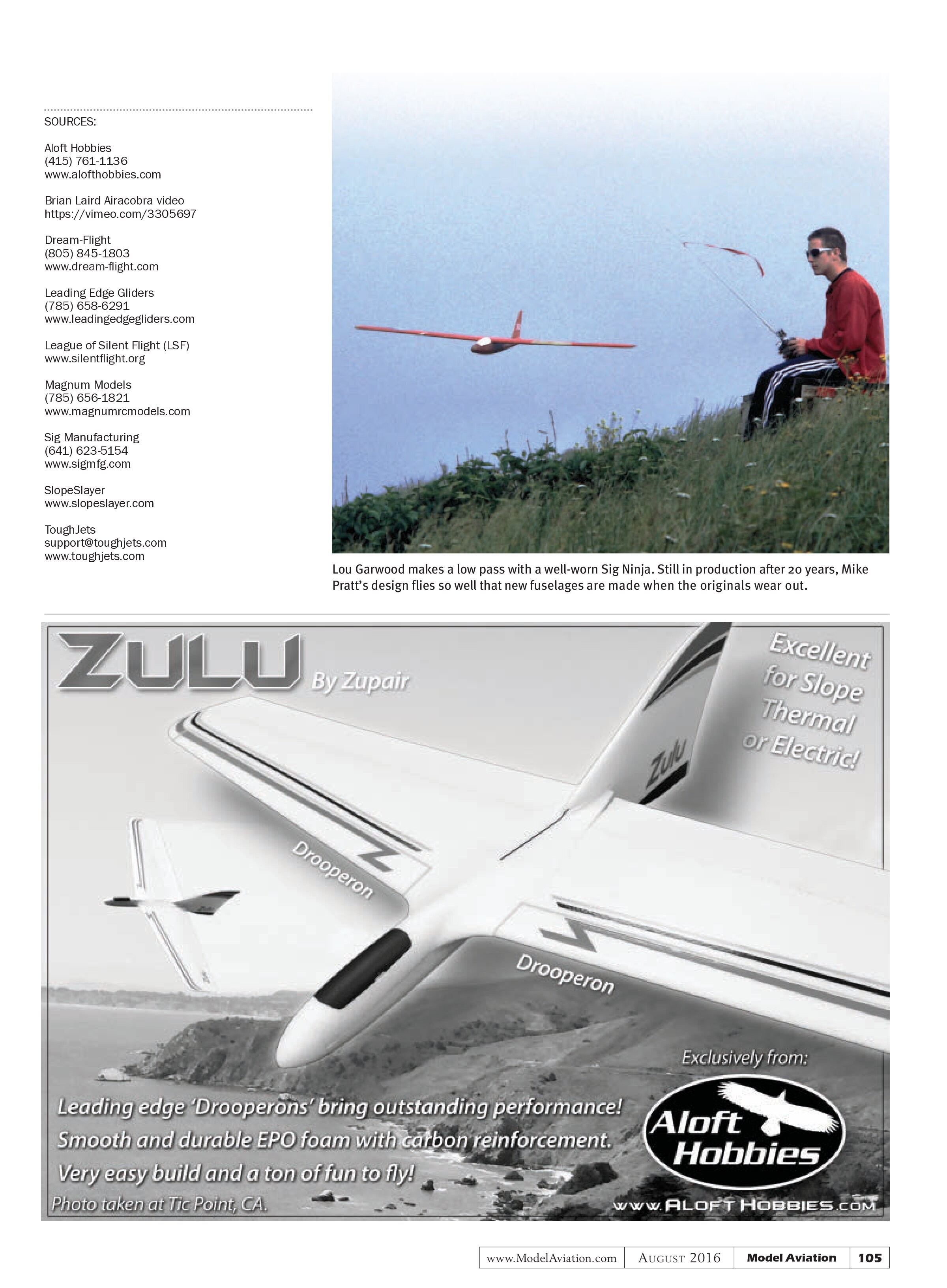
Mike Pratt: Sig Ninja, Sig Samurai
Regarding the Sig Ninja, it had to have outstanding flight performance. The model had to be very forgiving and easy to fly with no bad habits for low-time pilots. It had to be aerobatic enough to please even the hottest fliers. Also, 1° of wingtip washout was incorporated into the foam wing cores to give the Ninja outstanding low-speed stability.
It had to be easy to build. Modelers who value their leisure time want to spend less time in the workshop and more time flying.
Appearance: We must have made a hundred different drawings before deciding on the final design of the Ninja (I can’t stand an ugly model). Our goal was to maintain a low frontal area for the best possible performance, while keeping the lines simple and clean.
Larry Blevins: Magnum Models
I’m standing on the hill, getting ready to throw my sailplane out into the lift band. I have a flight with all [of] the loops, rolls, and inverted flight that I can stand. I land my sailplane with a big smile on my face.
Was I flying an all-glass composite sailplane, a small aerobatic sailplane, a warbird, or a big scale sailplane? It really doesn’t matter, because at that moment I flew the perfect sailplane.


SOURCES:
Aloft Hobbies
(415) 761-1136
www.aloftHobbies.com
Brian Laird Airacobra video
https://vimeo.com/3305697
Dream-Flight
(805) 845-1803
www.dream-flight.com
Leading Edge Gliders
(785) 658-6291
www.leadingedgegliders.com
League of Silent Flight (LSF)
www.silentflight.org
Magnum Models
(785) 656-1821
www.magnumrcmodels.com
Sig Manufacturing
(641) 623-5154
www.sig mfg.com
SlopeSlayer
www.slopeslayer.com