Master the Half Cuban 8
by John Glezellis
jglezellis@gmail.com
Similar to full-scale aerobatics contests, International Miniature Aerobatic Club (IMAC) competition contains different classes that progressively become more difficult to execute. The core maneuvers that appear from one class to another are typically quite common, but with different elements added to each figure to alter their complexity.
As you begin to study each routine, you must obtain skills to become competent in reading the Aresti symbols that are found in each program. Interestingly, many new and experienced pilots request a narrative for a given sequence because they are unable to read the Aresti symbols!
It is highly recommended that pilots of all levels attend a judging seminar and visit the official IMAC website (listed in “Sources”) to access information and to view regulations for RC Scale Aerobatics competition. After all, knowledge is of the essence! Points can easily be given away during a competition if a figure is performed with incorrect components.
Because some confusion exists about how to interpret Aresti symbols, this month’s topic of discussion revolves around the seventh maneuver in the 2016 Official Unlimited Known program: the Half Cuban 8.
This figure contains many elements that should help RC Scale Aerobatics newcomers become familiar with the language of aerobatics and how to interpret a routine. Without further delay, let’s begin!
Understanding Subtle Differences
Aerobatic sequences are developed to incorporate proper pace and balance while utilizing the aerobatic airspace. A competitor must understand that all figures within a routine begin and end on definite horizontal lines. If a line segment is not shown, a downgrade of one point per missing line will be applied to the score for the maneuver.
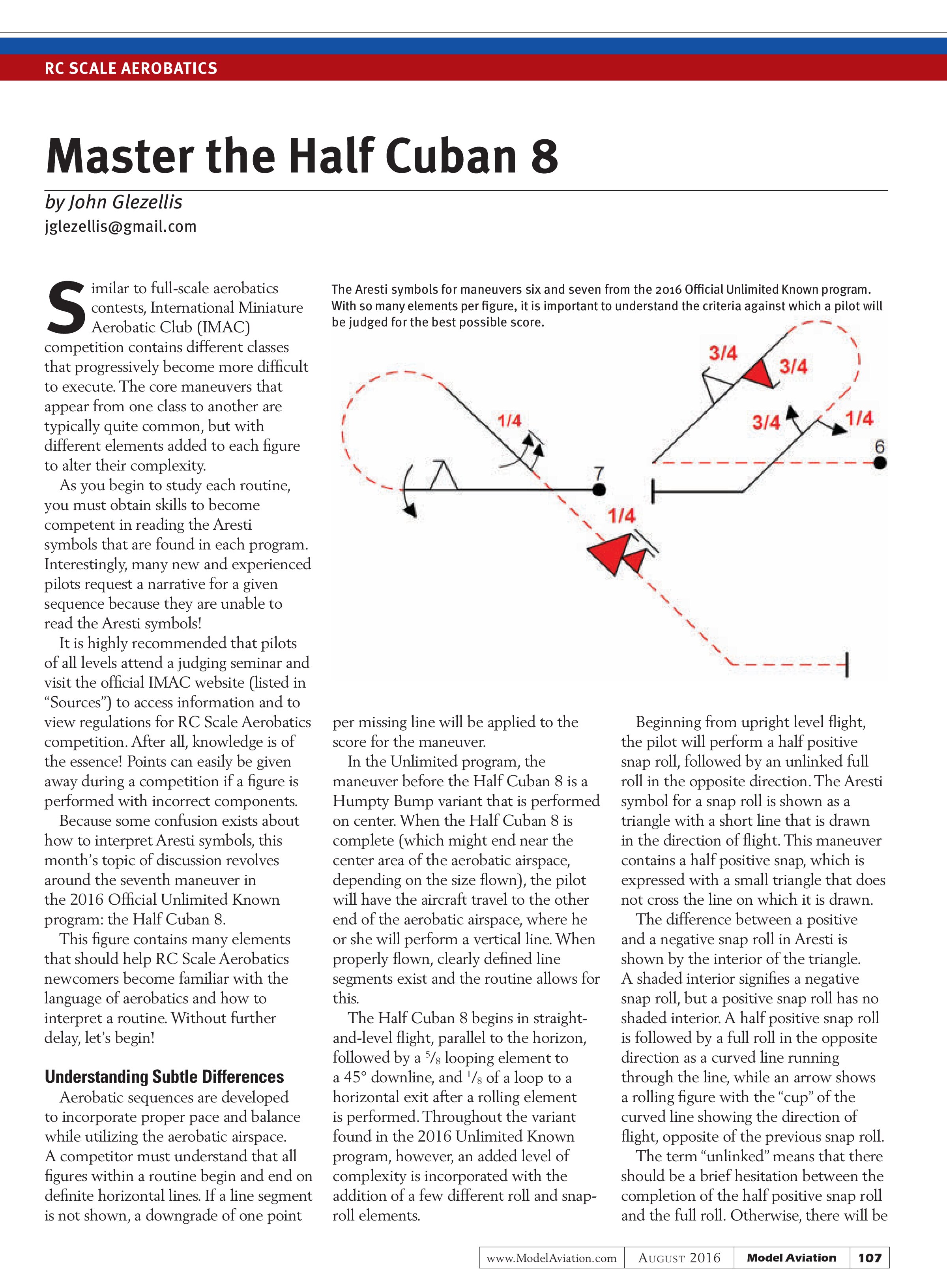
The Aresti symbols for maneuvers six and seven from the 2016 Official Unlimited Known program. With so many elements per figure, it is important to understand the criteria against which a pilot will be judged for the best possible score.

In the Unlimited program, the maneuver before the Half Cuban 8 is a Humpty Bump variant that is performed on center. When the Half Cuban 8 is complete (which might end near the center area of the aerobatic airspace, depending on the size flown), the pilot will have the aircraft travel to the other end of the aerobatic airspace, where he or she will perform a vertical line. When properly flown, clearly defined line segments exist and the routine allows for this.
The Half Cuban 8 begins in straight-and-level flight, parallel to the horizon, followed by a 5/8 looping element to a 45° downline, and 1/8 of a loop to a horizontal exit after a rolling element is performed. Throughout the variant found in the 2016 Unlimited Known program, however, an added level of complexity is incorporated with the addition of a few different roll and snap-roll elements.
Beginning from upright level flight, the pilot will perform a half positive snap roll, followed by an unlinked full roll in the opposite direction. The Aresti symbol for a snap roll is shown as a triangle with a short line that is drawn in the direction of flight. This maneuver contains a half positive snap, which is expressed with a small triangle that does not cross the line on which it is drawn.
The difference between a positive and a negative snap roll in Aresti is shown by the interior of the triangle. A shaded interior signifies a negative snap roll, but a positive snap roll has no shaded interior. A half positive snap roll is followed by a full roll in the opposite direction as a curved line running through the line, while an arrow shows a rolling figure with the “cup” of the curved line showing the direction of flight, opposite of the previous snap roll.
The term “unlinked” means that there should be a brief hesitation between the completion of the half positive snap roll and the full roll. Otherwise, there will be
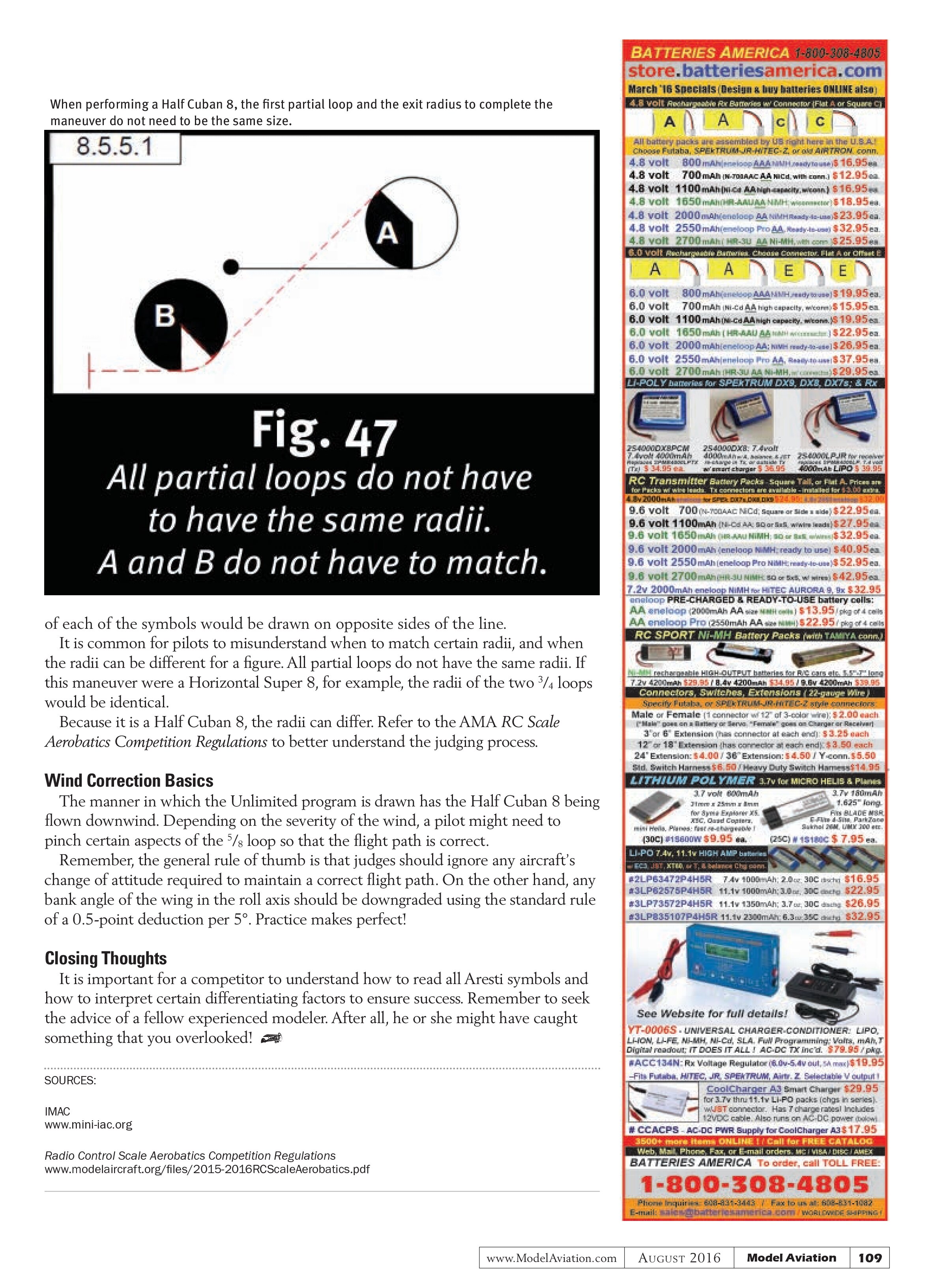
of each of the symbols would be drawn on opposite sides of the line. It is common for pilots to misunderstand when to match certain radii, and when the radii can be different for a figure. All partial loops do not have the same radii. If this maneuver were a Horizontal Super 8, for example, the radii of the two ¾ loops would be identical.
Because it is a Half Cuban 8, the radii can differ. Refer to the AMA RC Scale Aerobatics Competition Regulations to better understand the judging process.
When performing a Half Cuban 8, the first partial loop and the exit radius to complete the maneuver do not need to be the same size.

Wind Correction Basics
The manner in which the Unlimited program is drawn has the Half Cuban 8 being flown downwind. Depending on the severity of the wind, a pilot might need to pinch certain aspects of the ⅝ loop so that the flight path is correct.
Remember, the general rule of thumb is that judges should ignore any aircraft’s change of attitude required to maintain a correct flight path. On the other hand, any bank angle of the wing in the roll axis should be downgraded using the standard rule of a 0.5-point deduction per 5°. Practice makes perfect!
Closing Thoughts
It is important for a competitor to understand how to read all Aresti symbols and how to interpret certain differentiating factors to ensure success. Remember to seek the advice of a fellow experienced modeler. After all, he or she might have caught something that you overlooked!
SOURCES:
IMAC
www.mini-iac.org
Radio Control Scale Aerobatics Competition Regulations
www.modelaircraft.org/files/2015-2016RCScaleAerobatics.pdf