Making a dummy radial engine
by Stan Alexander
onawing4602@att.net

When building a radial-powered model aircraft, an accurate radial engine should be added inside of the aircraft cowling.
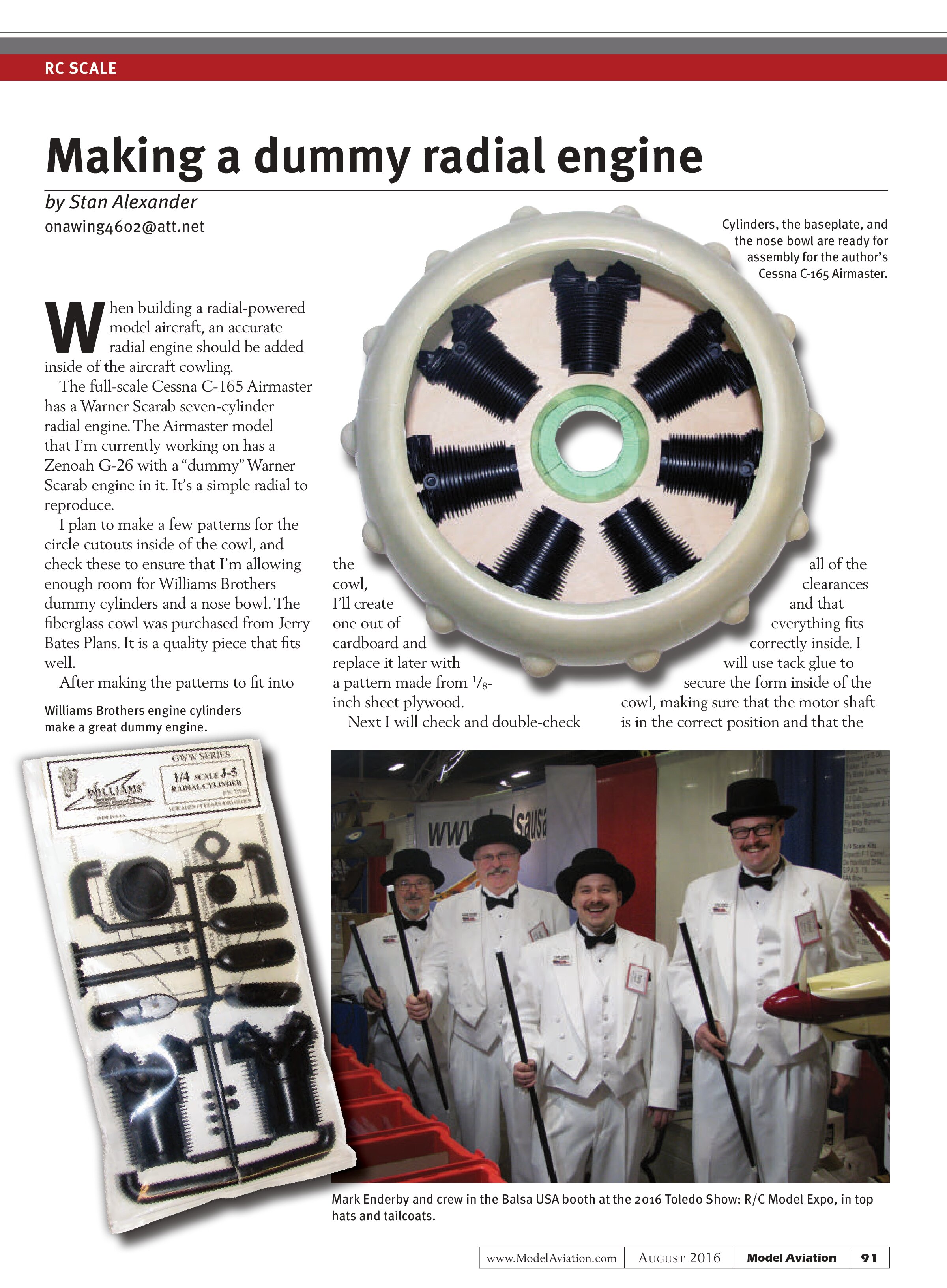
The full-scale Cessna C-165 Airmaster has a Warner Scarab seven-cylinder radial engine. The Airmaster model that I’m currently working on has a Zenoah G-26 with a “dummy” Warner Scarab engine in it. It’s a simple radial to reproduce.
I plan to make a few patterns for the circle cutouts inside of the cowl, and check these to ensure that I’m allowing enough room for Williams Brothers dummy cylinders and a nose bowl. The fiberglass cowl was purchased from Jerry Bates Plans. It is a quality piece that fits well.
After making the patterns to fit into the cowl, I’ll create one out of cardboard and replace it later with a pattern made from ⅛-inch sheet plywood.
Next I will check and double-check all of the clearances and that everything fits correctly inside. I will use tack glue to secure the form inside of the cowl, making sure that the motor shaft is in the correct position and that the
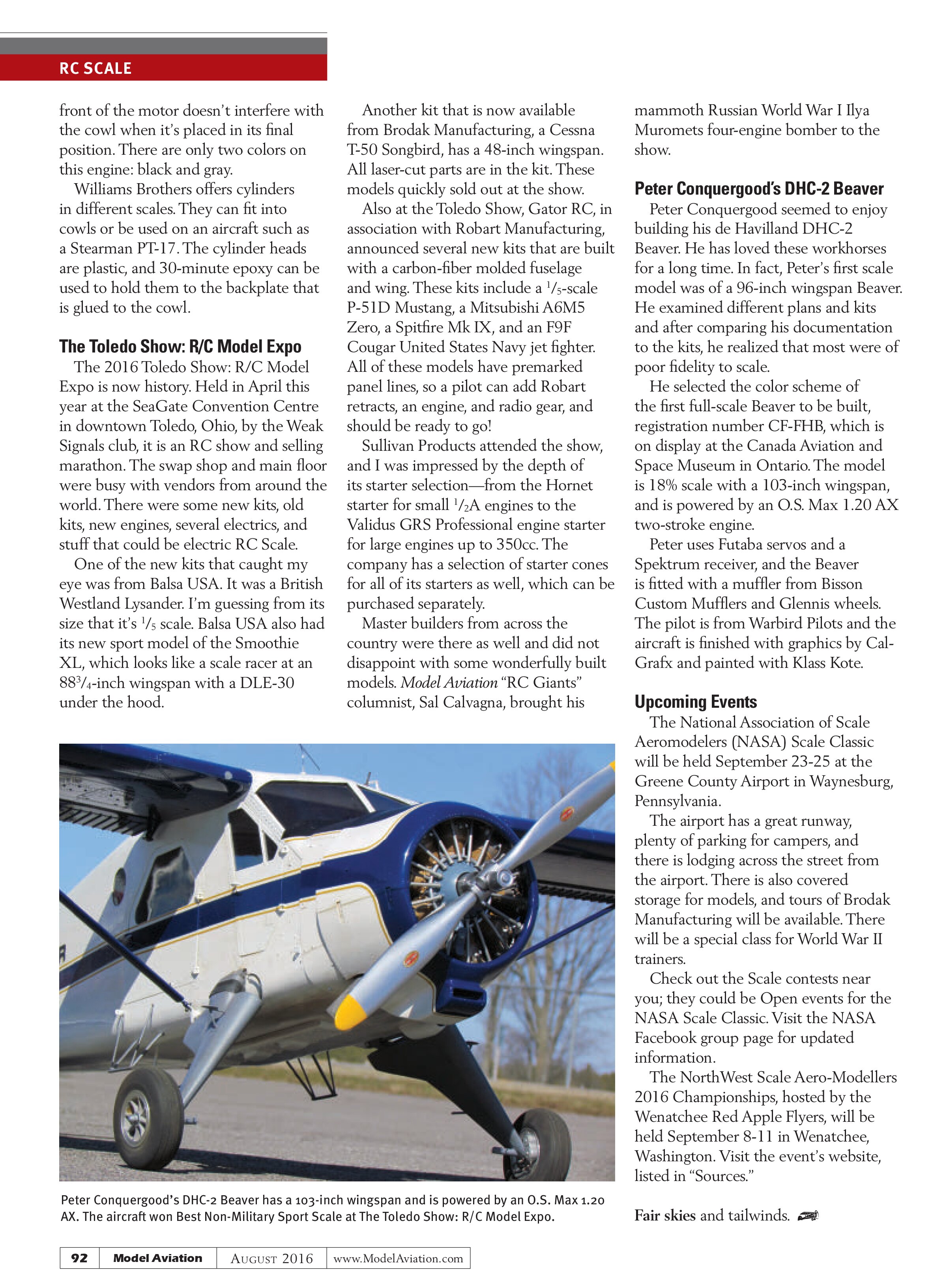
Williams Brothers engine cylinders make a great dummy engine.


front of the motor doesn’t interfere with the cowl when it’s placed in its final position. There are only two colors on this engine: black and gray.
Williams Brothers offers cylinders in different scales. They can fit into cowls or be used on an aircraft such as a Stearman PT-17. The cylinder heads are plastic, and 30-minute epoxy can be used to hold them to the backplate that is glued to the cowl.
The Toledo Show: R/C Model Expo
The 2016 Toledo Show: R/C Model Expo is now history. Held in April this year at the SeaGate Convention Centre in downtown Toledo, Ohio, by the Weak Signals club, it is an RC show and selling marathon. The swap shop and main floor were busy with vendors from around the world. There were some new kits, old kits, new engines, several electrics, and stuff that could be electric RC Scale.
One of the new kits that caught my eye was from Balsa USA. It was a British Westland Lysander. I’m guessing from its size that it’s 1/5 scale. Balsa USA also had its new sport model of the Smoothie XL, which looks like a scale racer at an 88¾-inch wingspan with a DLE-30 under the hood.
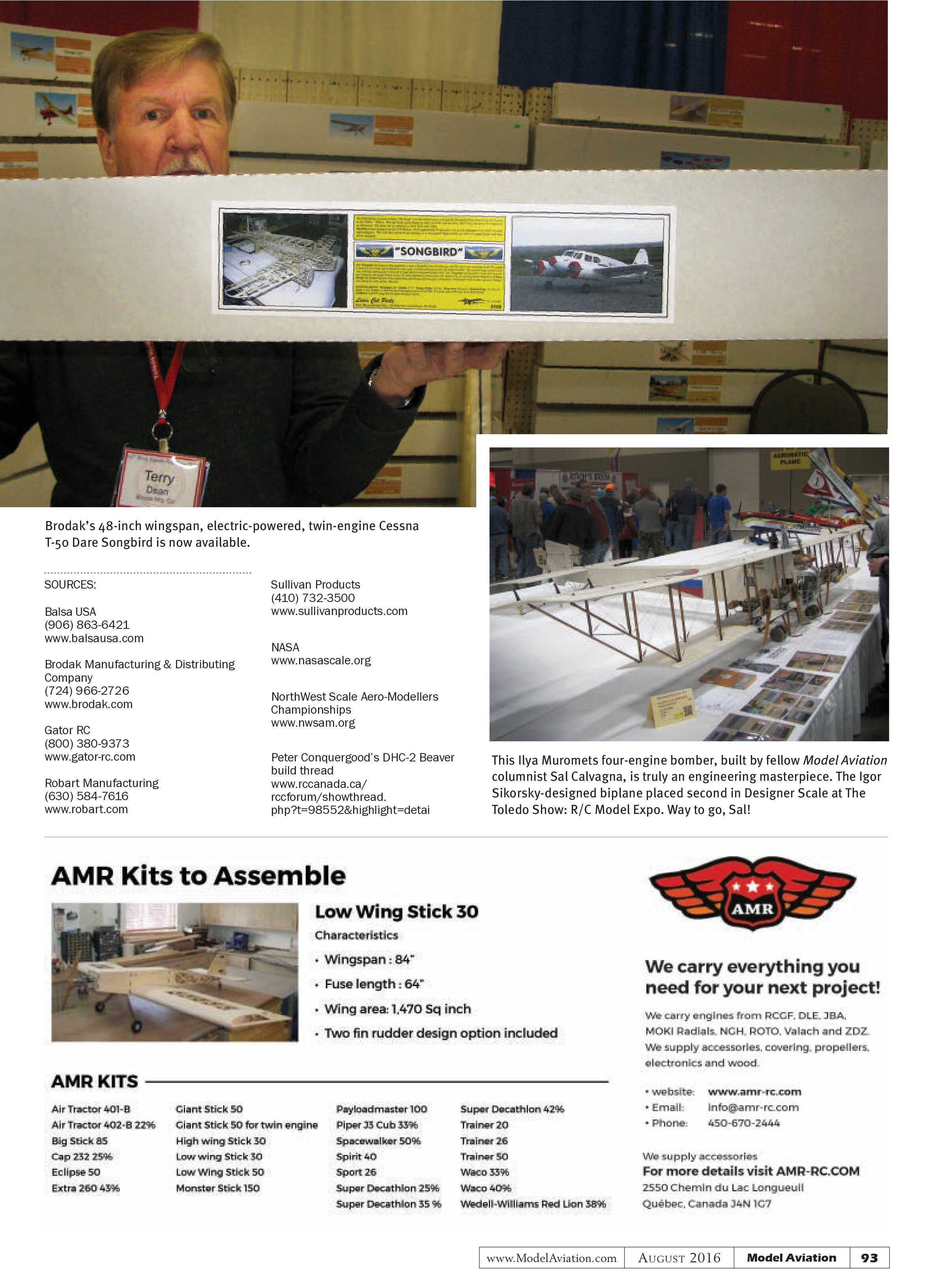
Another kit that is now available from Brodak Manufacturing, a Cessna T-50 Songbird, has a 48-inch wingspan. All laser-cut parts are in the kit. These models quickly sold out at the show.
Also at the Toledo Show, Gator RC, in association with Robart Manufacturing, announced several new kits that are built with a carbon-fiber molded fuselage and wing. These kits include a 1/5-scale P-51D Mustang, a Mitsubishi A6M5 Zero, a Spitfire Mk IX, and an F9F Cougar United States Navy jet fighter. All of these models have premarked panel lines, so a pilot can add Robart retracts, an engine, and radio gear, and should be ready to go!
Sullivan Products attended the show, and I was impressed by the depth of its starter selection—from the Hornet starter for small 1/2A engines to the Validus GRS Professional engine starter for large engines up to 350cc. The company has a selection of starter cones for all of its starters as well, which can be purchased separately.
Master builders from across the country were there as well and did not disappoint with some wonderfully built models. Model Aviation “RC Giants” columnist, Sal Calvagna, brought his mammoth Russian World War I Ilya Muromets four-engine bomber to the show.
Peter Conquergood’s DHC-2 Beaver
Peter Conquergood seemed to enjoy building his de Havilland DHC-2 Beaver. He has loved these workhorses for a long time. In fact, Peter’s first scale model was of a 96-inch wingspan Beaver. He examined different plans and kits and after comparing his documentation to the kits, he realized that most were of poor fidelity to scale.
He selected the color scheme of the first full-scale Beaver to be built, registration number CF-FHB, which is on display at the Canada Aviation and Space Museum in Ontario. The model is 18% scale with a 103-inch wingspan, and is powered by an O.S. Max 1.20 AX two-stroke engine.
Peter uses Futaba servos and a Spektrum receiver, and the Beaver is fitted with a muffler from Bisson Custom Mufflers and Glennis wheels. The pilot is from Warbird Pilots and the aircraft is finished with graphics by Cal-Grafx and painted with Klass Kote.


Brodak’s 48-inch wingspan, electric-powered, twin-engine Cessna T-50 Dare Songbird is now available.
SOURCES:
Balsa USA
(906) 863-6421
www.balsausa.com
Brodak Manufacturing & Distributing Company
(724) 966-2726
www.brodak.com
Gator RC
(800) 380-9373
www.gator-rc.com
Robart Manufacturing
(630) 584-7616
www.robart.com
Sullivan Products
(410) 732-3500
www.sullivanproducts.com
NorthWest Scale Aero-Modellers Championships
www.nwsam.org
Peter Conquergood’s DHC-2 Beaver build thread
www.rccanada.ca/rccforum/showthread.php?t=98552&highlight=detail

This Ilya Muromets four-engine bomber, built by fellow Model Aviation columnist Sal Calvagna, is truly an engineering masterpiece. The Igor Sikorsky-designed biplane placed second in Designer Scale at The Toledo Show: R/C Model Expo. Way to go, Sal!
Fair skies and tailwinds.