3-D printing for Combat
by Don Grissom
dongrissom@hilltopflyers.com
It is hard to believe that the flying season is nearly half over. I feel as though I just got started flying Combat this year. After having such a rough winter, it feels good to be doing something again. I ended up having many of my airplanes ready to fly because there was little damage done to them last year.

Last season I didn’t have enough Scale or Gnat airplanes to fly. I was able to purchase some Scale models from a person in Florida, which got me going, but I am still having issues cutting my own airplanes.
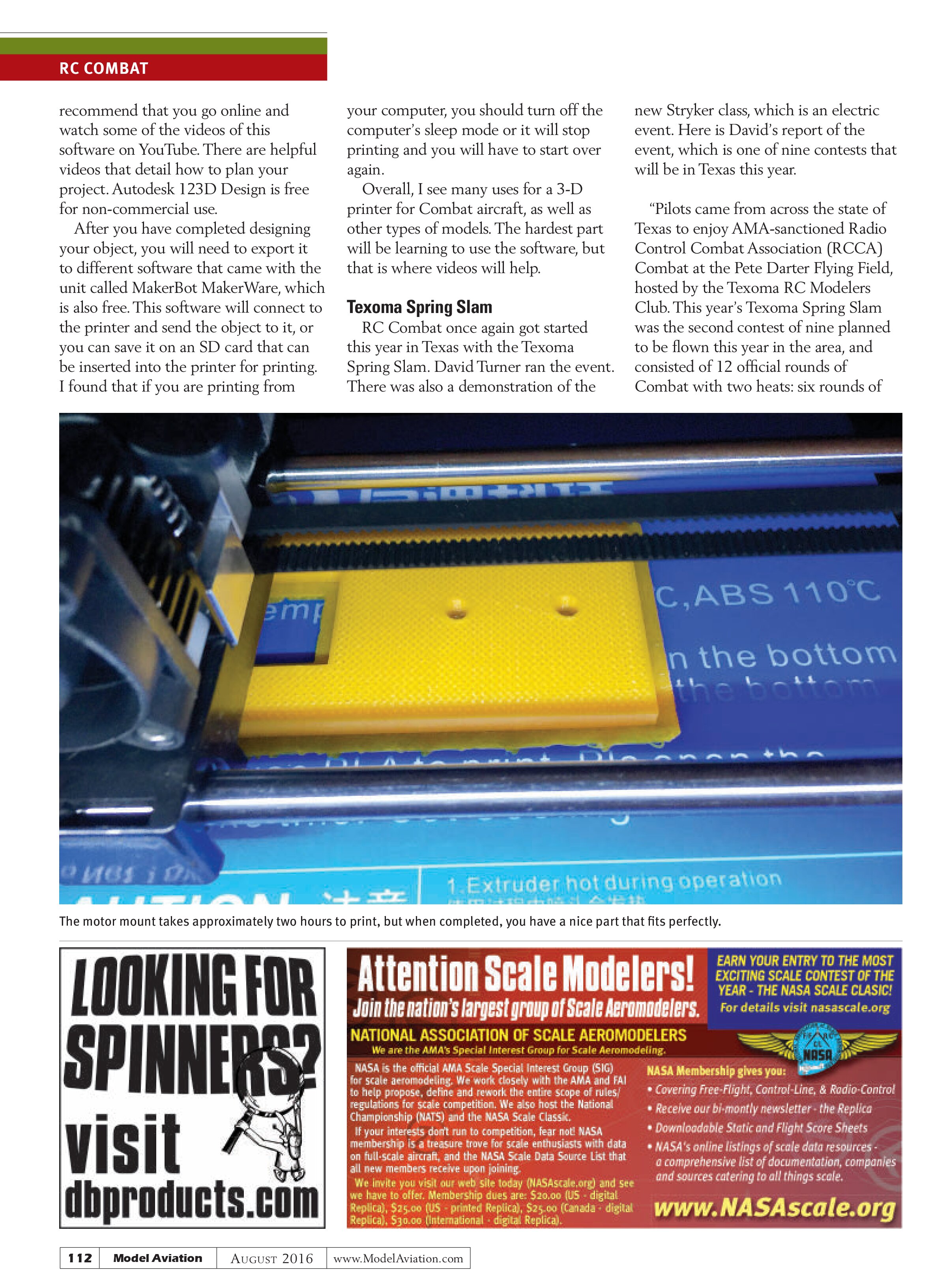
With Gnat aircraft, I decided to try a few new things. During the winter, I purchased a 3-D printer, which I have found is good for making small plastic parts for Combat airplanes. A Gnat airplane uses many plastic parts during its construction. After going to Lowe’s home-improvement store and getting sign material for the wings and an aluminum U-channel for the fuselage, I was ready to start making the plastic parts that I needed.
I am using a Qidi Technology Duel Extruder 3D Printer that I bought on Amazon. It had good reviews and came completely assembled. There are many models, but having the ability to print using both PLA and ABS plastic was going to be nice. The material for the unit runs approximately $20 to $25 per roll, but I have found that a roll will last for a while after you have figured things out.
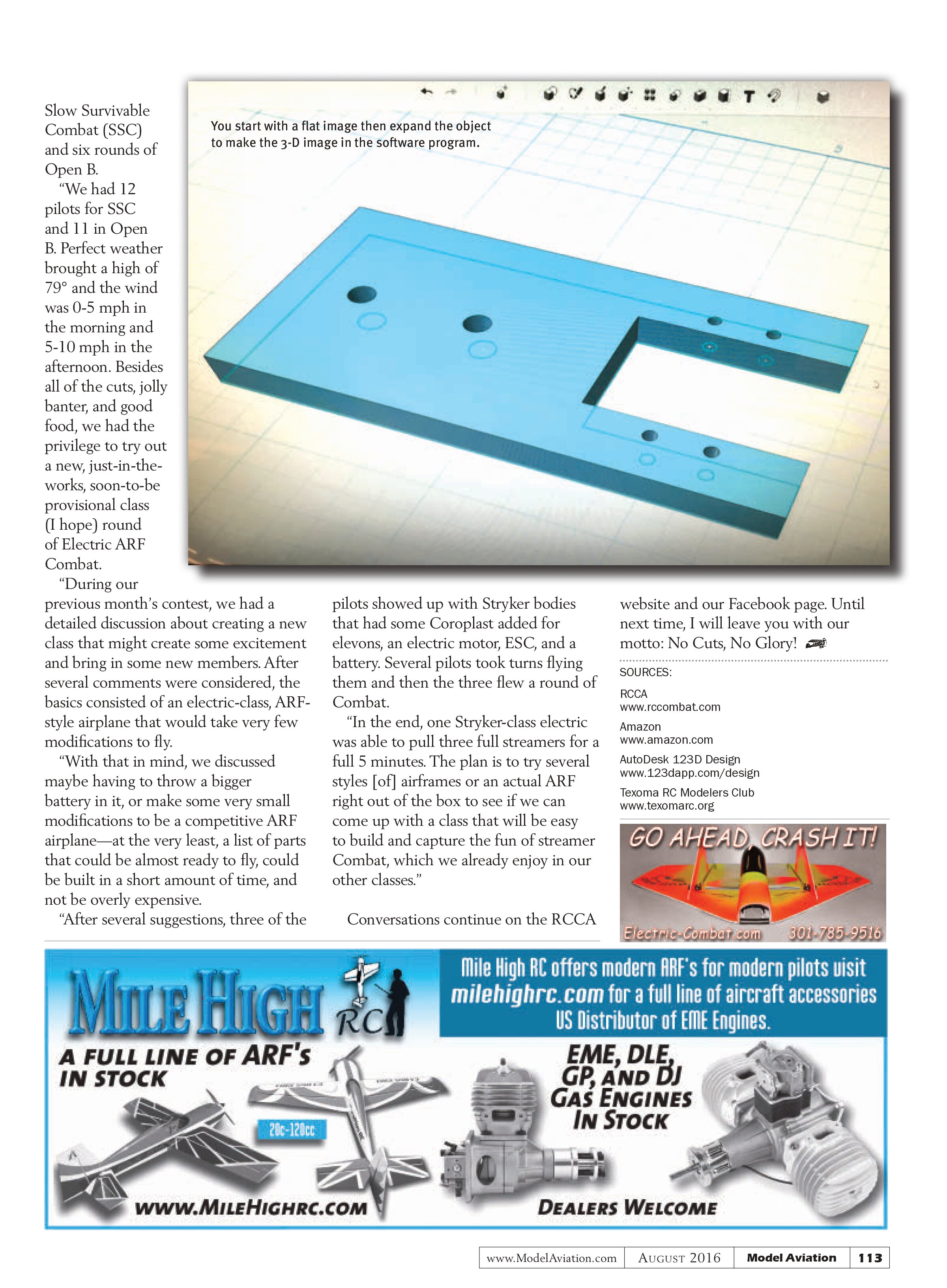
I use Autodesk 123D Design software. It works well, and is simple to use. I

recommend that you go online and watch some of the videos of this software on YouTube. There are helpful videos that detail how to plan your project. Autodesk 123D Design is free for non-commercial use.
After you have completed designing your object, you will need to export it to different software that came with the unit called MakerBot MakerWare, which is also free. This software will connect to the printer and send the object to it, or you can save it on an SD card that can be inserted into the printer for printing. I found that if you are printing from your computer, you should turn off the computer’s sleep mode or it will stop printing and you will have to start over again.
Overall, I see many uses for a 3-D printer for Combat aircraft, as well as other types of models. The hardest part will be learning to use the software, but that is where videos will help.
Texoma Spring Slam
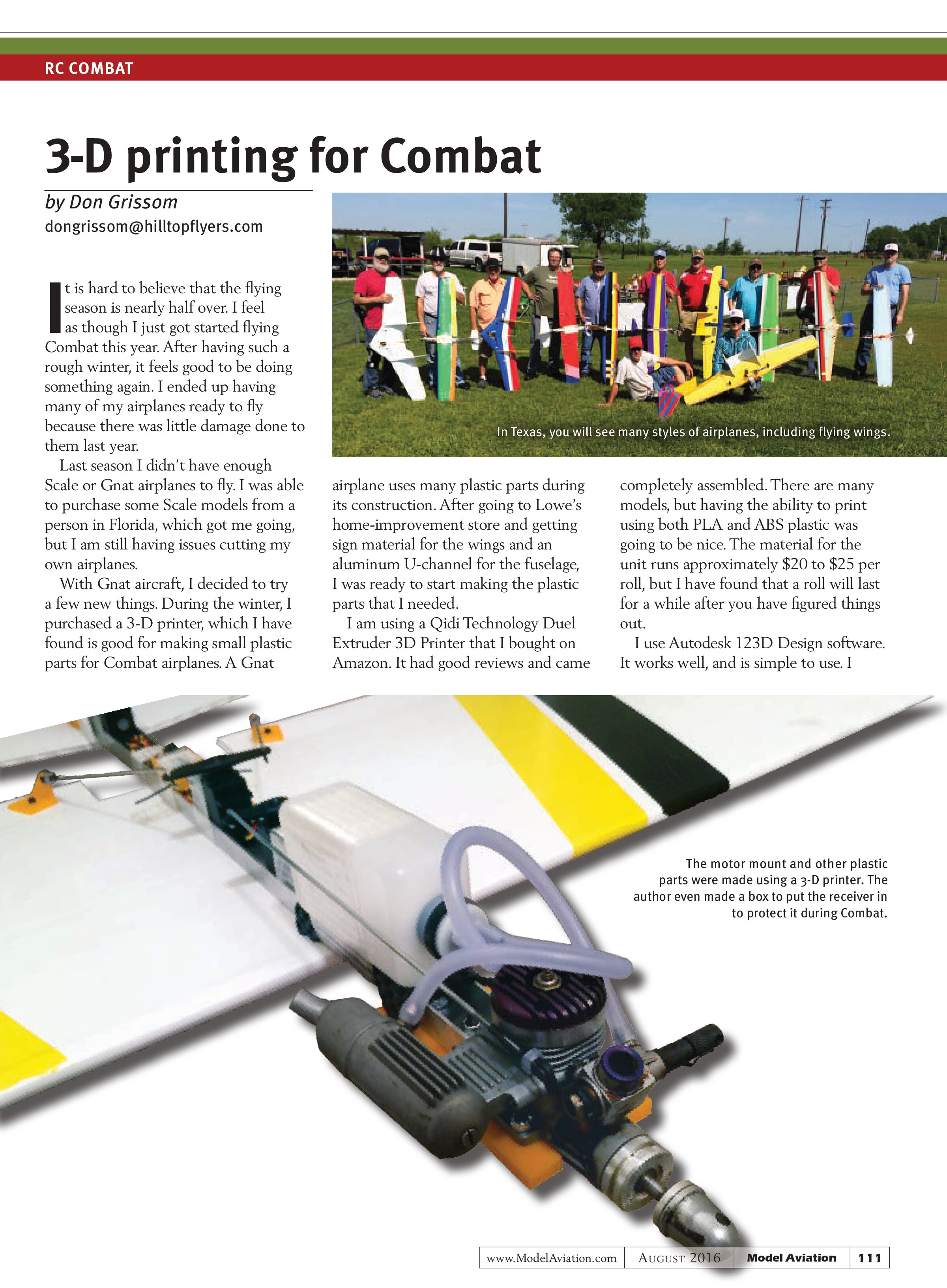
RC Combat once again got started this year in Texas with the Texoma Spring Slam. David Turner ran the event. There was also a demonstration of the new Stryker class, which is an electric event. Here is David’s report of the event, which is one of nine contests that will be in Texas this year.
“Pilots came from across the state of Texas to enjoy AMA-sanctioned Radio Control Combat Association (RCCA) Combat at the Pete Darter Flying Field, hosted by the Texoma RC Modelers Club. This year’s Texoma Spring Slam was the second contest of nine planned to be flown this year in the area, and consisted of 12 official rounds of Combat with two heats: six rounds of

The motor mount takes approximately two hours to print, but when completed, you have a nice part that fits perfectly.
Slow Survivable Combat (SSC) and six rounds of Open B. “We had 12 pilots for SSC and 11 in Open B. Perfect weather brought a high of 79° and the wind was 0-5 mph in the morning and 5-10 mph in the afternoon. Besides all of the cuts, jolly banter, and good food, we had the privilege to try out a new, just-in-the-works, soon-to-be provisional class (I hope) round of Electric ARF Combat.

“During our previous month’s contest, we had a detailed discussion about creating a new class that might create some excitement and bring in some new members. After several comments were considered, the basics consisted of an electric-class, ARF-style airplane that would take very few modifications to fly.
“With that in mind, we discussed maybe having to throw a bigger battery in it, or make some very small modifications to be a competitive ARF airplane—at the very least, a list of parts that could be almost ready to fly, could be built in a short amount of time, and not be overly expensive.
“After several suggestions, three of the pilots showed up with Stryker bodies that had some Coroplast added for elevons, an electric motor, ESC, and a battery. Several pilots took turns flying them and then the three flew a round of Combat.
“In the end, one Stryker-class electric was able to pull three full streamers for a full 5 minutes. The plan is to try several styles [of] airframes or an actual ARF right out of the box to see if we can come up with a class that will be easy to build and capture the fun of streamer Combat, which we already enjoy in our other classes.”
Conversations continue on the RCCA website and our Facebook page. Until next time, I will leave you with our motto: No Cuts, No Glory!
SOURCES:
RCCA
www.rccombat.com
Amazon
www.amazon.com
AutoDesk 123D Design
www.123dapp.com/design
Texoma RC Modelers Club
www.texomarc.org