Easy-to-build Rubber Scale model won at the 1983 Nats
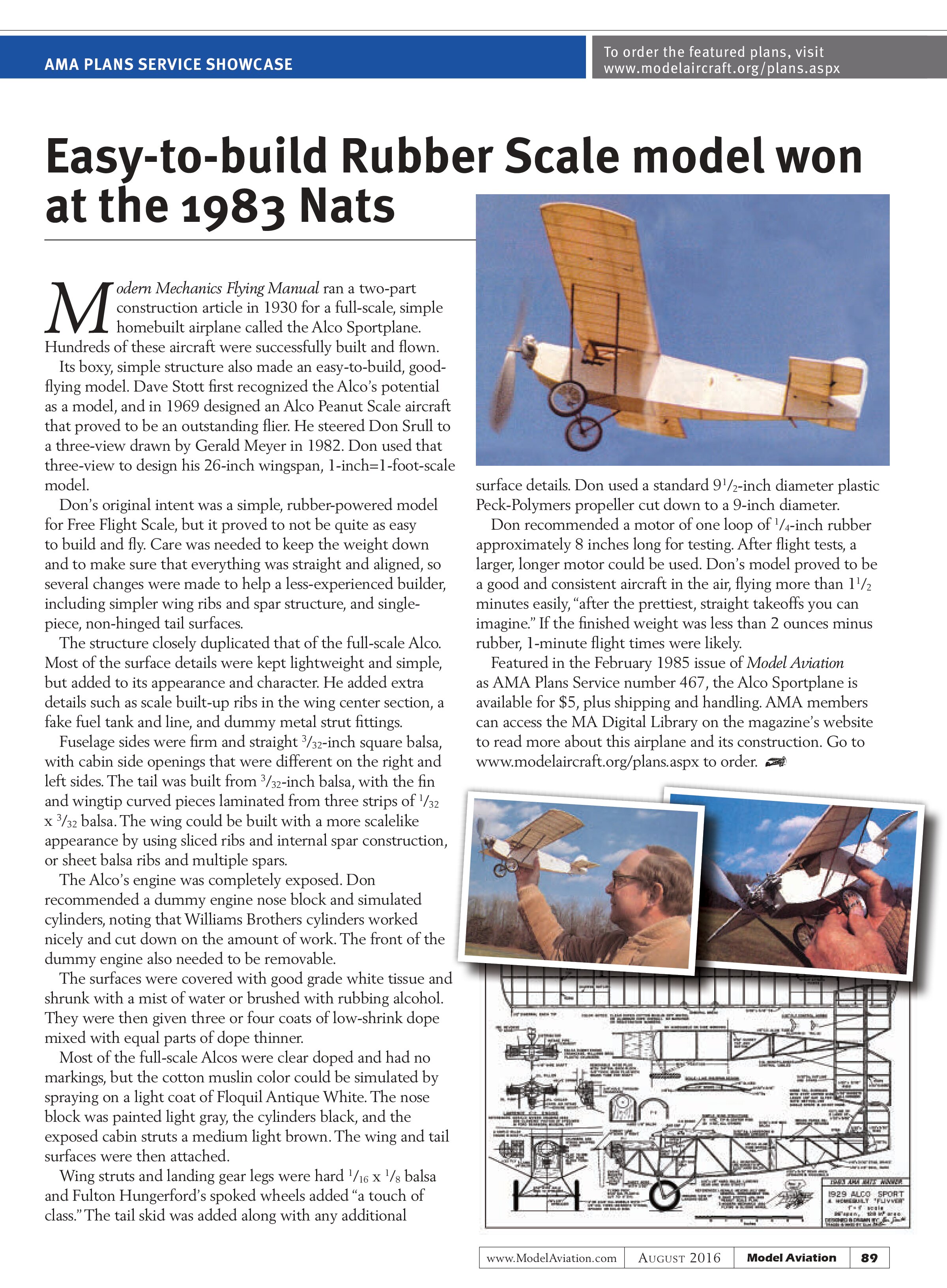
Modern Mechanics Flying Manual ran a two-part construction article in 1930 for a full-scale, simple homebuilt airplane called the Alco Sportplane. Hundreds of these aircraft were successfully built and flown. Its boxy, simple structure also made an easy-to-build, good-flying model. Dave Stott first recognized the Alco’s potential as a model, and in 1969 designed an Alco Peanut Scale aircraft that proved to be an outstanding flier. He steered Don Srull to a three-view drawn by Gerald Meyer in 1982. Don used that three-view to design his 26-inch wingspan, 1-inch=1-foot-scale model.
Don’s original intent was a simple, rubber-powered model for Free Flight Scale, but it proved to not be quite as easy to build and fly. Care was needed to keep the weight down and to make sure that everything was straight and aligned, so several changes were made to help a less-experienced builder, including simpler wing ribs and spar structure, and single-piece, non-hinged tail surfaces.
The structure closely duplicated that of the full-scale Alco. Most of the surface details were kept lightweight and simple, but added to its appearance and character. He added extra details such as scale built-up ribs in the wing center section, a fake fuel tank and line, and dummy metal strut fittings.
Fuselage sides were firm and straight ³⁄₃₂-inch square balsa, with cabin side openings that were different on the right and left sides. The tail was built from ³⁄₃₂-inch balsa, with the fin and wingtip curved pieces laminated from three strips of ¹⁄₃₂ x ³⁄₃₂ balsa. The wing could be built with a more scalelike appearance by using sliced ribs and internal spar construction, or sheet balsa ribs and multiple spars.
The Alco’s engine was completely exposed. Don recommended a dummy engine nose block and simulated cylinders, noting that Williams Brothers cylinders worked nicely and cut down on the amount of work. The front of the dummy engine also needed to be removable.
The surfaces were covered with good grade white tissue and shrunk with a mist of water or brushed with rubbing alcohol. They were then given three or four coats of low-shrink dope mixed with equal parts of dope thinner.
Most of the full-scale Alcos were clear doped and had no markings, but the cotton muslin color could be simulated by spraying on a light coat of Floquil Antique White. The nose block was painted light gray, the cylinders black, and the exposed cabin struts a medium light brown. The wing and tail surfaces were then attached.
Wing struts and landing gear legs were hard ¹⁄₁₆ x ¹⁄₈ balsa and Fulton Hungerford’s spoked wheels added “a touch of class.” The tail skid was added along with any additional

surface details. Don used a standard 9½-inch diameter plastic Peck-Polymers propeller cut down to a 9-inch diameter.
Don recommended a motor of one loop of ¼-inch rubber approximately 8 inches long for testing. After flight tests, a larger, longer motor could be used. Don’s model proved to be a good and consistent aircraft in the air, flying more than 1½ minutes easily, “after the prettiest, straight takeoffs you can imagine.” If the finished weight was less than 2 ounces minus rubber, 1-minute flight times were likely.
Featured in the February 1985 issue of Model Aviation as AMA Plans Service number 467, the Alco Sportplane is available for $5, plus shipping and handling. AMA members can access the MA Digital Library on the magazine’s website to read more about this airplane and its construction. Go to www.modelaircraft.org/plans.aspx to order.