The popular Ringmaster
Bob Angel
samrcflier@verizon.net

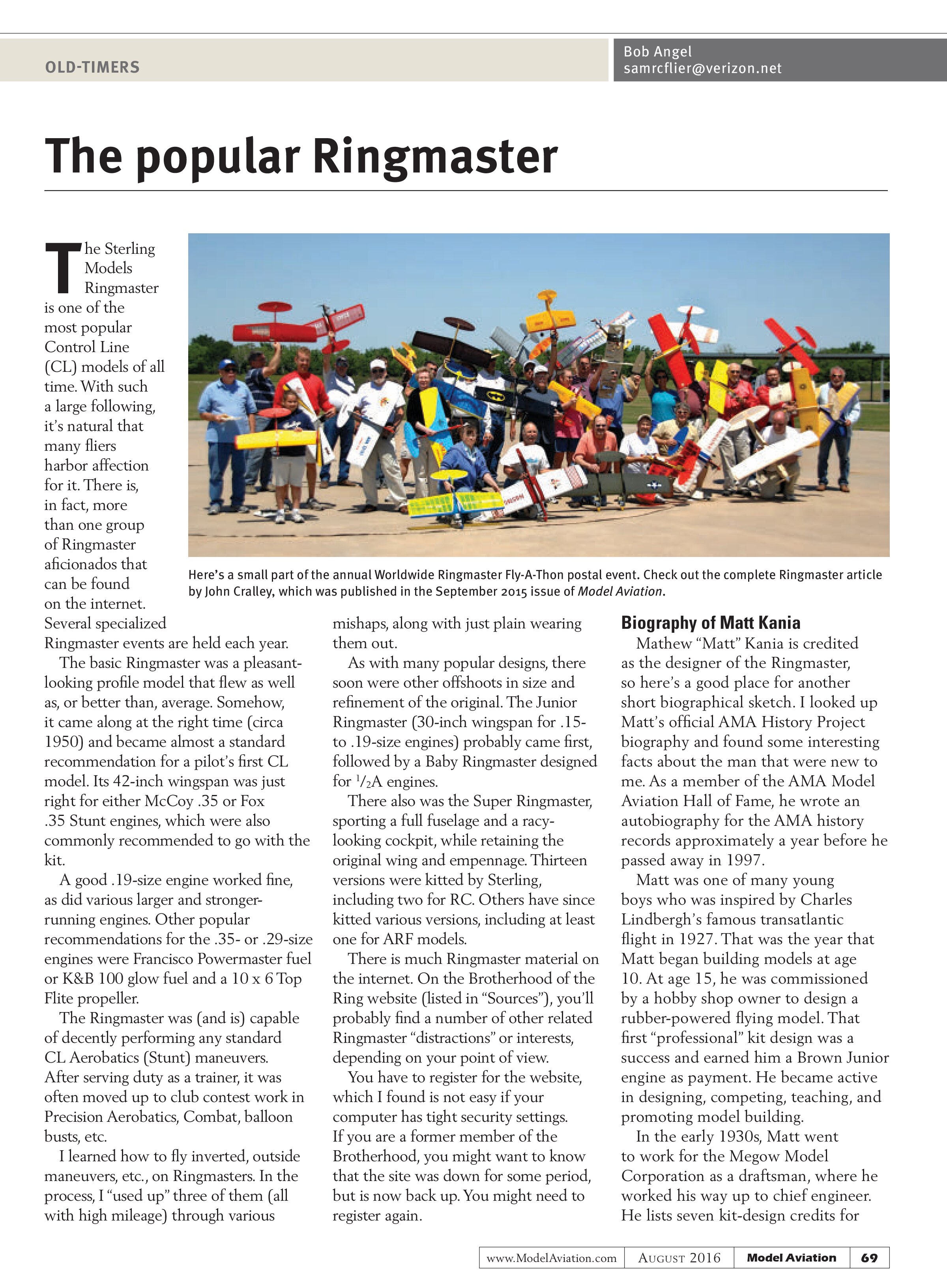
The Sterling Models Ringmaster is one of the most popular Control Line (CL) models of all time. With such a large following, it’s natural that many fliers harbor affection for it. There is, in fact, more than one group of Ringmaster aficionados that can be found on the internet. Several specialized Ringmaster events are held each year.
The basic Ringmaster was a pleasant-looking profile model that flew as well as, or better than, average. Somehow, it came along at the right time (circa 1950) and became almost a standard recommendation for a pilot’s first CL model. Its 42-inch wingspan was just right for either McCoy .35 or Fox .35 Stunt engines, which were also commonly recommended to go with the kit.
A good .19-size engine worked fine, as did various larger and stronger-running engines. Other popular recommendations for the .35- or .29-size engines were Francisco Powermaster fuel or K&B 100 glow fuel and a 10 x 6 Top Flite propeller.
The Ringmaster was (and is) capable of decently performing any standard CL Aerobatics (Stunt) maneuvers. After serving duty as a trainer, it was often moved up to club contest work in Precision Aerobatics, Combat, balloon busts, etc.
I learned how to fly inverted, outside maneuvers, etc., on Ringmasters. In the process, I “used up” three of them (all with high mileage) through various mishaps, along with just plain wearing them out.
As with many popular designs, there soon were other offshoots in size and refinement of the original. The Junior Ringmaster (30-inch wingspan for .15- to .19-size engines) probably came first, followed by a Baby Ringmaster designed for ½A engines.
There also was the Super Ringmaster, sporting a full fuselage and a racy-looking cockpit, while retaining the original wing and empennage. Thirteen versions were kitted by Sterling, including two for RC. Others have since kitted various versions, including at least one for ARF models.
There is much Ringmaster material on the internet. On the Brotherhood of the Ring website (listed in “Sources”), you’ll probably find a number of other related Ringmaster “distractions” or interests, depending on your point of view.
You have to register for the website, which I found is not easy if your computer has tight security settings. If you are a former member of the Brotherhood, you might want to know that the site was down for some period, but is now back up. You might need to register again.
Biography of Matt Kania
Mathew “Matt” Kania is credited as the designer of the Ringmaster, so here’s a good place for another short biographical sketch. I looked up Matt’s official AMA History Project biography and found some interesting facts about the man that were new to me. As a member of the AMA Model Aviation Hall of Fame, he wrote an autobiography for the AMA history records approximately a year before he passed away in 1997.
Matt was one of many young boys who was inspired by Charles Lindbergh’s famous transatlantic flight in 1927. That was the year that Matt began building models at age 10. At age 15, he was commissioned by a hobby shop owner to design a rubber-powered flying model. That first “professional” kit design was a success and earned him a Brown Junior engine as payment. He became active in designing, competing, teaching, and promoting model building.
In the early 1930s, Matt went to work for the Megow Model Corporation as a draftsman, where he worked his way up to chief engineer. He lists seven kit-design credits for
Megow, including four Free Flight and three CL models. He later became chief engineer for P.D.Q. Models, where he designed the Super Clown, another popular CL aircraft.
In 1950, he designed the famous Ringmaster for Sterling Models. He later designed two other sizes of the Ringmaster, plus the Super Ringmaster. He designed seven kits for Sterling, of which I’ve built and flown four. Since those early days, the Ringmaster has been copied and redesigned in many forms and by other kit and plans manufacturers.
Matt entered the Navy during World War II, where an early assignment had him building recognition models. Later, at Naval Air Station Patuxent River in Maryland, he was assigned as an aircrew chief. Harold (aka “Hal” or “Pappy”) deBolt was also stationed at Patuxent, and Matt, along with Hal and Bob Dishong, established the Patuxent Model Engineers.
A highlight of Matt’s career came in 1945 when Charles Lindbergh was a guest at a big military air show and conference. Charles asked to fly one of Matt’s assigned airplanes and Matt got to meet him and check him out for the flight.
Matt retired to Florida where he continued building, flying, and promoting modeling while staying active in model club work.
Brodak Ringmaster Kits
Brodak Manufacturing Company has long been a major supply source for CL kits and specialized CL supplies. The company makes a copy of the original Sterling S-1 Ringmaster kit, plus an almost-ready-to-cover version, and other Ringmasters, including a couple for electric power. The company’s online catalog features many other models that many of us knew and flew during the heyday of CL flying.
Incidentally, I received this note from Jack Hiner:
“I attended the Toledo R/C Trade Show last month. Brodak had a ready-to-cover original Ringmaster that looked great. Lightweight, unlike the old kits. I almost bought one.”
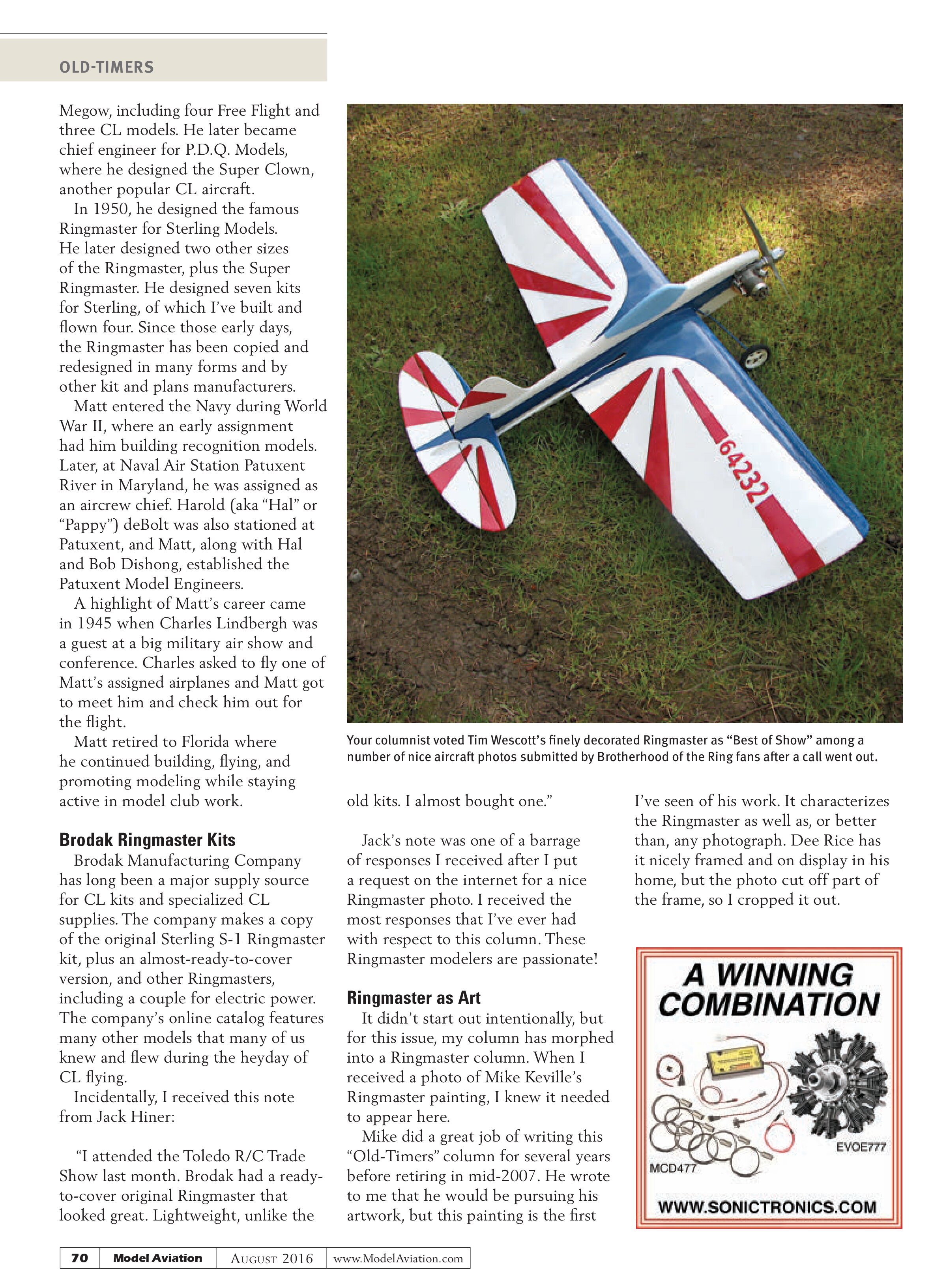
Jack’s note was one of a barrage of responses I received after I put a request on the internet for a nice Ringmaster photo. I received the most responses that I’ve ever had with respect to this column. These Ringmaster modelers are passionate!
Ringmaster as Art
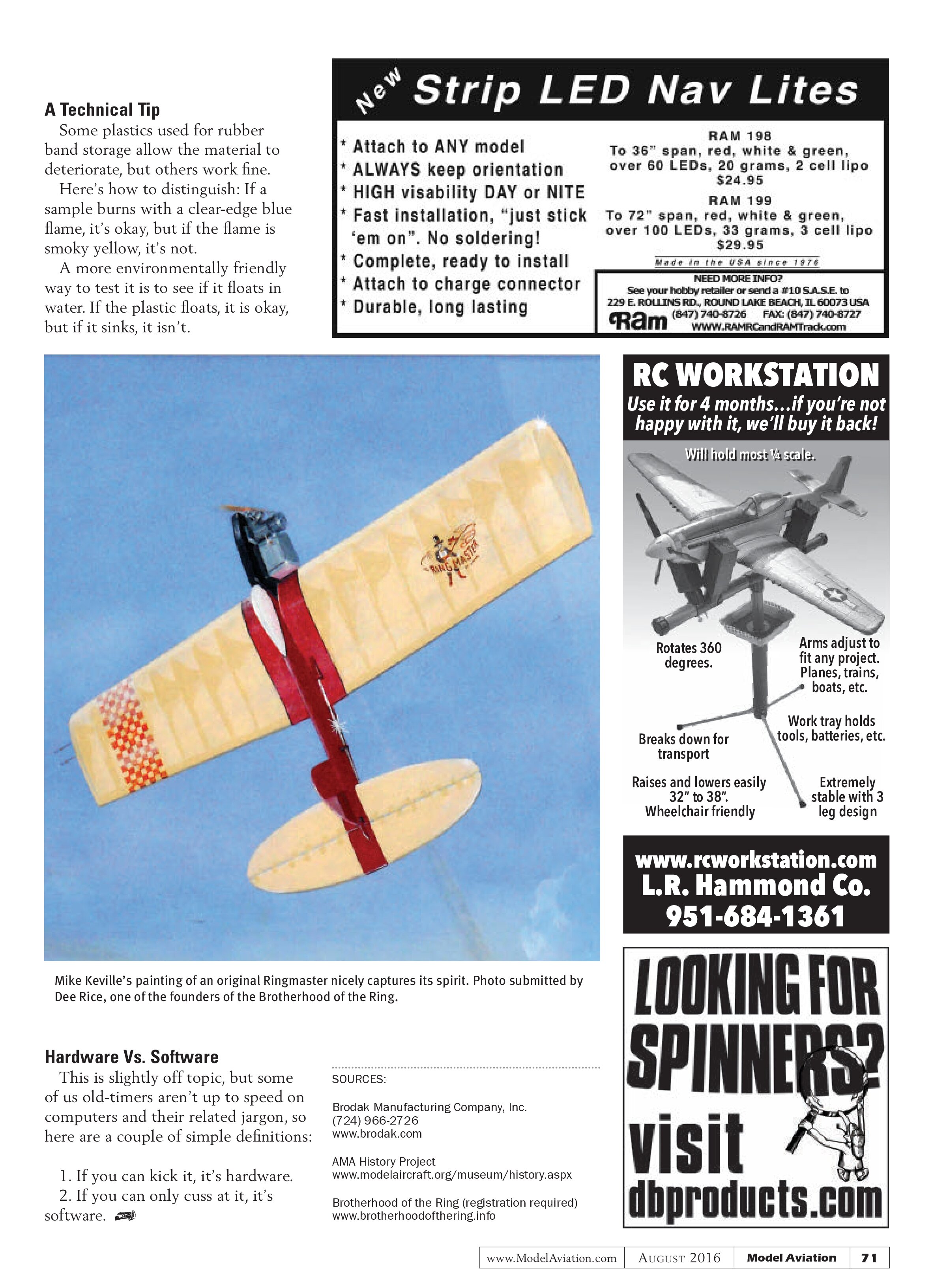
It didn’t start out intentionally, but for this issue, my column has morphed into a Ringmaster column. When I received a photo of Mike Keville’s Ringmaster painting, I knew it needed to appear here.
Mike did a great job of writing this “Old-Timers” column for several years before retiring in mid-2007. He wrote to me that he would be pursuing his artwork, but this painting is the first I’ve seen of his work. It characterizes the Ringmaster as well as, or better than, any photograph. Dee Rice has it nicely framed and on display in his home, but the photo cut off part of the frame, so I cropped it out.

A Technical Tip
Some plastics used for rubber band storage allow the material to deteriorate, but others work fine. Here’s how to distinguish: If a sample burns with a clear-edge blue flame, it’s okay, but if the flame is smoky yellow, it’s not.
A more environmentally friendly way to test it is to see if it floats in water. If the plastic floats, it is okay, but if it sinks, it isn’t.

Hardware Vs. Software
This is slightly off topic, but some of us old-timers aren’t up to speed on computers and their related jargon, so here are a couple of simple definitions:
- If you can kick it, it’s hardware.
- If you can only cuss at it, it’s software.
SOURCES:
Brodak Manufacturing Company, Inc.
(724) 966-2726
www.brodak.com
AMA History Project
www.modelaircraft.org/museum/history.aspx
Brotherhood of the Ring (registration required)
www.brotherhoodofthering.info