HORIZON HOBBY HOBBYZONE CONSCENDO S
Andrew Griffith
andy@customcutgraphix.com

An easy soaring experience
Learning how to fly RC without an experienced instructor has been universally discouraged. For me, one of the most gratifying aspects of the hobby is the friends I’ve made at the clubs I have belonged to and the events I have attended.
Those things noted, not everyone has easy access to an instructor, so Horizon Hobby produced the HobbyZone line so that those who don’t have the luxury of having an instructor can still find success within our awesome hobby.
SAFE technology is a technological leap forward toward this goal. SAFE stands for Sensor Assisted Flight Envelope and allows the pilot to choose an appropriate flight mode for his or her experience level, as well as having a panic recovery mode available at the flip of a switch in case things go awry.
With its SAFE receiver in beginner mode, a model will only bank enough to turn or pitch up or down enough to climb or descend, but no matter how far you move the stick or how long you hold it, the airplane won’t get in trouble.
In beginner mode, the airplane self-levels if the sticks are released to center. Intermediate mode gives you more control and maneuverability, but the model still won’t loop or roll inverted. Self-leveling is available by switching back to beginner mode or pressing the panic button.
When you’re ready for the big time, advanced mode unlocks the full potential of the Conscendo. While flying in advanced mode, the model won’t self-level unless you hit the panic button, but the stabilization system is still active, making flying in gusty wind not only possible, but enjoyable.
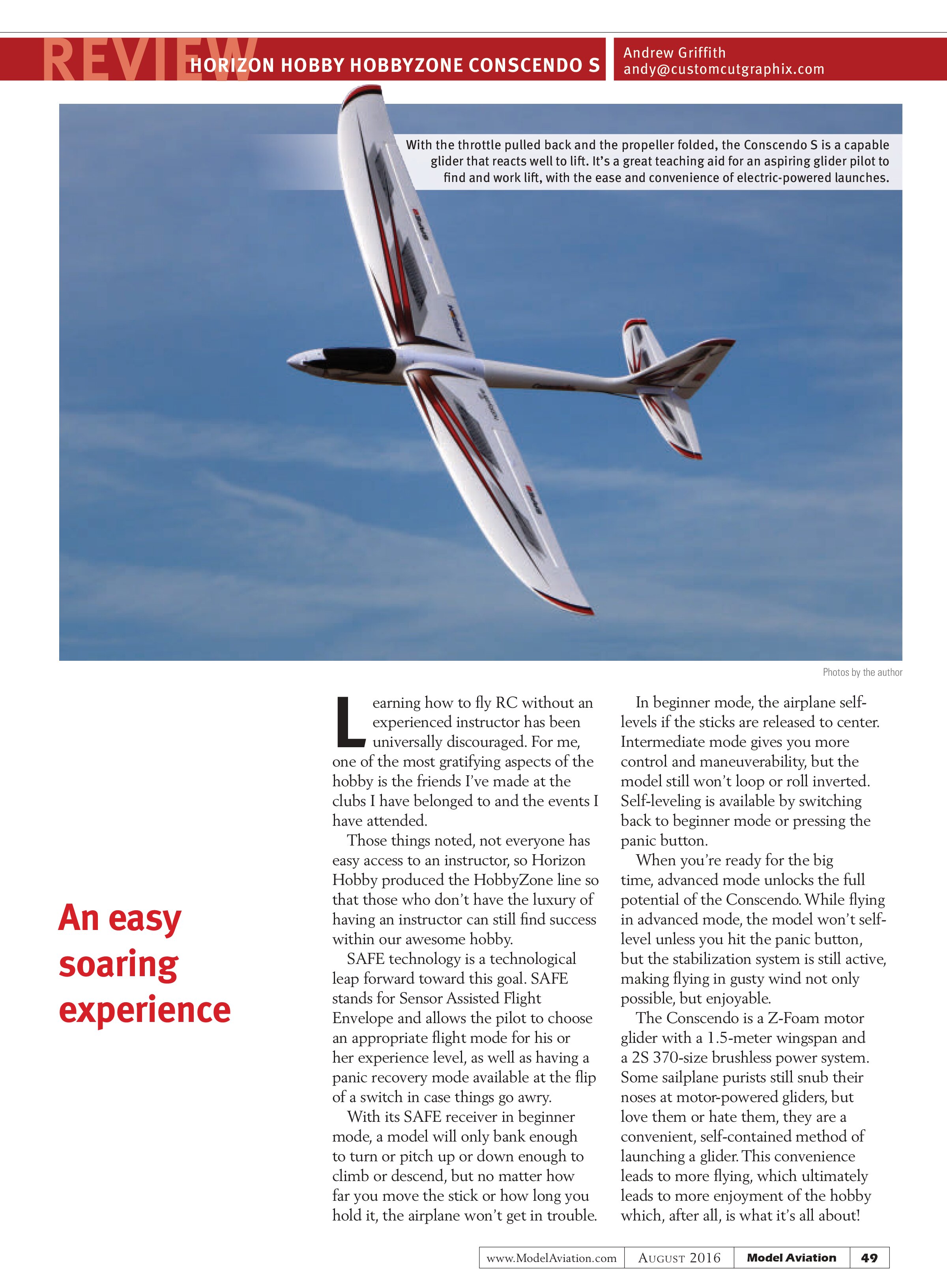
The Conscendo is a Z-Foam motor glider with a 1.5-meter wingspan and a 2S 370-size brushless power system. Some sailplane purists still snub their noses at motor-powered gliders, but love them or hate them, they are a convenient, self-contained method of launching a glider. This convenience leads to more flying, which ultimately leads to more enjoyment of the hobby which, after all, is what it’s all about!
AT A GLANCE ...
SPECIFICATIONS
Model type: Powered glider
Skill level: Beginner
Wingspan: 59 inches
Wing area: 405 square inches
Wing loading: 7.1 ounces per square foot
Airfoil: Flat bottom
Length: 39.6 inches
Weight: 20 ounces
Power system: 370-size brushless electric
Radio: Four-channel minimum DSM2 or DSMX
Construction: Z-Foam
Covering/finish: Painted foam
Street price: $169.99
TEST-MODEL DETAILS
Motor/engine used: E-flite 370 brushless motor (included)
Battery or fuel: E-flite 2S (7.4 volts) 1,300 mAh LiPo (included)
Propeller: Two-blade folding propeller (included)
Radio system: Spektrum DX18G2
Ready-to-fly weight: 20 ounces
Flight duration: 5 to 10 minutes
PLUSES
- What little assembly is needed can be completed in 30 minutes.
- Easy to fly for beginners, but fun for more experienced pilots.
- AS3X lets the Conscendo handle wind that would ground most foam airplanes.
- Easy access to change battery.
MINUS
- There were a few places where the glue was oozing out of joints.
Like many motor gliders, the Conscendo features a folding propeller to minimize drag when the motor is shut off. Control is provided via ailerons, rudder, elevator, and throttle. Although the Conscendo probably won’t be a true thermal floater like the Radian, with beginners in mind, it likely won’t be a hotliner either.
One thing is sure though, Matt Andren’s designs tend to fly well, so I was looking forward to getting it in the air.
Construction
The Conscendo S comes in two versions: an RTF version that includes a DX4 four-channel transmitter, and a BNF version that requires a four-channel DSM2/DSMX full-range transmitter. I received the BNF version for review and I’ll be using my DX18G2 because it never hurts to have 14 channels in reserve, just in case.
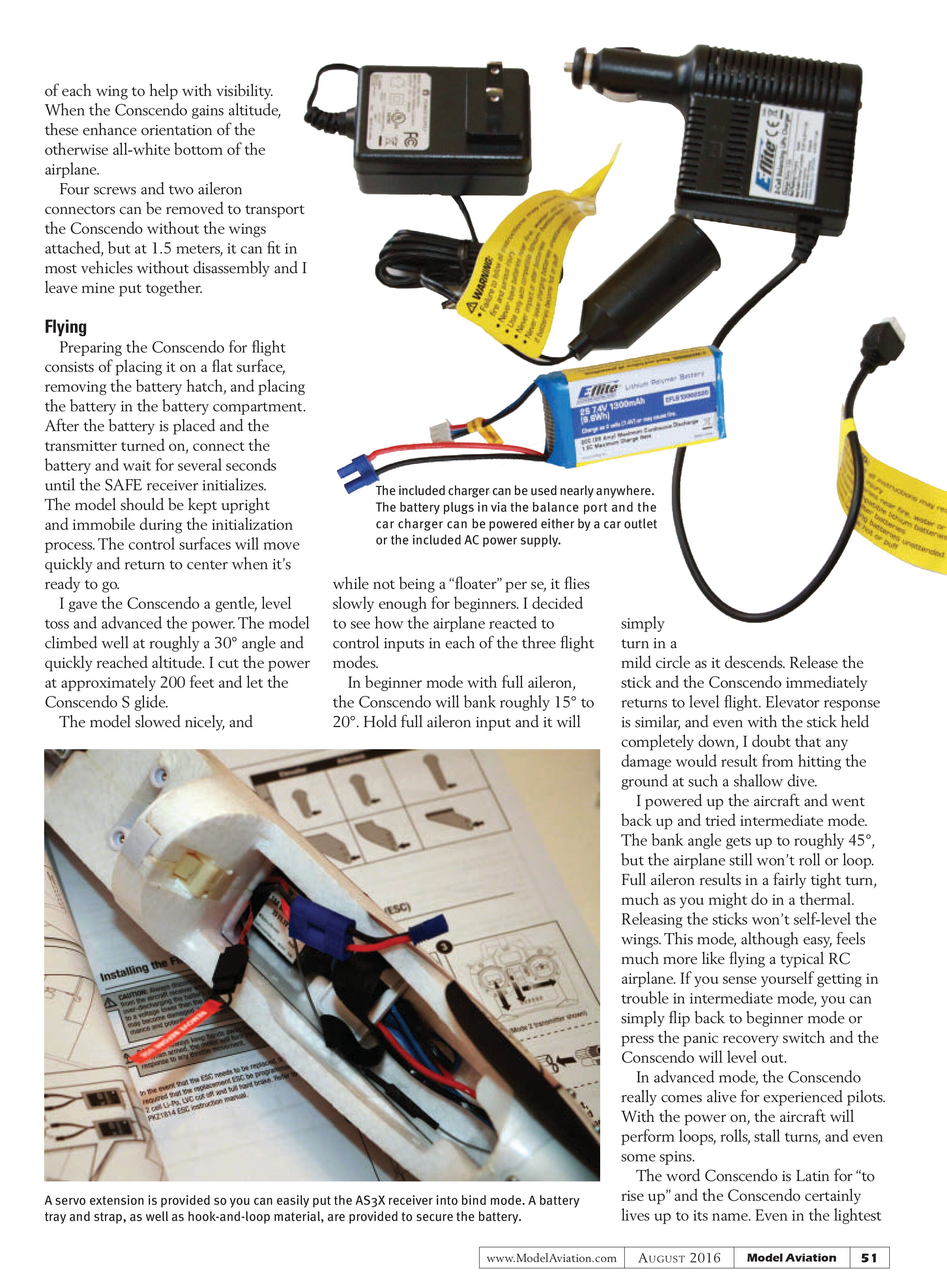
A 2S LiPo battery, DC car-style charger, and an AC adapter are all included. It’s actually kind of clever; the power supply has a receptacle that the car charger plugs into, then the whole thing plugs into the wall. It’s pretty simple—plug it in, connect the battery, and the light flashes while it’s charging and comes on steady when the charge is complete. I plugged in the battery and started charging it while I read the remainder of the manual.
The manual is thick and commensurate with the Conscendo’s target audience of beginner pilots. Everything is well explained and there are plenty of illustrations and notes.
Although the RTF version already has the radio bound and set up, the BNF version requires some programming specific to the SAFE receiver. A chart outlines the programming sequence for your particular radio and it only took a few minutes to set up the mode switch, panic recovery (buddy-box pushbutton), and dual rates needed for the Conscendo.
Binding the receiver is easy because a short servo extension is attached to the bind port that surfaces in the battery hatch. Plug a bind plug into the extension and bind the radio.
The horizontal stabilizer is installed next. The elevator halves plug into each other and the stabilizers are secured with tape provided in the kit. If you’re worried about using tape, you can use some Foam-Tac adhesive, but I built my Conscendo S per the manual and flew the daylights out of it. I had no issues with the tape securing the stabilizer. After the stabilizer is installed, you connect the control rod clevises and you’re done with the tail.
The wing halves slide together over the provided wing tube. Push the wires for the servos down into the fuselage toward the receiver. A fairing covers the wing joint and the wing is held in place with four screws. Connect the ailerons to the Y harness. It doesn’t matter how they are connected to the harness. As long as the colors on the wires match at the servo connectors, the ailerons will go the right way.
That’s all there is to it. The battery hatch is released by depressing the button and the hatch pops loose. Before installing the battery, I enabled the throttle-cut function on my DX18 radio and installed the battery.
With the model properly restrained, I tested that the motor was safe with the switch in throttle hold. With the transmitter in throttle hold, I installed the battery. When the receiver initializes and you have control, the next step is to make sure that all of the control surfaces are level by adjusting the clevises on the pushrods so that you aren’t using transmitter trim.
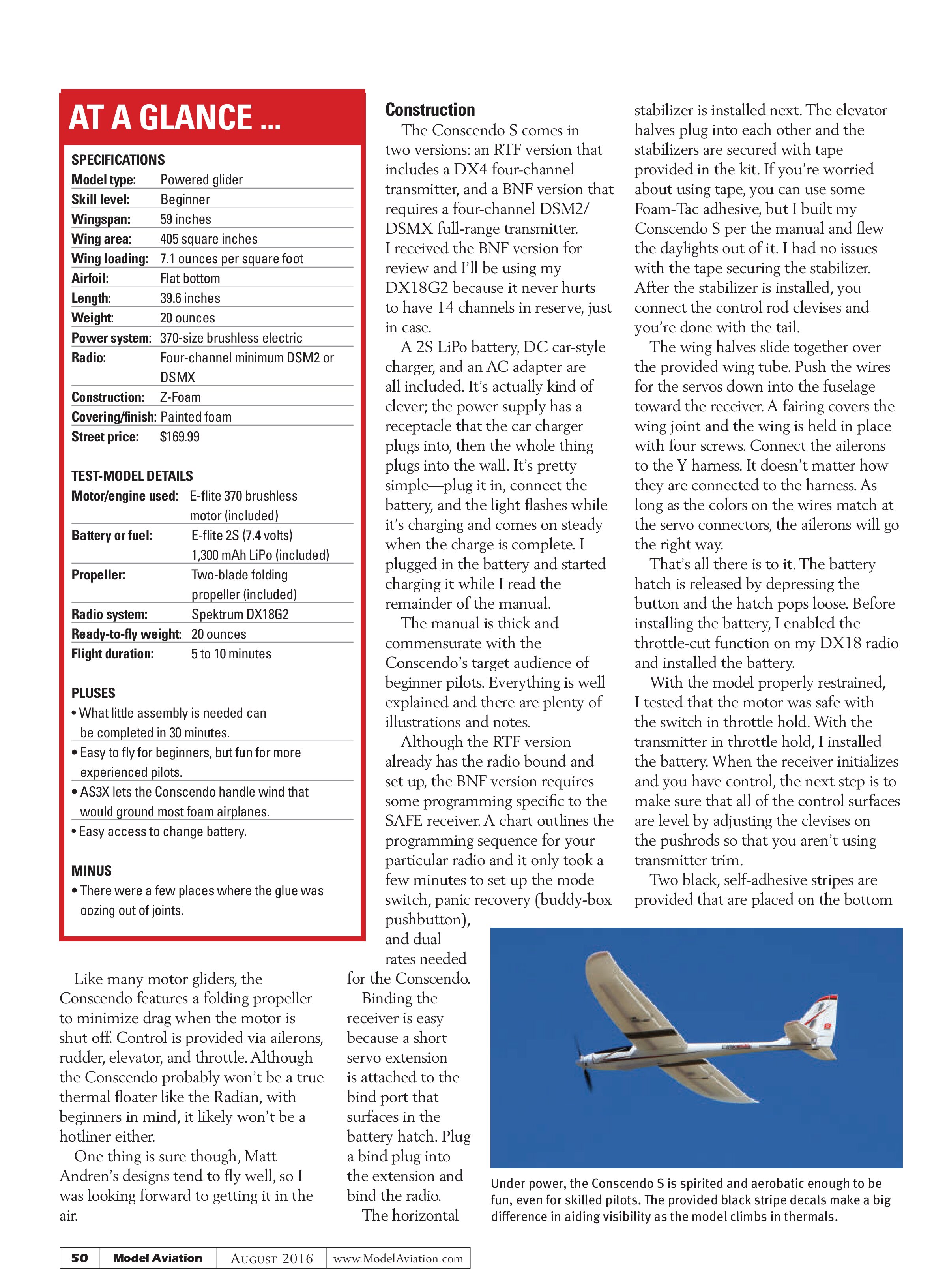
Two black, self-adhesive stripes are provided that are placed on the bottom of each wing to help with visibility. When the Conscendo gains altitude, these enhance orientation of the otherwise all-white bottom of the airplane.
Four screws and two aileron connectors can be removed to transport the Conscendo without the wings attached, but at 1.5 meters, it can fit in most vehicles without disassembly and I leave mine put together.
Flying
Preparing the Conscendo for flight consists of placing it on a flat surface, removing the battery hatch, and placing the battery in the battery compartment. After the battery is placed and the transmitter turned on, connect the battery and wait for several seconds until the SAFE receiver initializes. The model should be kept upright and immobile during the initialization process. The control surfaces will move quickly and return to center when it’s ready to go.
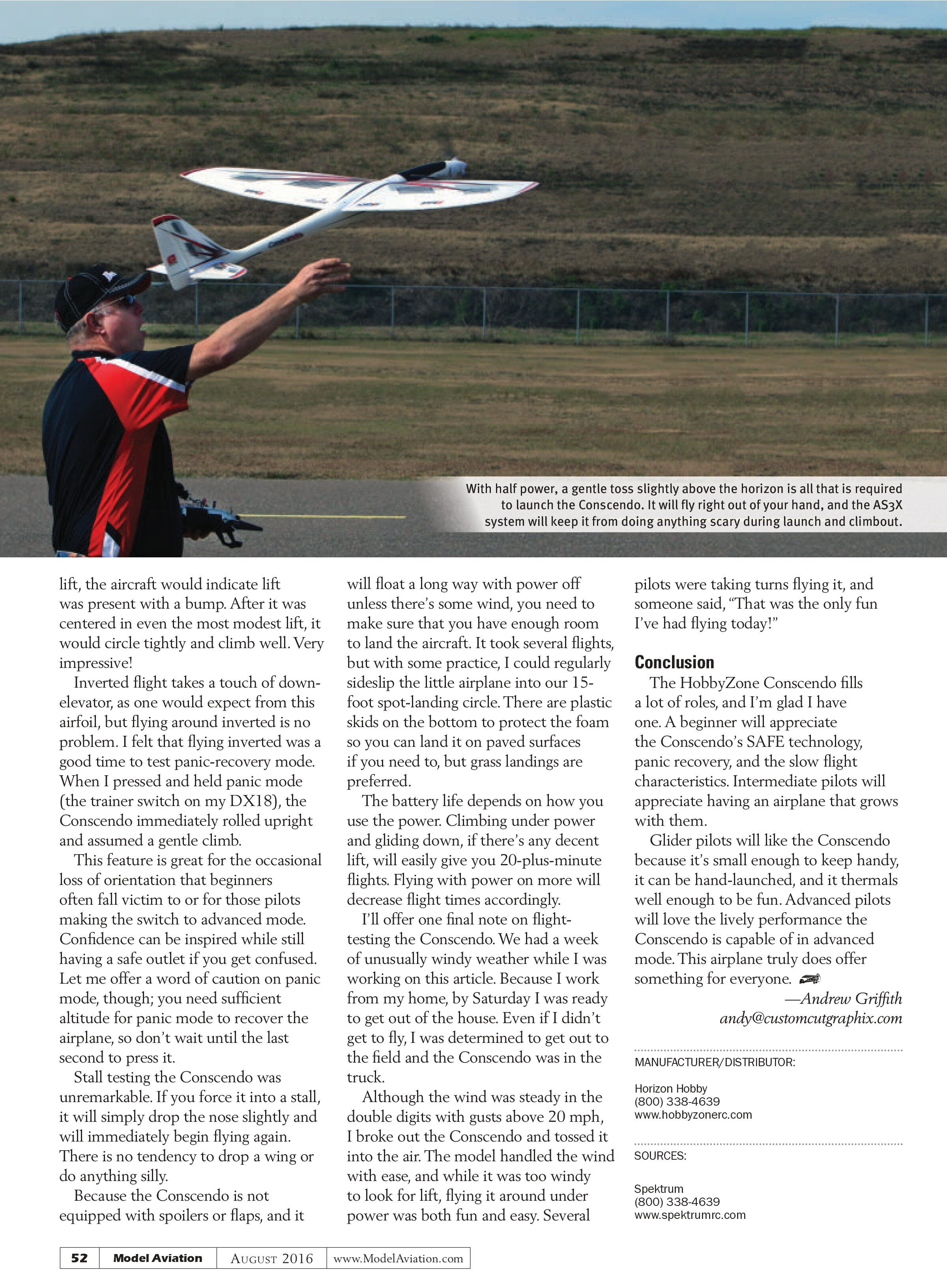
I gave the Conscendo a gentle, level toss and advanced the power. The model climbed well at roughly a 30° angle and quickly reached altitude. I cut the power at approximately 200 feet and let the Conscendo S glide.
The model slowed nicely, and

while not being a “floater” per se, it flies slowly enough for beginners. I decided to see how the airplane reacted to control inputs in each of the three flight modes.
In beginner mode with full aileron, the Conscendo will bank roughly 15° to 20°. Hold full aileron input and it will

simply turn in a mild circle as it descends. Release the stick and the Conscendo immediately returns to level flight. Elevator response is similar, and even with the stick held completely down, I doubt that any damage would result from hitting the ground at such a shallow dive.
I powered up the aircraft and went back up and tried intermediate mode. The bank angle gets up to roughly 45°, but the airplane still won’t roll or loop. Full aileron results in a fairly tight turn, much as you might do in a thermal. Releasing the sticks won’t self-level the wings. This mode, although easy, feels much more like flying a typical RC airplane. If you sense yourself getting in trouble in intermediate mode, you can simply flip back to beginner mode or press the panic recovery switch and the Conscendo will level out.
In advanced mode, the Conscendo really comes alive for experienced pilots. With the power on, the aircraft will perform loops, rolls, stall turns, and even some spins.
The word Conscendo is Latin for “to rise up” and the Conscendo certainly lives up to its name. Even in the lightest


lift, the aircraft would indicate lift was present with a bump. After it was centered in even the most modest lift, it would circle tightly and climb well. Very impressive!
Inverted flight takes a touch of down-elevator, as one would expect from this airfoil, but flying around inverted is no problem. I felt that flying inverted was a good time to test panic-recovery mode. When I pressed and held panic mode (the trainer switch on my DX18), the Conscendo immediately rolled upright and assumed a gentle climb.
This feature is great for the occasional loss of orientation that beginners often fall victim to or for those pilots making the switch to advanced mode. Confidence can be inspired while still having a safe outlet if you get confused. Let me offer a word of caution on panic mode, though; you need sufficient altitude for panic mode to recover the airplane, so don’t wait until the last second to press it.
Stall testing the Conscendo was unremarkable. If you force it into a stall, it will simply drop the nose slightly and will immediately begin flying again. There is no tendency to drop a wing or do anything silly.
Because the Conscendo is not equipped with spoilers or flaps, and it will float a long way with power off unless there’s some wind, you need to make sure that you have enough room to land the aircraft. It took several flights, but with some practice, I could regularly sideslip the little airplane into our 15-foot spot-landing circle. There are plastic skids on the bottom to protect the foam so you can land it on paved surfaces if you need to, but grass landings are preferred.
The battery life depends on how you use the power. Climbing under power and gliding down, if there’s any decent lift, will easily give you 20-plus-minute flights. Flying with power on more will decrease flight times accordingly.
I’ll offer one final note on flight-testing the Conscendo. We had a week of unusually windy weather while I was working on this article. Because I work from my home, by Saturday I was ready to get out of the house. Even if I didn’t get to fly, I was determined to get out to the field and the Conscendo was in the truck.
Although the wind was steady in the double digits with gusts above 20 mph, I broke out the Conscendo and tossed it into the air. The model handled the wind with ease, and while it was too windy to look for lift, flying it around under power was both fun and easy. Several pilots were taking turns flying it, and someone said, “That was the only fun I’ve had flying today!”
Conclusion
The HobbyZone Conscendo fills a lot of roles, and I’m glad I have one. A beginner will appreciate the Conscendo’s SAFE technology, panic recovery, and the slow flight characteristics. Intermediate pilots will appreciate having an airplane that grows with them.
Glider pilots will like the Conscendo because it’s small enough to keep handy, it can be hand-launched, and it thermals well enough to be fun. Advanced pilots will love the lively performance the Conscendo is capable of in advanced mode. This airplane truly does offer something for everyone.
—Andrew Griffith
andy@customcutgraphix.com
MANUFACTURER/DISTRIBUTOR:
Horizon Hobby
(800) 338-4639
www.hobbyzonerc.com
SOURCES:
Spektrum
(800) 338-4639
www.spektrumrc.com