Measuring battery capacity at the field
Bob Aberle
baberle@optonline.net
Q630: I’ve reached a point with electric-powered aircraft where I go to the flying field with sometimes 10 or more charged LiPo battery packs. During a flying session, I might even recharge a few of my depleted packs. I often forget which packs are charged and which ones need to be charged.
I’ve seen schemes where fully charged packs are identified by an extra connector set or a rubber band. I’d really like to have a meter that simply tells me the capacity of each battery pack. Is there such a battery capacity meter, and if so, where can I buy one?
A630: I suspect that there are several battery capacity meters on the hobby market. At my flying field, a voltmeter I often see being used is the Hyperion EOS Sentry Version 3 that can handle between two and eight LiPo cells.
It acts as a capacity meter, an individual cell or total pack voltmeter, a balancer, and a discharger. This meter runs roughly $22 to $25. I bought mine from MaxAmps.com. The website is listed in the “Sources” section at the end of this column.
You can see in the accompanying photo that this meter has a large (2½ x 1¼-inch) LCD screen. I have my meter set up to read voltage of the total pack, as well as capacity. I’ve found that the figures for the remaining capacity closely match the readings I that get on my Revolectrix Cellpro 4s charger.

In addition to LiPo batteries, this meter can check LiFe, NiCd, and NiMH batteries. When checking LiPo battery packs, you plug the balance connector on the battery pack into the meter. You instantly get a percentage of the capacity remaining in the pack.
I have noted one problem with the Hyperion meter. I’ve found, and several suppliers have verified, that it does not read single-cell voltage. Being a regular micro aircraft flier, I wanted to know which cell was at full charge or which was at partial charge.
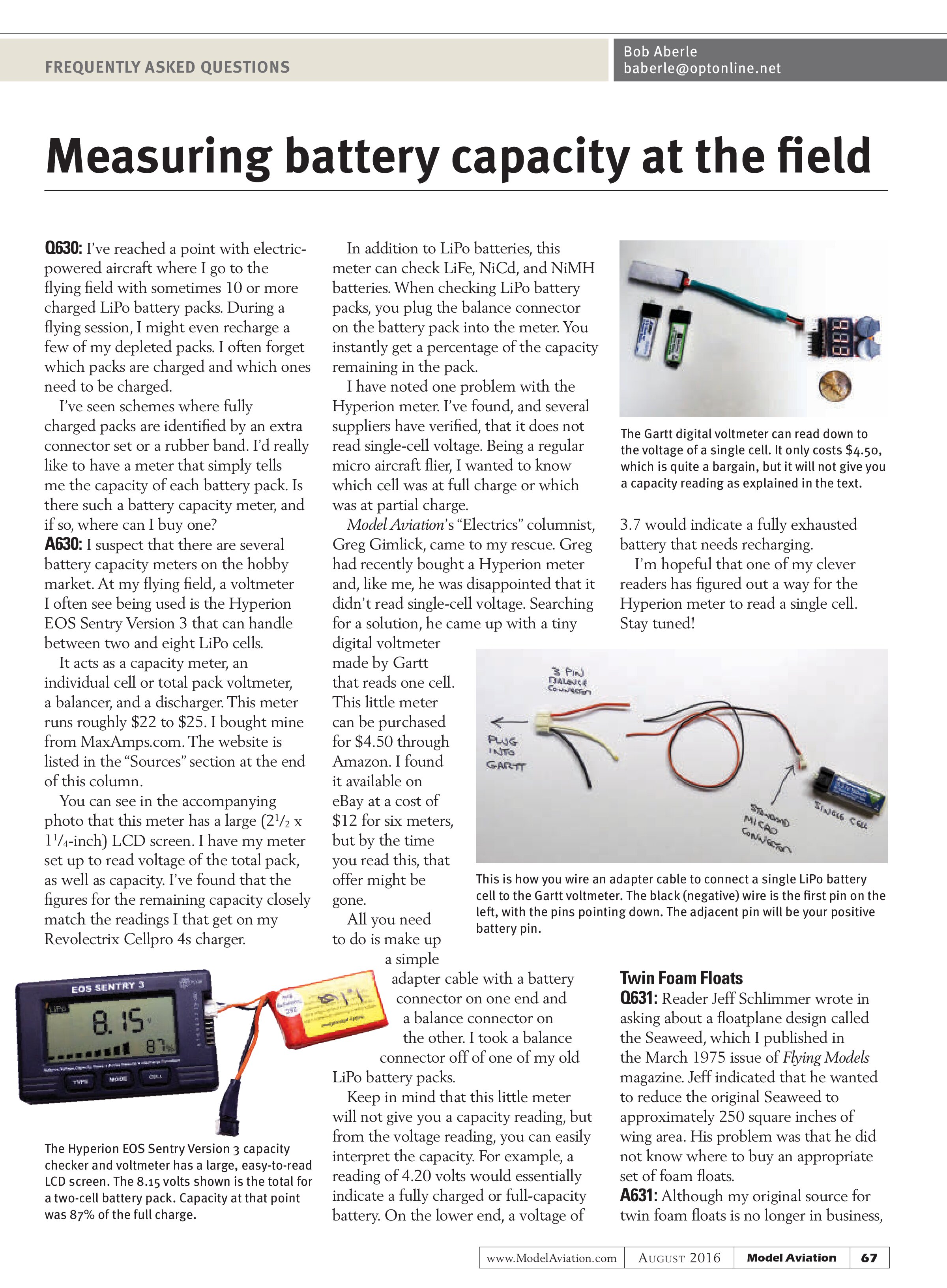
Model Aviation’s “Electrics” columnist, Greg Gimlick, came to my rescue. Greg had recently bought a Hyperion meter and, like me, he was disappointed that it didn’t read single-cell voltage. Searching for a solution, he came up with a tiny digital voltmeter made by Gartt that reads one cell. This little meter can be purchased for $4.50 through Amazon. I found it available on eBay at a cost of $12 for six meters, but by the time you read this, that offer might be gone.
All you need to do is make up a simple adapter cable with a battery connector on one end and a balance connector on the other. I took a balance connector off of one of my old LiPo battery packs.
Keep in mind that this little meter will not give you a capacity reading, but from the voltage reading, you can easily interpret the capacity. For example, a reading of 4.20 volts would essentially indicate a fully charged or full-capacity battery. On the lower end, a voltage of

3.7 would indicate a fully exhausted battery that needs recharging.
I’m hopeful that one of my clever readers has figured out a way for the Hyperion meter to read a single cell. Stay tuned!

Twin Foam Floats
Q631: Reader Jeff Schlimmer wrote in asking about a floatplane design called the Seaweed, which I published in the March 1975 issue of Flying Models magazine. Jeff indicated that he wanted to reduce the original Seaweed to approximately 250 square inches of wing area. His problem was that he did not know where to buy an appropriate set of foam floats.
A631: Although my original source for twin foam floats is no longer in business,

This 3-D sketch, done by reader Jeff Schlimmer, is of the author’s Seaweed floatplane that was originally published in the March 1975 issue of Flying Models.
I did find an excellent new source. It is called SeaPlane Supply and is owned by Mark Smith in Lake Orion, Michigan.
Mark offers a large inventory of twin foam floats ranging from as small as 10 inches in length all the way up to 114 inches and more. These floats are typically lightweight. They can be painted with foam-safe paints, or you can leave them simply “raw.”
I assure you that the airplane will still float. Mark is available to recommend a size for your floats. The 250-square-inch Seaweed will likely take a pair of 18-inch foam floats.
Ampeers Wire Gage Table
Q632: One more time, Bob—can you please give us a table that relates wire gauge (diameter) to the current carrying capability of that wire?
A632: A recent edition of Ampeers, the newsletter of the Electric Flyers Only club in southeastern Michigan, had a chart that I’m sure will satisfy you. I’ve included it in this column. Having the correct wire size is important to an electric flier. I suggest that you look up the Ampeers newsletter, which is edited by noted electric flier Ken Myers. I’ve listed Ken’s email address, as well as the newsletter website that covers all previously published newsletters, in “Sources.” This is all free, by the way.


SOURCES:
MaxAmps
(888) 654-4450
www.maxamps.com
Gartt voltage tester/Amazon
www.amazon.com/Speaker-Battery-Voltage-Tester-Buzzer/dp/B00G8R94CE
SeaPlane Supply
(248) 391-5970
www.seaplanesupply.com
Ken Myers
kmyers@theampe er.org
Ampeer newsletter index
www.theampeer.org/ampeer/Complete-Ampeer-Index.html