Electric inspirations and new reading material
by Louis Joyner
joyner28@comcast.net
Although Old-Timer (OT) and Nostalgia events have been around for years, some modelers use designs from the past as springboards for new models for the fast-growing E-36 event. It makes sense. A typical E-36 aircraft is not that different in size and power from the ½A Gas designs we flew a half century ago, so why not use a proven design as the foundation for a new model for a new class?
Unlike models built for the Nostalgia or OT events, these new designs can take advantage of modern materials, structural techniques, and a builder’s preferences. You can change and rearrange as much as you like. Two of these new, yet old, designs were selected for inclusion in the 2016 British Free Flight Forum Report that is reviewed in this column.
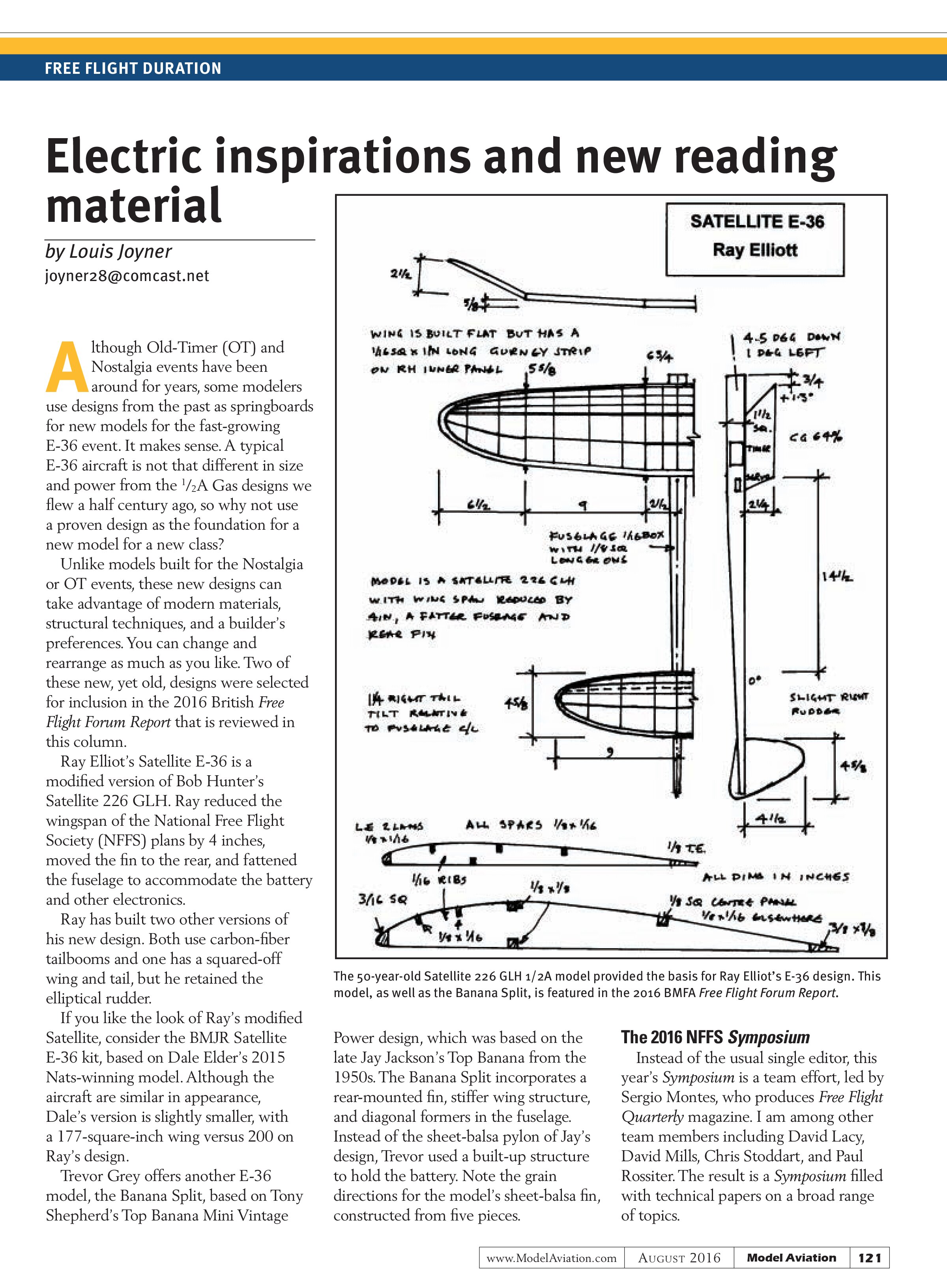
Ray Elliott’s Satellite E-36 is a modified version of Bob Hunter’s Satellite 226 GLH. Ray reduced the wingspan of the National Free Flight Society (NFFS) plans by 4 inches, moved the fin to the rear, and fattened the fuselage to accommodate the battery and other electronics.
Ray has built two other versions of his new design. Both use carbon-fiber tailbooms and one has a squared-off wing and tail, but he retained the elliptical rudder.
If you like the look of Ray’s modified Satellite, consider the BMJR Satellite E-36 kit, based on Dale Elder’s 2015 Nats-winning model. Although the aircraft are similar in appearance, Dale’s version is slightly smaller, with a 177-square-inch wing versus 200 on Ray’s design.
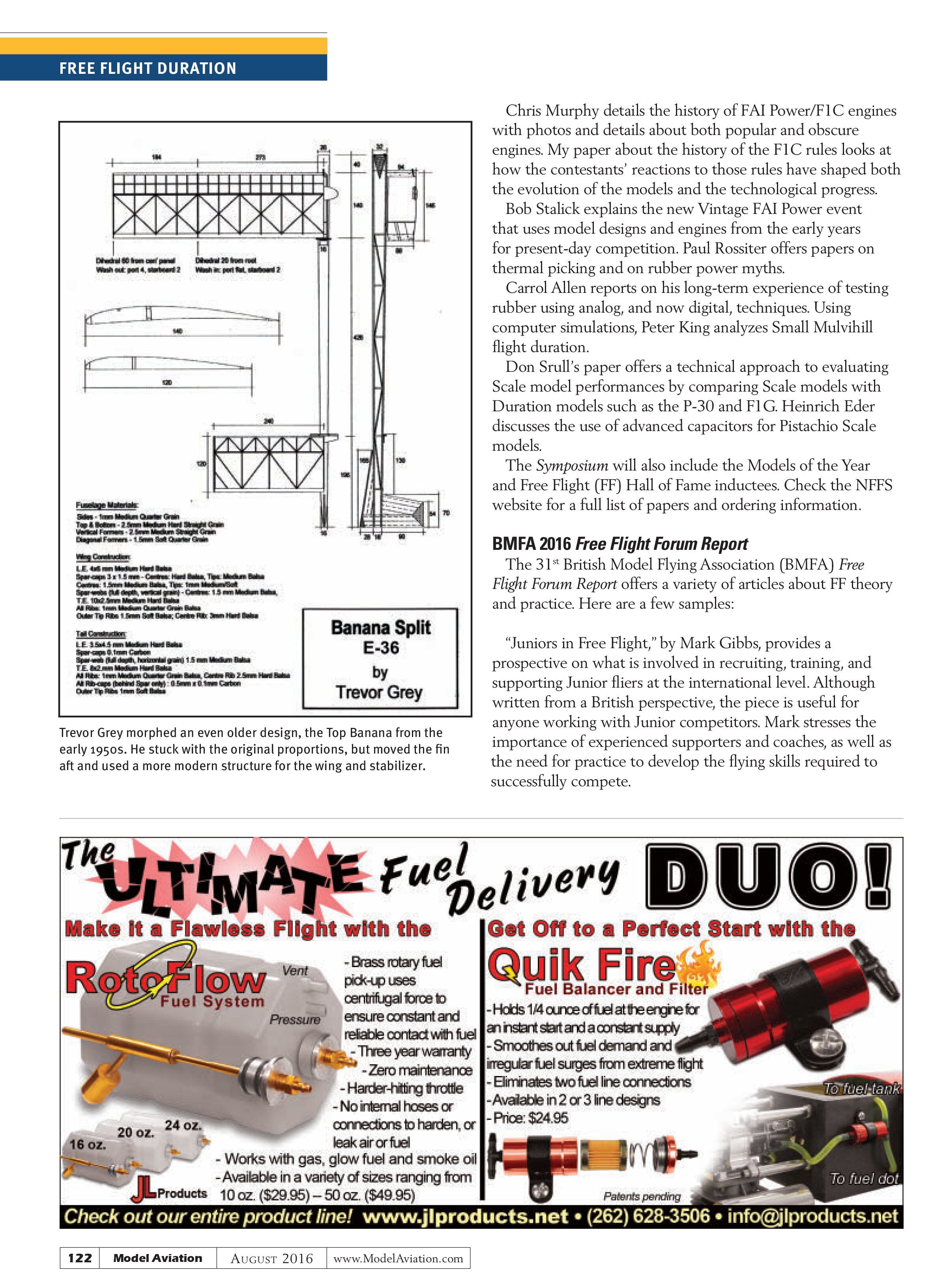
Trevor Grey offers another E-36 model, the Banana Split, based on Tony Shepherd’s Top Banana Mini Vintage Power design, which was based on the late Jay Jackson’s Top Banana from the 1950s. The Banana Split incorporates a rear-mounted fin, stiffer wing structure, and diagonal formers in the fuselage. Instead of the sheet-balsa pylon of Jay’s design, Trevor used a built-up structure to hold the battery. Note the grain directions for the model’s sheet-balsa fin, constructed from five pieces.

The 50-year-old Satellite 226 GLH 1/2A model provided the basis for Ray Elliott’s E-36 design. This model, as well as the Banana Split, is featured in the 2016 BMFA Free Flight Forum Report.
The 2016 NFFS Symposium
Instead of the usual single editor, this year’s Symposium is a team effort, led by Sergio Montes, who produces Free Flight Quarterly magazine. I am among other team members including David Lacy, David Mills, Chris Stoddart, and Paul Rossiter. The result is a Symposium filled with technical papers on a broad range of topics.

Trevor Grey morphed an even older design, the Top Banana from the early 1950s. He stuck with the original proportions, but moved the fin aft and used a more modern structure for the wing and stabilizer.
Chris Murphy details the history of FAI Power/F1C engines with photos and details about both popular and obscure engines. My paper about the history of the F1C rules looks at how the contestants’ reactions to those rules have shaped both the evolution of the models and the technological progress.
Bob Stalick explains the new Vintage FAI Power event that uses model designs and engines from the early years for present-day competition. Paul Rossiter offers papers on thermal picking and on rubber power myths.
Carrol Allen reports on his long-term experience of testing rubber using analog, and now digital, techniques. Using computer simulations, Peter King analyzes Small Mulvihill flight duration.
Don Srull’s paper offers a technical approach to evaluating Scale model performances by comparing Scale models with Duration models such as the P-30 and F1G. Heinrich Eder discusses the use of advanced capacitors for Pistachio Scale models.
The Symposium will also include the Models of the Year and Free Flight (FF) Hall of Fame inductees. Check the NFFS website for a full list of papers and ordering information.
BMFA 2016 Free Flight Forum Report
The 31st British Model Flying Association (BMFA) Free Flight Forum Report offers a variety of articles about FF theory and practice. Here are a few samples:
“Juniors in Free Flight,” by Mark Gibbs, provides a prospective on what is involved in recruiting, training, and supporting Junior fliers at the international level. Although written from a British perspective, the piece is useful for anyone working with Junior competitors. Mark stresses the importance of experienced supporters and coaches, as well as the need for practice to develop the flying skills required to successfully compete.
He also points out the need for high-quality models and support equipment, noting that several of the Russian youth were flying flapped F1B models. Mark also wrote another paper called “Weather Forecasts: How Good Are They and How to Interpret Them,” which will be of use to all modelers who fly outdoors.
In “Methanol to Lithium,” 2013 F1C Power World Champion Peter Watson details his recent experiences transitioning from gas to electric power, both in the popular E-36 event and in F1Q, the international Electric event. Alan Brocklehurst offers two papers, “Computations at Low Reynolds Number and a New Aerofoil for F1G (Coupe d’Hiver) Models” and “Capitalizing on Low Drag Aerofoils and All That.”
With “Basic Propeller Theory,” Andy Sephton provides an easier-to-understand graphic approach to one of the most complex of aerodynamic subjects. Andy also produced another paper on a most unusual subject: “Indoor Scale Free Flight Gliders.” Most interesting is the variety of launch methods discussed.
Carbon fiber is the subject of two papers. “Carbon Fibre for Aeromodellers,” by Mick Lester, provides a look at the variety of carbon-fiber types and materials available, a brief discussion of laminating resin, and an interesting section about making a heat box for post-curing carbon-fiber components. One suggestion is to use an inexpensive infrared reptile heating mat from a pet store. The mats come in a variety of shapes and sizes and can be used with a plug-in thermostat to accurately regulate temperature.
“Carbon Fibre Covered Prop Blades,” by Phil Ball, focuses on making simple molds to laminate Rubber model blades from thin sheet balsa and carbon fabric. Rather than using a vacuum pump and bag setup, Phil uses C-clamps.
Also of interest to Rubber fliers is Peter Brown’s “The Making and Testing of F1B Rubber Motors.” Particularly appealing is his method of dealing with 1/16-inch rubber, which has become increasingly popular for both F1B and F1G as a way to make up motors to a uniform length for increased consistency.
Peter details how he weighs motors and, most importantly, keeps from ending up with a tangled mess. His testing method involves a computer-controlled machine of his own design. It not only automates the stretching and measuring, but also provides a graph of the process for each motor tested. You can see the machine in action on YouTube, at the website link listed in “Sources.”
In addition to the two E-36 designs mentioned, “Some Interesting and Successful Models from 2016” showcases a variety of designs, including Adam Beales’ BMFA Rubber model, which uses carbon-fiber tube spars for both the wing and stabilizer.
Mark Benns’ F1D Indoor model and Bob Stalick’s Dixie-Pearl 1/2A and F1J Power aircraft are also detailed. Coupe No.14 is a simple, but elegant, F1G design by David Greaves, who passed away in 2015.
The 2016 BMFA Free Flight Forum Report can be ordered by email directly from Martin Dilly or through the NFFS.
Junior FF Team
This month, the US will be fielding an experienced team for the 2016 Junior FF World Championships in Prilep, Macedonia. All but one of the team members flew in the 2014 Junior World Champs and this will be Sevak Malkhasyan’s fourth Junior World Championships.
The Junior FF World Championships consists of three events: F1A Nordic Towline Glider, F1B Wakefield Rubber, and F1P Power. There are individual and team awards for each of the events, as well as an overall team championship. Several of the USA team members have volunteered to fly more than one event, allowing the US to field three-person teams in all of the events.
F1A team members are Cade Fedor, Alex Stalick, and Joel Yori, who is flying in his first Junior World Championships. F1B team members are Troy Davis, Jace Pivonka, and Sevak Malkhasyan. The F1P team includes Cade Fedor, Sevak Malkhasyan, and Alex Stalic. Jim Parker is the team manager.
SOURCES:
NFFS
www.freeflight.org
Peter Brown’s rubber testing machine
www.youtube.com/watch?v=np78KE80X3Q
BMFA Free Flight Forum Report
Martin Dilly
martindilly20@gmail.com
FAI Power.com
www.faipower.com
BMJR Models
(321) 537-1159
www.bjmjmodels.com
Free Flight Quarterly
www.freeflightquarterly.com/wordpress