Focal Point
Aeromaster

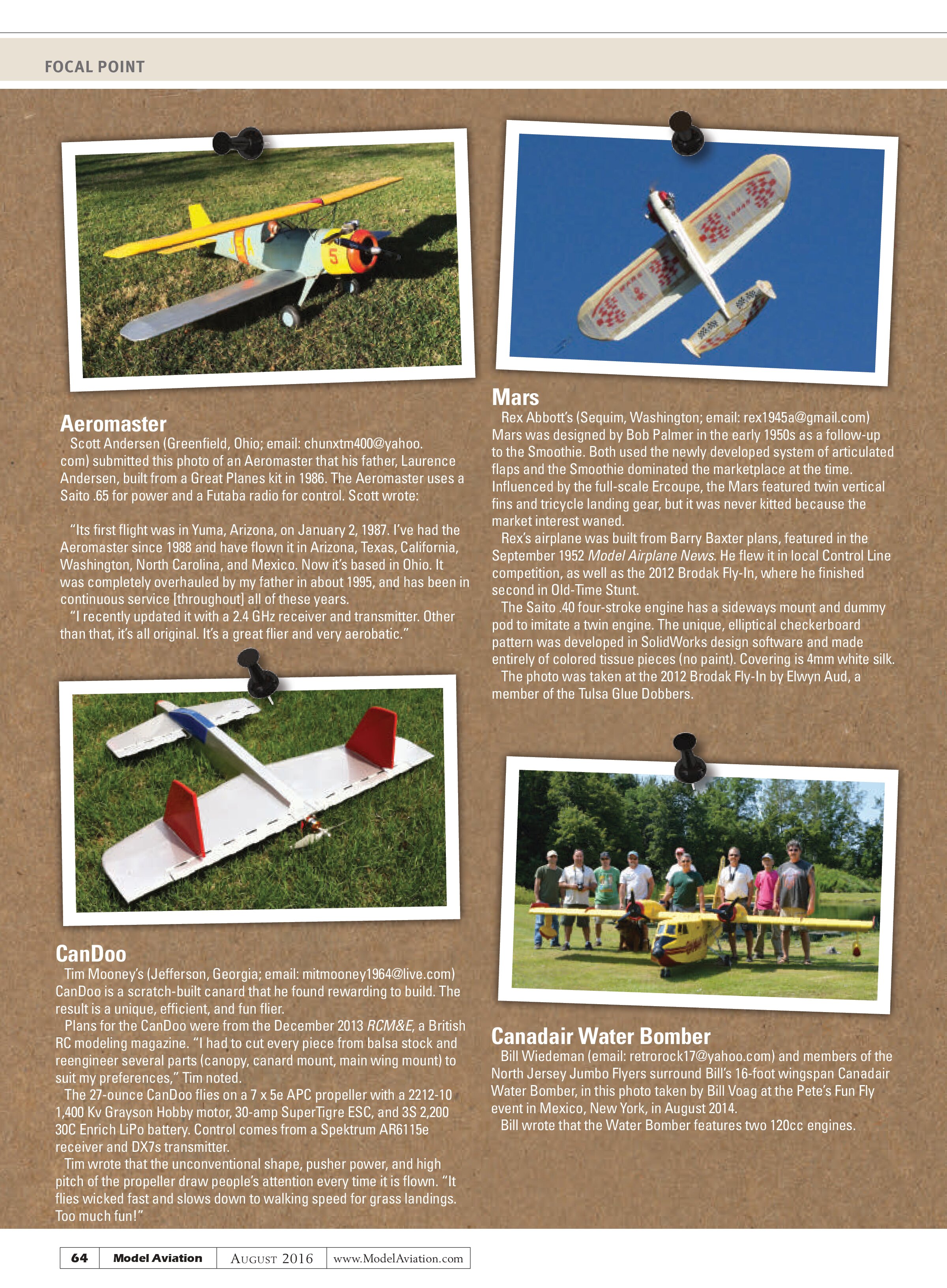
Scott Andersen (Greenfield, Ohio; email: chunxtm400@yahoo.com) submitted this photo of an Aeromaster that his father, Laurence Andersen, built from a Great Planes kit in 1986. The Aeromaster uses a Saito .65 for power and a Futaba radio for control. Scott wrote:
“Its first flight was in Yuma, Arizona, on January 2, 1987. I’ve had the Aeromaster since 1988 and have flown it in Arizona, Texas, California, Washington, North Carolina, and Mexico. Now it’s based in Ohio. It was completely overhauled by my father in about 1995, and has been in continuous service [throughout all of these years.
“I recently updated it with a 2.4 GHz receiver and transmitter. Other than that, it’s all original. It’s a great flier and very aerobatic.”
CanDoo

Tim Mooney’s (Jefferson, Georgia; email: mitmooney1964@live.com) CanDoo is a scratch-built canard that he found rewarding to build. The result is a unique, efficient, and fun flier.
Plans for the CanDoo were from the December 2013 RCM&E, a British RC modeling magazine. “I had to cut every piece from balsa stock and reengineer several parts (canopy, canard mount, main wing mount) to suit my preferences,” Tim noted.
The 27-ounce CanDoo flies on a 7 x 5e APC propeller with a 2212-10 1,400 Kv Grayson Hobby motor, 30-amp SuperTigre ESC, and 3S 2,200 30C Enrich LiPo battery. Control comes from a Spektrum AR6115e receiver and DX7s transmitter.
Tim wrote that the unconventional shape, pusher power, and high pitch of the propeller draw people’s attention every time it is flown. “It flies wicked fast and slows down to walking speed for grass landings. Too much fun!”
Mars

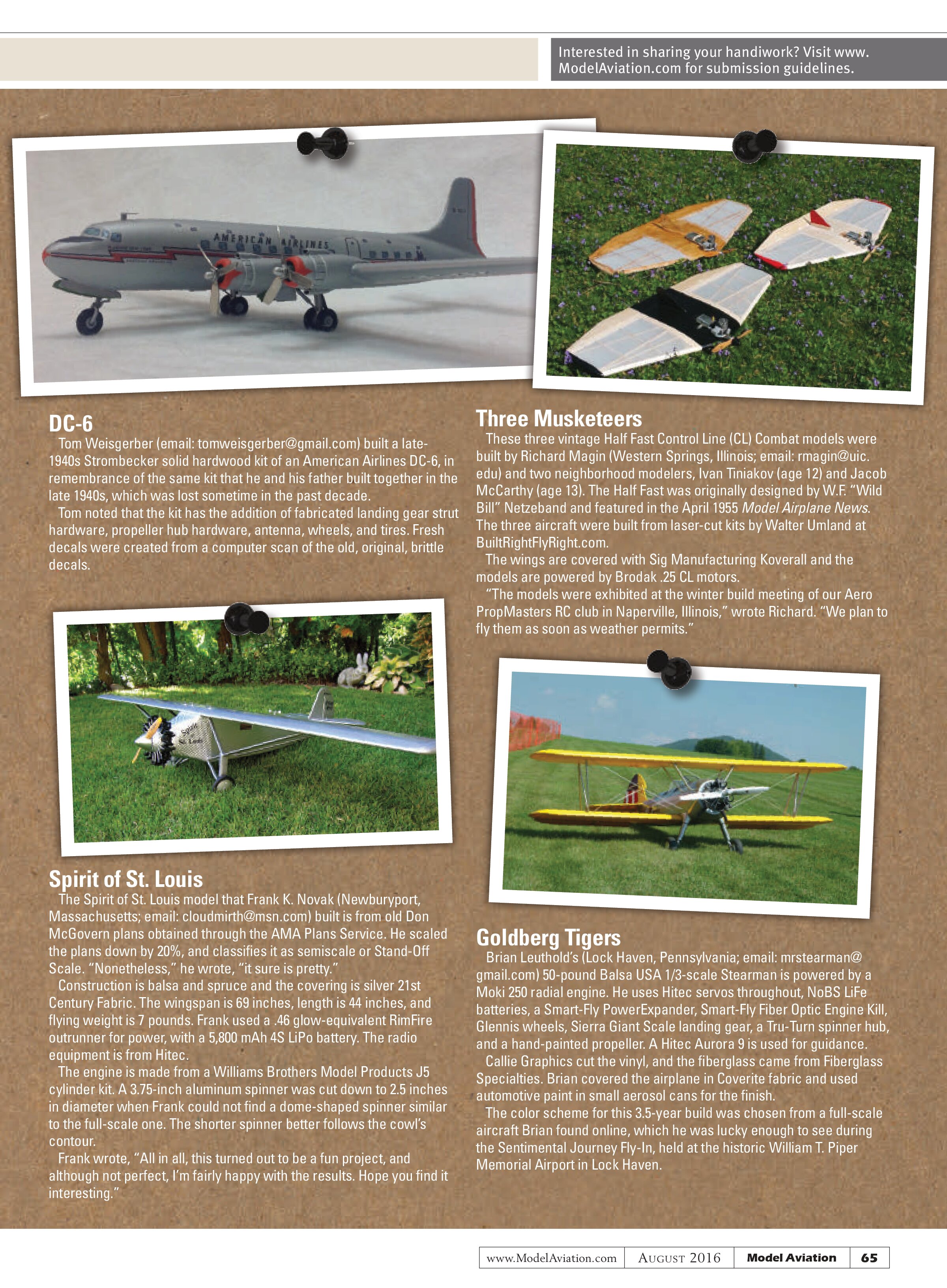
Rex Abbott’s (Sequim, Washington; email: rex1945a@gmail.com) Mars was designed by Bob Palmer in the early 1950s as a follow-up to the Smoothie. Both used the newly developed system of articulated flaps and the Smoothie dominated the marketplace at the time.
Influenced by the full-scale Ercoupe, the Mars featured twin vertical fins and tricycle landing gear, but it was never kitted because the market interest waned.
Rex’s airplane was built from Barry Baxter plans, featured in the September 1952 Model Airplane News. He flew it in local Control Line competition, as well as the 2012 Brodak Fly-In, where he finished second in Old-Time Stunt.
The Saito .40 four-stroke engine has a sideways mount and dummy pod to imitate a twin engine. The unique, elliptical checkerboard pattern was developed in SolidWorks design software and made entirely of colored tissue pieces (no paint). Covering is 4mm white silk.
The photo was taken at the 2012 Brodak Fly-In by Elwyn Aud, a member of the Tulsa Glue Dobbers.
Canadair Water Bomber

Bill Wiedeman (email: retrorock17@yahoo.com) and members of the North Jersey Jumbo Flyers surround Bill’s 16-foot wingspan Canadair Water Bomber, in this photo taken by Bill Voag at the Pete’s Fun Fly event in Mexico, New York, in August 2014.
Bill wrote that the Water Bomber features two 120cc engines.
DC-6

Tom Weisgerber (email: tomweisgerber@gmail.com) built a late-1940s Strombecker solid hardwood kit of an American Airlines DC-6, in remembrance of the same kit that he and his father built together in the late 1940s, which was lost sometime in the past decade.
Tom noted that the kit has the addition of fabricated landing gear strut hardware, propeller hub hardware, antenna, wheels, and tires. Fresh decals were created from a computer scan of the old, original, brittle decals.
Spirit of St. Louis

The Spirit of St. Louis model that Frank K. Novak (Newburyport, Massachusetts; email: cloudmirth@msn.com) built is from old Don McGovern plans obtained through the AMA Plans Service. He scaled the plans down by 20%, and classifies it as semiscale or Stand-Off Scale. “Nonetheless,” he wrote, “it sure is pretty.”
Construction is balsa and spruce and the covering is silver 21st Century Fabric. The wingspan is 69 inches, length is 44 inches, and flying weight is 7 pounds. Frank used a .46 glow-equivalent RimFire outrunner for power, with a 5,800 mAh 4S LiPo battery. The radio equipment is from Hitec.
The engine is made from a Williams Brothers Model Products J5 cylinder kit. A 3.75-inch aluminum spinner was cut down to 2.5 inches in diameter when Frank could not find a dome-shaped spinner similar to the full-scale one. The shorter spinner better follows the cowl’s contour.
Frank wrote, “All in all, this turned out to be a fun project, and although not perfect, I’m fairly happy with the results. Hope you find it interesting.”
Three Musketeers

These three vintage Half Fast Control Line (CL) Combat models were built by Richard Magin (Western Springs, Illinois; email: rmagin@uic.edu) and two neighborhood modelers, Ivan Tiniakov (age 12) and Jacob McCarthy (age 13). The Half Fast was originally designed by W.F. “Wild Bill” Netzeband and featured in the April 1955 Model Airplane News. The three aircraft were built from laser-cut kits by Walter Umland at BuiltRightFlyRight.com.
The wings are covered with Sig Manufacturing Koverall and the models are powered by Brodak .25 CL motors.
“The models were exhibited at the winter build meeting of our Aero PropMasters RC club in Naperville, Illinois,” wrote Richard. “We plan to fly them as soon as weather permits.”
Goldberg Tigers

Brian Leuthold’s (Lock Haven, Pennsylvania; email: mrstearman@gmail.com) 50-pound Balsa USA 1/3-scale Stearman is powered by a Moki 250 radial engine. He uses Hitec servos throughout, NoBS LiFe batteries, a Smart-Fly PowerExpander, Smart-Fly Fiber Optic Engine Kill, Glennis wheels, Sierra Giant Scale landing gear, a Tru-Turn spinner hub, and a hand-painted propeller. A Hitec Aurora 9 is used for guidance.
Callie Graphics cut the vinyl, and the fiberglass came from Fiberglass Specialties. Brian covered the airplane in Coverite fabric and used automotive paint in small aerosol cans for the finish.
The color scheme for this 3.5-year build was chosen from a full-scale aircraft Brian found online, which he was lucky enough to see during the Sentimental Journey Fly-In, held at the historic William T. Piper Memorial Airport in Lock Haven.