Mounting made easy
Greg Gimlick
maelectrics@gimlick.com
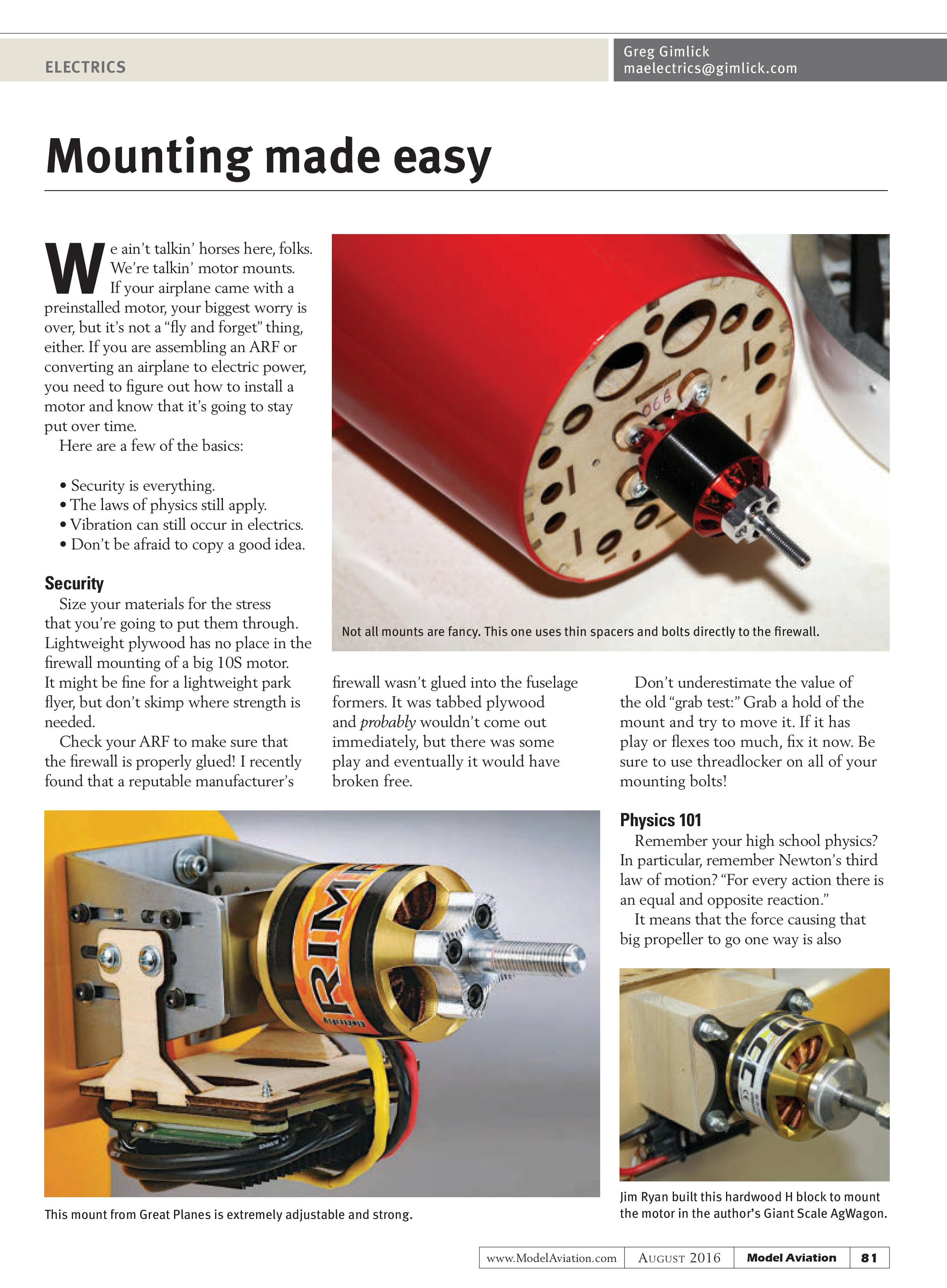
We ain’t talkin’ horses here, folks. We’re talkin’ motor mounts. If your airplane came with a preinstalled motor, your biggest worry is over, but it’s not a “fly and forget” thing, either. If you are assembling an ARF or converting an airplane to electric power, you need to figure out how to install a motor and know that it’s going to stay put over time.
Here are a few of the basics:
- Security is everything.
- The laws of physics still apply.
- Vibration can still occur in electrics.
- Don’t be afraid to copy a good idea.

Security
Size your materials for the stress that you’re going to put them through. Lightweight plywood has no place in the firewall mounting of a big 10S motor. It might be fine for a lightweight park flyer, but don’t skimp where strength is needed.
Check your ARF to make sure that the firewall is properly glued! I recently found that a reputable manufacturer’s firewall wasn’t glued into the fuselage formers. It was tabbed plywood and probably wouldn’t come out immediately, but there was some play and eventually it would have broken free.
Don’t underestimate the value of the old “grab test:” Grab a hold of the mount and try to move it. If it has play or flexes too much, fix it now. Be sure to use threadlocker on all of your mounting bolts!

Physics 101
Remember your high school physics? In particular, remember Newton’s third law of motion? “For every action there is an equal and opposite reaction.”
It means that the force causing that big propeller to go one way is also


causing a force to go the other way. You’ll often hear it referred to as torque, but whatever you call it, you had better mount that motor securely or there will be consequences.
There is nothing like seeing a big motor powered by a 12S battery exit the front of an airplane in flight! How do I know? I demonstrated it at a fly-in a couple of years ago—unintentionally. The constant stress worked the bolt holes in the firewall until it eventually ripped through the plywood.
A 20-inch propeller with 4,000 watts of power is a lot of force. The plywood had been drilled several times after I had changed the motor and mounts, so there wasn’t enough material between two of the bolt holes to provide the needed strength. This was entirely my fault.
The Vibration Myth
I often hear people say, “The great thing is that there isn’t any vibration in an electric airplane.” That couldn’t be further from the truth. Out-of-balance propellers and spinners will cause vibration in an electric-powered aircraft the same way it will in a glow- or gas-powered airplane.
Asymmetrical loading from flexing propellers under load will cause incredible forces to be transmitted back through the airframe. Worn bearings can cause vibration the same way loose hardware will. Don’t assume that there isn’t any vibration working against you.
Be a Copycat
You don’t need to reinvent the wheel. There are hundreds of examples in magazines and online showing great motor-mounting methods. Find one that works for your situation and copy it. Be sure it’s a good idea, though! Talk with experienced friends if you’re new to electrics and see what they think.
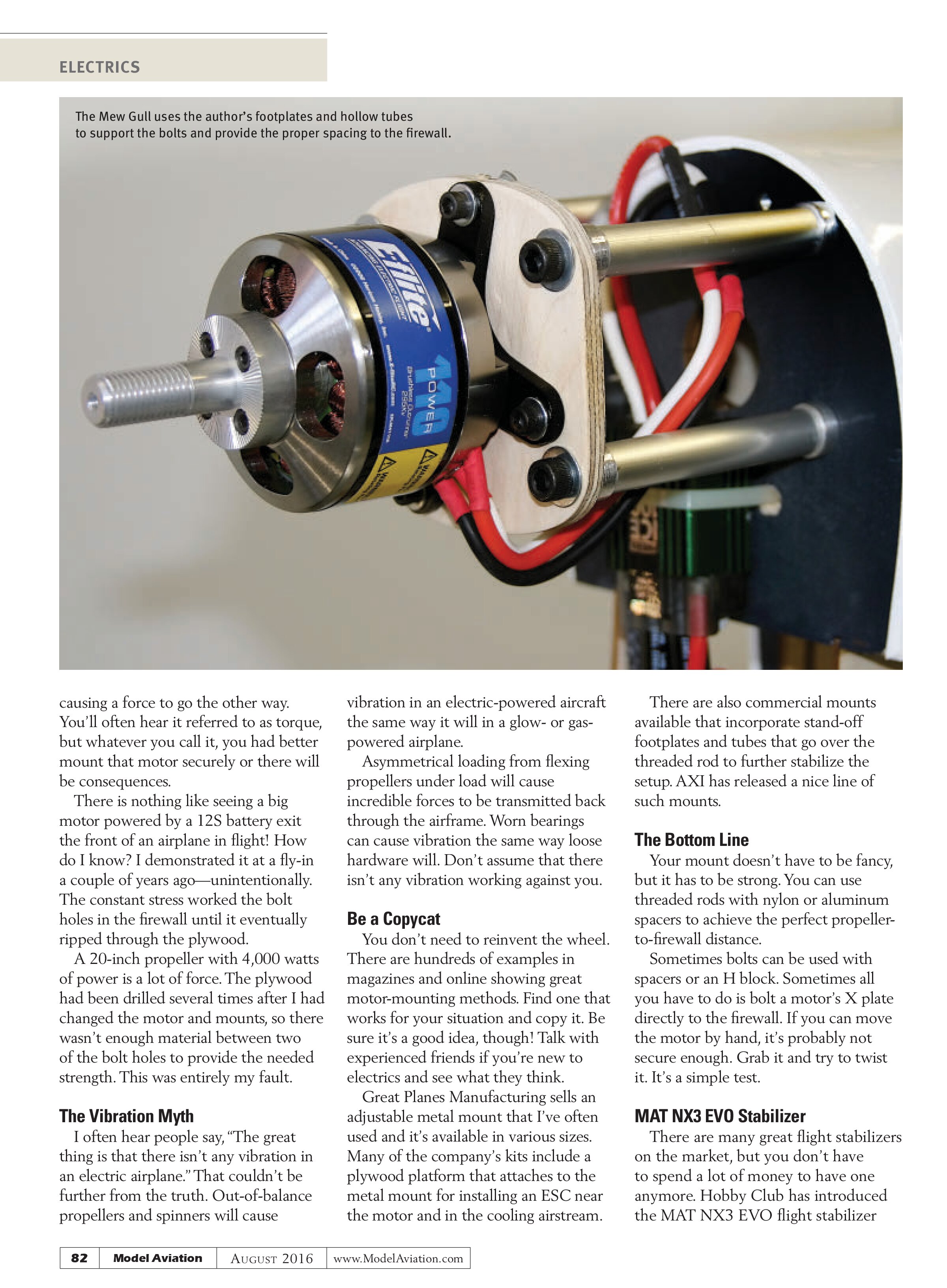
Great Planes Manufacturing sells an adjustable metal mount that I’ve often used and it’s available in various sizes. Many of the company’s kits include a plywood platform that attaches to the metal mount for installing an ESC near the motor and in the cooling airstream.
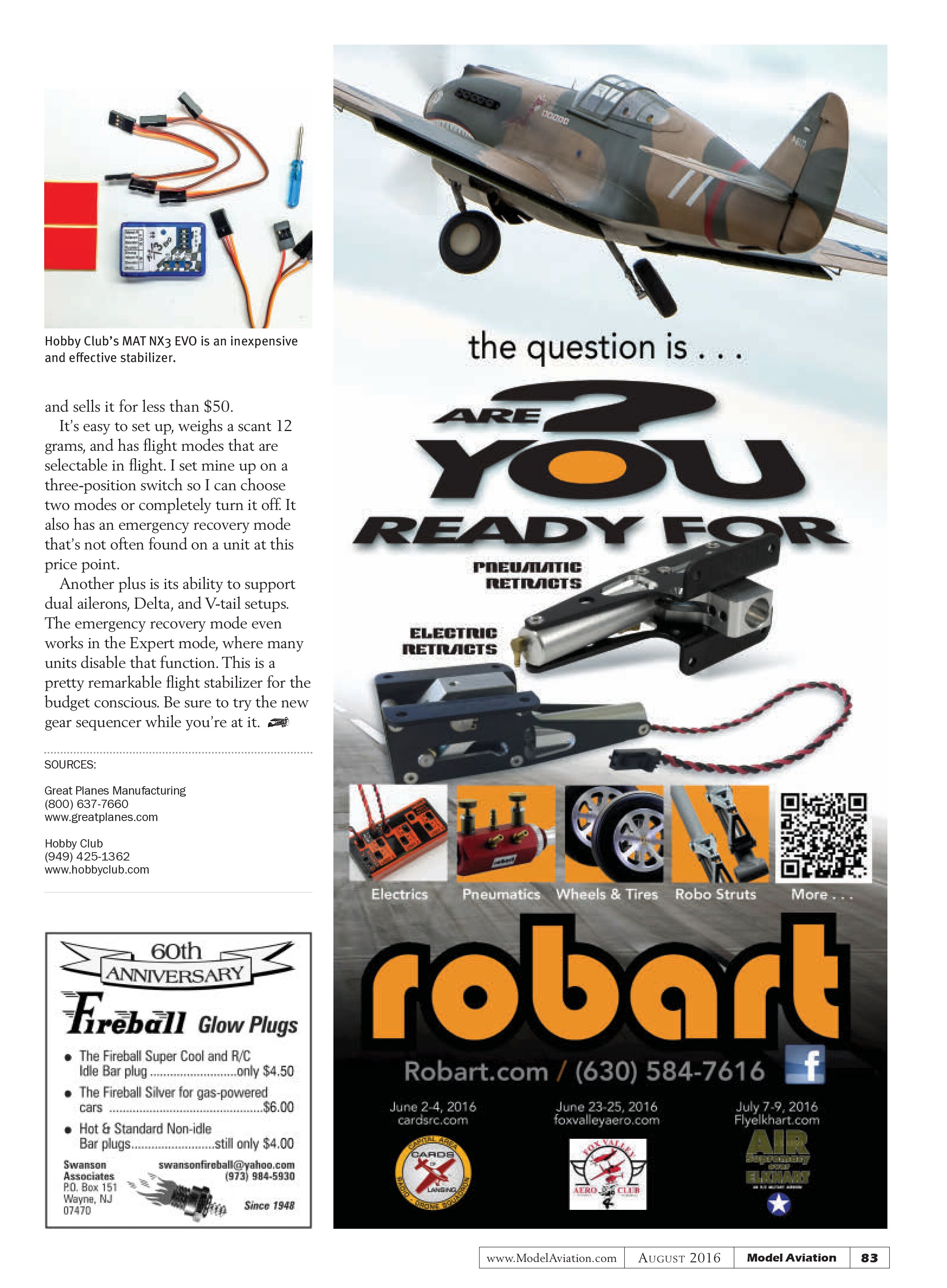
There are also commercial mounts available that incorporate stand-off footplates and tubes that go over the threaded rod to further stabilize the setup. AXI has released a nice line of such mounts.
The Bottom Line
Your mount doesn’t have to be fancy, but it has to be strong. You can use threaded rods with nylon or aluminum spacers to achieve the perfect propeller-to-firewall distance.
Sometimes bolts can be used with spacers or an H block. Sometimes all you have to do is bolt a motor’s X plate directly to the firewall. If you can move the motor by hand, it’s probably not secure enough. Grab it and try to twist it. It’s a simple test.
MAT NX3 EVO Stabilizer
There are many great flight stabilizers on the market, but you don’t have to spend a lot of money to have one anymore. Hobby Club has introduced the MAT NX3 EVO flight stabilizer

It’s easy to set up, weighs a scant 12 grams, and has flight modes that are selectable in flight. I set mine up on a three-position switch so I can choose two modes or completely turn it off. It also has an emergency recovery mode that’s not often found on a unit at this price point.
Another plus is its ability to support dual ailerons, Delta, and V-tail setups. The emergency recovery mode even works in the Expert mode, where many units disable that function. This is a pretty remarkable flight stabilizer for the budget conscious. Be sure to try the new gear sequencer while you’re at it.
SOURCES:
Great Planes Manufacturing
(800) 637-7660
www.greatplanes.com
Hobby Club
(949) 425-1362
www.hobbyclub.com