In the Air
Membership news and updates
from AMA Headquarters
New World Record Set
Two Ohio sailplane pilots have set a new world record that has been ratified by the FAI.
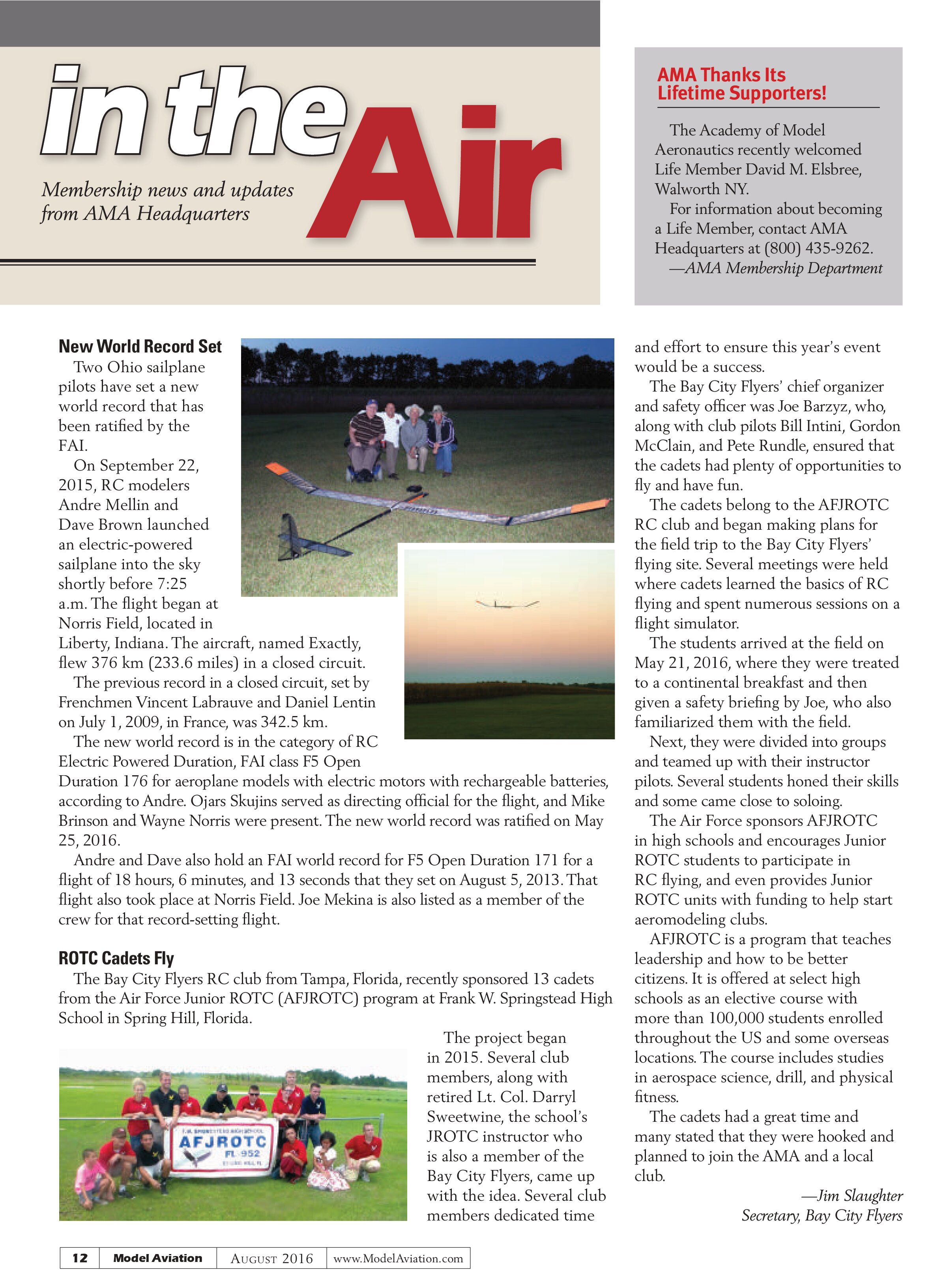
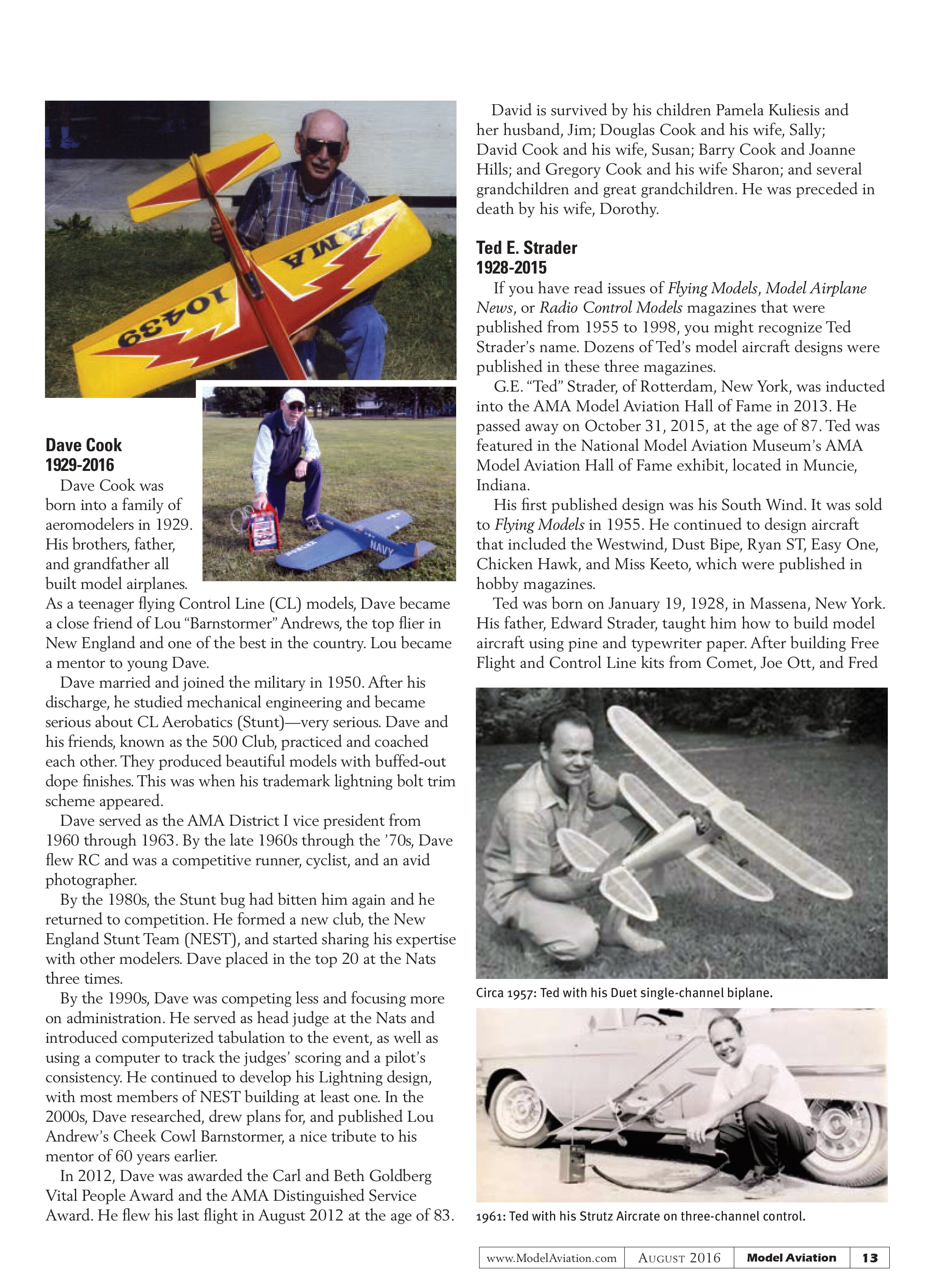
On September 22, 2015, RC modelers Andre Mellin and Dave Brown launched an electric-powered sailplane into the sky shortly before 7:25 a.m. The flight began at Norris Field, located in Liberty, Indiana. The aircraft, named Exactly, flew 376 km (233.6 miles) in a closed circuit.
The previous record in a closed circuit, set by Frenchmen Vincent Labrauve and Daniel Lentin on July 1, 2009, in France, was 342.5 km.
The new world record is in the category of RC Electric Powered Duration, FAI class F5 Open Duration 176 for aeroplane models with electric motors with rechargeable batteries, according to Andre. Ojars Skujins served as directing official for the flight, and Mike Brinson and Wayne Norris were present. The new world record was ratified on May 25, 2016.
Andre and Dave also hold an FAI world record for F5 Open Duration 171 for a flight of 18 hours, 6 minutes, and 13 seconds that they set on August 5, 2013. That flight also took place at Norris Field. Joe Mekina is also listed as a member of the crew for that record-setting flight.


ROTC Cadets Fly
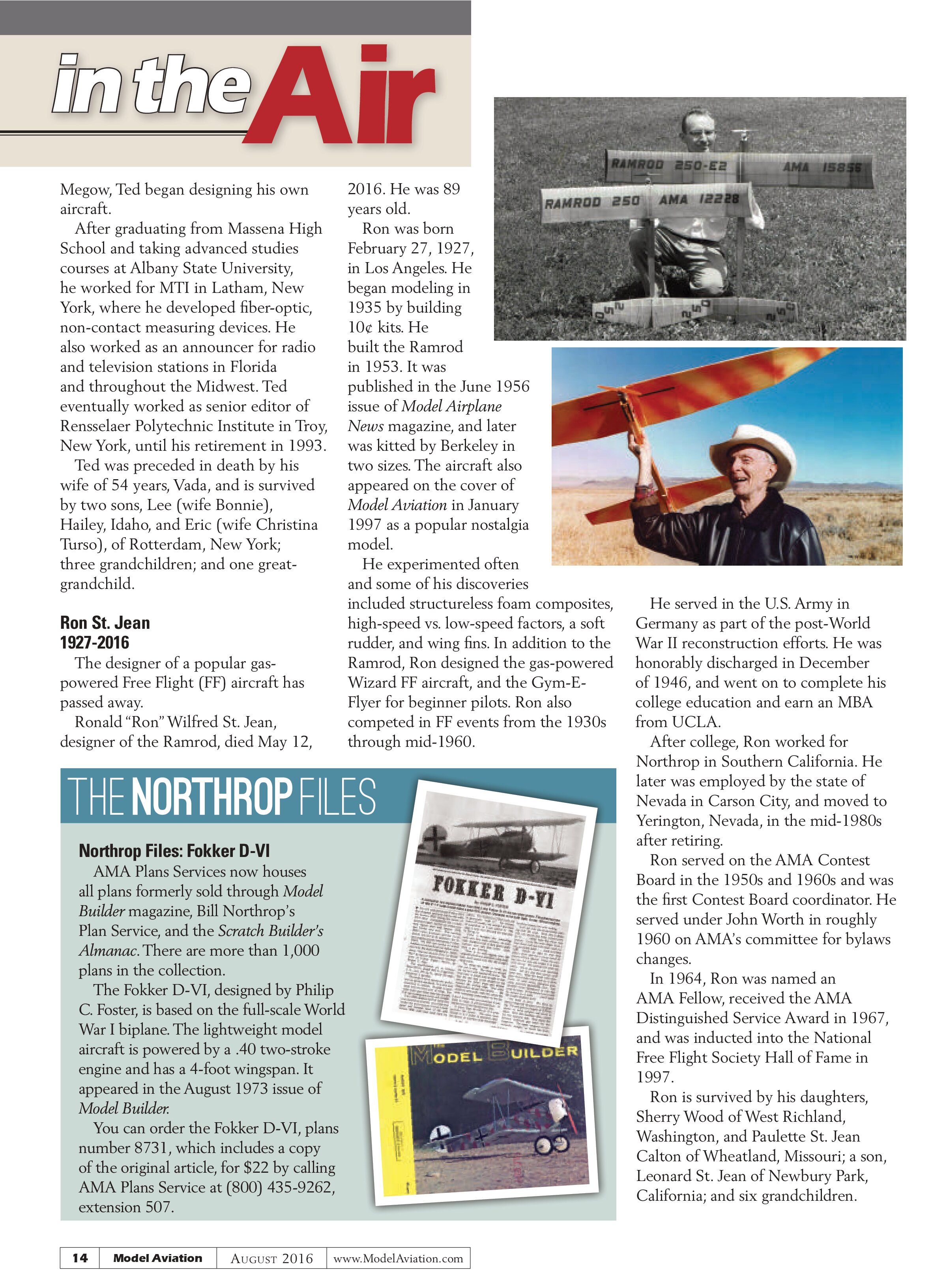
The Bay City Flyers RC club from Tampa, Florida, recently sponsored 13 cadets from the Air Force Junior ROTC (AFJROTC) program at Frank W. Springstead High School in Spring Hill, Florida.

The project began in 2015. Several club members, along with retired Lt. Col. Darryl Sweetwine, the school’s JROTC instructor who is also a member of the Bay City Flyers, came up with the idea. Several club members dedicated time and effort to ensure this year’s event would be a success.
The Bay City Flyers’ chief organizer and safety officer was Joe Barzyz, who, along with club pilots Bill Intini, Gordon McClain, and Pete Rundle, ensured that the cadets had plenty of opportunities to fly and have fun.
The cadets belong to the AFJROTC RC club and began making plans for the field trip to the Bay City Flyers’ flying site. Several meetings were held where cadets learned the basics of RC flying and spent numerous sessions on a flight simulator.
The students arrived at the field on May 21, 2016, where they were treated to a continental breakfast and then given a safety briefing by Joe, who also familiarized them with the field.
Next, they were divided into groups and teamed up with their instructor pilots. Several students honed their skills and some came close to soloing.
The Air Force sponsors AFJROTC in high schools and encourages Junior ROTC students to participate in RC flying, and even provides Junior ROTC units with funding to help start aeromodeling clubs.
AFJROTC is a program that teaches leadership and how to be better citizens. It is offered at select high schools as an elective course with more than 100,000 students enrolled throughout the US and some overseas locations. The course includes studies in aerospace science, drill, and physical fitness.
The cadets had a great time and many stated that they were hooked and planned to join the AMA and a local club.
—Jim Slaughter
Secretary, Bay City Flyers
David is survived by his children Pamela Kuliesis and her husband, Jim; Douglas Cook and his wife, Sally; David Cook and his wife, Susan; Barry Cook and Joanne Hills; and Gregory Cook and his wife Sharon; and several grandchildren and great grandchildren. He was preceded in death by his wife, Dorothy.


Dave Cook
1929-2016
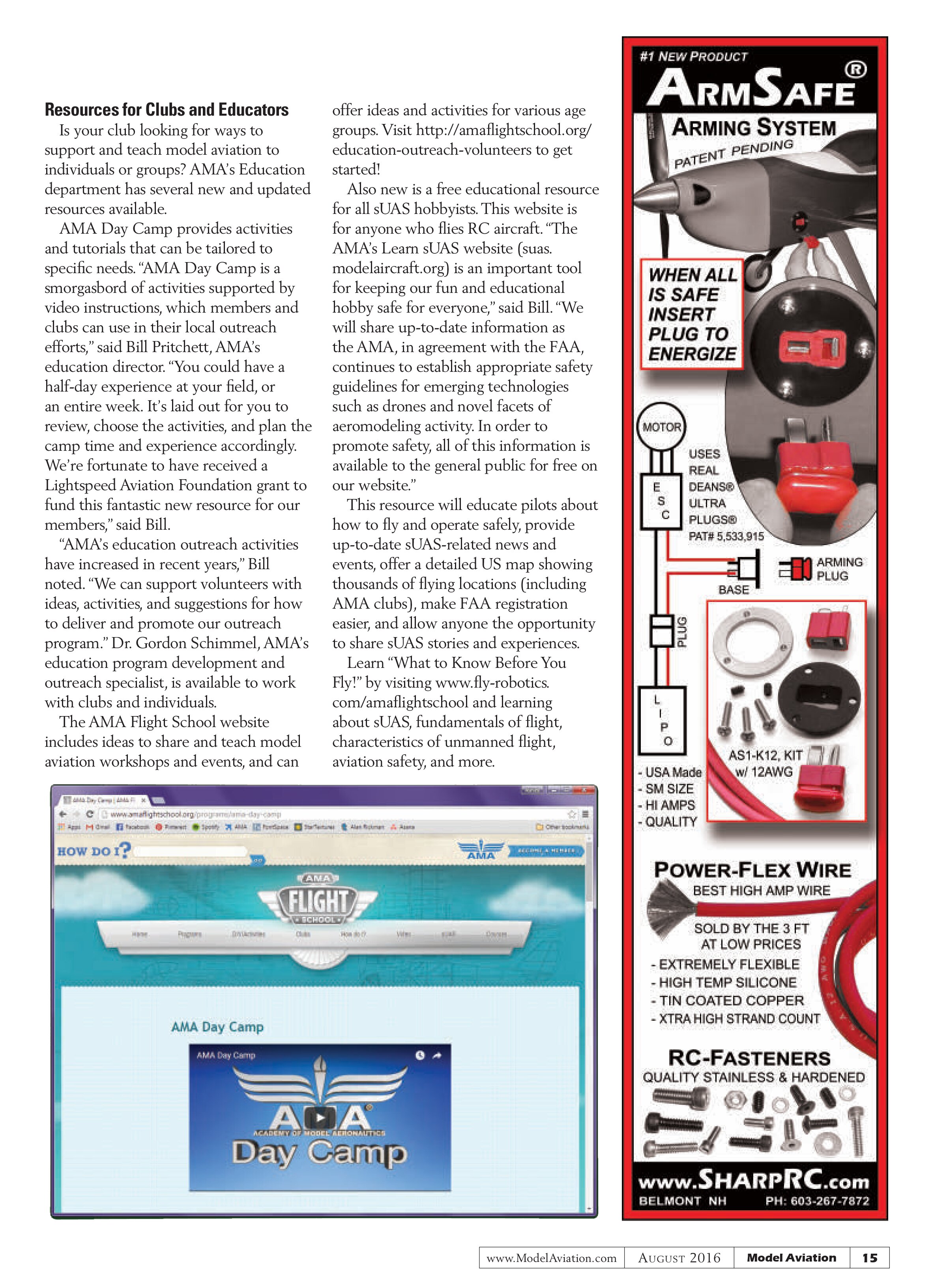
Dave Cook was born into a family of aeromodelers in 1929. His brothers, father, and grandfather all built model airplanes.
As a teenager flying Control Line (CL) models, Dave became a close friend of Lou “Barnstormer” Andrews, the top flier in New England and one of the best in the country. Lou became a mentor to young Dave.
Dave married and joined the military in 1950. After his discharge, he studied mechanical engineering and became serious about CL Aerobatics (Stunt)—very serious. Dave and his friends, known as the 500 Club, practiced and coached each other. They produced beautiful models with buffed-out dope finishes. This was when his trademark lightning bolt trim scheme appeared.
Dave served as the AMA District I vice president from 1960 through 1963. By the late 1960s through the ’70s, Dave flew RC and was a competitive runner, cyclist, and an avid photographer.
By the 1980s, the Stunt bug had bitten him again and he returned to competition. He formed a new club, the New England Stunt Team (NEST), and started sharing his expertise with other modelers. Dave placed in the top 20 at the Nats three times.
By the 1990s, Dave was competing less and focusing more on administration. He served as head judge at the Nats and introduced computerized tabulation to the event, as well as using a computer to track the judges’ scoring and a pilot’s consistency. He continued to develop his Lightning design, with most members of NEST building at least one. In the 2000s, Dave researched, drew plans for, and published Lou Andrew’s Cheek Cowl Barnstormer, a nice tribute to his mentor of 60 years earlier.
In 2012, Dave was awarded the Carl and Beth Goldberg Vital People Award and the AMA Distinguished Service Award. He flew his last flight in August 2012 at the age of 83.
Ted E. Strader
1928-2015
If you have read issues of Flying Models, Model Airplane News, or Radio Control Models magazines that were published from 1955 to 1998, you might recognize Ted Strader’s name. Dozens of Ted’s model aircraft designs were published in these three magazines.
G.E. “Ted” Strader, of Rotterdam, New York, was inducted into the AMA Model Aviation Hall of Fame in 2013. He passed away on October 31, 2015, at the age of 87. Ted was featured in the National Model Aviation Museum’s AMA Model Aviation Hall of Fame exhibit, located in Muncie, Indiana.
His first published design was his South Wind. It was sold to Flying Models in 1955. He continued to design aircraft that included the Westwind, Dust Bipe, Ryan ST, Easy One, Chicken Hawk, and Miss Keeto, which were published in hobby magazines.
Ted was born on January 19, 1928, in Massena, New York. His father, Edward Strader, taught him how to build model aircraft using pine and typewriter paper. After building Free Flight and Control Line kits from Comet, Joe Ott, and Fred

Circa 1957: Ted with his Duet single-channel biplane.

1961: Ted with his Strutz Aircrate on three-channel control.
Megow, Ted began designing his own aircraft.
After graduating from Massena High School and taking advanced studies courses at Albany State University, he worked for MTI in Latham, New York, where he developed fiber-optic, non-contact measuring devices. He also worked as an announcer for radio and television stations in Florida and throughout the Midwest. Ted eventually worked as senior editor of Rensselaer Polytechnic Institute in Troy, New York, until his retirement in 1993.
Ted was preceded in death by his wife of 54 years, Vada, and is survived by two sons, Lee (wife Bonnie), Hailey, Idaho, and Eric (wife Christina Turso), of Rotterdam, New York; three grandchildren; and one great-grandchild.
Ron St. Jean
1927-2016
The designer of a popular gas-powered Free Flight (FF) aircraft has passed away.
Ronald “Ron” Wilfred St. Jean, designer of the Ramrod, died May 12, 2016. He was 89 years old.
Ron was born February 27, 1927, in Los Angeles. He began modeling in 1935 by building 10¢ kits. He built the Ramrod in 1953. It was published in the June 1956 issue of Model Airplane News magazine, and later was kitted by Berkeley in two sizes. The aircraft also appeared on the cover of Model Aviation in January 1997 as a popular nostalgia model.
He experimented often and some of his discoveries included structureless foam composites, high-speed vs. low-speed factors, a soft rudder, and wing fins. In addition to the Ramrod, Ron designed the gas-powered Wizard FF aircraft, and the Gym-E-Flyer for beginner pilots. Ron also competed in FF events from the 1930s through mid-1960.


He served in the U.S. Army in Germany as part of the post-World War II reconstruction efforts. He was honorably discharged in December of 1946, and went on to complete his college education and earn an MBA from UCLA.
After college, Ron worked for Northrop in Southern California. He later was employed by the state of Nevada in Carson City, and moved to Yerington, Nevada, in the mid-1980s after retiring.
Ron served on the AMA Contest Board in the 1950s and 1960s and was the first Contest Board coordinator. He served under John Worth in roughly 1960 on AMA’s committee for bylaws changes.
In 1964, Ron was named an AMA Fellow, received the AMA Distinguished Service Award in 1967, and was inducted into the National Free Flight Society Hall of Fame in 1997.
Ron is survived by his daughters, Sherry Wood of West Richland, Washington, and Paulette St. Jean Calton of Wheatland, Missouri; a son, Leonard St. Jean of Newbury Park, California; and six grandchildren.
Northrop Files: Fokker D-VI
AMA Plans Services now houses all plans formerly sold through Model Builder magazine, Bill Northrop’s Plan Service, and the Scratch Builder’s Almanac. There are more than 1,000 plans in the collection.
The Fokker D-VI, designed by Philip C. Foster, is based on the full-scale World War I biplane. The lightweight model aircraft is powered by a .40 two-stroke engine and has a 4-foot wingspan. It appeared in the August 1973 issue of Model Builder.
You can order the Fokker D-VI, plans number 8731, which includes a copy of the original article, for $22 by calling AMA Plans Service at (800) 435-9262, extension 507.


Resources for Clubs and Educators
Is your club looking for ways to support and teach model aviation to individuals or groups? AMA’s Education department has several new and updated resources available.
AMA Day Camp provides activities and tutorials that can be tailored to specific needs. “AMA Day Camp is a smorgasbord of activities supported by video instructions, which members and clubs can use in their local outreach efforts,” said Bill Pritchett, AMA’s education director. “You could have a half-day experience at your field, or an entire week. It’s laid out for you to review, choose the activities, and plan the camp time and experience accordingly. We’re fortunate to have received a Lightspeed Aviation Foundation grant to fund this fantastic new resource for our members,” said Bill.
“AMA’s education outreach activities have increased in recent years,” Bill noted. “We can support volunteers with ideas, activities, and suggestions for how to deliver and promote our outreach program.” Dr. Gordon Schimmel, AMA’s education program development and outreach specialist, is available to work with clubs and individuals.
The AMA Flight School website includes ideas to share and teach model aviation workshops and events, and can offer ideas and activities for various age groups. Visit http://amaflightschool.org/education-outreach-volunteers to get started!
Also new is a free educational resource for all sUAS hobbyists. This website is for anyone who flies RC aircraft. “The AMA’s Learn sUAS website (suas.modelaircraft.org) is an important tool for keeping our fun and educational hobby safe for everyone,” said Bill. “We will share up-to-date information as the AMA, in agreement with the FAA, continues to establish appropriate safety guidelines for emerging technologies such as drones and novel facets of aeromodeling activity. In order to promote safety, all of this information is available to the general public for free on our website.”
This resource will educate pilots about how to fly and operate safely, provide up-to-date sUAS-related news and events, offer a detailed US map showing thousands of flying locations (including AMA clubs), make FAA registration easier, and allow anyone the opportunity to share sUAS stories and experiences.
Learn “What to Know Before You Fly!” by visiting www.fly-robotics.com/amaflightschool and learning about sUAS, fundamentals of flight, characteristics of unmanned flight, aviation safety, and more.

AMA Logo History
AMA’s logo has changed throughout the past 80 years, but even going back to that first one, the torch and wings were there. The earliest rendition of the logo that we can find was published in the second issue of Model Aviation (August 1936). It was designed by Frank Zaic.
In that issue, it stated, “The Academy emblem or seal will be used to decorate the Academy’s letterhead, membership cards, publications, etc. It will form the corporate seal when the incorporation of the Academy has been accomplished. The symbol of the central torch, for knowledge, and wings, for flight, is most fitting to the purposes of the Academy.”
Surrounding the winged torch was the initial name for the Academy, the American Academy for Model Aeronautics. (This was changed to Academy of Model Aeronautics soon afterward.)
In approximately 1940, because the National Aeronautic Association (NAA) served as AMA’s parent organization, the letters NAA were placed in the center of the wings. By the time that AMA was incorporated in 1966, the logo had already been changed—with the wings expanded and AMA written in the center of the torch.
The wings have lengthened and shortened throughout the years, AMA was moved below the iconic symbols, “Since 1936” was added, and more changes have taken place for special celebrations, but the torch and wings remain. Cheers to another 80 years of our icons of knowledge and flight.
If you find an AMA logo that is different from the ones pictured, snap a picture and post it on the museum’s Facebook page. Please let us know where you found it. We’d love to see more renditions of the torch and wings.
—National Model Aviation Museum staff