Early actuators
Bob Noll
bobrc@aol.com
This month, I will tell you about the early actuators that we used to guide our airplanes and keep them from flying away.
Bringing the airplanes back to the flying field where we had hand launched them was our primary objective. In those days, aerobatics was only for full-scale airplanes. Single channel meant that only a single carrier wave signal was transmitted by our transmitter. That signal, after being received by the receiver, allowed a coil on an escapement to be actuated and move the rudder. Yes, we flew with only rudder control in those early days.
Today, escapement mechanisms are found in pendulum or windup clocks and were the basis for early developers who built the first escapements for radio control. In the 1940s, modelers had to make their own escapements. I found articles in Model Airplane News and in the February 1950 issue of Flying Models where escapements were mentioned,
but neither magazine contained any advertisements for buying one.
J.S. Luck wrote a two-part article for Model Airplane News (February and March 1950) titled “Reliable Escapements,” where he explained what it took to build one. In Flying Models, Walter A. Good and Gordon S. Light explained, “The escapement is the muscle which puts into action the signal received by the brain.”
There was mention in those magazines of an Aerotrol radio set, but I could not find any advertisements for

escapements until March 1952. That was when Berkeley announced its Super Aerotrol system with a receiver for $13.95, transmitter for $21.95, and an escapement kit for $2.95. The magazine ad contained a boldface statement: “Flash!—License free after March 24, 1952.”
Polk’s Hobbies advertised its Electronics Developments radio control system in July 1952. The system was listed at $52.90, the receiver separately at $18.95, and the escapement at $5.95. The Polk ad stated that the escapement was 100% reliable.
Before March 24, 1952, a license was required by the FCC for any radio transmissions. Most RC equipment was being developed by amateur radio operators who had purchased these licenses, so many of the early experimenters built their RC systems to operate on the 50 MHz or 6-meter amateur radio band.
On March 24, 1952, the FCC opened the citizens band and, although an FCC license was still required, it was available at no cost. The citizens band was on 27 MHz and the common frequency for that day was 27.255 MHz.
A rubber motor powered all of the escapements that I used. This motor was made from ⅛-inch or ³⁄₁₆-inch rubber, which was attached to the escapement and the rear of the fuselage. The rubber was wound a certain number of times to provide the power that advanced the escapement when necessary.
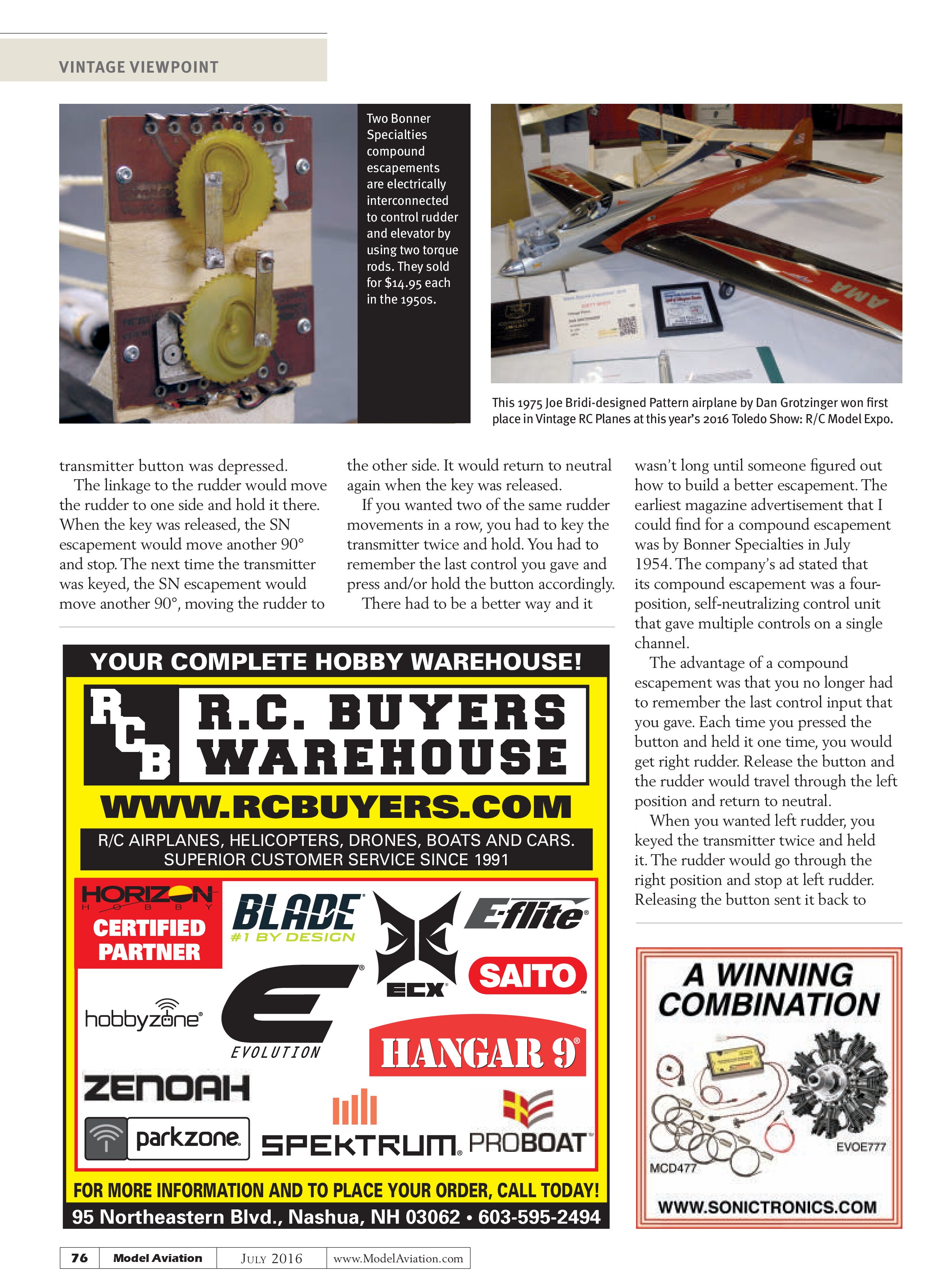
The simple escapement was the least expensive and the first type available. It was referred to as a self-neutralizing (SN) escapement. When the escapement was activated by the receiver through a relay, it would rotate 90° and stay there as long as the
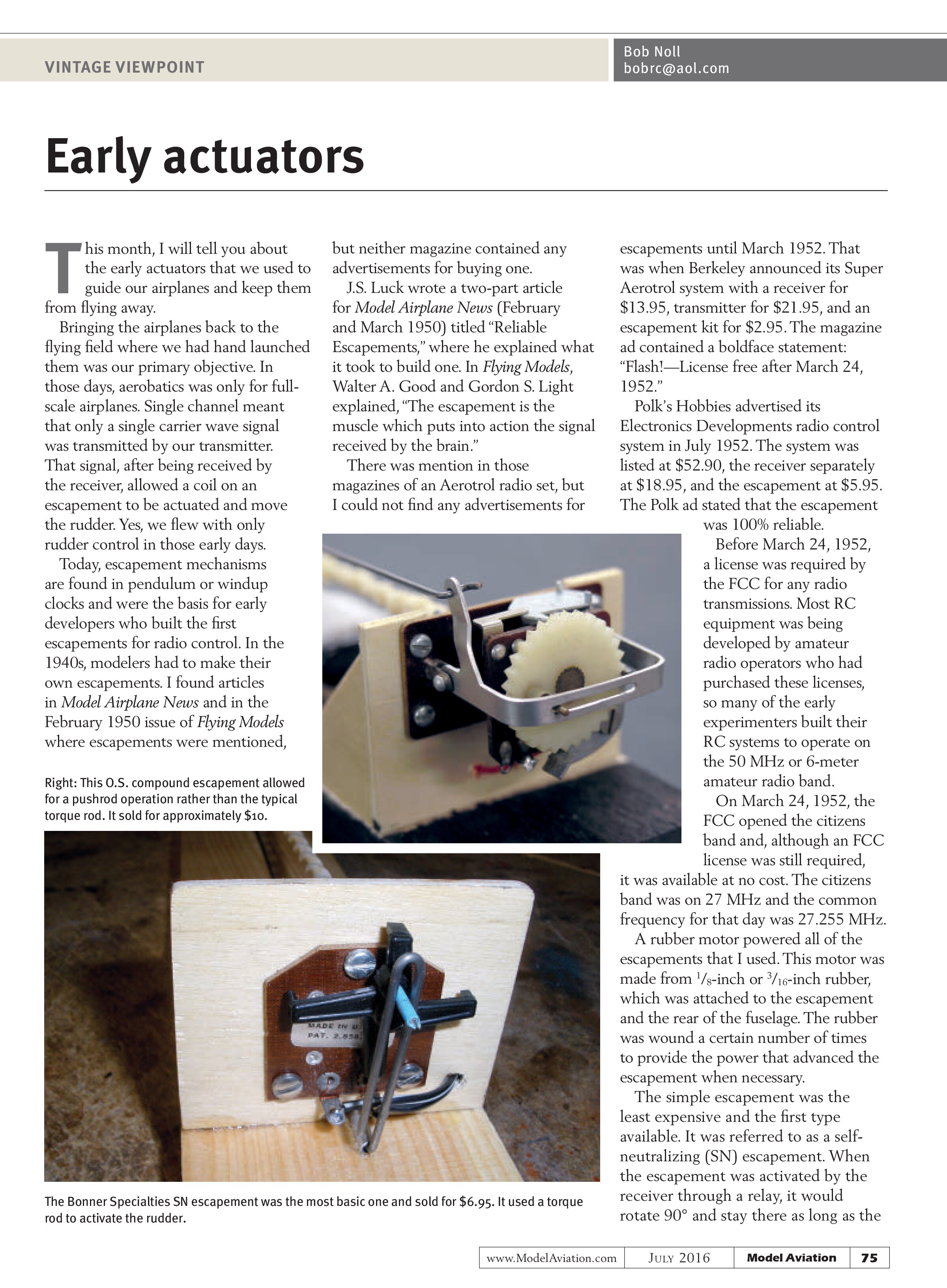
Right: This O.S. compound escapement allowed for a pushrod operation rather than the typical torque rod. It sold for approximately $10.

transmitter button was depressed. The linkage to the rudder would move the rudder to one side and hold it there. When the key was released, the SN escapement would move another 90° and stop. The next time the transmitter was keyed, the SN escapement would move another 90°, moving the rudder to
the other side. It would return to neutral again when the key was released. If you wanted two of the same rudder movements in a row, you had to key the transmitter twice and hold. You had to remember the last control you gave and press and/or hold the button accordingly. There had to be a better way and it
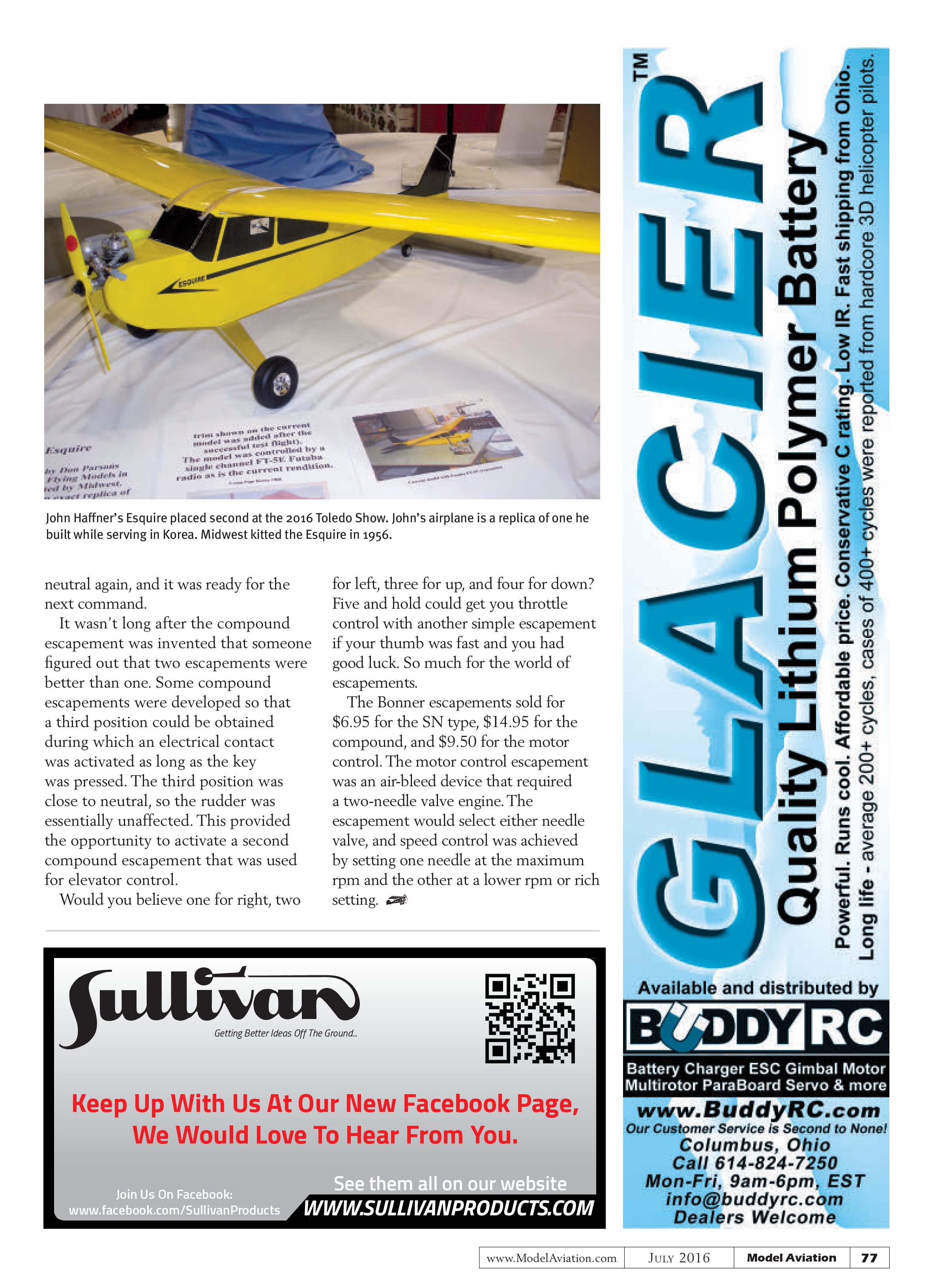
wasn’t long until someone figured out how to build a better escapement. The earliest magazine advertisement that I could find for a compound escapement was by Bonner Specialties in July 1954. The company’s ad stated that its compound escapement was a four-position, self-neutralizing control unit that gave multiple controls on a single channel. The advantage of a compound escapement was that you no longer had to remember the last control input that you gave. Each time you pressed the button and held it one time, you would get right rudder. Release the button and the rudder would travel through the left position and return to neutral. When you wanted left rudder, you keyed the transmitter twice and held it. The rudder would go through the right position and stop at left rudder. Releasing the button sent it back to
neutral again, and it was ready for the next command. It wasn’t long after the compound escapement was invented that someone figured out that two escapements were better than one. Some compound escapements were developed so that a third position could be obtained during which an electrical contact was activated as long as the key was pressed. The third position was close to neutral, so the rudder was essentially unaffected. This provided the opportunity to activate a second compound escapement that was used for elevator control. Would you believe one for right, two
for left, three for up, and four for down? Five and hold could get you throttle control with another simple escapement if your thumb was fast and you had good luck. So much for the world of escapements. The Bonner escapements sold for $6.95 for the SN type, $14.95 for the compound, and $9.50 for the motor control. The motor control escapement was an air-bleed device that required a two-needle valve engine. The escapement would select either needle valve, and speed control was achieved by setting one needle at the maximum rpm and the other at a lower rpm or rich setting.