The archenemy of safety
Dave Gee

Don’t you just love super villains? Battling evil is more satisfying when the bad guy wears a corny costume and has a sinister laugh.
I’ve figured out who my nemesis is when it comes to safe aeromodeling. He glares back at me in the mirror each morning. Of course, we are all our own worst enemies when it comes to avoiding incidents with our models.
It’s embarrassing to not be able to blame things on anyone else, but in our hobby, each pilot is the commodore of an air fleet and he or she makes all of the decisions. I get to pick the type of model, whether to buy or build it, and how it will be operated. The responsibility of flying safely is mine.
This autonomy is part of the appeal of our hobby, but it carries the risk of becoming complacent with such power. It takes a sharp pilot to resist taking the shortcuts that become tempting after a while.
Our inner commodore says,
“We’ve made many flights with this dependable model. We know the power and control systems inside and out. Why do a full preflight inspection? I’m in charge here, and I say we can skip it this time!”
Even after many decades in this hobby, I sometimes feel evil urges to cut corners. The truth is that I’m not experienced enough to skip tried-and-true safety precautions. None of us are. The moment that I try a shortcut is when a gremlin will sneak in and remind me why a rule was made. If you see me wearing a bandage on my finger sometime, you’ll know that the bad guy in the mirror had his way.
Drones and Soda
Once upon a time,

there were local hobby shops all across the country. You could drop by and look at the latest models, and beginners could get advice and information. These days, that type of hobby shop is rare. Many novices are on their own when learning to build and fly their machines. Helping new pilots become safe pilots is an important part of supporting our hobby.
With the current multirotor/drone movement, I’ve found aeromodeling items for sale in the oddest locations. A local electronics store had dozens of types of multirotors, along with conventional RC helicopters and fixed-wing models in RC and Free Flight types, for sale. Across town, a bedding store had a display of infrared-controlled rotorcraft. Some toy stores, museum gift shops, and sporting goods stores also have models for sale these days.
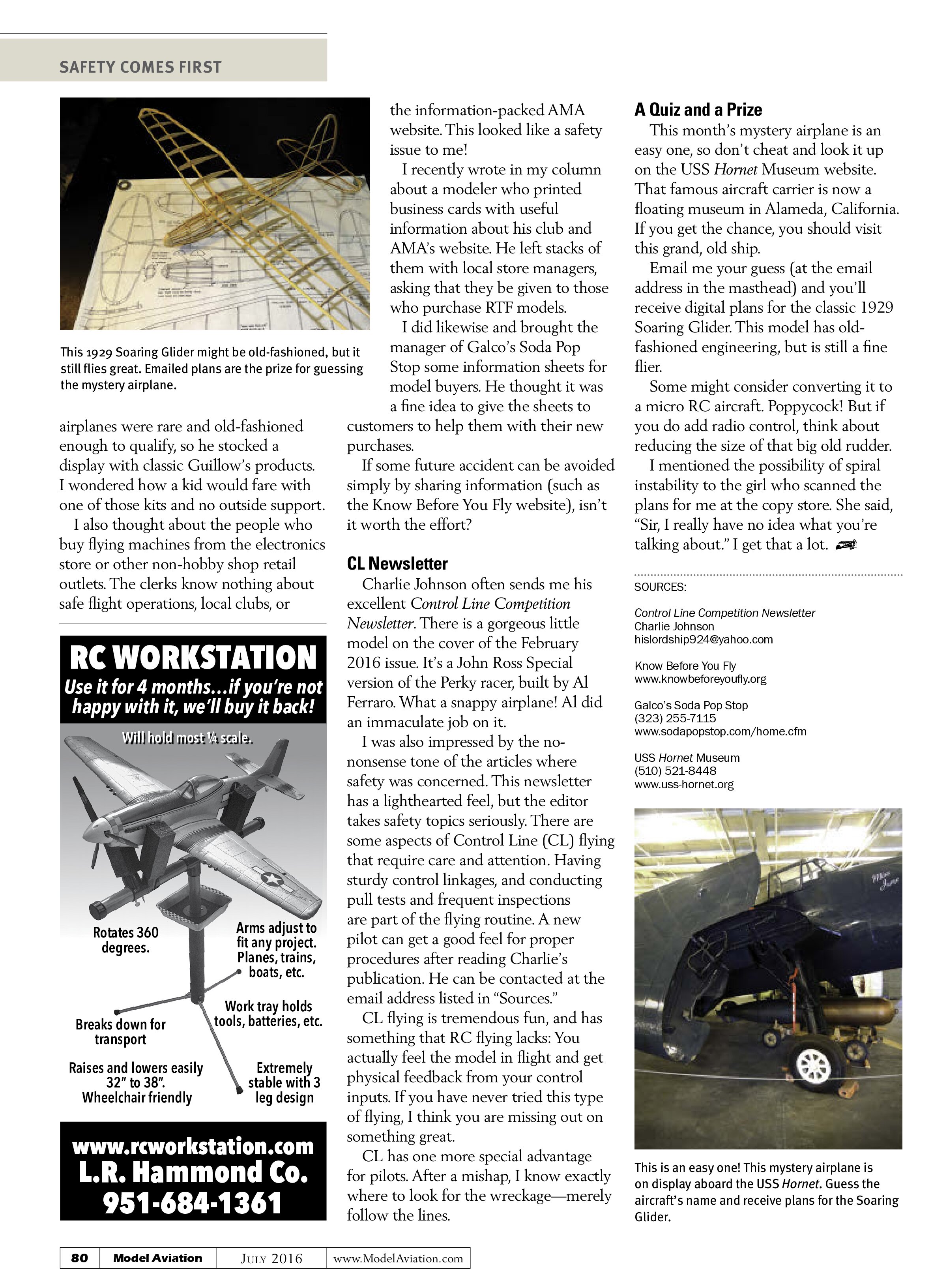
Topping it all was the rack of balsa model kits that I found at Galco’s Soda Pop Stop in Los Angeles. You might have seen this store on a food or travel channel. It sells unusual or obsolete beverages and candy bars that you thought were long gone. The shop carries Abita Root Beer from the New Orleans area, and boy is it good!
The owner decided that model

airplanes were rare and old-fashioned enough to qualify, so he stocked a display with classic Guillows products. I wondered how a kid would fare with one of those kits and no outside support.
I also thought about the people who buy flying machines from the electronics store or other non-hobby shop retail outlets. The clerks know nothing about safe flight operations, local clubs, or the information-packed AMA website. This looked like a safety issue to me!
I recently wrote in my column about a modeler who printed business cards with useful information about his club and AMA’s website. He left stacks of them with local store managers, asking that they be given to those who purchase RTF models.
I did likewise and brought the manager of Galco’s Soda Pop Stop some information sheets for model buyers. He thought it was a fine idea to give the sheets to customers to help them with their new purchases.
If some future accident can be avoided simply by sharing information (such as the Know Before You Fly website), isn’t it worth the effort?
CL Newsletter
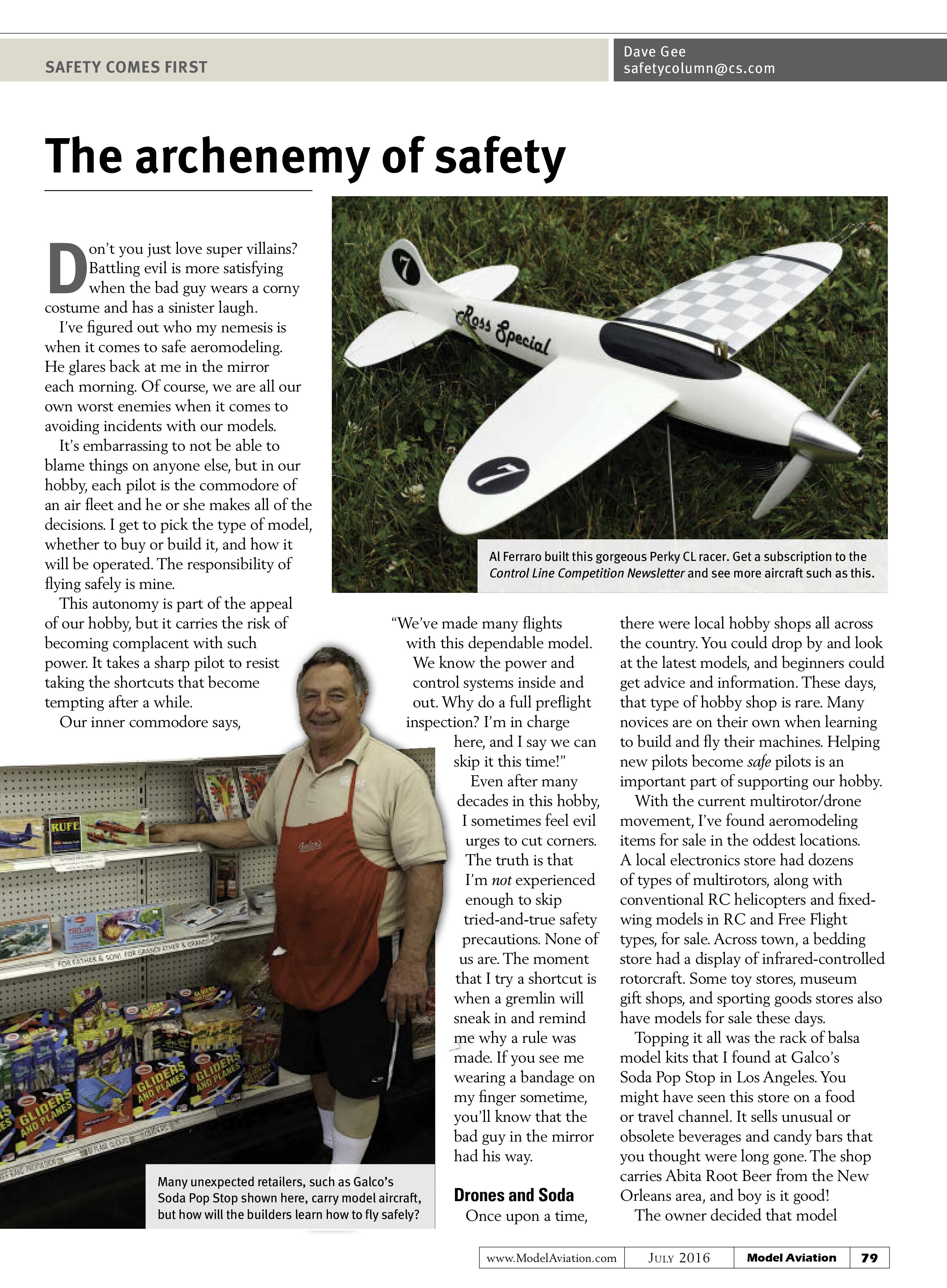
Charlie Johnson often sends me his excellent Control Line Competition Newsletter. There is a gorgeous little model on the cover of the February 2016 issue. It’s a John Ross Special version of the Perky racer, built by Al Ferraro. What a snappy airplane! Al did an immaculate job on it.
I was also impressed by the no-nonsense tone of the articles where safety was concerned. This newsletter has a lighthearted feel, but the editor takes safety topics seriously. There are some aspects of Control Line (CL) flying that require care and attention. Having sturdy control linkages, and conducting pull tests and frequent inspections are part of the flying routine. A new pilot can get a good feel for proper procedures after reading Charlie’s publication. He can be contacted at the email address listed in “Sources.”
CL flying is tremendous fun, and has something that RC flying lacks: You actually feel the model in flight and get physical feedback from your control inputs. If you have never tried this type of flying, I think you are missing out on something great.
CL has one more special advantage for pilots. After a mishap, I know exactly where to look for the wreckage—merely follow the lines.
A Quiz and a Prize
This month’s mystery airplane is an easy one, so don’t cheat and look it up on the USS Hornet Museum website. That famous aircraft carrier is now a floating museum in Alameda, California. If you get the chance, you should visit this grand, old ship.
Email me your guess (at the email address in the masthead) and you’ll receive digital plans for the classic 1929 Soaring Glider. This model has old-fashioned engineering, but is still a fine flier.
Some might consider converting it to a micro RC aircraft. Poppycock! But if you do add radio control, think about reducing the size of that big old rudder.
I mentioned the possibility of spiral instability to the girl who scanned the plans for me at the copy store. She said, “Sir, I really have no idea what you’re talking about.” I get that a lot.
SOURCES:
Control Line Competition Newsletter
Charlie Johnson
hislordship924@yahoo.com
Know Before You Fly
www.knowbeforeyoufly.org
Galco’s Soda Pop Stop
(323) 255-7115
www.sodapopstop.com/home.cfm
USS Hornet Museum
(510) 521-8448
www.uss-hornet.org