Is the LSF reinventing itself?
by Gordon Buckland
gordon@gatorf3b.com

In the past few years, the League of Silent Flight (LSF) has gone through somewhat of an overhaul in an attempt to become more relevant to today’s Soaring pilots and to revitalize interest in the program.
The LSF has probably helped shape the futures of more sailplane pilots in the US than any other single factor. This has been accomplished not only through the LSF Soaring Accomplishment Program (SAP), but also by promoting Soaring every summer at the Nats in Muncie, Indiana, and sponsoring other events and national teams.
In recent years, pilots have migrated to electric-launch sailplanes and the number of entrants in winch-launch events has decreased across the country. Over time, this would have been the death knell to the LSF SAP as it was.
A couple of years ago, however, after a lengthy debate, the Electric Soaring Accomplishment Program (ESAP) was born to welcome this new breed of sailplane pilots.
The ESAP was created as a parallel achievement program that would not detract from the existing LSF SAP that has been successful for many years. The new ESAP was enthusiastically embraced by many pilots brandishing their modern, self-launching Soaring machines.
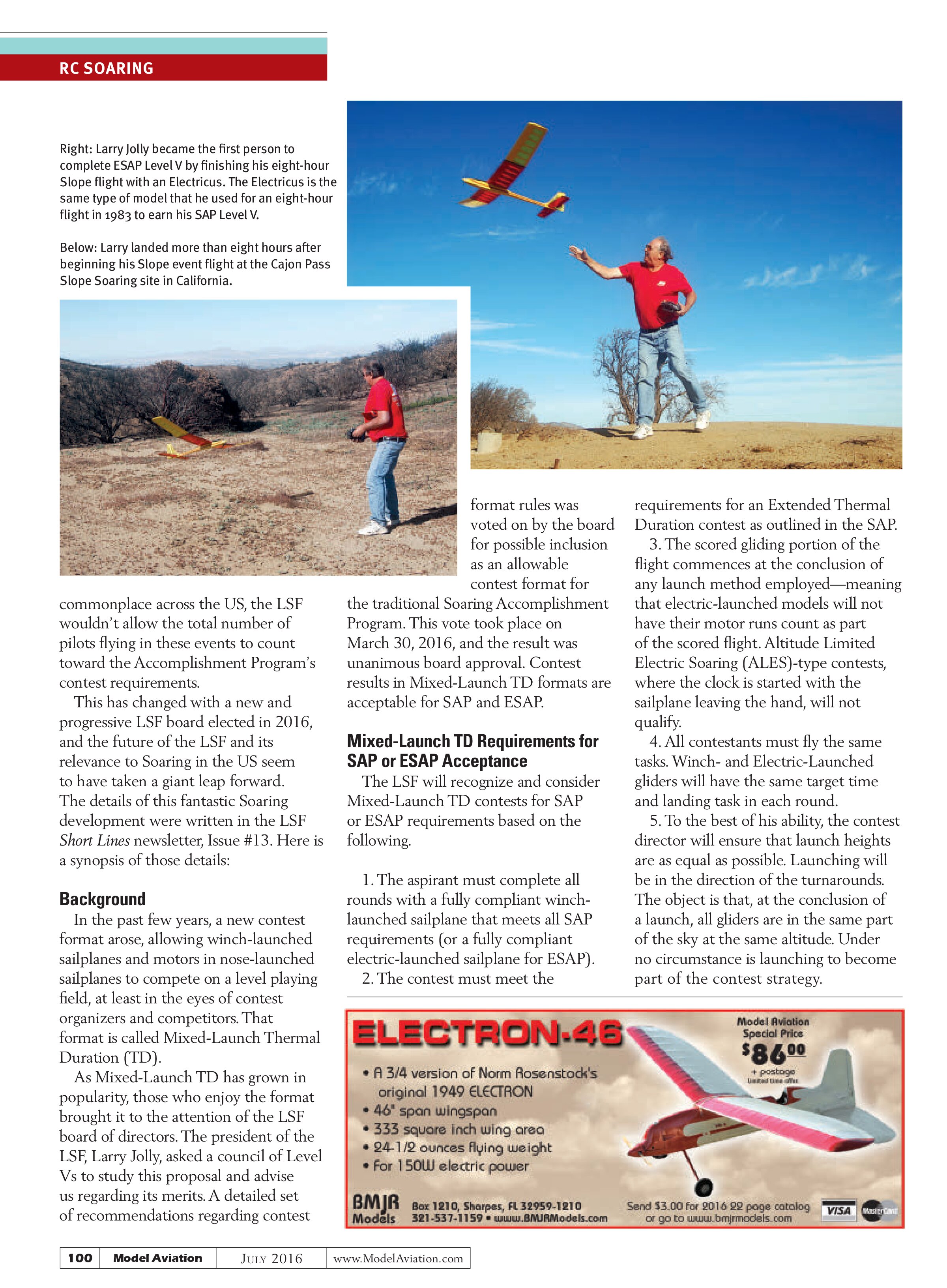
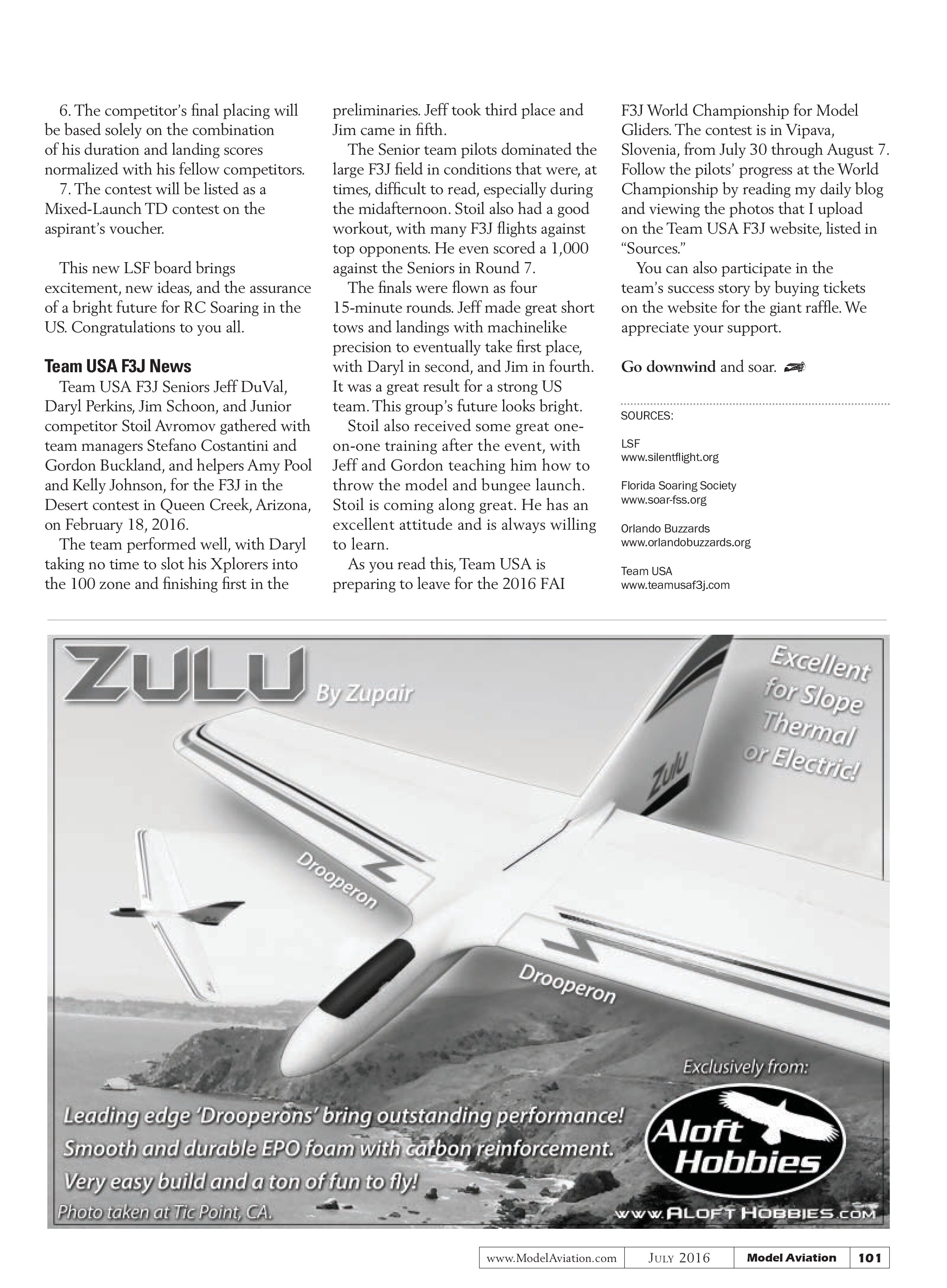
The race was now on to see who would achieve the coveted ESAP Level V first. The front-runners soon emerged as Larry Jolly, Merril Brady, and David Beach—who all completed Level IV in early 2015. It was Larry Jolly (the grandfather of Soaring in the US) who was the first to reach ESAP Level V on August 15, 2015. Larry worked through the five levels in record time—completing the program in slightly more than 12 months after he began. He also became the first to achieve Level V in both SAP and ESAP. Congratulations, Larry!
There was clearly new LSF excitement in Soaring circles. Many blue forms were produced at the conclusion of events, as pilots worked to verify their achievements in the new program.
The biggest hurdle for all pilots who were moving forward with SAP or ESAP was having enough participation in events to meet the contest requirements at each level.
Although mixed-launch events (pioneered in 2013 by Raed Elazzawi of the Orlando Buzzards and the Florida Soaring Society) had become


commonplace across the US, the LSF wouldn’t allow the total number of pilots flying in these events to count toward the Accomplishment Program’s contest requirements.
This has changed with a new and progressive LSF board elected in 2016, and the future of the LSF and its relevance to Soaring in the US seem to have taken a giant leap forward. The details of this fantastic Soaring development were written in the LSF Short Lines newsletter, Issue #13. Here is a synopsis of those details:
Background
In the past few years, a new contest format arose, allowing winch-launched sailplanes and motors in nose-launched sailplanes to compete on a level playing field, at least in the eyes of contest organizers and competitors. That format is called Mixed-Launch Thermal Duration (TD).
As Mixed-Launch TD has grown in popularity, those who enjoy the format brought it to the attention of the LSF board of directors. The president of the LSF, Larry Jolly, asked a council of Level Vs to study this proposal and advise us regarding its merits. A detailed set of recommendations regarding contest format rules was voted on by the board for possible inclusion as an allowable contest format for the traditional Soaring Accomplishment Program. This vote took place on March 30, 2016, and the result was unanimous board approval. Contest results in Mixed-Launch TD formats are acceptable for SAP and ESAP.
Mixed-Launch TD Requirements for SAP or ESAP Acceptance
The LSF will recognize and consider Mixed-Launch TD contests for SAP or ESAP requirements based on the following.
- The aspirant must complete all rounds with a fully compliant winch-launched sailplane that meets all SAP requirements (or a fully compliant electric-launched sailplane for ESAP).
- The contest must meet the requirements for an Extended Thermal Duration contest as outlined in the SAP.
- The scored gliding portion of the flight commences at the conclusion of any launch method employed—meaning that electric-launched models will not have their motor runs count as part of the scored flight. Altitude Limited Electric Soaring (ALES)-type contests, where the clock is started with the sailplane leaving the hand, will not qualify.
- All contestants must fly the same tasks. Winch- and Electric-Launched gliders will have the same target time and landing task in each round.
- To the best of his ability, the contest director will ensure that launch heights are as equal as possible. Launching will be in the direction of the turnarounds. The object is that, at the conclusion of a launch, all gliders are in the same part of the sky at the same altitude. Under no circumstance is launching to become part of the contest strategy.
- The competitor’s final placing will be based solely on the combination of his duration and landing scores normalized with his fellow competitors.
- The contest will be listed as a Mixed-Launch TD contest on the aspirant’s voucher.
This new LSF board brings excitement, new ideas, and the assurance of a bright future for RC Soaring in the US. Congratulations to you all.
Team USA F3J News
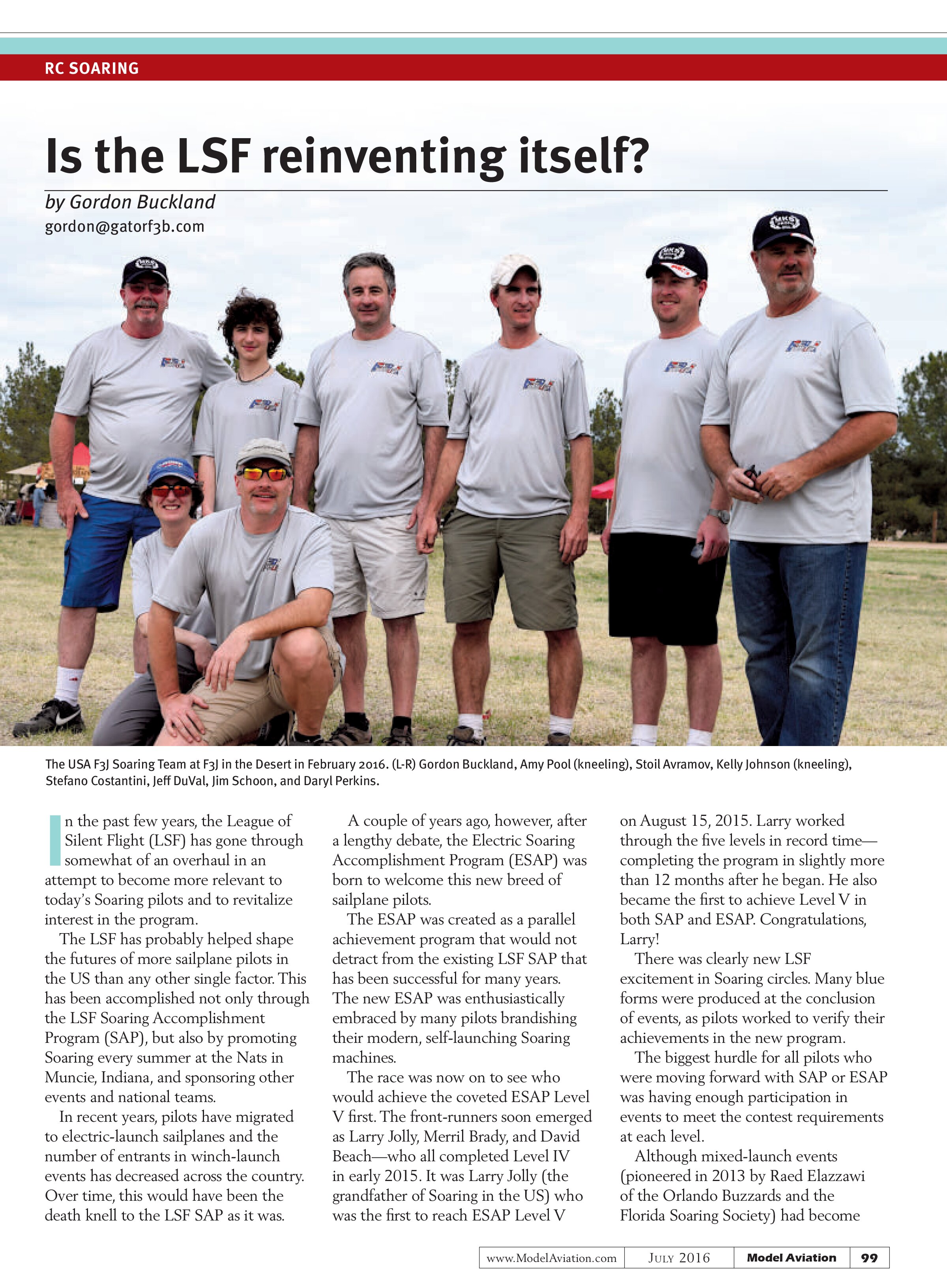
Team USA F3J Seniors Jeff DuVal, Daryl Perkins, Jim Schoon, and Junior competitor Stoil Avromov gathered with team managers Stefano Costantini and Gordon Buckland, and helpers Amy Pool and Kelly Johnson, for the F3J in the Desert contest in Queen Creek, Arizona, on February 18, 2016.
The team performed well, with Daryl taking no time to slot his Xplorers into the 100 zone and finishing first in the preliminaries. Jeff took third place and Jim came in fifth.
The Senior team pilots dominated the large F3J field in conditions that were, at times, difficult to read, especially during the midafternoon. Stoil also had a good workout, with many F3J flights against top opponents. He even scored a 1,000 against the Seniors in Round 7.
The finals were flown as four 15-minute rounds. Jeff made great short tows and landings with machinelike precision to eventually take first place, with Daryl in second, and Jim in fourth. It was a great result for a strong US team. This group’s future looks bright.
Stoil also received some great one-on-one training after the event, with Jeff and Gordon teaching him how to throw the model and bungee launch. Stoil is coming along great. He has an excellent attitude and is always willing to learn.
As you read this, Team USA is preparing to leave for the 2016 FAI F3J World Championship for Model Gliders. The contest is in Vipava, Slovenia, from July 30 through August 7. Follow the pilots’ progress at the World Championship by reading my daily blog and viewing the photos that I upload on the Team USA F3J website, listed in “Sources.”
You can also participate in the team’s success story by buying tickets on the website for the giant raffle. We appreciate your support.
Go downwind and soar.
SOURCES:
LSF
www.silentflight.org
Florida Soaring Society
www.soar-fss.org
Orlando Buzzards
www.orlandobuzzards.org
Team USA
www.teamusaf3j.com