Phoenix Q-40 Classic
by Aaron “AJ” Seaholm
aseaholm@gmail.com
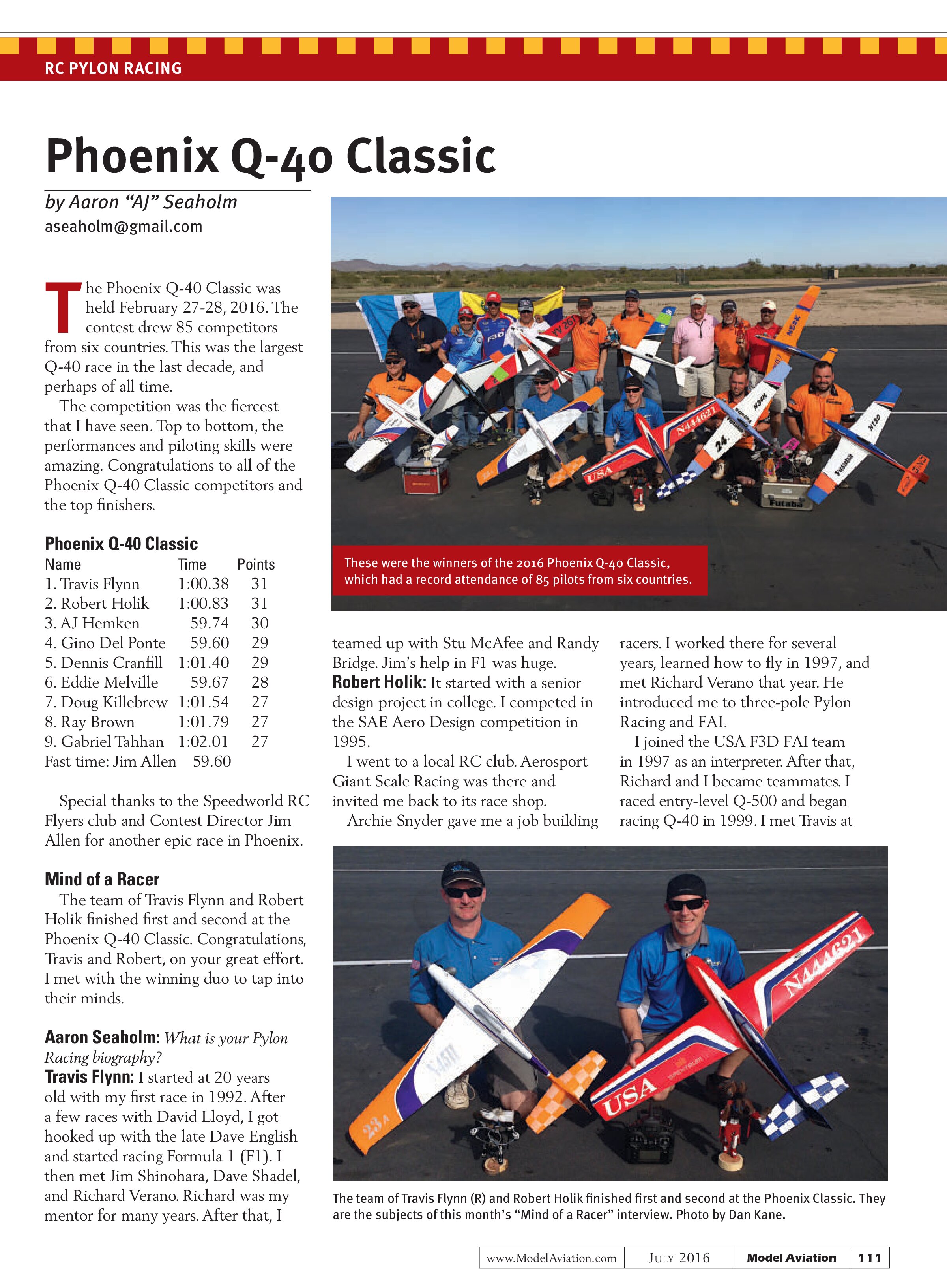
The Phoenix Q-40 Classic was held February 27-28, 2016. The contest drew 85 competitors from six countries. This was the largest Q-40 race in the last decade, and perhaps of all time.
The competition was the fiercest that I have seen. Top to bottom, the performances and piloting skills were amazing. Congratulations to all of the Phoenix Q-40 Classic competitors and the top finishers.
Phoenix Q-40 Classic
Name Time Points
1. Travis Flynn 1:00.38 31
2. Robert Holik 1:00.83 31
3. AJ Hemken 59.74 30
4. Gino Del Ponte 59.60 29
5. Dennis Cranfill 1:01.40 29
6. Eddie Melville 59.67 28
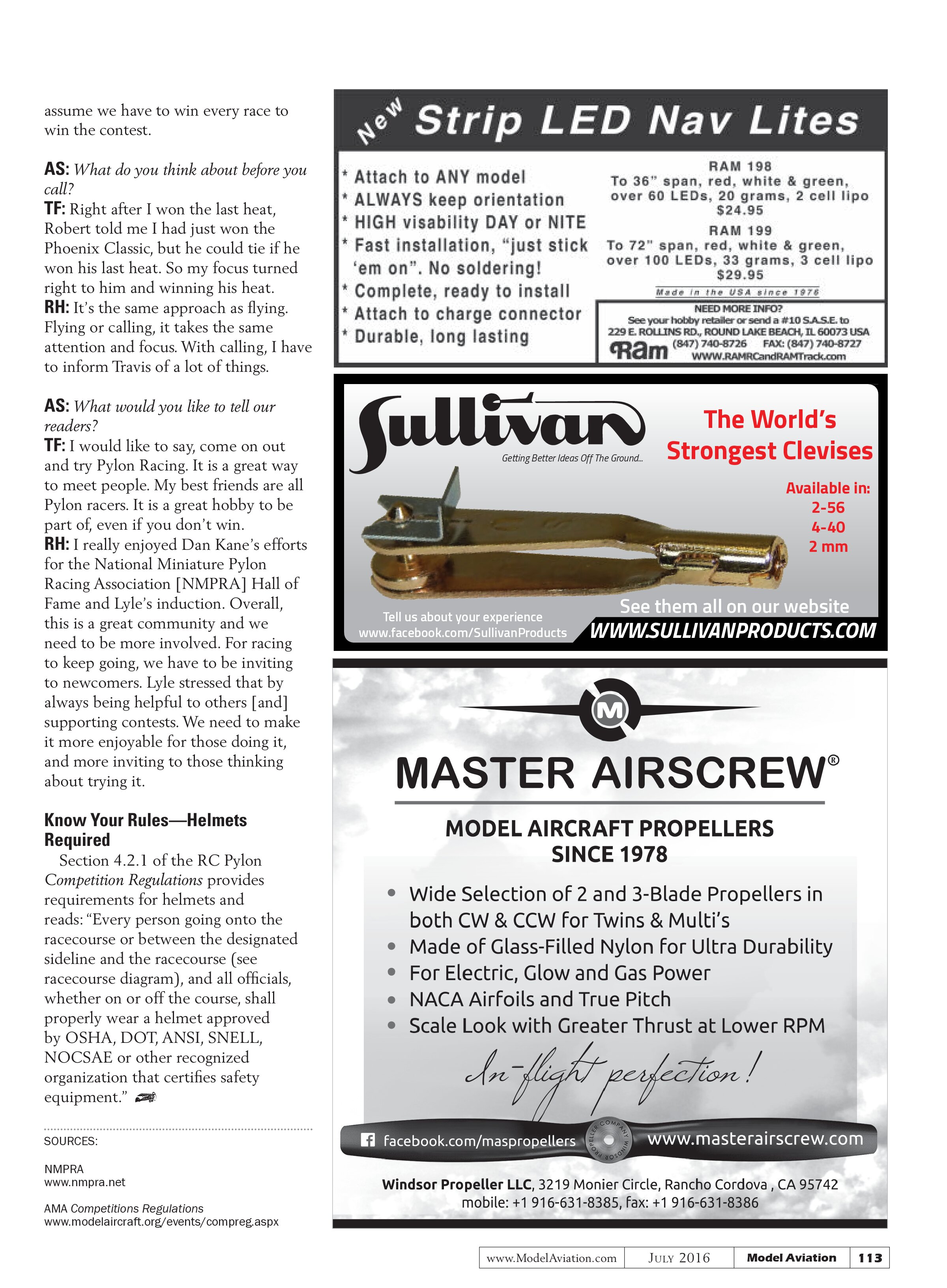
7. Doug Killebrew 1:01.54 27
8. Ray Brown 1:01.79 27
9. Gabriel Tahhan 1:02.01 27
Fast time: Jim Allen 59.60
Special thanks to the Speedworld RC Flyers club and Contest Director Jim Allen for another epic race in Phoenix.
Mind of a Racer
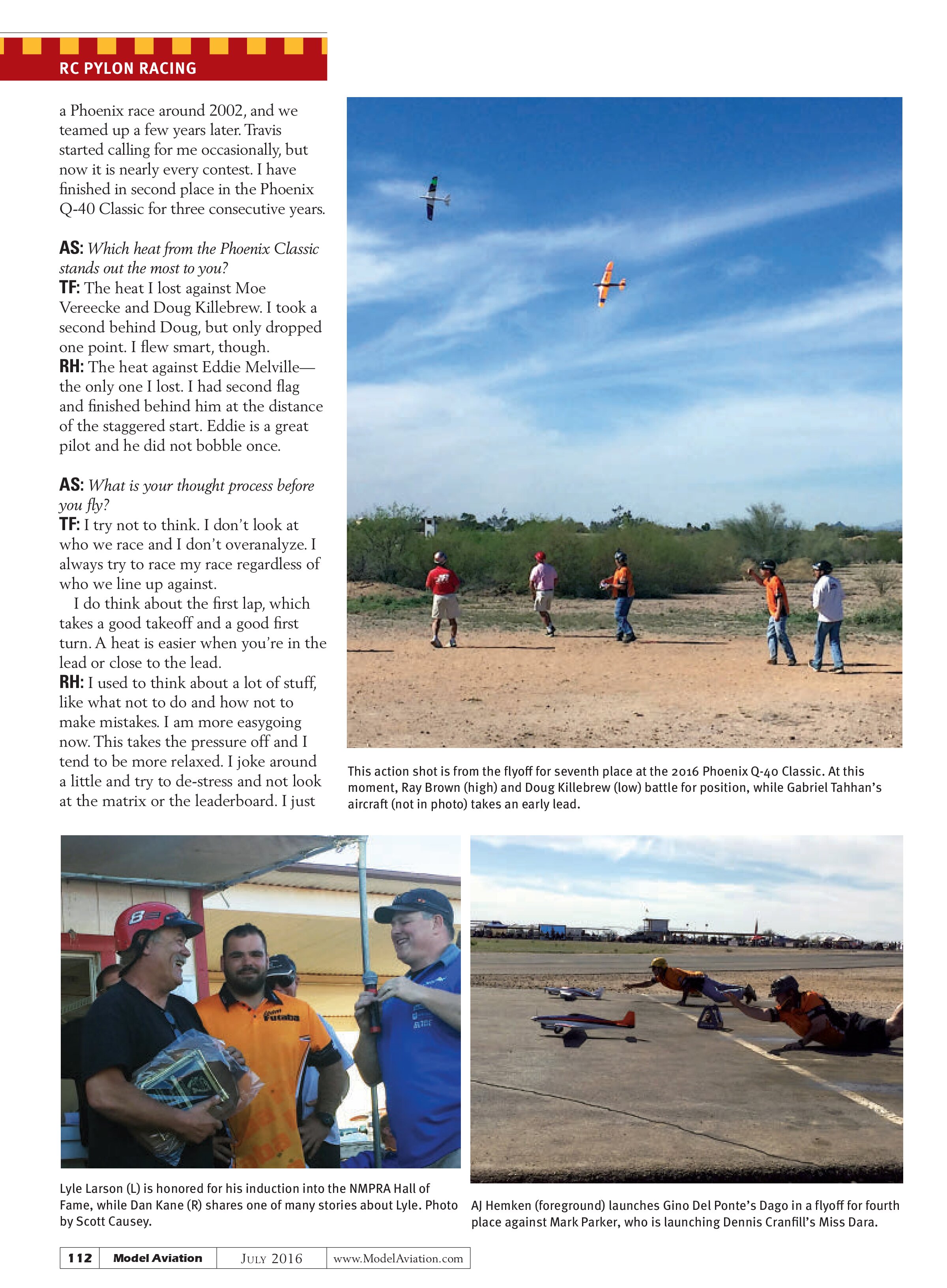
The team of Travis Flynn and Robert Holik finished first and second at the Phoenix Q-40 Classic. Congratulations, Travis and Robert, on your great effort. I met with the winning duo to tap into their minds.
Aaron Seaholm: What is your Pylon Racing biography?
Travis Flynn: I started at 20 years old with my first race in 1992. After a few races with David Lloyd, I got hooked up with the late Dave English and started racing Formula 1 (F1). I then met Jim Shinohara, Dave Shadel, and Richard Verano. Richard was my mentor for many years. After that, I teamed up with Stu McAfee and Randy Bridge. Jim’s help in F1 was huge.
Robert Holik: It started with a senior design project in college. I competed in the SAE Aero Design competition in 1995.
I went to a local RC club. Aerosport Giant Scale Racing was there and invited me back to its race shop.
Archie Snyder gave me a job building racers. I worked there for several years, learned how to fly in 1997, and met Richard Verano that year. He introduced me to three-pole Pylon Racing and FAI.
I joined the USA F3D FAI team in 1997 as an interpreter. After that, Richard and I became teammates. I raced entry-level Q-500 and began racing Q-40 in 1999. I met Travis at


a Phoenix race around 2002, and we teamed up a few years later. Travis started calling for me occasionally, but now it is nearly every contest. I have finished in second place in the Phoenix Q-40 Classic for three consecutive years.
AS: Which heat from the Phoenix Classic stands out the most to you?
TF: The heat I lost against Moe Vereecke and Doug Killebrew. I took a second behind Doug, but only dropped one point. I flew smart, though.
RH: The heat against Eddie Melville—the only one I lost. I had second flag and finished behind him at the distance of the staggered start. Eddie is a great pilot and he did not bobble once.
AS: What is your thought process before you fly?
TF: I try not to think. I don’t look at who we race and I don’t overanalyze. I always try to race my race regardless of who we line up against.
I do think about the first lap, which takes a good takeoff and a good first turn. A heat is easier when you’re in the lead or close to the lead.
RH: I used to think about a lot of stuff, like what not to do and how not to make mistakes. I am more easygoing now. This takes the pressure off and I tend to be more relaxed. I joke around a little and try to de-stress and not look at the matrix or the leaderboard. I just


assume we have to win every race to win the contest.
AS: What do you think about before you call?
TF: Right after I won the last heat, Robert told me I had just won the Phoenix Classic, but he could tie if he won his last heat. So my focus turned right to him and winning his heat.
RH: It’s the same approach as flying. Flying or calling, it takes the same attention and focus. With calling, I have to inform Travis of a lot of things.
AS: What would you like to tell our readers?
TF: I would like to say, come on out and try Pylon Racing. It is a great way to meet people. My best friends are all Pylon racers. It is a great hobby to be part of, even if you don’t win.
RH: I really enjoyed Dan Kane’s efforts for the National Miniature Pylon Racing Association [NMPRA] Hall of Fame and Lyle’s induction. Overall, this is a great community and we need to be more involved. For racing to keep going, we have to be inviting to newcomers. Lyle stressed that by always being helpful to others [and] supporting contests. We need to make it more enjoyable for those doing it, and more inviting to those thinking about trying it.
Know Your Rules—Helmets Required
Section 4.2.1 of the RC Pylon Competition Regulations provides requirements for helmets and reads: “Every person going onto the racecourse or between the designated sideline and the racecourse (see racecourse diagram), and all officials, whether on or off the course, shall properly wear a helmet approved by OSHA, DOT, ANSI, SNELL, NOCSAE or other recognized organization that certifies safety equipment.”
SOURCES:
NMPRA
www.nmpra.net
AMA Competitions Regulations
www.modelaircraft.org/events/compreg.aspx