Meet David Donaldson
Chris Mulcahy
cspaced@gmail.com
“Drone” is definitely a buzzword right now. Unfortunately, our helicopters now fall under that designation too, at least according to the FAA. It is immediately apparent to me why full-scale pilots are concerned about our model aircraft and what we know as drones.
I had a conversation with a commercial full-scale helicopter pilot who, in addition to flying medevac missions in and out of unusual places, is also an enthusiastic drone pilot. I thought his perspective might be interesting to some readers, so here is what he had to say.

Chris Mulcahy: Could you introduce yourself to our readers and explain what you do for a living?
David Donaldson: My name is David Donaldson. I am a commercial-rated helicopter pilot living in North Carolina. I have been flying emergency medical helicopters since 2009. I also hold a CFII (Commercial Flight Instrument Instructor) rating.
CM: What type of RC aircraft do you fly, and what drew you into it?
DD: Drones! Or is it quadcopters? I can remember being at work one night and seeing a video on YouTube about Storm Racing Drones and I was hooked! Seeing these videos of guys sitting in chairs with goggles on and flying these small aircraft through the woods with LED lights on them, was extremely cool to me. I think I might’ve made my purchase that night! Impulsive, I know …
CM: How has your opinion about drones/sUAS changed from before you were involved in FPV flying to now?
DD: My opinion has changed. I have only been in the RC world for about a year and growing in this hobby has shown me that there are a lot of responsible, courteous people out there flying drones.
CM: How has this new growth in drone activity affected your day job?
DD: Every day when I fly the helicopter, I’m constantly looking for RC aircraft. It’s embedded into my scan. As an EMS [emergency medical service] operator, my company’s altitude minimums are 300 feet during the day and 500 feet at night. With the popularity of drones, we have changed our suggested cruising altitudes to 1,000 feet during the day and 1,500 feet at night.
CM: For those who are wondering, what kind of damage could a typical drone do to your aircraft?
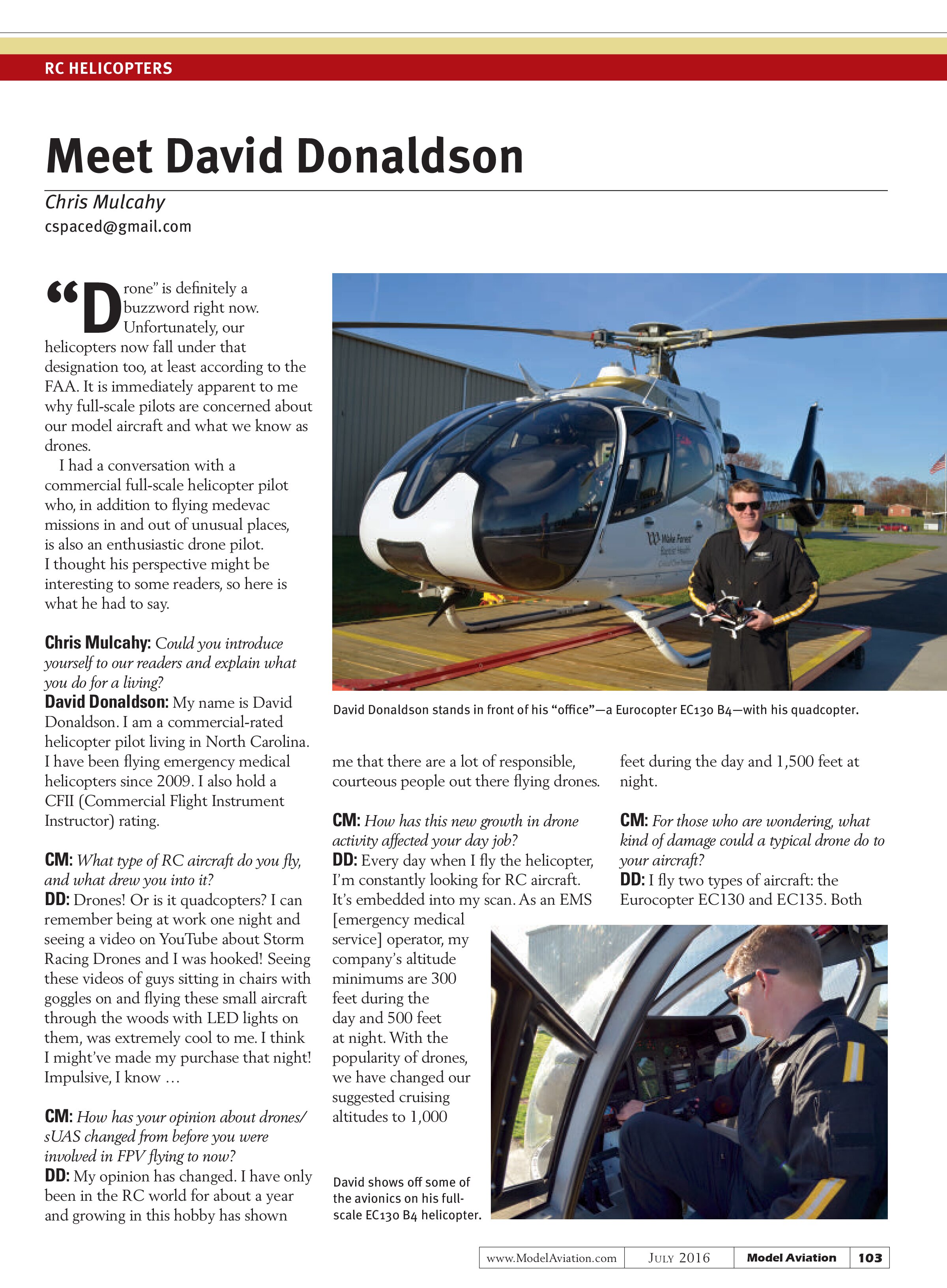
DD: I fly two types of aircraft: the Eurocopter EC130 and EC135. Both

and encourage other people to fly responsibly. Stop thinking that every time you see something on the news about a drone being close to an aircraft that someone’s making it up if he or she doesn’t have a picture. The last thing on my mind at 940 mph is getting a picture of a drone that I’m trying to get away from.
I think what we are missing in this hobby is common sense. Every day you see a new video of someone flying a quadcopter over a crowd of people or a stadium or next to an airport. We have to be smart and not fight the system. The FAA is not the bad guy; it’s separating the good pilots from the not-so-smart people. If you’re not doing anything wrong, why fight the system?

of these helicopters have a lot of composite/plastic. If you’re cruising around and a blade on something [such as a drone] hits, it would be catastrophic.
CM: Speaking as a full-scale pilot, what do you think of the FAA’s drone registration?
DD: I initially thought it was a bad idea for the FAA to get involved with a hobby. But at the same time, there are so many operators out there who are not flying smart.
CM: It’s always hard to view an issue from both sides, but you are in a unique position to do so. In that regard, what are your thoughts about the future integration of sUAS and manned aircraft?
DD: Drones are the future. Right now we have pilots in news helicopters, utility helicopters, and fighting fires. Slowly but surely, I foresee sUAS aircraft taking some of these jobs. Why not?
Do I think a drone could fly around the city and monitor traffic? Sure I do. Putting light poles in the ground or spraying cornfields? Yep. Whether we like it or not, I think it’s coming. [This is] all my opinion, of course.
CM: If there was one thing you could tell every drone/sUAS pilot out there, what would it be?
DD: If there was one thing that I could tell people, it would be to help police the hobby. Fly responsibly and encourage other people to fly responsibly. Stop thinking that every time you see something on the news about a drone being close to an aircraft that someone’s making it up if he or she doesn’t have a picture. The last thing on my mind at 940 mph is getting a picture of a drone that I’m trying to get away from.
I think what we are missing in this hobby is common sense. Every day you see a new video of someone flying a quadcopter over a crowd of people or a stadium or next to an airport. We have to be smart and not fight the system. The FAA is not the bad guy; it’s separating the good pilots from the not-so-smart people. If you’re not doing anything wrong, why fight the system?
CM: What is your favorite quadcopter at the moment?
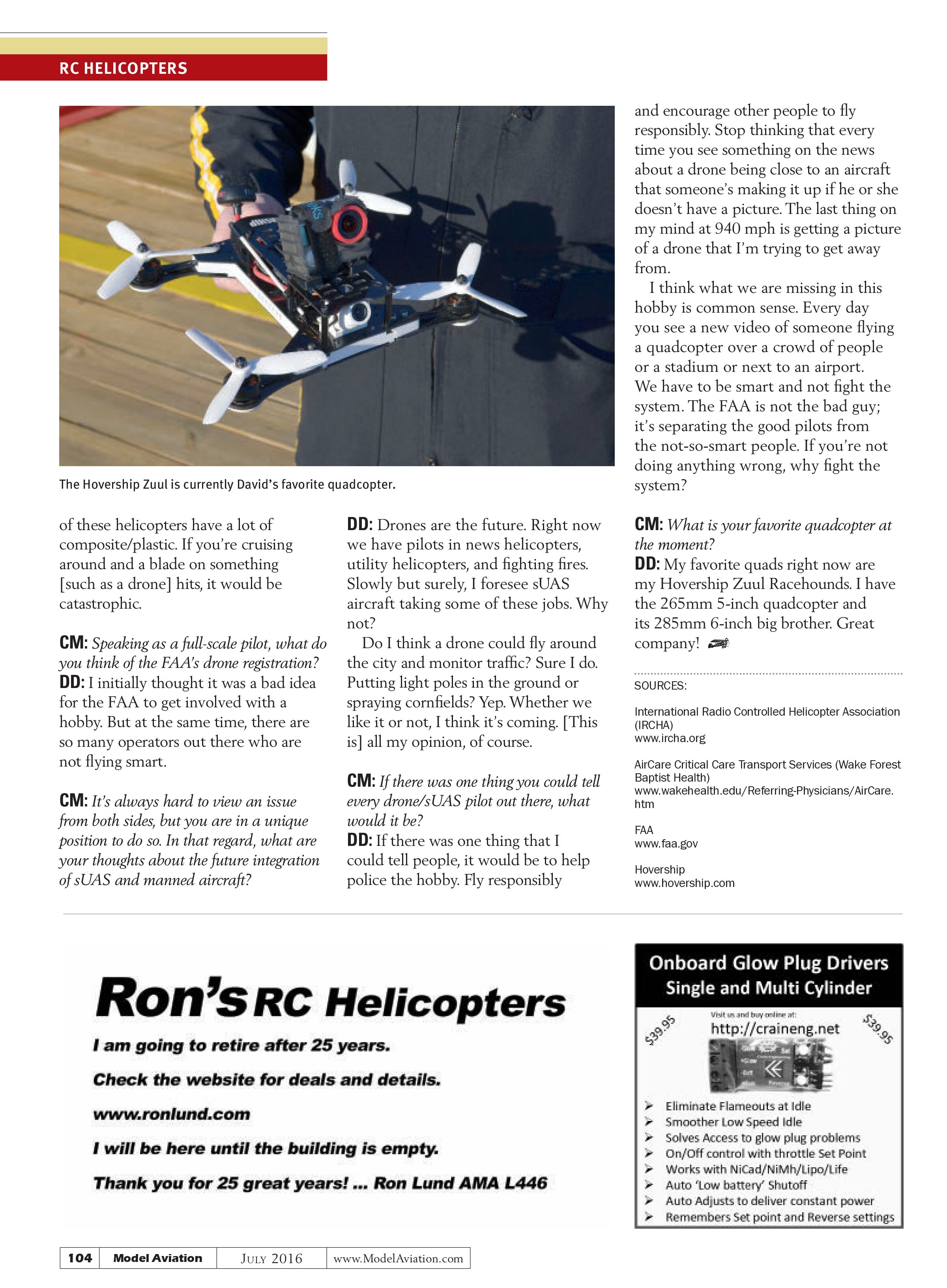
DD: My favorite quads right now are my Hovership Zuul Racehounds. I have the 265mm 5-inch quadcopter and its 285mm 6-inch big brother. Great company!
Sources:
International Radio Controlled Helicopter Association (IRCHA)
www.ircha.org
AirCare Critical Care Transport Services (Wake Forest Baptist Health)
www.wakehealth.edu/Referring-Physicians/AirCare.htm
FAA
www.faa.gov
Hovership
www.hovership.com