Starting in RC Aerobatics
by Peter Vogel
vogel.peter@gmail.com
If I did my job right in the past three columns, you’ve begun to think about experimenting with RC Aerobatics (Pattern) flying. The good news is that if you’ve been flying for a while, you probably have an airplane that is perfectly capable of flying the Sportsman pattern.
All you need is an airplane with a symmetrical or semisymmetrical airfoil that has adequate power to pull a clean vertical upline for approximately 100 to 200 feet. The disadvantages of having a semisymmetrical airfoil won’t bite you too much because you’ll spend little time flying inverted.

Given the power-to-weight ratios of most ARF aircraft these days, there are many airplanes that fit the bill! If you are ready to take the dive into the addictive world of RC Aerobatics, there are other characteristics you’ll want to look for. There’s a reason why many Pattern aircraft have a similar body style and appearance. A list of excellent starter airplanes appears at the end of this column.
Common Mistakes
Having judged three rounds of the Sportsman class at a contest this past weekend, and often calling for Sportsman pilots in the past five years of competition, I’ve seen some common mistakes that are worth addressing.
First and foremost, dial back your control throws! You will never need more than approximately 10° of aileron deflection when flying the Sportsman pattern. Aileron deflection is usually equal up and down, with some airplanes requiring a small amount of differential.
If you see your airplane yaw as a result of aileron input, you need some differential to reduce throws on the side where the airplane is yawing. Similarly, you will never need more than approximately 12° of up-elevator and 14° of down-elevator.
For the rudder, you’ll want access to the full available deflection for stall turns, but you want the rudder to be soft around the center to allow for sneaking in minor heading corrections without yanking the tail around.
This can be done with exponential if you are careful, or you can set a stick condition so that you are in low rudder rate until you move the rudder stick past 90% in either direction and then kick in high rate. This will keep the rudder tame and linear (or with mild exponential) for most flying so that you have some finesse on the rudder, but can still “kick” the rudder in hard for your stall turns.
The second mistake I frequently see is flying the airplane like a rocket ship! Your throttle stick is proportional control, not an on/off switch, so use it that way! Set things up so that you have a nice, comfortable cruising speed at half stick or slightly above. At that setting, with your wings level, your airplane should fly a nice, straight-and-level path (not sinking or climbing) from 60° to your left to 60° to your right—or vice versa—in roughly 6 to 10 seconds at 150 meters (about 500 feet) out from your position.
This gives you the time you need to think about and get set up for each individual maneuver. The faster you fly, and the closer to yourself that you fly, the less time you will have to think and make adjustments.
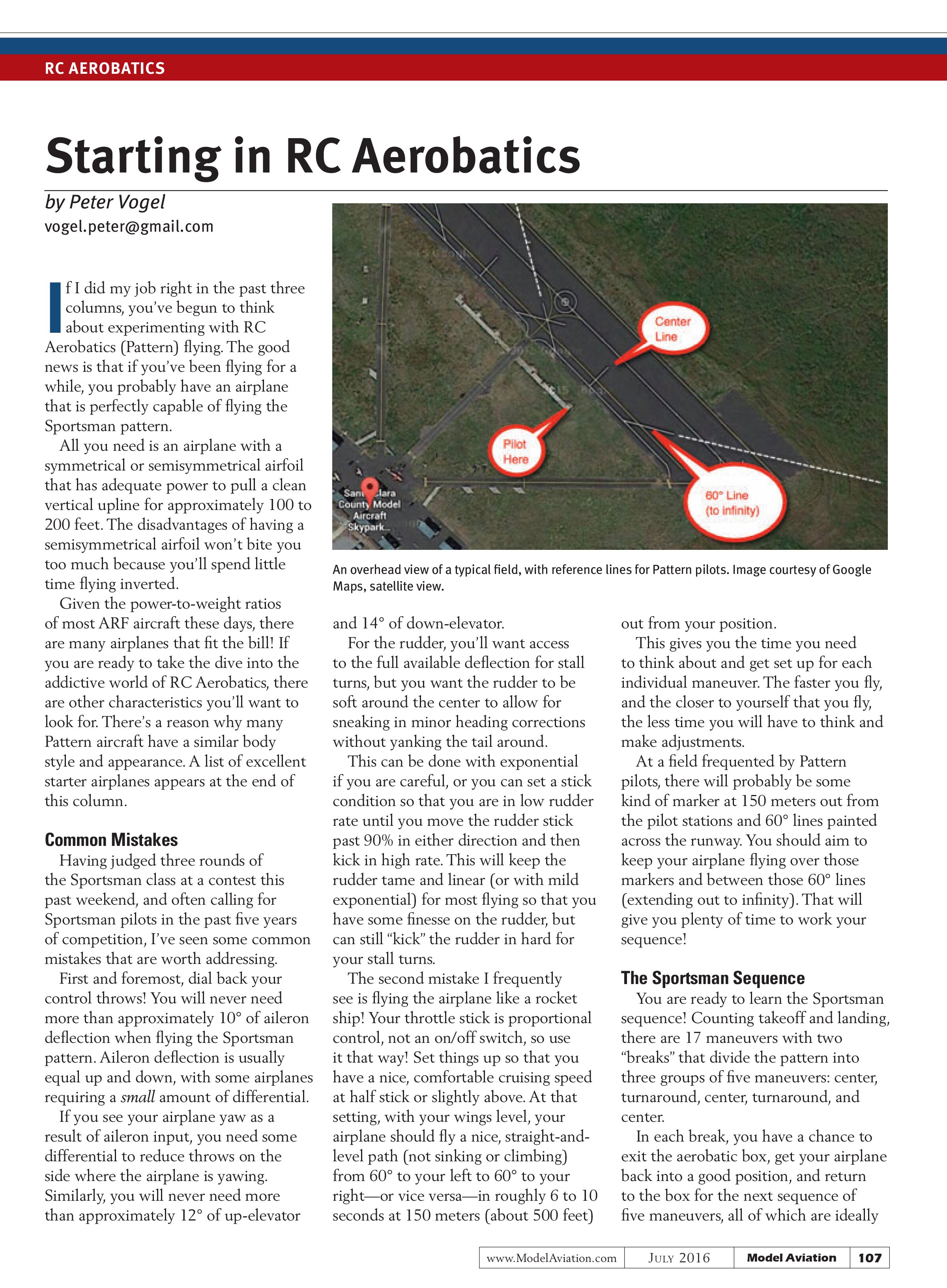
At a field frequented by Pattern pilots, there will probably be some kind of marker at 150 meters out from the pilot stations and 60° lines painted across the runway. You should aim to keep your airplane flying over those markers and between those 60° lines (extending out to infinity). That will give you plenty of time to work your sequence!
The Sportsman Sequence
You are ready to learn the Sportsman sequence! Counting takeoff and landing, there are 17 maneuvers with two “breaks” that divide the pattern into three groups of five maneuvers: center, turnaround, center, turnaround, and center.
In each break, you have a chance to exit the aerobatic box, get your airplane back into a good position, and return to the box for the next sequence of five maneuvers, all of which are ideally
performed on the exact same “line” running parallel to the runway, roughly 150 meters (500 feet) out from where you stand:
At a contest, you’ll have a caller to
- Takeoff (upwind).
- Straight flight out (upwind, center).
- Half-Reverse Cuban 8 (turnaround).
- Straight flight back (downwind, center).
- Stall turn without rolls (turnaround).
- Double Immelmann without rolls (upwind, center).
Break: Exit the box, free turnaround.
- One horizontal roll (downwind, center).
- Half-Reverse Cuban 8 (turnaround).
- Cobra roll without rolls (upwind, center).
- Immelmann Turn (turnaround).
- 45° downline on center (downwind, center).
Break: Exit the box, free turnaround.
- 45° upline on center (upwind, center).
- Split S (turnaround).
- Two-point roll, pause in center (downwind, center).
- Half Cuban 8 (turnaround).
- Two inside loops (upwind, center).
- Landing.
remind you what comes next (and ideally offer some gentle guidance), but if you don’t have a buddy to call you through the maneuvers when you are practicing, it’s pretty quick to memorize and practice one five-maneuver segment at a time until you can string it all together from memory.
The Finer Points

Many people look at the Sportsman sequence and think, “That’s really easy!” Indeed, performing any individual maneuver isn’t really “hard” on the face of it, but what separates the top competitors from everyone else is precision.
I am running out of space so I’ll begin with only the takeoff. Because everyone has to take off, no matter what kind of plane you have, it’s the perfect introduction to what I mean by focusing on the finer details and precision. We’ll look at the rest of the sequence in a subsequent article.
I often see Sportsman pilots take off approximately 6 feet from where they were placed on the runway, jamming the throttle stick to full from a standing start on the runway (generally causing a pronounced yaw to the left) and leaping into the air at a 60° to 80° angle like a Patriot missile on an intercept course with an approaching Scud missile. That’s not a takeoff. It’s a departure and will earn you some pretty low scores!
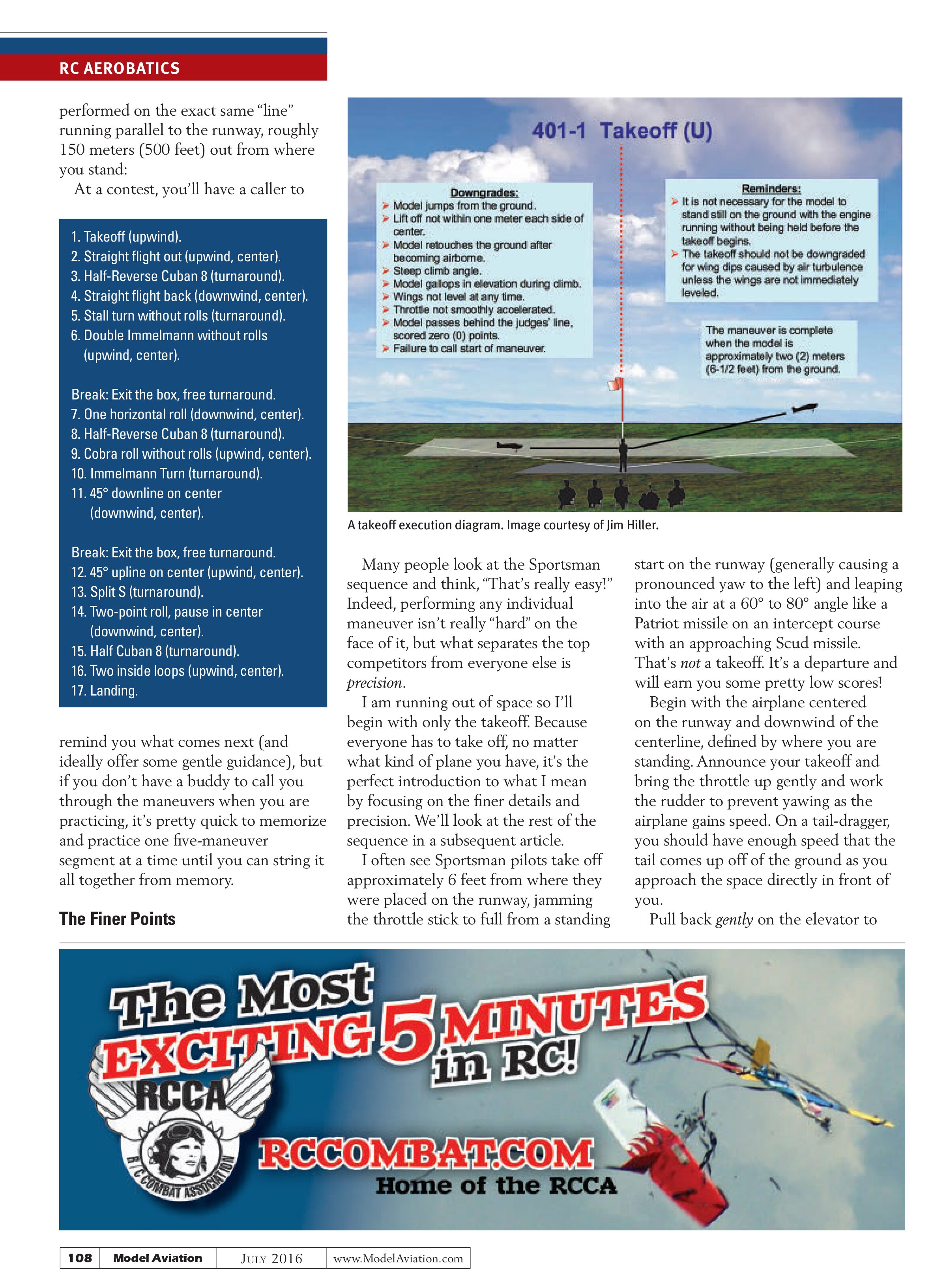
Begin with the airplane centered on the runway and downwind of the centerline, defined by where you are standing. Announce your takeoff and bring the throttle up gently and work the rudder to prevent yawing as the airplane gains speed. On a tail-dragger, you should have enough speed that the tail comes up off of the ground as you approach the space directly in front of you.
Pull back gently on the elevator to bring the wheels off of the ground within 3 feet of your centerline and climb out at a gentle 10° to 20° climb angle, holding your wings completely level as you climb to a comfortable altitude to make your unscored downwind pass to prepare to enter the box (those 60° lines). When your altitude is above 2 meters (slightly more than 6 feet), call “takeoff complete.”
Congratulations! You just received a score near 10 on your takeoff!
It’s a lot to take in for such a simple maneuver, isn’t it? But it is precisely this level of finesse that makes Pattern addictive. Similar to golf, anyone can whack a ball around, but few can do it precisely enough to get the ball into the hole in less than par. What you will find as you begin to focus on the precision of your flying is that everything else you do in RC becomes easier, and every aspect of your flying, even when you are just getting out and boring holes in the sky, improves dramatically. Give it a try.
In most parts of the country, there probably is a Pattern pilot nearby who would be willing to coach you. Visit the National Society of Radio Control Aerobatics (NSRCA) website, navigate to the “New Pilot Info” section, and click on “Find A Coach” to help locate a nearby pilot.
Good Starter Airplanes
The FMS Olympus, available from MotionRC for $289.99, makes a great introductory Pattern airplane when running on 5S LiPo batteries (6S is overpowered). It will fly the Sportsman sequence well.
Any vintage or classic Pattern airplane (such as the Great Planes Kaos or E-flite Phoenix 7, or even a secondhand Tiporare, Curare, etc.) will fly a modern Sportsman sequence well.
AJ Aircraft has announced a new Pattern airplane that was designed by US F3A champion Andrew Jesky. It will come in 63-inch and full 2-meter versions.
F3A Unlimited sells a number of 70-size, 110-size, 120-size, and 2-meter airplanes at a variety of price points. F3A Unlimited is a go-to site for US and Canadian Pattern addicts.
SOURCES:
NSRCA
www.nsrca.us
MotionRC
(224) 633-9090
www.motionrc.com
Great Planes Model Manufacturing
(800) 637-7660
www.greatplanes.com
E-flite
(800) 338-4639
www.e-fliterc.com
AJ Aircraft
(734) 244-4015
www.aj-aircraft.com
F3A Unlimited
(800) 591-2875
www.f3aunlimited.com