Unusual historical aircraft makes a simple build
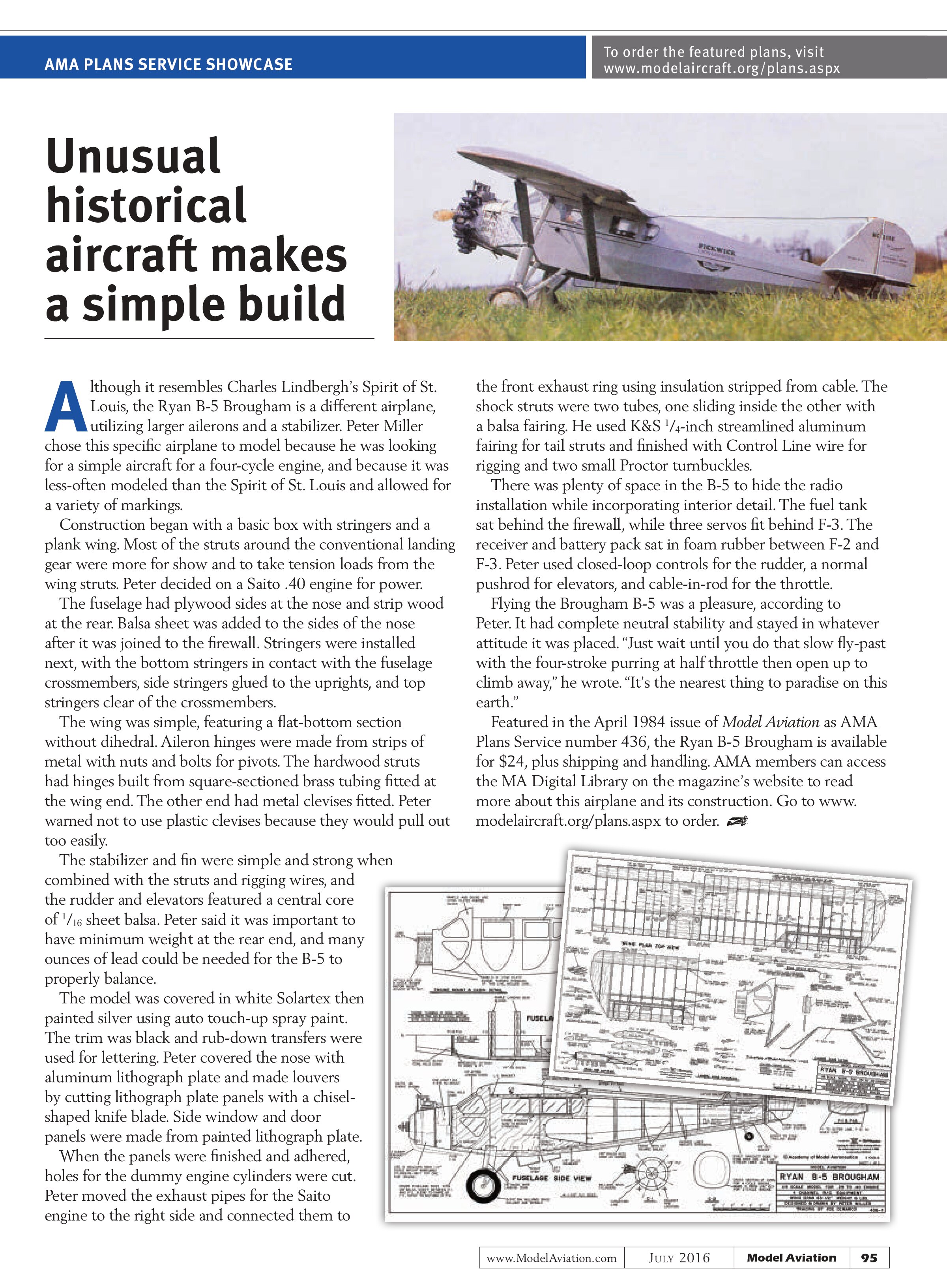
Although it resembles Charles Lindbergh’s Spirit of St. Louis, the Ryan B-5 Brougham is a different airplane, utilizing larger ailerons and a stabilizer. Peter Miller chose this specific airplane to model because he was looking for a simple aircraft for a four-cycle engine, and because it was less-often modeled than the Spirit of St. Louis and allowed for a variety of markings.
Construction began with a basic box with stringers and a plank wing. Most of the struts around the conventional landing gear were more for show and to take tension loads from the wing struts. Peter decided on a Saito .40 engine for power.
The fuselage had plywood sides at the nose and strip wood at the rear. Balsa sheet was added to the sides of the nose after it was joined to the firewall. Stringers were installed next, with the bottom stringers in contact with the fuselage crossmembers, side stringers glued to the uprights, and top stringers clear of the crossmembers.
The wing was simple, featuring a flat-bottom section without dihedral. Aileron hinges were made from strips of metal with nuts and bolts for pivots. The hardwood struts had hinges built from square-sectioned brass tubing fitted at the wing end. The other end had metal clevises fitted. Peter warned not to use plastic clevises because they would pull out too easily.
The stabilizer and fin were simple and strong when combined with the struts and rigging wires, and the rudder and elevators featured a central core of ¹⁄₁₆ sheet balsa. Peter said it was important to have minimum weight at the rear end, and many ounces of lead could be needed for the B-5 to properly balance.
The model was covered in white Solart ex then painted silver using auto touch-up spray paint. The trim was black and rub-down transfers were used for lettering. Peter covered the nose with aluminum lithograph plate and made louvers by cutting lithograph plate panels with a chisel-shaped knife blade. Side window and door panels were made from painted lithograph plate.
When the panels were finished and adhered, holes for the dummy engine cylinders were cut. Peter moved the exhaust pipes for the Saito engine to the right side and connected them to the front exhaust ring using insulation stripped from cable. The shock struts were two tubes, one sliding inside the other with a balsa fairing. He used K&S ¹⁄₄-inch streamlined aluminum fairing for tail struts and finished with Control Line wire for rigging and two small Proctor turnbuckles.
There was plenty of space in the B-5 to hide the radio installation while incorporating interior detail. The fuel tank sat behind the firewall, while three servos fit behind F-3. The receiver and battery pack sat in foam rubber between F-2 and F-3. Peter used closed-loop controls for the rudder, a normal pushrod for elevators, and cable-in-rod for the throttle.
Flying the Brougham B-5 was a pleasure, according to Peter. It had complete neutral stability and stayed in whatever attitude it was placed. “Just wait until you do that slow fly-past with the four-stroke purring at half throttle then open up to climb away,” he wrote. “It’s the nearest thing to paradise on this earth.”
Featured in the April 1984 issue of Model Aviation as AMA Plans Service number 436, the Ryan B-5 Brougham is available for $24, plus shipping and handling. AMA members can access the MA Digital Library on the magazine’s website to read more about this airplane and its construction. Go to www.modelaircraft.org/plans.aspx to order.