Excellobatics foam
Joe Malinchak
joemal@echoes.net

For years, I have written about models constructed using Durobatics foam. Unlike anything on the market, the foam allowed me to build some ultralightweight micro RC models. I could also print beautiful graphics onto the foam by applying several coats of inkAID and sending the foam sheets through an inkjet printer.
The thin foam sheets became precious to me after they were no longer produced. Fortunately, I had a good supply of them, but I knew that my supply would run low some day and I would have to find a replacement.
I planned to make a foam slicer to try to cut my own foam to approximately the same size and thickness as Durobatics foam. As I was about to do this, however, a new company was formed to manufacture foam with the same properties as Durobatics. This was wonderful news to me and to everyone who wanted to try working with Durobatics foam, but I could not find any available for purchase.
Excelobatics
Harsha Wijesooriya resides in Sri Lanka and has come up with a new foam product that he calls Excelobatics. I had the chance to test some

preproduction samples of the foam to see if it would be a good replacement for Durobatics foam. He sent me several sheets of different thicknesses, with some that were precoated and ready for printing using a standard inkjet printer.
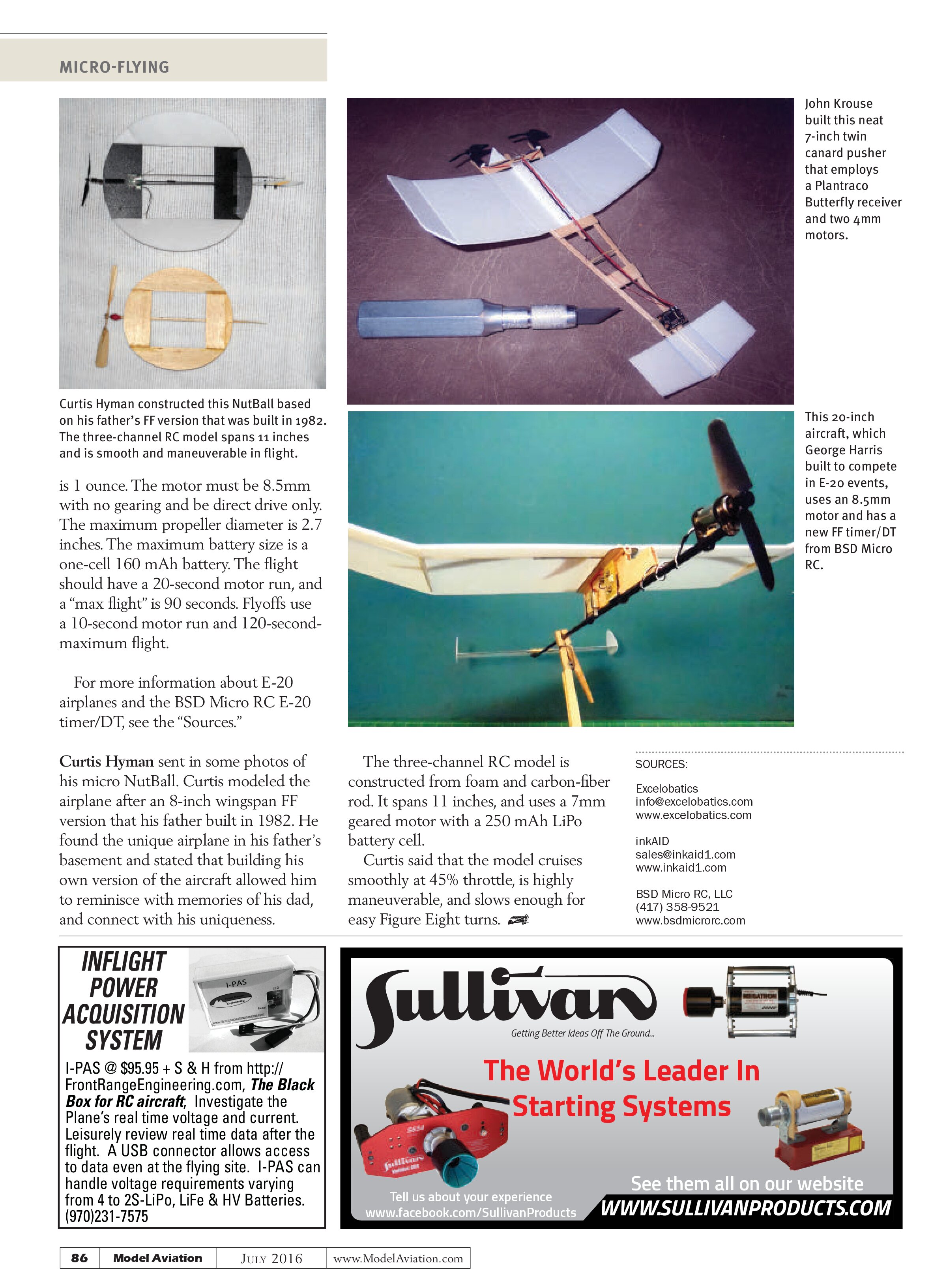
The foam sheets that I received measured 8.1 x 11.5 inches. They are available in 0.1, 0.25, and 0.50mm thicknesses. The 0.25mm sheets weigh 1.2 grams and are lighter than Durobatics foam of the same size and thickness. That is good news!
I wanted to try the uncoated foam with my proven technique of applying inkAID to print my graphics. I airbrushed four coats of inkAID thinned with water and allowed each coat to dry before applying the next. I printed one of my designs. The result was beautifully printed graphics of the same quality as those printed on Durobatics foam.
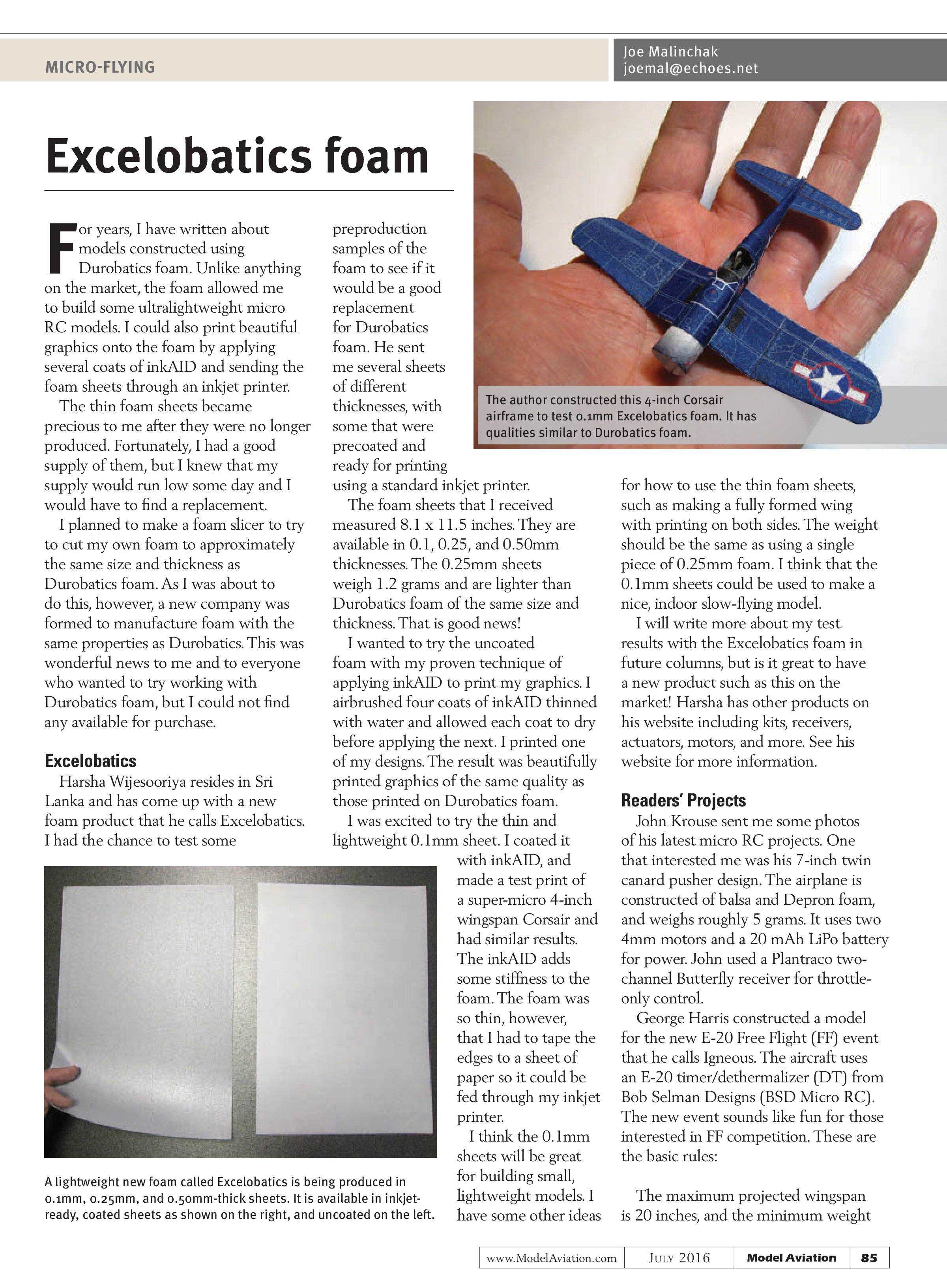
I was excited to try the thin and lightweight 0.1mm sheet. I coated it with inkAID, and made a test print of a super-micro 4-inch wingspan Corsair and had similar results. The inkAID adds some stiffness to the foam. The foam was so thin, however, that I had to tape the edges to a sheet of paper so it could be fed through my inkjet printer.
I think the 0.1mm sheets will be great for building small, lightweight models. I have some other ideas for how to use the thin foam sheets, such as making a fully formed wing with printing on both sides. The weight should be the same as using a single piece of 0.25mm foam. I think that the 0.1mm sheets could be used to make a nice, indoor slow-flying model.
I will write more about my test results with the Excelobatics foam in future columns, but is it great to have a new product such as this on the market! Harsha has other products on his website including kits, receivers, actuators, motors, and more. See his website for more information.
Readers’ Projects
John Krouse sent me some photos of his latest micro RC projects. One that interested me was his 7-inch twin canard pusher design. The airplane is constructed of balsa and Depron foam, and weighs roughly 5 grams. It uses two 4mm motors and a 20 mAh LiPo battery for power. John used a Plantraco two-channel Butterfly receiver for throttle-only control.
George Harris constructed a model for the new E-20 Free Flight (FF) event that he calls Igneous. The aircraft uses an E-20 timer/dethermalizer (DT) from Bob Selman Designs (BSD Micro RC). The new event sounds like fun for those interested in FF competition. These are the basic rules:
The maximum projected wingspan is 20 inches, and the minimum weight


is 1 ounce. The motor must be 8.5mm with no gearing and be direct drive only. The maximum propeller diameter is 2.7 inches. The maximum battery size is a one-cell 160 mAh battery. The flight should have a 20-second motor run, and a “max flight” is 90 seconds. Flyoffs use a 10-second motor run and 120-second-maximum flight.
For more information about E-20 airplanes and the BSD Micro RC E-20 timer/DT, see the “Sources.”
Curtis Hyman sent in some photos of his micro NutBall. Curtis modeled the airplane after an 8-inch wingspan FF version that his father built in 1982. He found the unique airplane in his father’s basement and stated that building his own version of the aircraft allowed him to reminisce with memories of his dad, and connect with his uniqueness.
The three-channel RC model is constructed from foam and carbon-fiber rod. It spans 11 inches, and uses a 7mm geared motor with a 250 mAh LiPo battery cell.
Curtis said that the model cruises smoothly at 45% throttle, is highly maneuverable, and slows enough for easy Figure Eight turns.
SOURCES:
Excelobatics
info@excelobatics.com
www.excelobatics.com
inkAID
sales@inkaid1.com
www.inkaid1.com
BSD Micro RC, LLC
(417) 358-9521
www.bsdmicrorc.com