District III—Ohio, Pennsylvania, West Virginia

Vice President
mradcliff@suddenlink.net
199 Heron Dr., St. Marys WV 26170
Tel.: (304) 684-2133
www.amadistrict-iii.org
www.facebook.com/ama.district.iii
I was recently contacted by the West Virginia University (WVU) Unmanned Aerial Team and invited to attend the Inaugural Mountaineer Collegiate UAV Flyoff. This was a design, build, and fly competition held at Louis Bennett Field at historic Jackson’s Mill in Jane Lew, West Virginia, on Saturday, April 23, 2016.
The idea for hosting such an event came from Dr. Peter Gull and Dr. Patrick Browning, both professors of the mechanical and aerospace engineering department at WVU. According to Patrick, the competition is similar in scope to the American Institute of Aeronautics and Astronautics (AIAA) Design/Build/Fly Competition.
Each team designs two airplanes to complete three technical flight missions and an optional bonus ground mission. Teams also present a poster of their design and build process. The missions include Gatorade transportation, timed flight, aircraft transportation, delivery, and assembly.
Upon arrival, I was impressed with the level of enthusiasm and excitement shown by the student teams. A walk through the competitors’ pit area revealed some interesting and unique designs. One thing that struck me was that none of the competitors were using LiPo batteries to power their electric aircraft. I later learned that AIAA

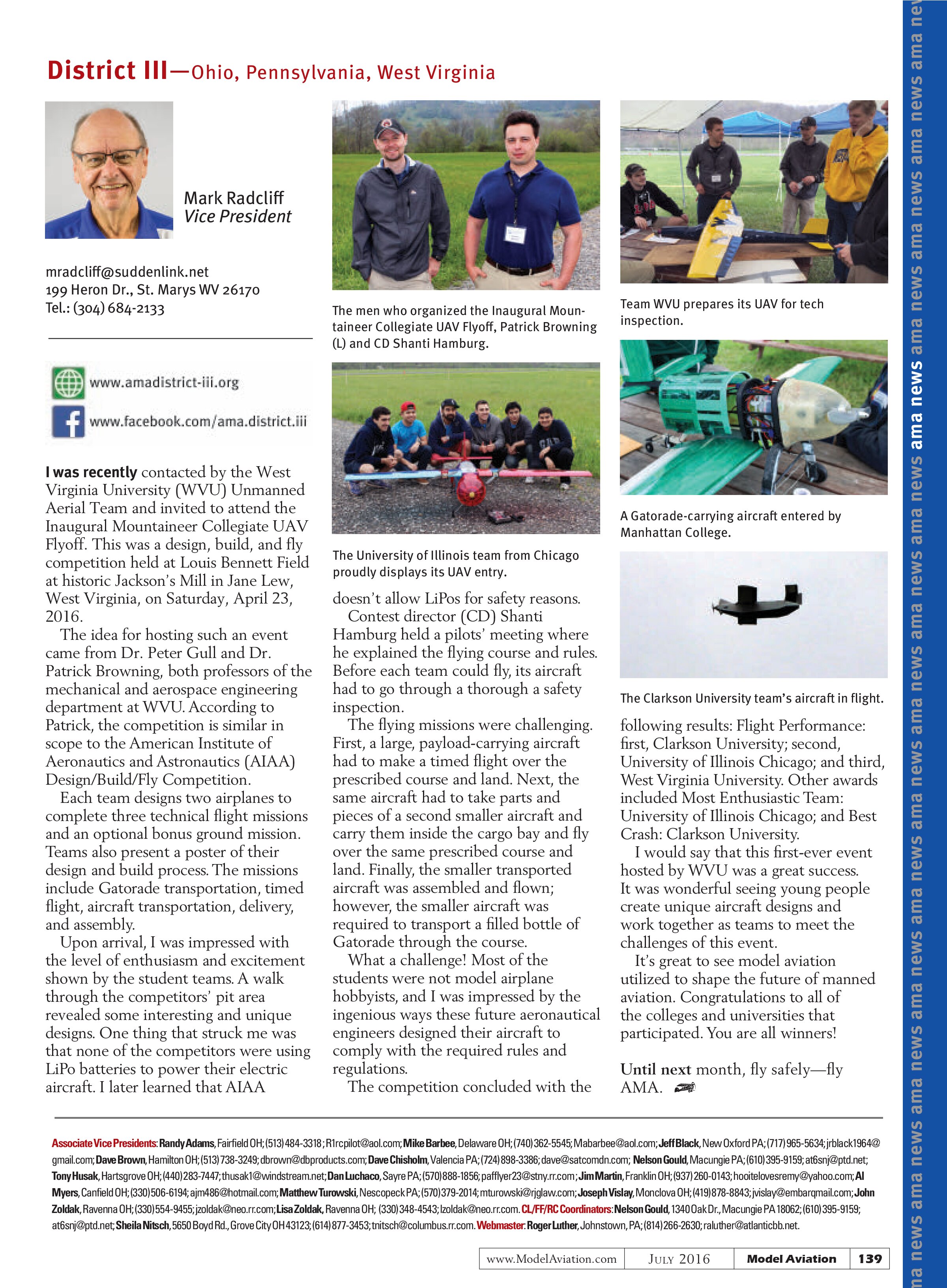
The men who organized the Inaugural Mountaineer Collegiate UAV Flyoff, Patrick Browning (L) and CD Shanti Hamburg.

The University of Illinois team from Chicago proudly displays its UAV entry.
doesn’t allow LiPos for safety reasons.
Contest director (CD) Shanti Hamburg held a pilots’ meeting where he explained the flying course and rules. Before each team could fly, its aircraft had to go through a thorough a safety inspection.
The flying missions were challenging. First, a large, payload-carrying aircraft had to make a timed flight over the prescribed course and land. Next, the same aircraft had to take parts and pieces of a second smaller aircraft and carry them inside the cargo bay and fly over the same prescribed course and land. Finally, the smaller transported aircraft was assembled and flown; however, the smaller aircraft was required to transport a filled bottle of Gatorade through the course.
What a challenge! Most of the students were not model airplane hobbyists, and I was impressed by the ingenious ways these future aeronautical engineers designed their aircraft to comply with the required rules and regulations.
The competition concluded with the

Team WVU prepares its UAV for tech inspection.

A Gatorade-carrying aircraft entered by Manhattan College.

The Clarkson University team’s aircraft in flight.
following results: Flight Performance: first, Clarkson University; second, University of Illinois Chicago; and third, West Virginia University. Other awards included Most Enthusiastic Team: University of Illinois Chicago; and Best Crash: Clarkson University.
I would say that this first-ever event hosted by WVU was a great success. It was wonderful seeing young people create unique aircraft designs and work together as teams to meet the challenges of this event.
It’s great to see model aviation utilized to shape the future of manned aviation. Congratulations to all of the colleges and universities that participated. You are all winners!
Until next month, fly safely—fly AMA.