Electric Carrier project
by Dick Perry
tailhooker@comcast.net
Beginning with this column, I will report on my endeavors into the relatively new (to me) realm of Electric Control Line (CL) Carrier. Listening to others who have made the transition is a helpful way to focus on my own efforts. My hope is that by documenting my experiences and thought processes, I might encourage and facilitate the transition for some of you who are considering trying our Electric events.
I readily admit to loving the high-speed part of our event. I love working with the engine, and I love the sensations associated with going fast. The sound, the smell, the pull, the image of the model as it rushes past the background, blurred by both concentration and speed—these are all a real high for me. The only down part is that it lasts less than 20 seconds!
It won’t be the same flying Electric Carrier. I’m hoping to keep the speed, but the sound will be gone. On the upside, so will the ear protection, the spilled fuel, the oil on the airplane, the cleanup, and the pads and cardboard to keep my car clean. I think I can live with that.
I enjoy researching subjects to model for Carrier. My MO-1 models work well, go fast, are easy to fly, and I know them after flying more than six versions in different classes. There is also a large element of sameness to them.
My electrics won’t be MO-1s. There are two reasons for that. First, I need a change. Second, I will be using ARF models as a starting point, and there aren’t any MO-1 ARFs out there (fortunately).

I started looking into ARFs long ago as an option for engine-powered Carrier models. Although John Vlna has been successful in flying some ARFs in traditional Carrier events, I found most of the available models were designed for smaller engines if they met our size requirements. They also tended to have less than a 44-inch wingspan—large models are best for our event.
I was encouraged when I found a 44-inch model of an AT-6/SNJ that looked promising, but discovered that it was not dimensionally accurate enough to meet our Scale Carrier requirements. It also had a flat-bottom airfoil. I stayed with my MO-1s.
I was encouraged by the Scale RC Combat event rules. The 1/12-scale requirement was good for us in many fighter-size subjects, but the rules allow a 10% dimension tolerance. That wasn’t bad, as it turns out, with many of the kits that are available meeting our 5% rule. But they had no landing gear, were still designed for smaller engines, and they tended to be expensive with the limited market. I stayed with my MO-1s.
The environment has changed with the proliferation of electric-powered RC ARFs and the introduction of Electric Navy Carrier. Digital graphics capability and laser cutting have also worked in our favor.
Many ARF manufacturers can scan three-views, import airfoils, use standard structural design features, and cut parts with much less labor and investment in production equipment than what was required for manual drafting and die cutting. Even printed covering materials are being used with color schemes, markings, and panel lines already on the material when it is applied.
The ease of design and production does have a potentially detrimental effect. I learned to fly when I was a kid, and many of the kits I built were still

available when I taught my own kids to fly a quarter century later.
A modern ARF model may no longer be available only months after you take delivery. With sufficient demand, a second production run may take place in a year or more. Finding an exact replacement for a model you crash, wear out, or just want to duplicate might not be possible.
For these reasons, I’ll mention particular models I’ve found, but I’ll concentrate on the research process because those models are no longer available. Even a model I just finished might not be available when this article is published.
I start my searches looking for a model that will be near the 44-inch wingspan limit. Because most specifications are in metric units, that translates to a 1,117mm maximum. Anything built to exactly 1,100mm will work, but anything slightly larger will need some wingtip reshaping to keep the model legal. There are quite a few airplanes in the 1,100mm-size class.
I look for wood construction because it seems to be lighter, can easily lend itself to modifications, and has readily definable structural members. Cast foam models look great in photos, but their structural strength depends on the relatively massive size of the foam components, resulting in internal dimensions for such things as the battery, ESC, and motor that can accommodate only the equipment they were designed for. That could be inadequate for the larger motor or battery you want or need to use.
Glow engines are vibration machines. Every turn of the propeller has a period of acceleration (power stroke) and deceleration (compression stroke) with some coasting included in between. Changing torques are transmitted to the aircraft just as they are applied to the propeller. Electric motors are smoother and require less structure to deal with vibration. That’s also why electric propellers can be so much thinner than glow propellers.
Unfortunately, landing forces are just as strong no matter what power system you use. Our arrested landings include not only the arresting forces, but also dropping the model on its gear from a very nose-high attitude. Such forces were not part of the design analysis of any RC ARF model. You definitely don’t want to have the arresting hook be the only thing that stops during the landing. Neither do you want the model to stop while the engine, battery, or both continue on down the deck.
Mounting a standard two-line bellcrank is relatively easy for any experienced CL modeler, as is the addition of a leadout guide to the wing. Wing mounts on an ARF won’t be designed for the torque applied by the leadout guide. ARF structures won’t be designed for a pull test and flight loads on the bellcrank mount, either. Modifying structures for all of these issues is easier with wood construction.
I’ve found two SNJ models with 44-inch wingspans—one from Global Hobby Distributors and one from HobbyKing.
Great Planes Model Manufacturing once produced a Combat Corsair for the RC Combat event. With a 43.25-inch wingspan, it has a cavernous fuselage and looks great. It can’t help but look beautiful; it’s a Corsair!
As an RC Combat model, it doesn’t have landing gear. I located two Spitfire (Seafire for us) models from HobbyKing, one with a 50-inch wingspan and one with a 49-inch wingspan and a different canopy configuration.
The 49-inch model will be the subject of my next column. It fits our wingspan limits because the Royal Navy used Seafires with clipped wingtips for low-altitude work. It works out perfectly. As of April, the smaller Spitfire is still listed on the HobbyKing website, but is not in stock.
Southwest Regionals
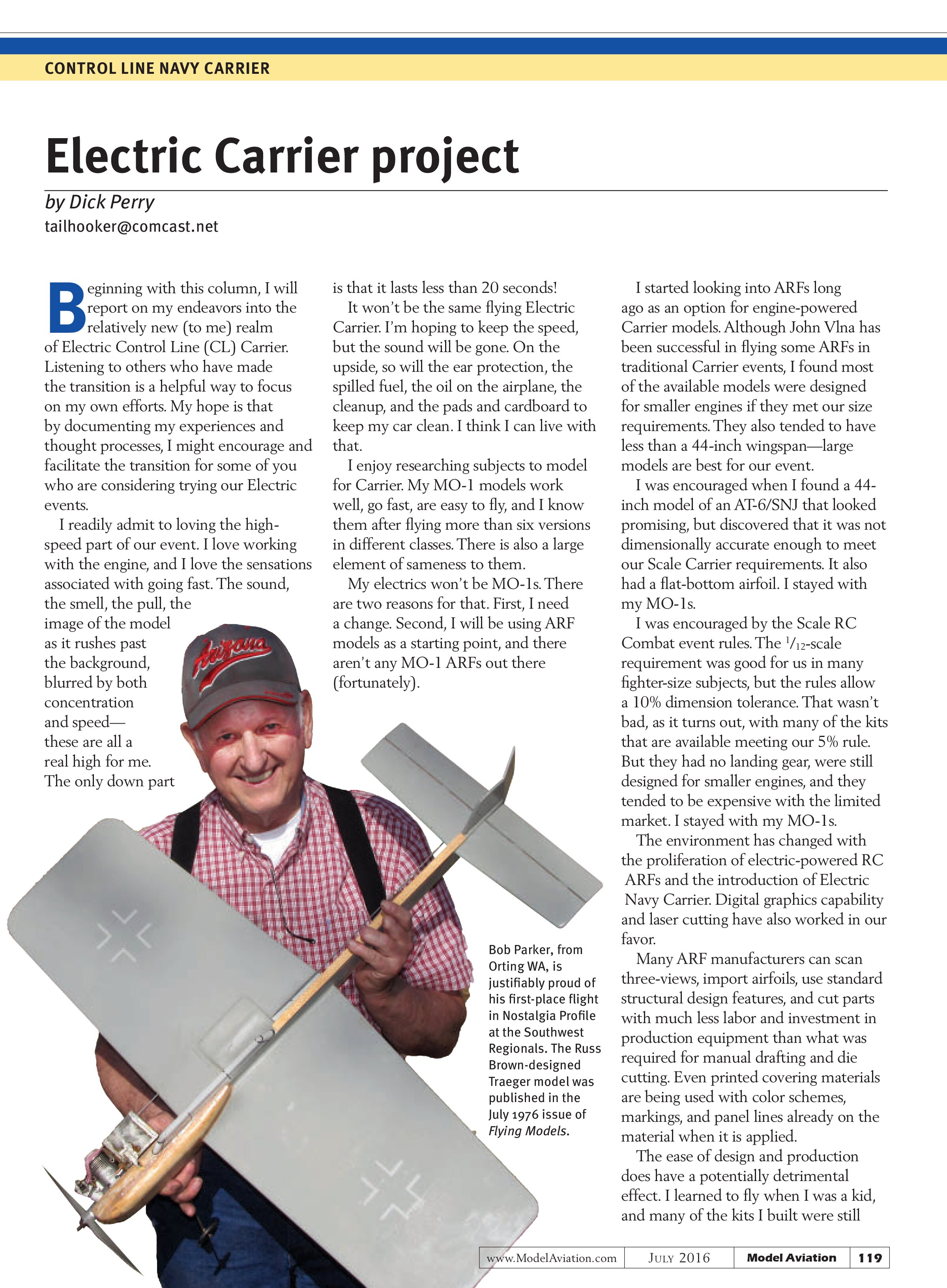
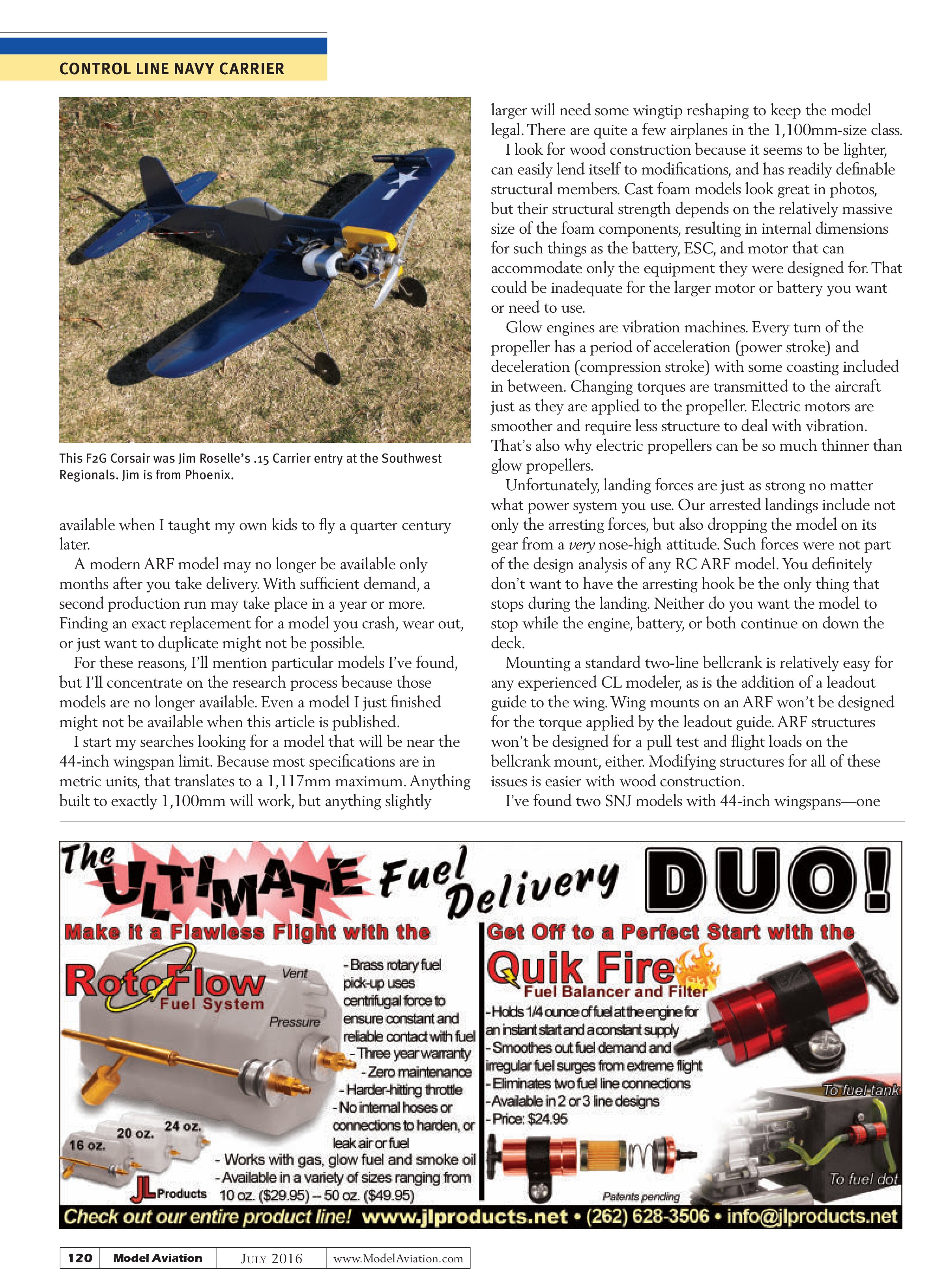
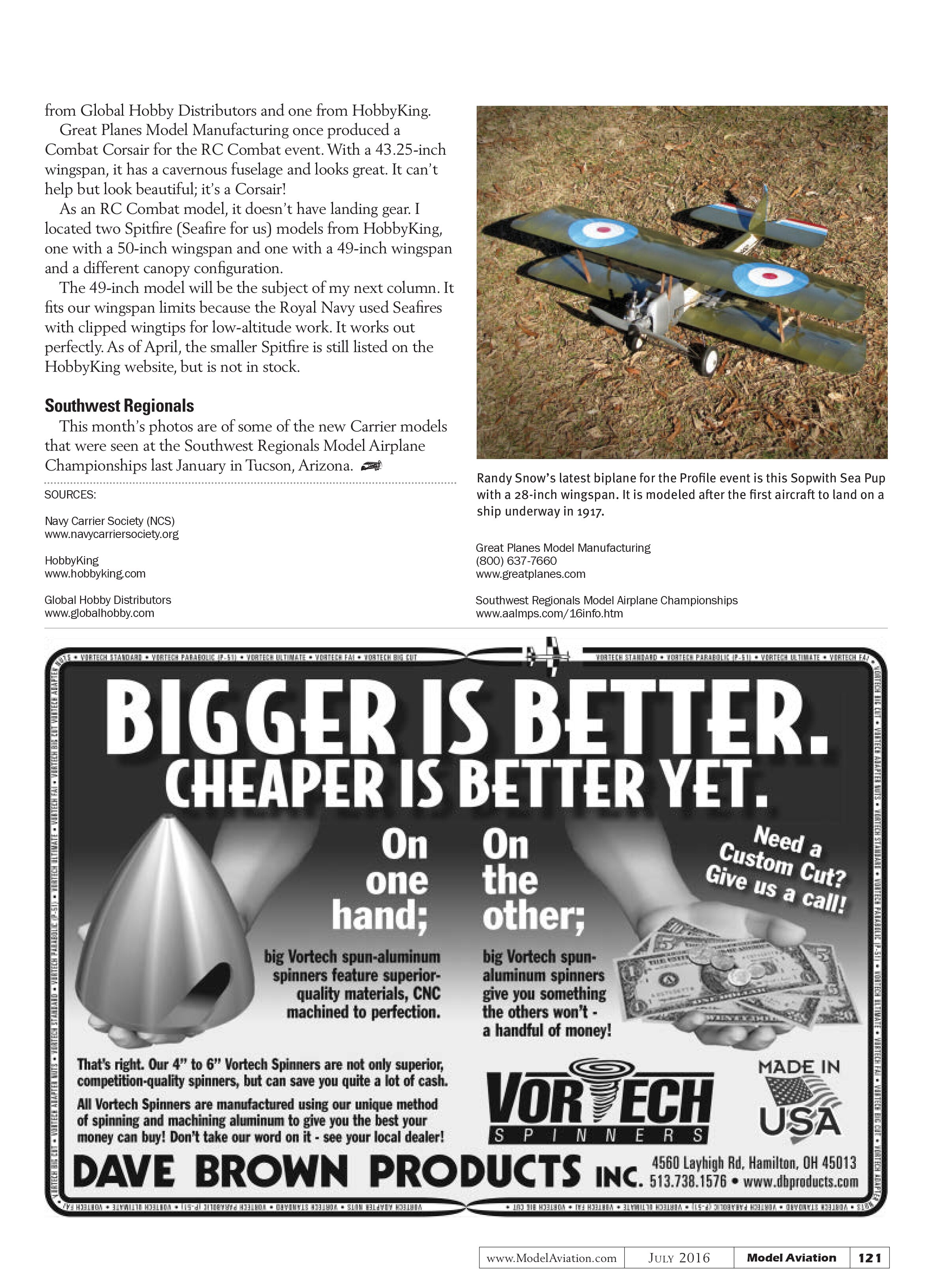
This month’s photos are of some of the new Carrier models that were seen at the Southwest Regionals Model Airplane Championships last January in Tucson, Arizona.
SOURCES:
Navy Carrier Society (NCS)
www.navycarriersociety.org
HobbyKing
www.hobbyking.com
Global Hobby Distributors
www.globalhobby.com

Great Planes Model Manufacturing
(800) 637-7660
www.greatplanes.com
Southwest Regionals Model Airplane Championships
www.aalmps.com/16info.htm