Phoenix F2D March Madness
by Mark Rudner
rudner@mit.edu

They’ve done it again. This past March, Lance Matassa and his crew put on another great installment of the season-opening March Madness F2D Combat Challenge in Phoenix. I’m not sure how many years the March Madness has run, but the two Phoenix contests—March Madness and the Red Flag in November—are now established as the unofficial bookends of the US F2D season.
It had been several years since I was able to attend, but as luck would have it, this time it fit in perfectly with my work travel schedule. It was a great pleasure to be back.
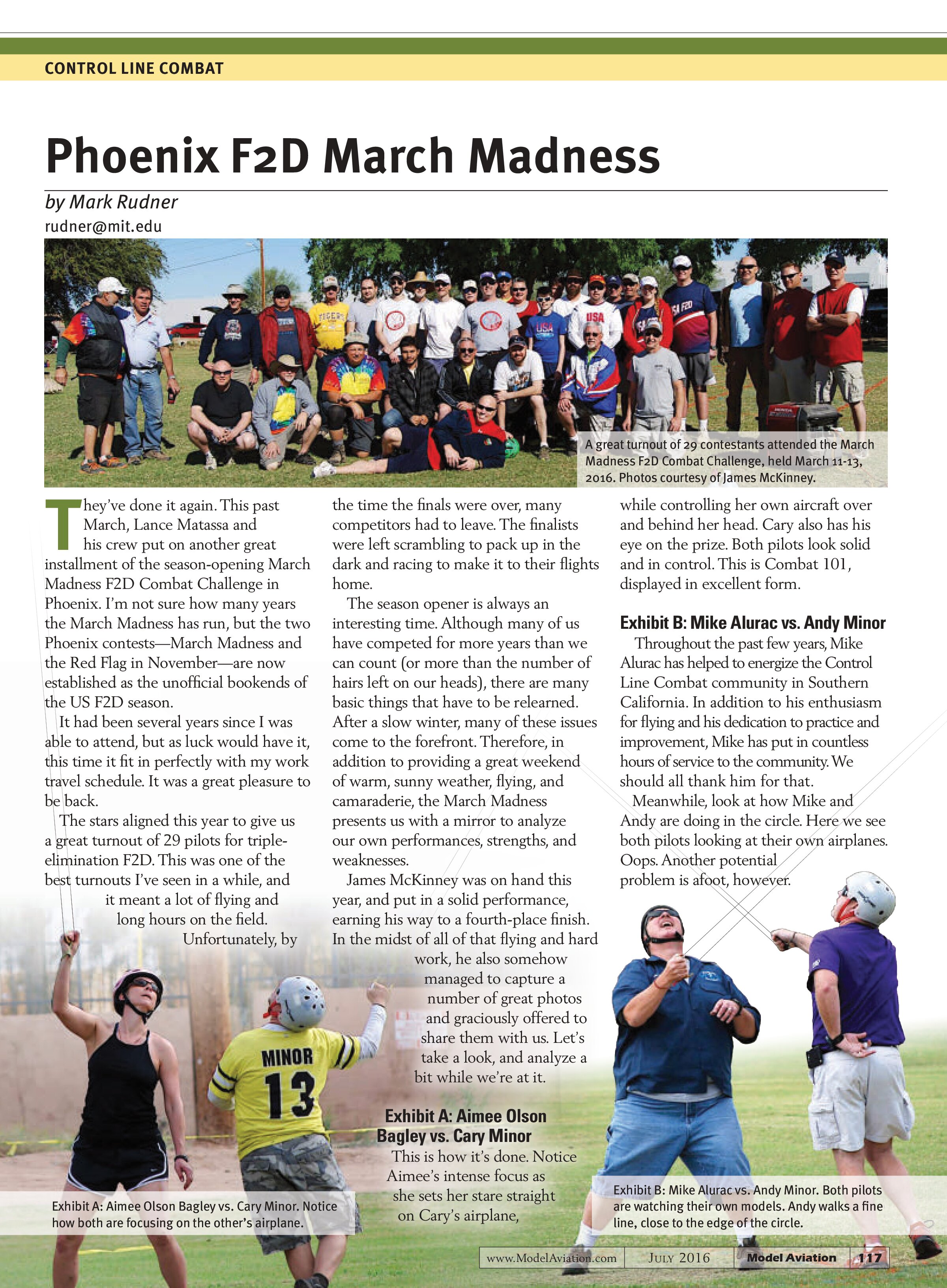
The stars aligned this year to give us a great turnout of 29 pilots for triple-elimination F2D. This was one of the best turnouts I’ve seen in a while, and it meant a lot of flying and long hours on the field. Unfortunately, by
the time the finals were over, many competitors had to leave. The finalists were left scrambling to pack up in the dark and racing to make it to their flights home.
The season opener is always an interesting time. Although many of us have competed for more years than we can count (or more than the number of hairs left on our heads), there are many basic things that have to be relearned. After a slow winter, many of these issues come to the forefront. Therefore, in addition to providing a great weekend of warm, sunny weather, flying, and camaraderie, the March Madness presents us with a mirror to analyze our own performances, strengths, and weaknesses.
James McKinney was on hand this year, and put in a solid performance, earning his way to a fourth-place finish. In the midst of all of that flying and hard work, he also somehow managed to capture a number of great photos and graciously offered to share them with us. Let’s take a look, and analyze a bit while we’re at it.

Exhibit A: Aimee Olson Bagley vs. Cary Minor
This is how it’s done. Notice Aimee’s intense focus as she sets her stare straight on Cary’s airplane, while controlling her own aircraft over and behind her head. Cary also has his eye on the prize. Both pilots look solid and in control. This is Combat 101, displayed in excellent form.

Exhibit B: Mike Alurac vs. Andy Minor
Throughout the past few years, Mike Alurac has helped to energize the Control Line Combat community in Southern California. In addition to his enthusiasm for flying and his dedication to practice and improvement, Mike has put in countless hours of service to the community. We should all thank him for that.
Meanwhile, look at how Mike and Andy are doing in the circle. Here we see both pilots looking at their own airplanes. Oops. Another potential problem is afoot, however.
Andy’s left shoe appears to be right on the paint marking the edge of the pilot’s circle. This is a risky position. If he puts his right foot down outside the circle, he’ll be in danger of picking up a 40-point penalty.
Keeping track of proper body position is a higher-level function compared with basic flying and aiming for the streamer. It is often one of the first things to go after a long off-season. Andy was flying great all weekend, and might have known exactly where his foot was, but this picture serves as a useful reminder for all of us to remain vigilant about body position.
Exhibit C: Greg Wornell and Chuck Rudner Pitting
Here’s another cautionary tale. Pitting in F2D is a complex operation. There are many procedures that need to be executed, and countless ways to go astray. One of the most important aspects of pitting is routine. There are many ways to skin a cat. Exactly which way you choose isn’t that important as long as you find a way that works reliably for you. Follow your routine without shortcuts every time—nothing should ever be left to chance.
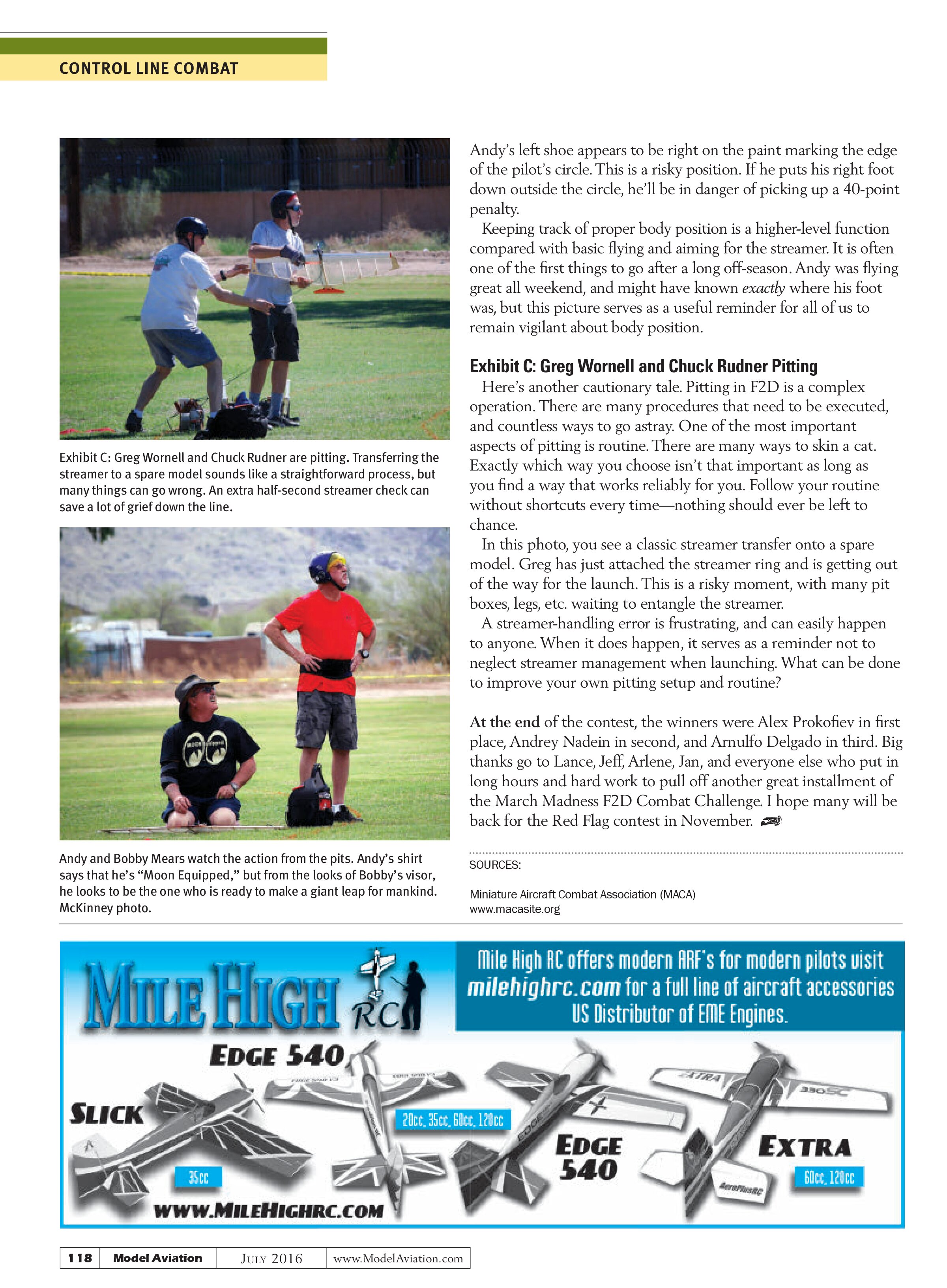
In this photo, you see a classic streamer transfer onto a spare model. Greg has just attached the streamer ring and is getting out of the way for the launch. This is a risky moment, with many pit boxes, legs, etc. waiting to entangle the streamer.
A streamer-handling error is frustrating, and can easily happen to anyone. When it does happen, it serves as a reminder not to neglect streamer management when launching. What can be done to improve your own pitting setup and routine?
At the end of the contest, the winners were Alex Prokofiev in first place, Andrey Nadein in second, and Arnulfo Delgado in third. Big thanks go to Lance, Jeff, Arlene, Jan, and everyone else who put in long hours and hard work to pull off another great installment of the March Madness F2D Combat Challenge. I hope many will be back for the Red Flag contest in November.


Exhibit C: Greg Wornell and Chuck Rudner are pitting. Transferring the streamer to a spare model sounds like a straightforward process, but many things can go wrong. An extra half-second streamer check can save a lot of grief down the line.
Andy and Bobby Mears watch the action from the pits. Andy’s shirt says that he’s “Moon Equipped,” but from the looks of Bobby’s visor, he looks to be the one who is ready to make a giant leap for mankind. McKinney photo.
SOURCES:
Miniature Aircraft Combat Association (MACA)
www.macasite.org