The Enlightening Bug project
by Bob Hunt
robinhunt@rcn.com

I’ve received a number of emails and telephone calls regarding the Enlightening Bug project that I wrote about in my March 2016 column. It seems that many have been searching for a model that has the attributes that this aircraft promises to possess.
To recap, I have always thought that Bob Baron’s Humbug design would make an ideal Control Line (CL) Aerobatics (Stunt) airplane for intermediate- or even advanced-class fliers. It has no flaps, is relatively small, and has outrigger booms to support its long stabilizer, so it would be very rigid and twist resistant (see the Humbug photos in the March 2016 “CL Aerobatics” column).
I stretched a new set of “clothes” on the Humbug, and opted to power it with an electric motor system. I initially called it the Lightening Bug, but my friend, Tom Huff (who is also building one), said it should be called the Enlightening Bug because it promises to teach him new flying and building lessons. So, Enlightening Bug it is!
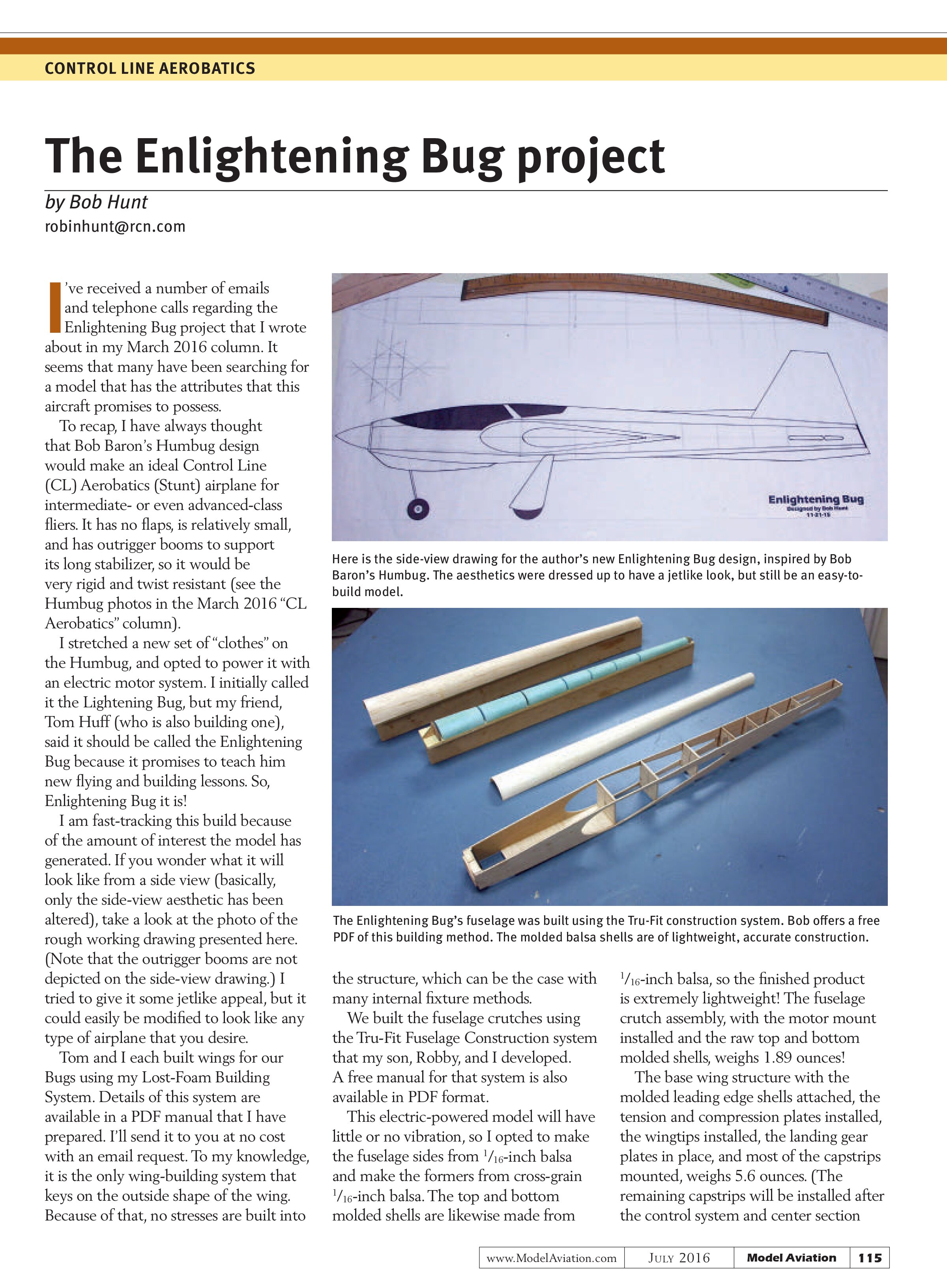
I am fast-tracking this build because of the amount of interest the model has generated. If you wonder what it will look like from a side view (basically, only the side-view aesthetic has been altered), take a look at the photo of the rough working drawing presented here. (Note that the outrigger booms are not depicted on the side-view drawing.) I tried to give it some jetlike appeal, but it could easily be modified to look like any type of airplane that you desire.
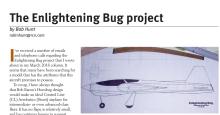
Tom and I each built wings for our Bugs using my Lost-Foam Building System. Details of this system are available in a PDF manual that I have prepared. I’ll send it to you at no cost with an email request. To my knowledge, it is the only wing-building system that keys on the outside shape of the wing. Because of that, no stresses are built into the structure, which can be the case with many internal fixture methods.

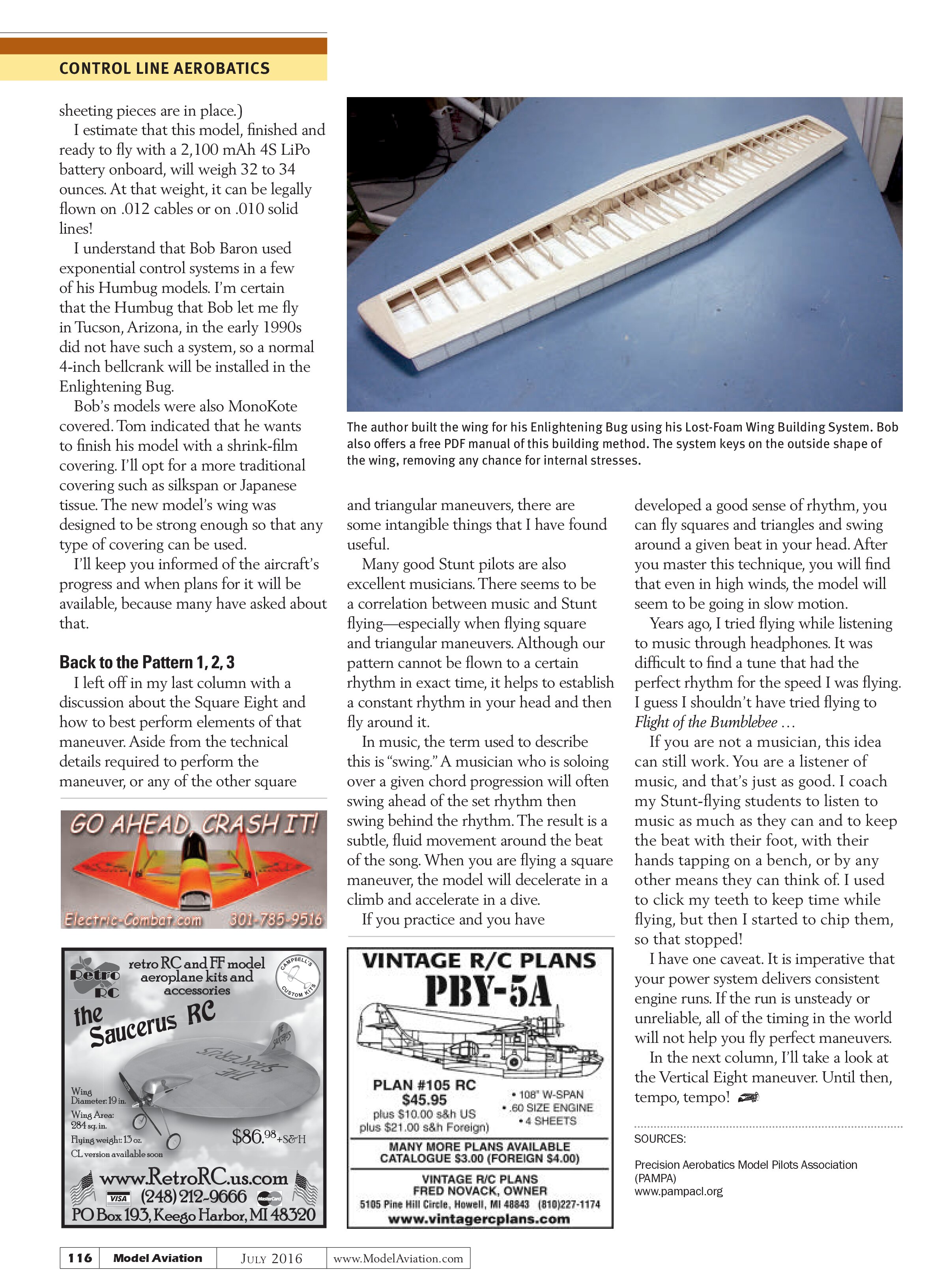
We built the fuselage crutches using the Tru-Fit Fuselage Construction system that my son, Robby, and I developed. A free manual for that system is also available in PDF format.
This electric-powered model will have little or no vibration, so I opted to make the fuselage sides from 1/16-inch balsa and make the formers from cross-grain 1/16-inch balsa. The top and bottom molded shells are likewise made from 1/16-inch balsa, so the finished product is extremely lightweight! The fuselage crutch assembly, with the motor mount installed and the raw top and bottom molded shells, weighs 1.89 ounces!
The base wing structure with the molded leading edge shells attached, the tension and compression plates installed, the wingtips installed, the landing gear plates in place, and most of the capstrips mounted, weighs 5.6 ounces. (The remaining capstrips will be installed after the control system and center section
sheeting pieces are in place.)
I estimate that this model, finished and ready to fly with a 2,100 mAh 4S LiPo battery onboard, will weigh 32 to 34 ounces. At that weight, it can be legally flown on .012 cables or on .010 solid lines!
I understand that Bob Baron used exponential control systems in a few of his Humbug models. I’m certain that the Humbug that Bob let me fly in Tucson, Arizona, in the early 1990s did not have such a system, so a normal 4-inch bellcrank will be installed in the Enlightening Bug.
Bob’s models were also MonoKote covered. Tom indicated that he wants to finish his model with a shrink-film covering. I’ll opt for a more traditional covering such as silkspan or Japanese tissue. The new model’s wing was designed to be strong enough so that any type of covering can be used.
I’ll keep you informed of the aircraft’s progress and when plans for it will be available, because many have asked about that.
Back to the Pattern 1, 2, 3
I left off in my last column with a discussion about the Square Eight and how to best perform elements of that maneuver. Aside from the technical details required to perform the maneuver, or any of the other square and triangular maneuvers, there are some intangible things that I have found useful.
Many good Stunt pilots are also excellent musicians. There seems to be a correlation between music and Stunt flying—especially when flying square and triangular maneuvers. Although our pattern cannot be flown to a certain rhythm in exact time, it helps to establish a constant rhythm in your head and then fly around it.
In music, the term used to describe this is “swing.” A musician who is soloing over a given chord progression will often swing ahead of the set rhythm then swing behind the rhythm. The result is a subtle, fluid movement around the beat of the song. When you are flying a square maneuver, the model will decelerate in a climb and accelerate in a dive.
If you practice and you have developed a good sense of rhythm, you can fly squares and triangles and swing around a given beat in your head. After you master this technique, you will find that even in high winds, the model will seem to be going in slow motion.
Years ago, I tried flying while listening to music through headphones. It was difficult to find a tune that had the perfect rhythm for the speed I was flying. I guess I shouldn’t have tried flying to Flight of the Bumblebee . . .
If you are not a musician, this idea can still work. You are a listener of music, and that’s just as good. I coach my Stunt-flying students to listen to music as much as they can and to keep the beat with their foot, with their hands tapping on a bench, or by any other means they can think of. I used to click my teeth to keep time while flying, but then I started to chip them, so that stopped!
I have one caveat. It is imperative that your power system delivers consistent engine runs. If the run is unsteady or unreliable, all of the timing in the world will not help you fly perfect maneuvers.
In the next column, I’ll take a look at the Vertical Eight maneuver. Until then, tempo, tempo!

SOURCES:
Precision Aerobatics Model Pilots Association (PAMPA)
www.pampacl.org