A new breed of RC pilots
Jim T. Graham
jgraham@rcgroups.com
I have big news! There is a whole new breed of RC pilots out there, and that’s good!
A few weeks ago, my friend and coworker, Jason Cole, convinced me to drive an hour to do some FPV racing—or, at the very least, to watch some FPV racing. There is a club there and Jason has been a member of it for a while.
I have done my share of racing FPV quadcopters in the shop, but I mostly fly them around the back of our local airfield. We had some FPV gates made, so on pretty days we like to set them up and fly through them.
FPV Racing
If you use the internet, then you probably know that FPV racing is becoming big. There are races all around the world with purses as high as $1 million! You read that right! The World Drone Prix, held in Dubai, United Arab Emirates, in March 2016, was the biggest race so far, with fliers from around the world competing.
The first TBS Mega Drone X FPV race was held April 30 and May 1, in Louisville, Kentucky, inside the Louisville Mega Cavern. Was it awesome? Yes.
I mention all of this because FPV racing has taken off. It has been picked up by conventional media and it shines a positive light on this side of the hobby.
FPV Racing Flying Style
Do you know pilots who have never flown RC, who will never join the AMA, who purchase a 400-size quadcopter, and who might fly near an airport? Those are not FPV racers. FPV racers fly small multirotors that are lightweight, fast, and usually stay approximately 20 feet off of the ground. They fly through gates that are close to 14 feet wide x 14 feet high, so how high can they go?
The pilots tend to hit the gates often, so they are adept at putting these little racers back together. They are real RC pilots—just like the stick-and-tissue builders from the old days, 3-D pilots, or International Miniature Aerobatic Club competitors. Some build machines and fly the teeth off of them.
What Is FPV Racing?
In writing this, I’m assuming that most of you know what FPV racing is, but for those who don’t, I will describe it.
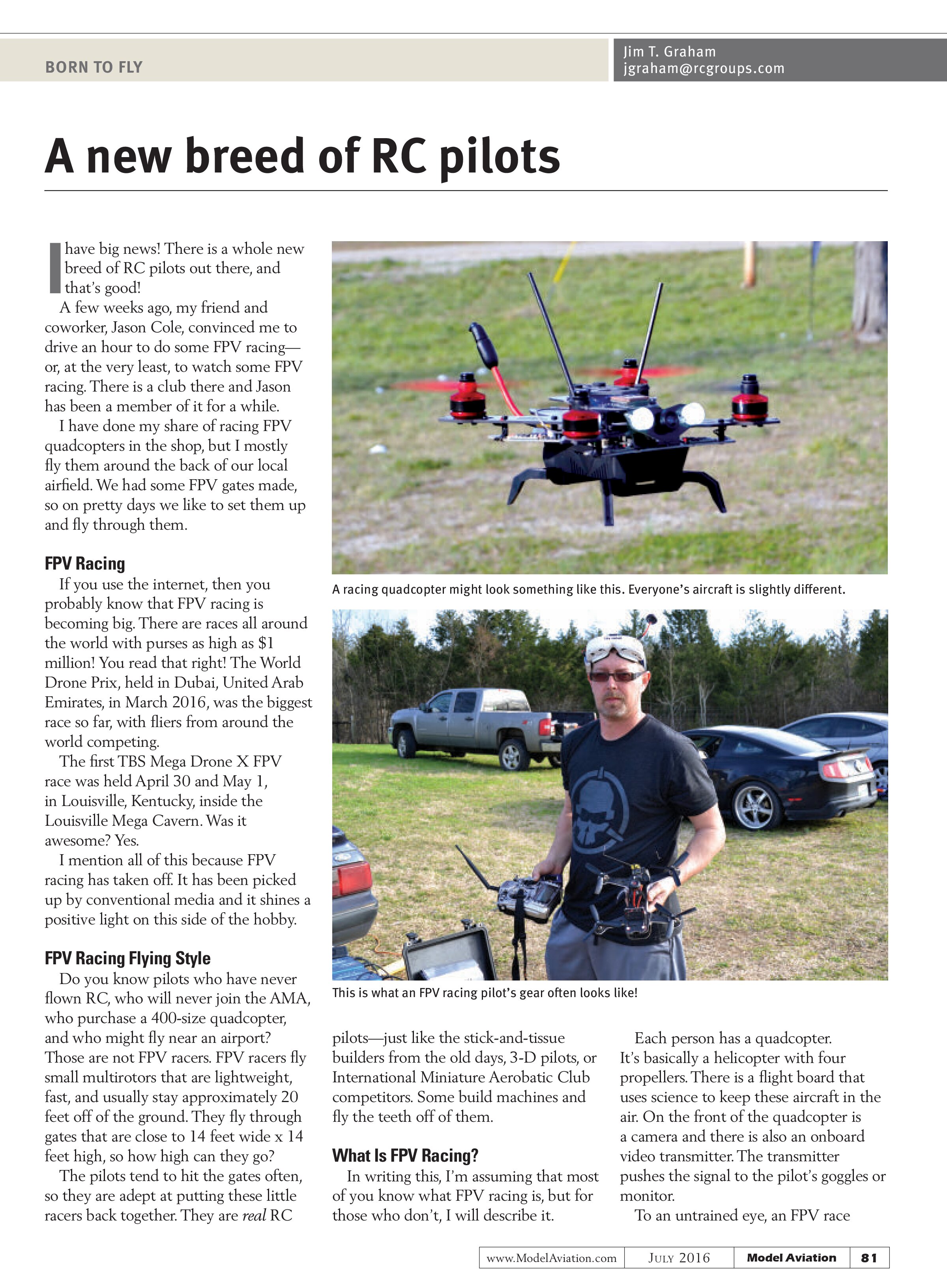
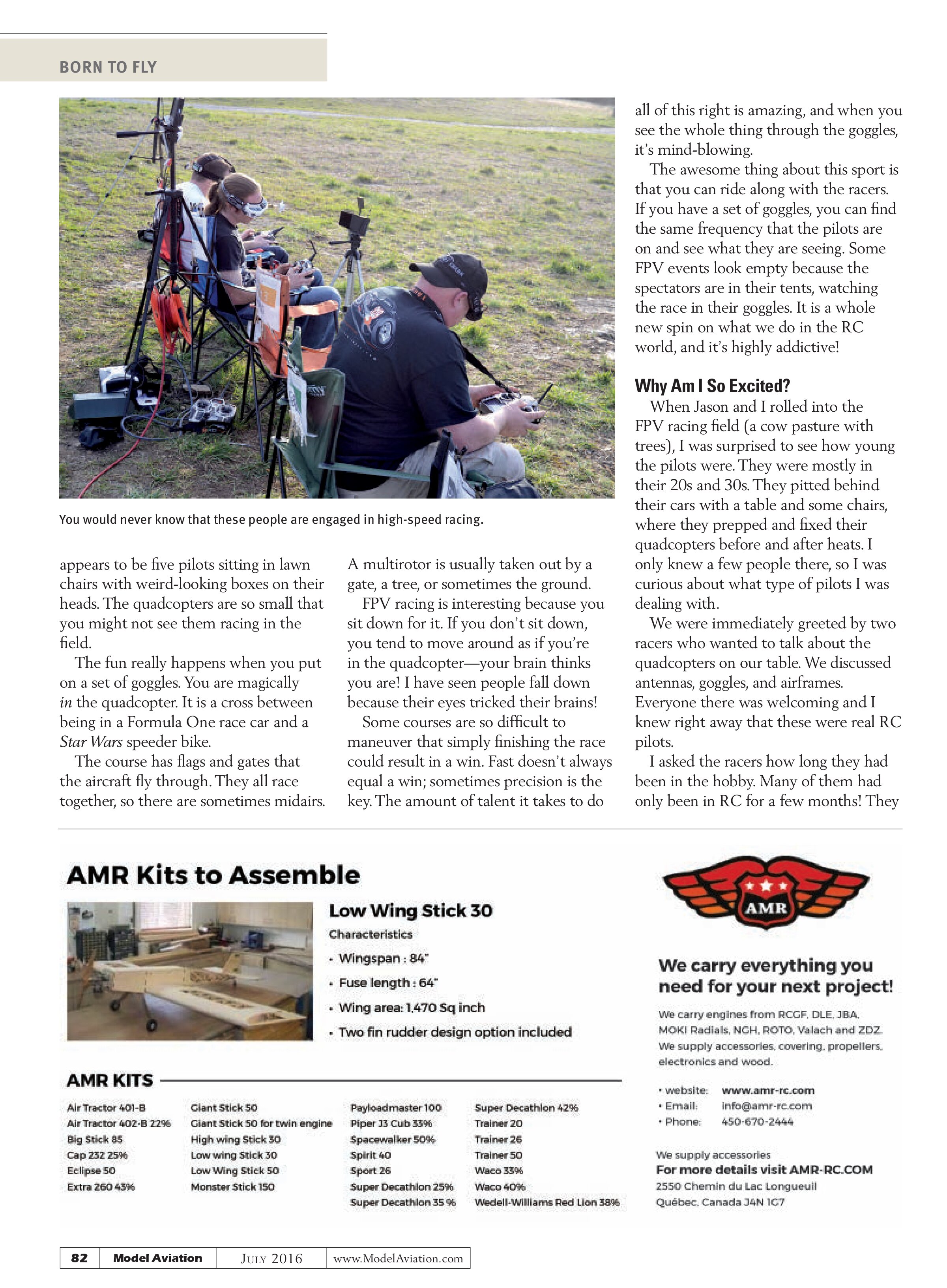
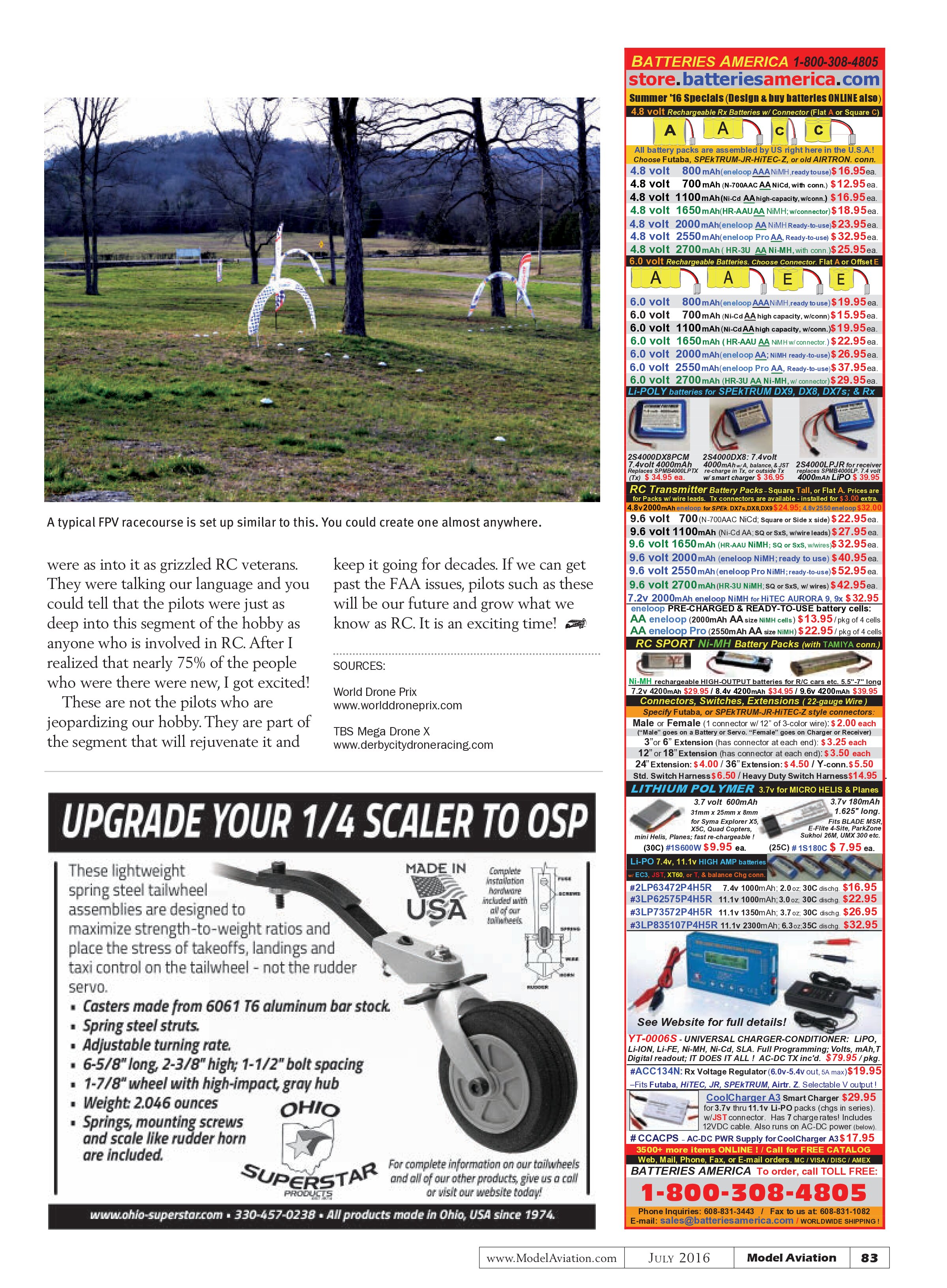
Each person has a quadcopter. It’s basically a helicopter with four propellers. There is a flight board that uses science to keep these aircraft in the air. On the front of the quadcopter is a camera and there is also an onboard video transmitter. The transmitter pushes the signal to the pilot’s goggles or monitor.
To an untrained eye, an FPV race


appears to be five pilots sitting in lawn chairs with weird-looking boxes on their heads. The quadcopters are so small that you might not see them racing in the field.
The fun really happens when you put on a set of goggles. You are magically in the quadcopter. It is a cross between being in a Formula One race car and a Star Wars speeder bike.
The course has flags and gates that the aircraft fly through. They all race together, so there are sometimes midairs.
A multirotor is usually taken out by a gate, a tree, or sometimes the ground.
FPV racing is interesting because you sit down for it. If you don’t sit down, you tend to move around as if you’re in the quadcopter—your brain thinks you are! I have seen people fall down because their eyes tricked their brains!
Some courses are so difficult to maneuver that simply finishing the race could result in a win. Fast doesn’t always equal a win; sometimes precision is the key. The amount of talent it takes to do all of this right is amazing, and when you see the whole thing through the goggles, it’s mind-blowing.
The awesome thing about this sport is that you can ride along with the racers. If you have a set of goggles, you can find the same frequency that the pilots are on and see what they are seeing. Some FPV events look empty because the spectators are in their tents, watching the race in their goggles. It is a whole new spin on what we do in the RC world, and it’s highly addictive!
Why Am I So Excited?
When Jason and I rolled into the FPV racing field (a cow pasture with trees), I was surprised to see how young the pilots were. They were mostly in their 20s and 30s. They pitted behind their cars with a table and some chairs, where they prepped and fixed their quadcopters before and after heats. I only knew a few people there, so I was curious about what type of pilots I was dealing with.
We were immediately greeted by two racers who wanted to talk about the quadcopters on our table. We discussed antennas, goggles, and airframes. Everyone there was welcoming and I knew right away that these were real RC pilots.
I asked the racers how long they had been in the hobby. Many of them had only been in RC for a few months! They were as into it as grizzled RC veterans. They were talking our language and you could tell that the pilots were just as deep into this segment of the hobby as anyone who is involved in RC. After I realized that nearly 75% of the people who were there were new, I got excited!
These are not the pilots who are jeopardizing our hobby. They are part of the segment that will rejuvenate it and
keep it going for decades. If we can get past the FAA issues, pilots such as these will be our future and grow what we know as RC. It is an exciting time!
SOURCES:
World Drone Prix
www.worlddroneprix.com
TBS Mega Drone X
www.derbycitydroneracing.com