Revisiting my RC roots
Thayer Syme
thayer@flying-models.com
“Boyertown? I know where Boyertown is,” my father remarked one day last fall, when learning of my December travel plans. I was a bit taken aback by his comment, as Boyertown, Pennsylvania, is home to just slightly more than 4,000 people, and the drive is a solid six-plus hours from his home in northern New England.
“Unicast is in Boyertown,” he finished. Wow, was that ever a blast from the past.
The summer I turned 15, I went to work for my father, expecting to purchase a couple of brass locomotives for my model railroad before heading back to my second year of high school that fall.
I had just finished phase one of an 8 x 18-foot layout as classes ended that spring. The basic bench work was complete, and I had laid slightly more than 35 feet of roadbed and track, establishing the main outer loop and

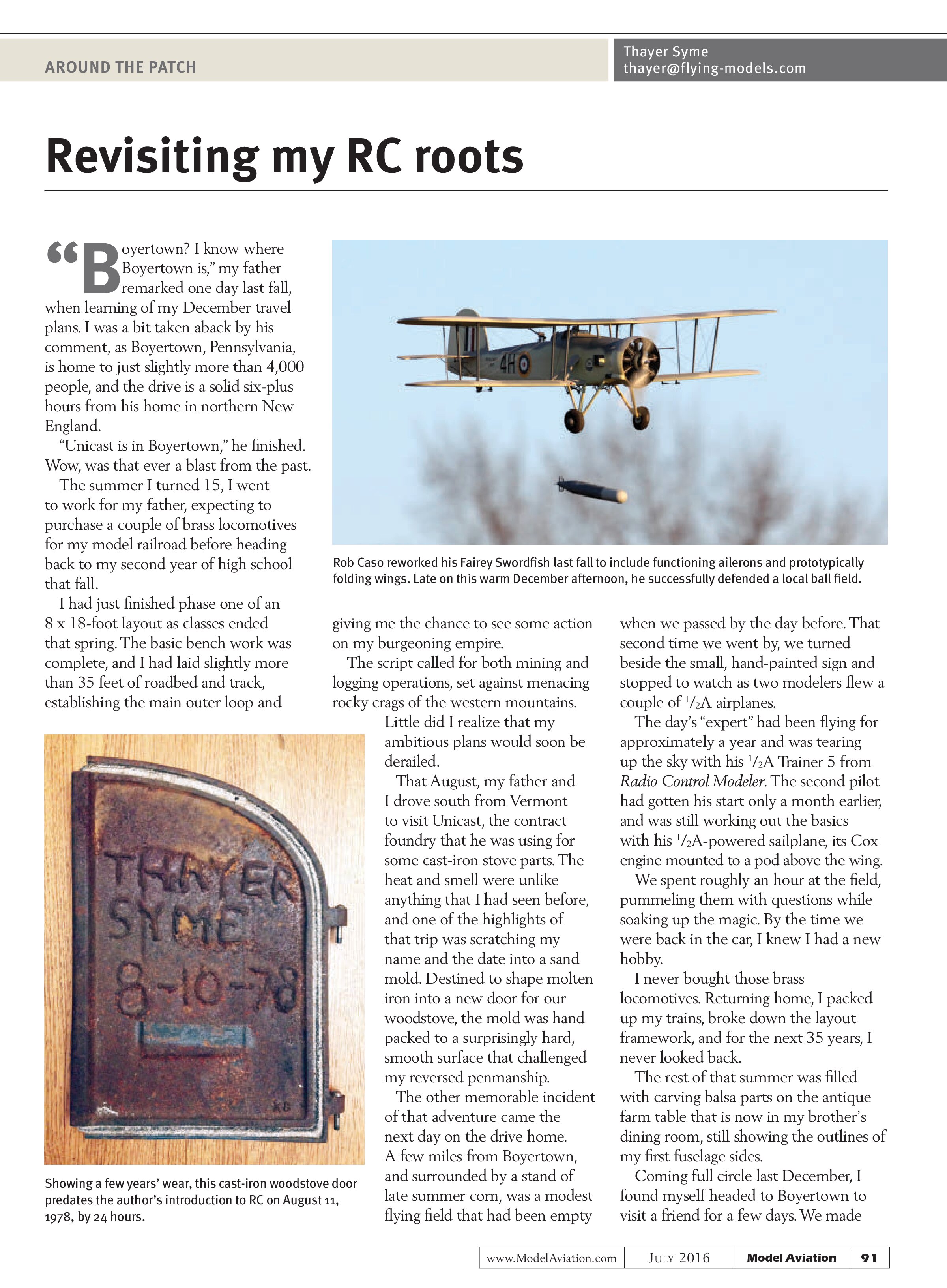
Rob Caso reworked his Fairey Swordfish last fall to include functioning ailerons and prototypically folding wings. Late on this warm December afternoon, he successfully defended a local ball field.
giving me the chance to see some action on my burgeoning empire.
The script called for both mining and logging operations, set against menacing rocky crags of the western mountains.
Little did I realize that my ambitious plans would soon be derailed.
That August, my father and I drove south from Vermont to visit Unicast, the contract foundry that he was using for some cast-iron stove parts. The heat and smell were unlike anything that I had seen before, and one of the highlights of that trip was scratching my name and the date into a sand mold. Destined to shape molten iron into a new door for our woodstove, the mold was hand packed to a surprisingly hard, smooth surface that challenged my reversed penmanship.
The other memorable incident of that adventure came the next day on the drive home. A few miles from Boyertown, and surrounded by a stand of late summer corn, was a modest flying field that had been empty
when we passed by the day before. That second time we went by, we turned beside the small, hand-painted sign and stopped to watch as two modelers flew a couple of 1/2A airplanes.
The day’s “expert” had been flying for approximately a year and was tearing up the sky with his 1/2A Trainer 5 from Radio Control Modeler. The second pilot had gotten his start only a month earlier, and was still working out the basics with his 1/2A-powered sailplane, its Cox engine mounted to a pod above the wing.
We spent roughly an hour at the field, pummeling them with questions while soaking up the magic. By the time we were back in the car, I knew I had a new hobby.
I never bought those brass locomotives. Returning home, I packed up my trains, broke down the layout framework, and for the next 35 years, I never looked back.
The rest of that summer was filled with carving balsa parts on the antique farm table that is now in my brother’s dining room, still showing the outlines of my first fuselage sides.
Coming full circle last December, I found myself headed to Boyertown to visit a friend for a few days. We made

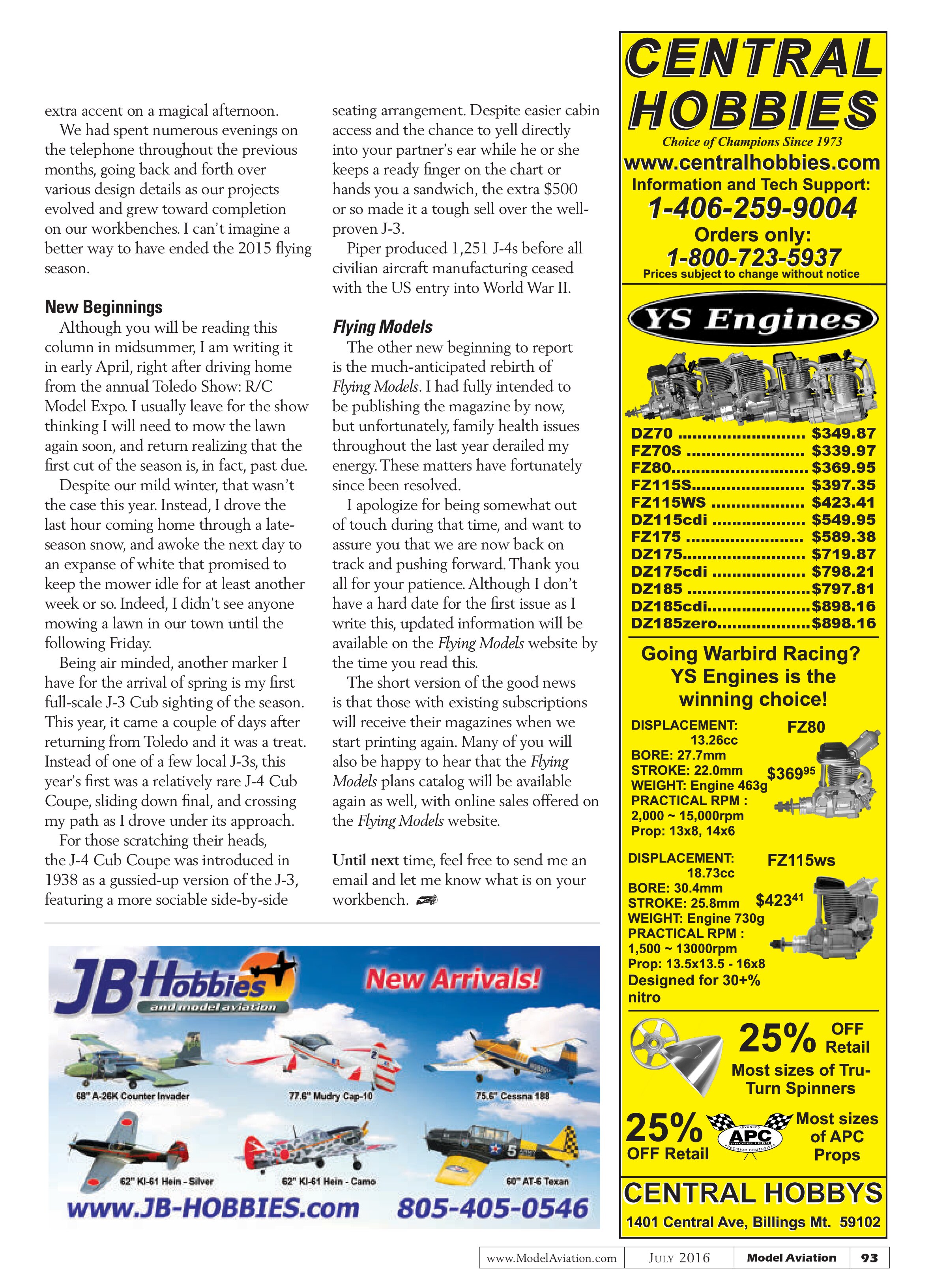
Showing a few years’ wear, this cast-iron woodstove door predates the author’s introduction to RC on August 11, 1978, by 24 hours.
extra accent on a magical afternoon. We had spent numerous evenings on the telephone throughout the previous months, going back and forth over various design details as our projects evolved and grew toward completion on our workbenches. I can’t imagine a better way to have ended the 2015 flying season.
New Beginnings
Although you will be reading this column in midsummer, I am writing it in early April, right after driving home from the annual Toledo Show: R/C Model Expo. I usually leave for the show thinking I will need to mow the lawn again soon, and return realizing that the first cut of the season is, in fact, past due.
Despite our mild winter, that wasn’t the case this year. Instead, I drove the last hour coming home through a late-season snow, and awoke the next day to an expanse of white that promised to keep the mower idle for at least another week or so. Indeed, I didn’t see anyone mowing a lawn in our town until the following Friday.
Being air minded, another marker I have for the arrival of spring is my first full-scale J-3 Cub sighting of the season. This year, it came a couple of days after returning from Toledo and it was a treat. Instead of one of a few local J-3s, this year’s first was a relatively rare J-4 Cub Coupe, sliding down final, and crossing my path as I drove under its approach.
For those scratching their heads, the J-4 Cub Coupe was introduced in 1938 as a gussied-up version of the J-3, featuring a more sociable side-by-side seating arrangement. Despite easier cabin access and the chance to yell directly into your partner’s ear while he or she keeps a ready finger on the chart or hands you a sandwich, the extra $500 or so made it a tough sell over the well-proven J-3. Piper produced 1,251 J-4s before all civilian aircraft manufacturing ceased with the US entry into World War II.
Flying Models
The other new beginning to report is the much-anticipated rebirth of Flying Models. I had fully intended to be publishing the magazine by now, but unfortunately, family health issues throughout the last year derailed my energy. These matters have fortunately since been resolved.
I apologize for being somewhat out of touch during that time, and want to assure you that we are now back on track and pushing forward. Thank you all for your patience. Although I don’t have a hard date for the first issue as I write this, updated information will be available on the Flying Models website by the time you read this.
The short version of the good news is that those with existing subscriptions will receive their magazines when we start printing again. Many of you will also be happy to hear that the Flying Models plans catalog will be available again as well, with online sales offered on the Flying Models website.
Until next time, feel free to send me an email and let me know what is on your workbench.