Climb inside the Cockpit Ground Station

EPV flying was still a lonely outpost on the far fringes of the world of model aviation when the Roswell Flight Test Crew got its start. As did many early pioneers, we struggled to even describe the experience. The most common phrase you would hear was, “It’s like being in the cockpit.”
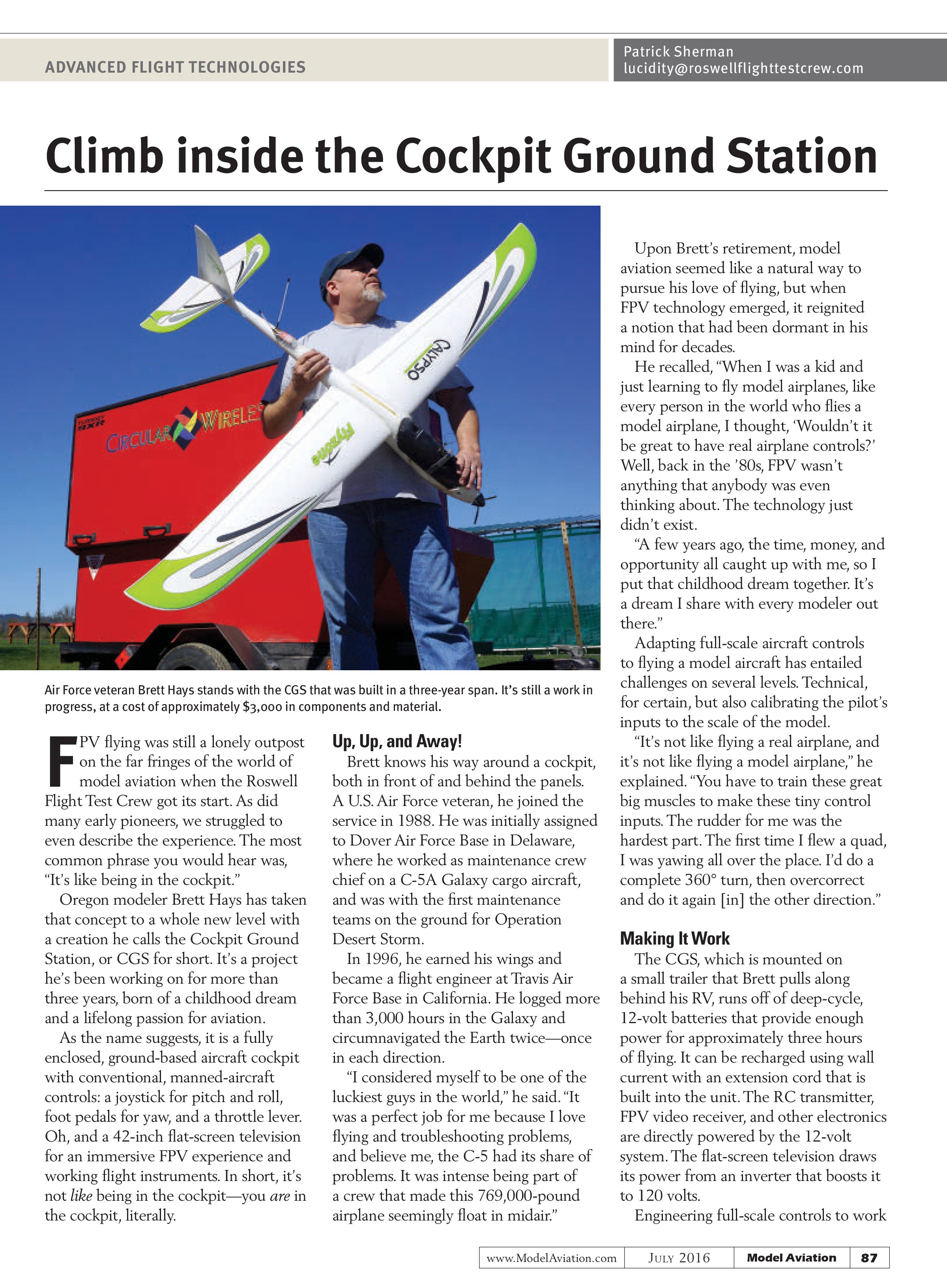
Oregon modeler Brett Hays has taken that concept to a whole new level with a creation he calls the Cockpit Ground Station, or CGS for short. It’s a project he’s been working on for more than three years, born of a childhood dream and a lifelong passion for aviation.
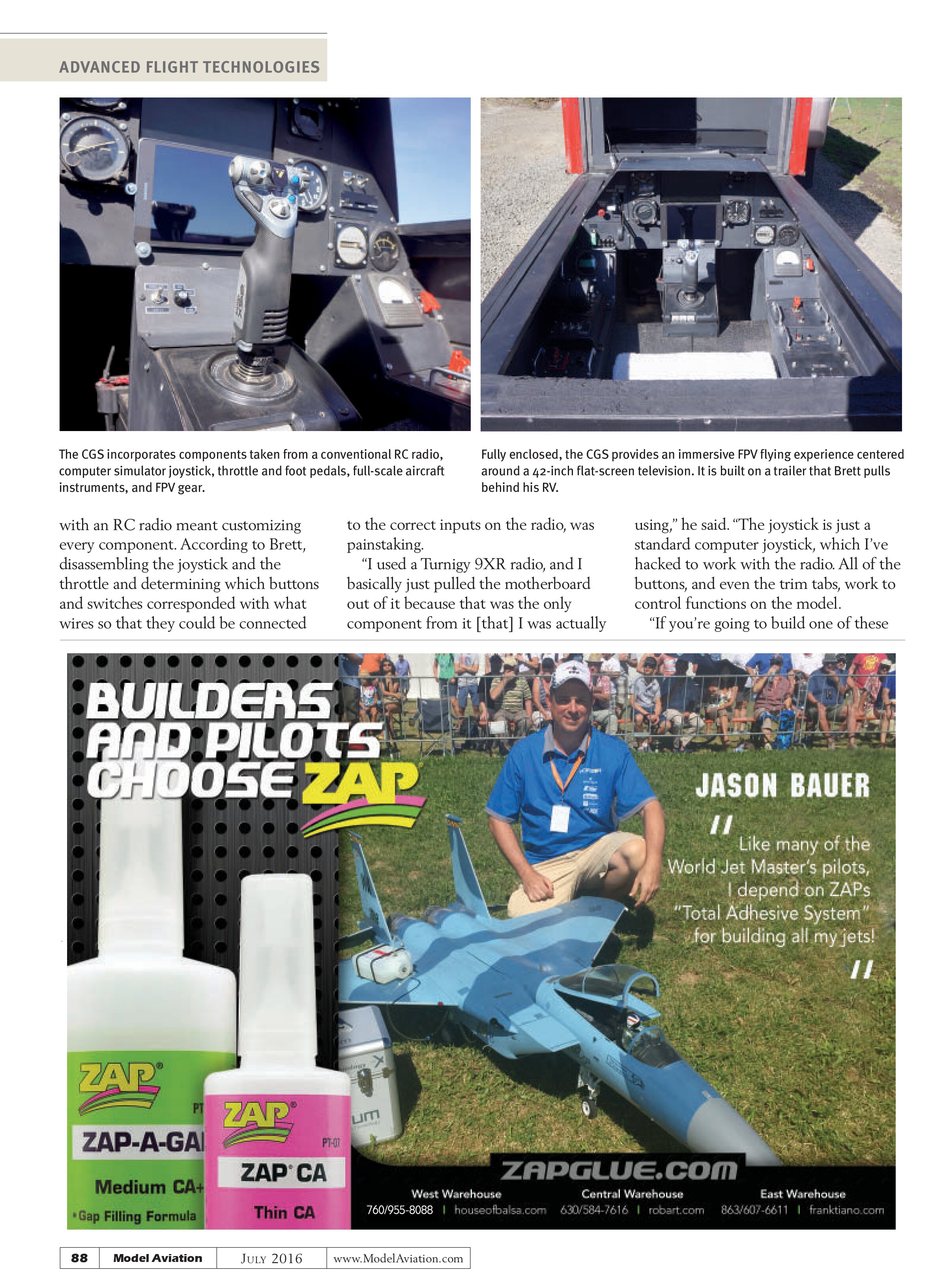
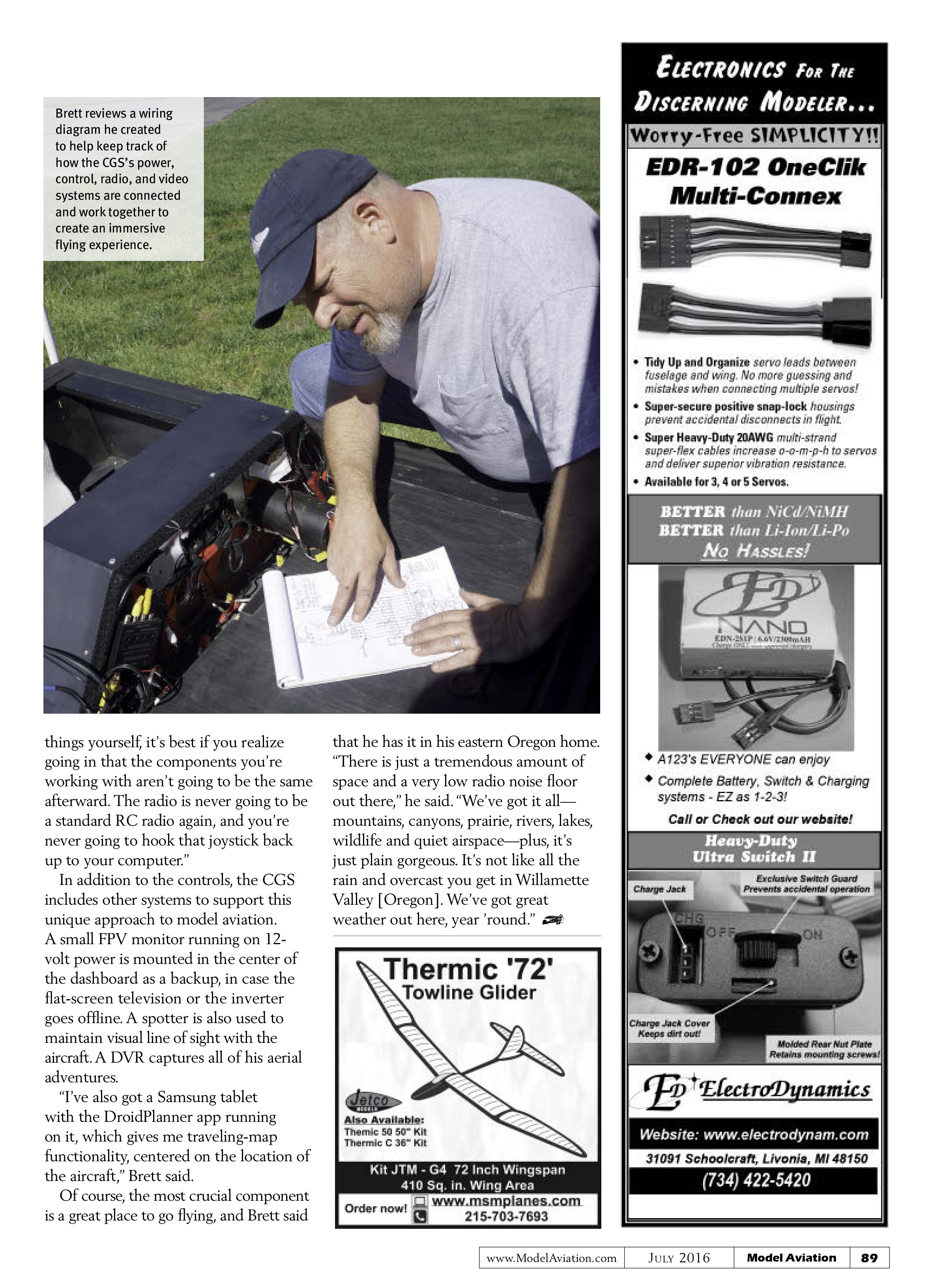
As the name suggests, it is a fully enclosed, ground-based aircraft cockpit with conventional, manned-aircraft controls: a joystick for pitch and roll, foot pedals for yaw, and a throttle lever. Oh, and a 42-inch flat-screen television for an immersive FPV experience and working flight instruments. In short, it’s not like being in the cockpit—you are in the cockpit, literally.
Up, Up, and Away!
Brett knows his way around a cockpit, both in front of and behind the panels. A U.S. Air Force veteran, he joined the service in 1988. He was initially assigned to Dover Air Force Base in Delaware, where he worked as maintenance crew chief on a C-5A Galaxy cargo aircraft, and was with the first maintenance teams on the ground for Operation Desert Storm.
In 1996, he earned his wings and became a flight engineer at Travis Air Force Base in California. He logged more than 3,000 hours in the Galaxy and circumnavigated the Earth twice—once in each direction.
“I considered myself to be one of the luckiest guys in the world,” he said. “It was a perfect job for me because I love flying and troubleshooting problems, and believe me, the C-5 had its share of problems. It was intense being part of a crew that made this 769,000-pound airplane seemingly float in midair.”
Upon Brett’s retirement, model aviation seemed like a natural way to pursue his love of flying, but when FPV technology emerged, it reignited a notion that had been dormant in his mind for decades.
He recalled, “When I was a kid and just learning to fly model airplanes, like every person in the world who flies a model airplane, I thought, ‘Wouldn’t it be great to have real airplane controls?’ Well, back in the ’80s, FPV wasn’t anything that anybody was even thinking about. The technology just didn’t exist.
“A few years ago, the time, money, and opportunity all caught up with me, so I put that childhood dream together. It’s a dream I share with every modeler out there.”
Adapting full-scale aircraft controls to flying a model aircraft has entailed challenges on several levels. Technical, for certain, but also calibrating the pilot’s inputs to the scale of the model.
“It’s not like flying a real airplane, and it’s not like flying a model airplane,” he explained. “You have to train these great big muscles to make these tiny control inputs. The rudder for me was the hardest part. The first time I flew a quad, I was yawing all over the place. I’d do a complete 360° turn, then overcorrect and do it again [in] the other direction.”
Making It Work
The CGS, which is mounted on a small trailer that Brett pulls along behind his RV, runs off of deep-cycle, 12-volt batteries that provide enough power for approximately three hours of flying. It can be recharged using wall current with an extension cord that is built into the unit. The RC transmitter, FPV video receiver, and other electronics are directly powered by the 12-volt system. The flat-screen television draws its power from an inverter that boosts it to 120 volts.
Engineering full-scale controls to work
with an RC radio meant customizing every component. According to Brett, disassembling the joystick and the throttle and determining which buttons and switches corresponded with what wires so that they could be connected to the correct inputs on the radio, was painstaking.
“I used a Turnigy 9XR radio, and I basically just pulled the motherboard out of it because that was the only component from it [that] I was actually using,” he said. “The joystick is just a standard computer joystick, which I’ve hacked to work with the radio. All of the buttons, and even the trim tabs, work to control functions on the model.
“If you’re going to build one of these


things yourself, it’s best if you realize going in that the components you’re working with aren’t going to be the same afterward. The radio is never going to be a standard RC radio again, and you’re never going to hook that joystick back up to your computer.”
In addition to the controls, the CGS includes other systems to support this unique approach to model aviation. A small FPV monitor running on 12-volt power is mounted in the center of the dashboard as a backup, in case the flat-screen television or the inverter goes offline. A spotter is also used to maintain visual line of sight with the aircraft. A DVR captures all of his aerial adventures.
“I’ve also got a Samsung tablet with the DroidPlanner app running on it, which gives me traveling-map functionality, centered on the location of the aircraft,” Brett said.
Of course, the most crucial component is a great place to go flying, and Brett said that he has it in his eastern Oregon home. “There is just a tremendous amount of space and a very low radio noise floor out there,” he said. “We’ve got it all—mountains, canyons, prairie, rivers, lakes, wildlife and quiet airspace—plus, it’s just plain gorgeous. It’s not like all the rain and overcast you get in Willamette Valley [Oregon]. We’ve got great weather out here, year ’round.”