Does size matter?
Dave Gee
safetycolumn@cs.com
A mother recently asked me for advice about which RC model aircraft to buy as a gift for a new young flier. She wanted to purchase an appropriate beginner’s model, “not something big and dangerous.”
Sure, it’s funny that she would want advice from the worst RC pilot ever, but her question made me stop and think. I wondered about the public’s perceptions of some model aircraft being big and dangerous and whether they were accurate or not.
Are larger models more dangerous than smaller ones? Bigger means heavier and more powerful, but that doesn’t automatically make smaller, lighter, and less-powerful aircraft safer. It’s all relative. I fly some small airplanes, so what seems big to me might look petite to a Giant Scale pilot.
How about this angle? If the owner of a large model is more likely to take the big powerplant seriously, is there a risk of becoming complacent about the little engine on the nose of a midsize airplane?
A big propeller could do a lot of damage to a careless operator, but is a smaller one easier to overlook and more likely to contact a hand during adjustment?
Our miniature engines have improved throughout the years. There are some powerful, but small, electric systems. Is a motor with a high-energy output more dangerous in a small aircraft? It’s handier and easier to maneuver on a workbench.
Larger airplanes require us to get up and walk around them; a smaller airplane gets picked up and held. Does that make a large aircraft more dangerous or safer?
I reviewed the accident report emails that I have received, but they were anecdotal and incomplete. To create a database, I would need to know how many flights were made with each model size, how many incidents occurred, and how serious each one was.

Construction and repair work should be included. What a job it would be to put that database together!
In lieu of a scientific study, here’s my answer: I bet that it works out evenly across the board for RC gas-powered and electric-powered airplanes, with the dimensions of the model not being a serious factor. My suspicion is that the pilot’s mental attitude is more important than the size, power, or aircraft configuration. Do you agree?
A foolish or inattentive modeler will have trouble no matter what. If an airplane is a handy size, things might go wrong sooner. A bigger aircraft commands more respect, but when an incident does occur, it could be more serious. Neither is inherently safer.
An injury is not the model’s fault, in any case—except for that one airplane that got loose and chased me across the field. I still hold a grudge.
Two Kinds of Trouble
The accident reports that I receive

seem to come in two categories: either the victim was inexperienced and didn’t know a particular safety rule, or he or she knew better, but somehow—just for a moment—didn’t follow


proper procedure. Sometimes the lesson is painful.
It’s not always simple and easy. You have to learn, think, and pay attention to fly safely, and it’s a fun process. Each successful flight proves that you have what it takes.
I recently had a painful lesson of my own, regarding model size. Middle school students in a model club wanted to conduct a building session. They tend to think outside of the box, so they requested “something so big we can’t get
it out of the room when it’s finished.” That’s the spirit!
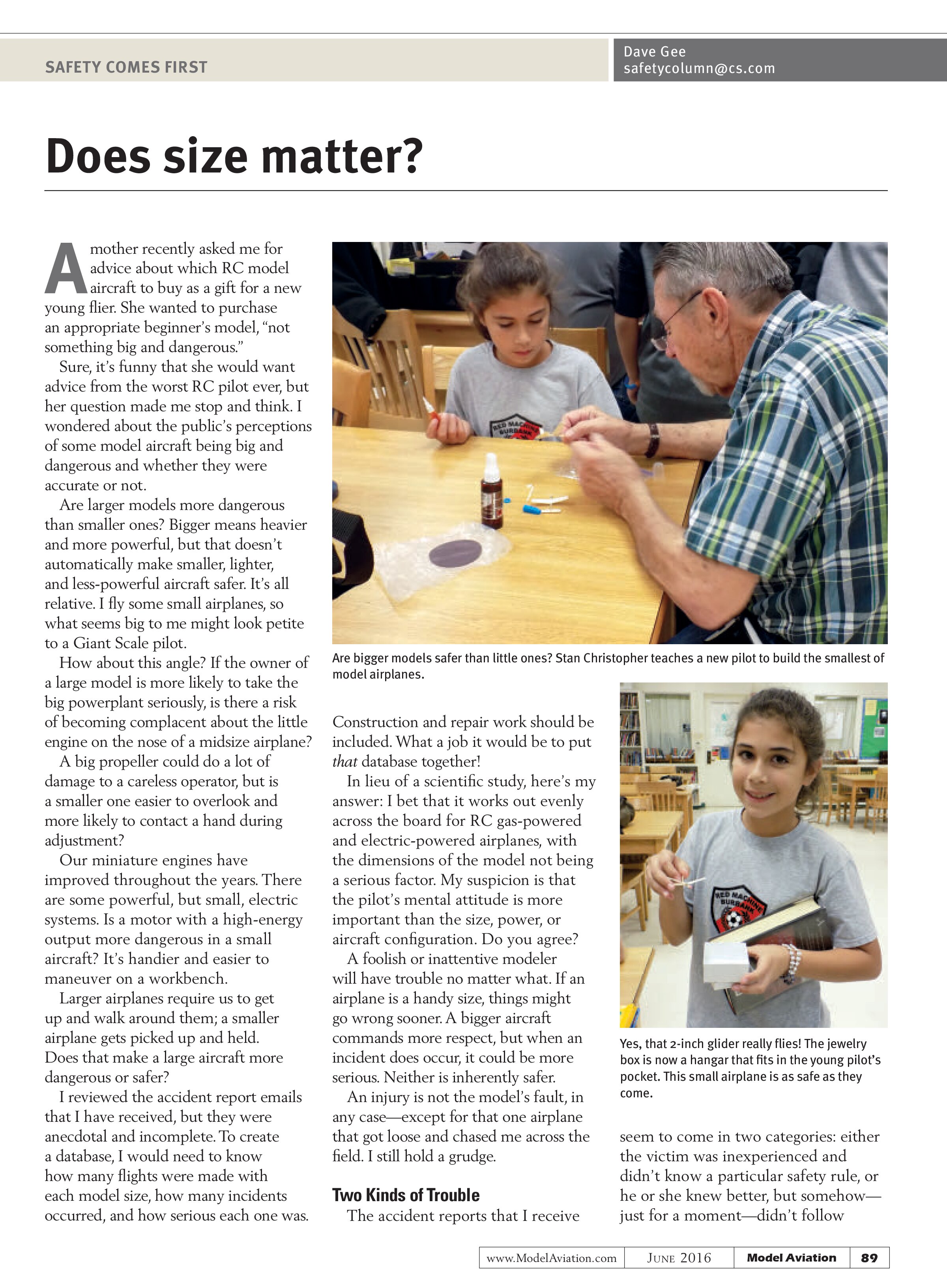
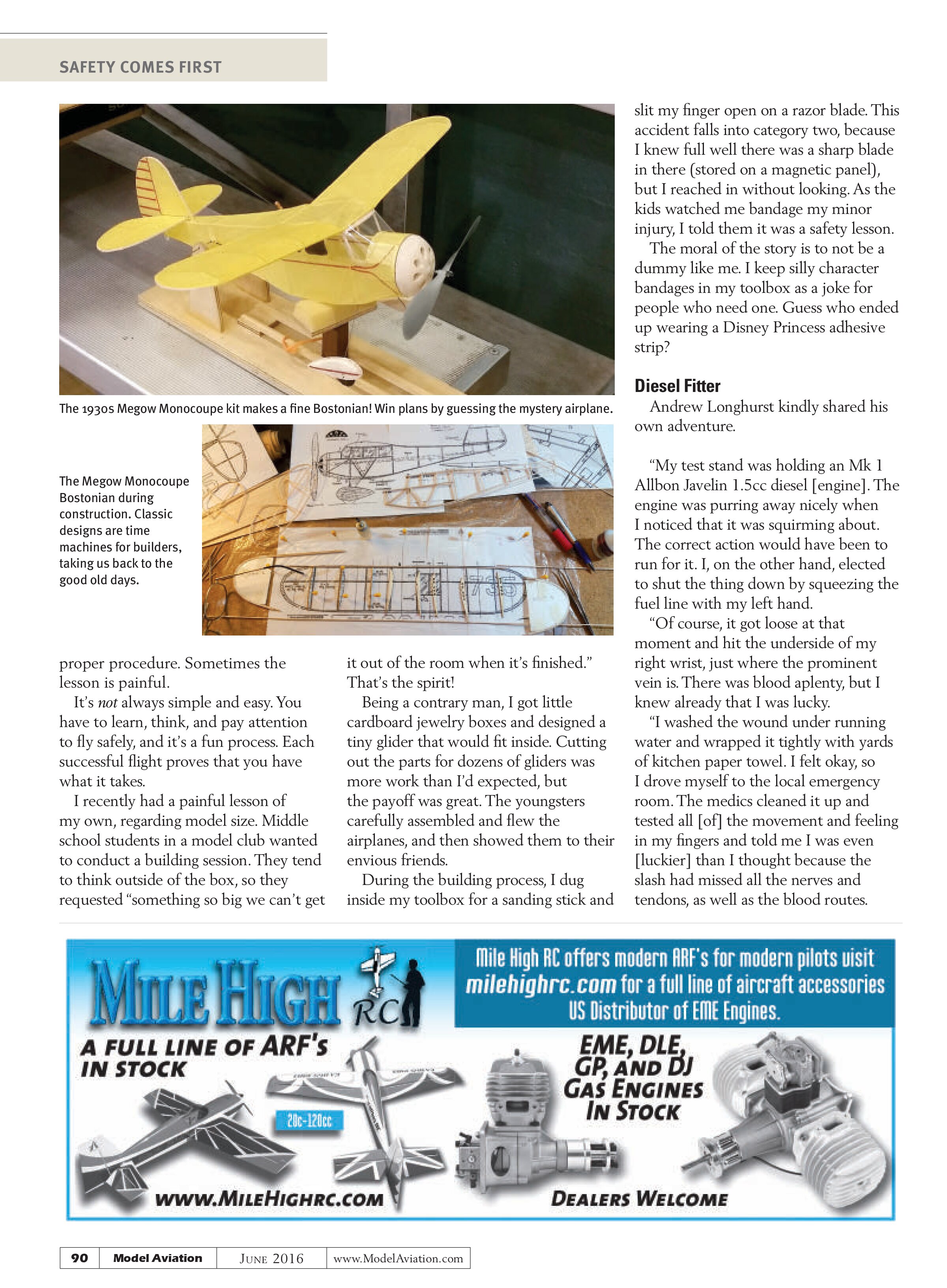
Being a contrary man, I got little cardboard jewelry boxes and designed a tiny glider that would fit inside. Cutting out the parts for dozens of gliders was more work than I’d expected, but the payoff was great. The youngsters carefully assembled and flew the airplanes, and then showed them to their envious friends.
During the building process, I dug inside my toolbox for a sanding stick and slit my finger open on a razor blade. This accident falls into category two, because I knew full well there was a sharp blade in there (stored on a magnetic panel), but I reached in without looking. As the kids watched me bandage my minor injury, I told them it was a safety lesson. The moral of the story is to not be a dummy like me. I keep silly character bandages in my toolbox as a joke for people who need one. Guess who ended up wearing a Disney Princess adhesive strip?
Diesel Fitter
Andrew Longhurst kindly shared his own adventure.
“My test stand was holding an Mk 1 Allbon Javelin 1.5cc diesel [engine]. The engine was purring away nicely when I noticed that it was squirming about. The correct action would have been to run for it. I, on the other hand, elected to shut the thing down by squeezing the fuel line with my left hand.
“Of course, it got loose at that moment and hit the underside of my right wrist, just where the prominent vein is. There was blood aplenty, but I knew already that I was lucky.
“I washed the wound under running water and wrapped it tightly with yards of kitchen paper towel. I felt okay, so I drove myself to the local emergency room. The medics cleaned it up and tested all [of] the movement and feeling in my fingers and told me I was even [luckier] than I thought because the slash had missed all the nerves and tendons, as well as the blood routes.

They stitched it all up (I was very brave) and sent me home.
“I later added a strong wire restraint for my test stand. It loops ’round the engine shaft housing and back to the mounting board so that any engine being tested cannot move forward more than a few millimeters, even if the whole caboodle falls apart.
“It has done the job twice since then.”
Andrew used an engineering solution to prevent further incidents, but his presence of mind saved him from more serious trouble on that day. Good fortune did the rest.
I urge everyone to avoid being alone at the field or when operating engines or power tools. Whether you need help, or are the one who aids someone else, being injured and alone is something of which to steer clear.
Mystery Airplane
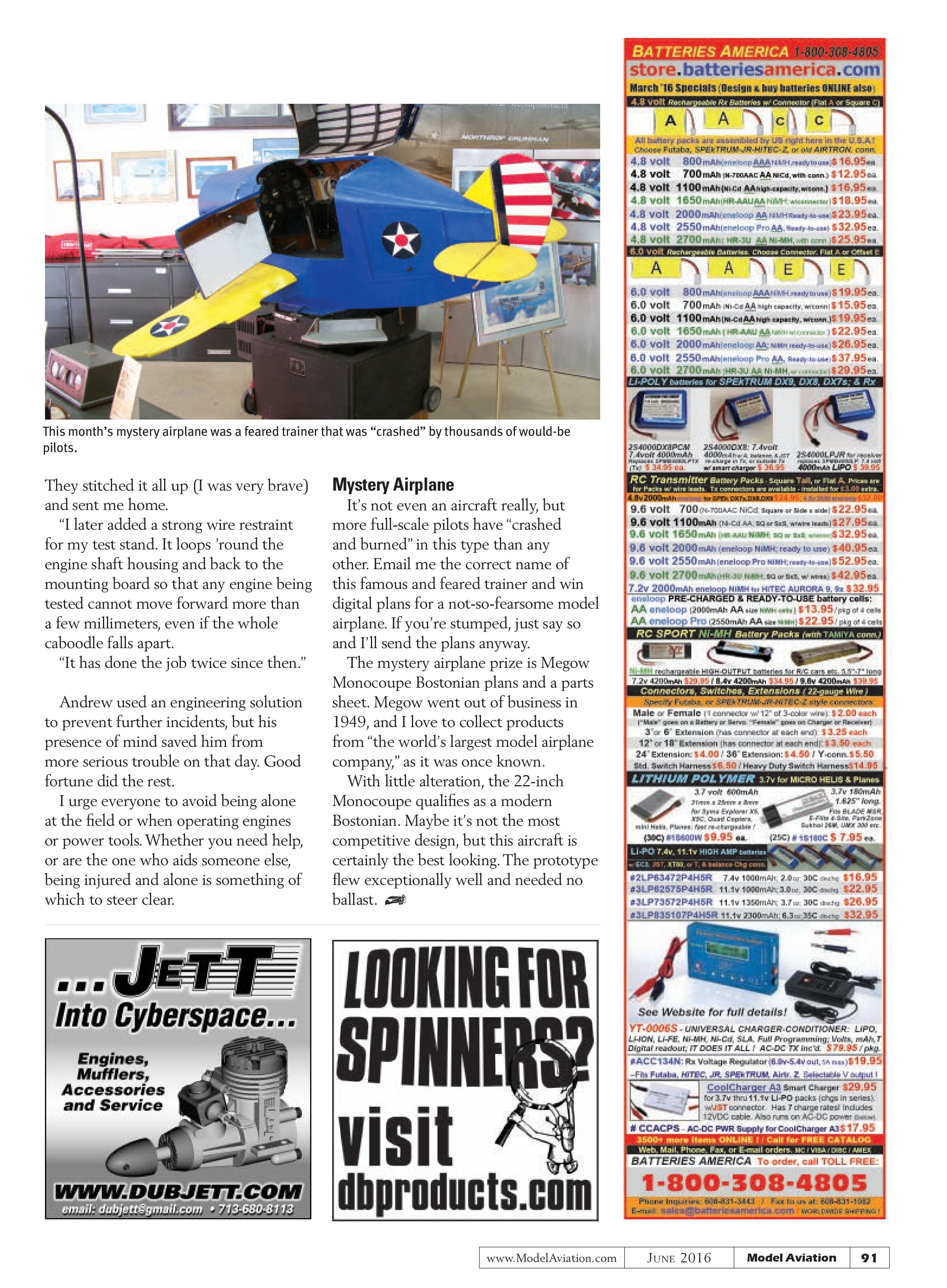
It’s not even an aircraft really, but more full-scale pilots have “crashed and burned” in this type than any other. Email me the correct name of this famous and feared trainer and win digital plans for a not-so-fearsome model airplane. If you’re stumped, just say so and I’ll send the plans anyway.
The mystery airplane prize is Megow Monocoupe Bostonian plans and a parts sheet. Megow went out of business in 1949, and I love to collect products from “the world’s largest model airplane company,” as it was once known.
With little alteration, the 22-inch Monocoupe qualifies as a modern Bostonian. Maybe it’s not the most competitive design, but this aircraft is certainly the best looking. The prototype flew exceptionally well and needed no ballast. ✈