One-Design Racing
by Dave Garwood
dave.garwood.518@gmail.com

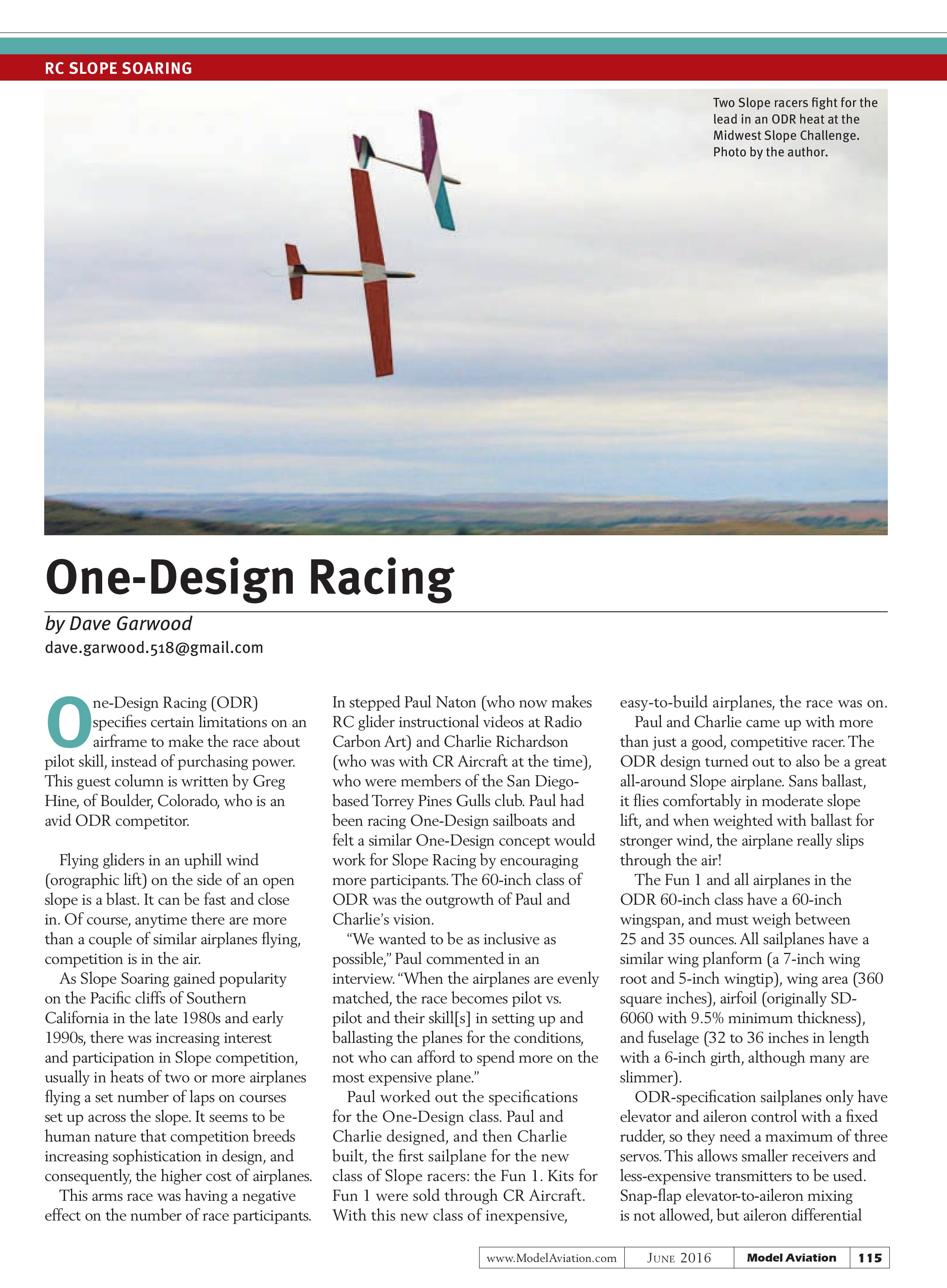
One-Design Racing (ODR) specifies certain limitations on an airframe to make the race about pilot skill, instead of purchasing power. This guest column is written by Greg Hine, of Boulder, Colorado, who is an avid ODR competitor.
Flying gliders in an uphill wind (orographic lift) on the side of an open slope is a blast. It can be fast and close in. Of course, anytime there are more than a couple of similar airplanes flying, competition is in the air.
As Slope Soaring gained popularity on the Pacific cliffs of Southern California in the late 1980s and early 1990s, there was increasing interest and participation in Slope competition, usually in heats of two or more airplanes flying a set number of laps on courses set up across the slope. It seems to be human nature that competition breeds increasing sophistication in design, and consequently, the higher cost of airplanes.
This arms race was having a negative effect on the number of race participants.
In stepped Paul Naton (who now makes RC glider instructional videos at Radio Carbon Art) and Charlie Richardson (who was with CR Aircraft at the time), who were members of the San Diego-based Torrey Pines Gulls club. Paul had been racing One-Design sailboats and felt a similar One-Design concept would work for Slope Racing by encouraging more participants. The 60-inch class of ODR was the outgrowth of Paul and Charlie’s vision.
“We wanted to be as inclusive as possible,” Paul commented in an interview. “When the airplanes are evenly matched, the race becomes pilot vs. pilot and their skill[s] in setting up and ballasting the planes for the conditions, not who can afford to spend more on the most expensive plane.”
Paul worked out the specifications for the One-Design class. Paul and Charlie designed, and then Charlie built, the first sailplane for the new class of Slope racers: the Fun 1. Kits for Fun 1 were sold through CR Aircraft. With this new class of inexpensive, easy-to-build airplanes, the race was on.
Paul and Charlie came up with more than just a good, competitive racer. The ODR design turned out to also be a great all-around Slope airplane. Sans ballast, it flies comfortably in moderate slope lift, and when weighted with ballast for stronger wind, the airplane really slips through the air!
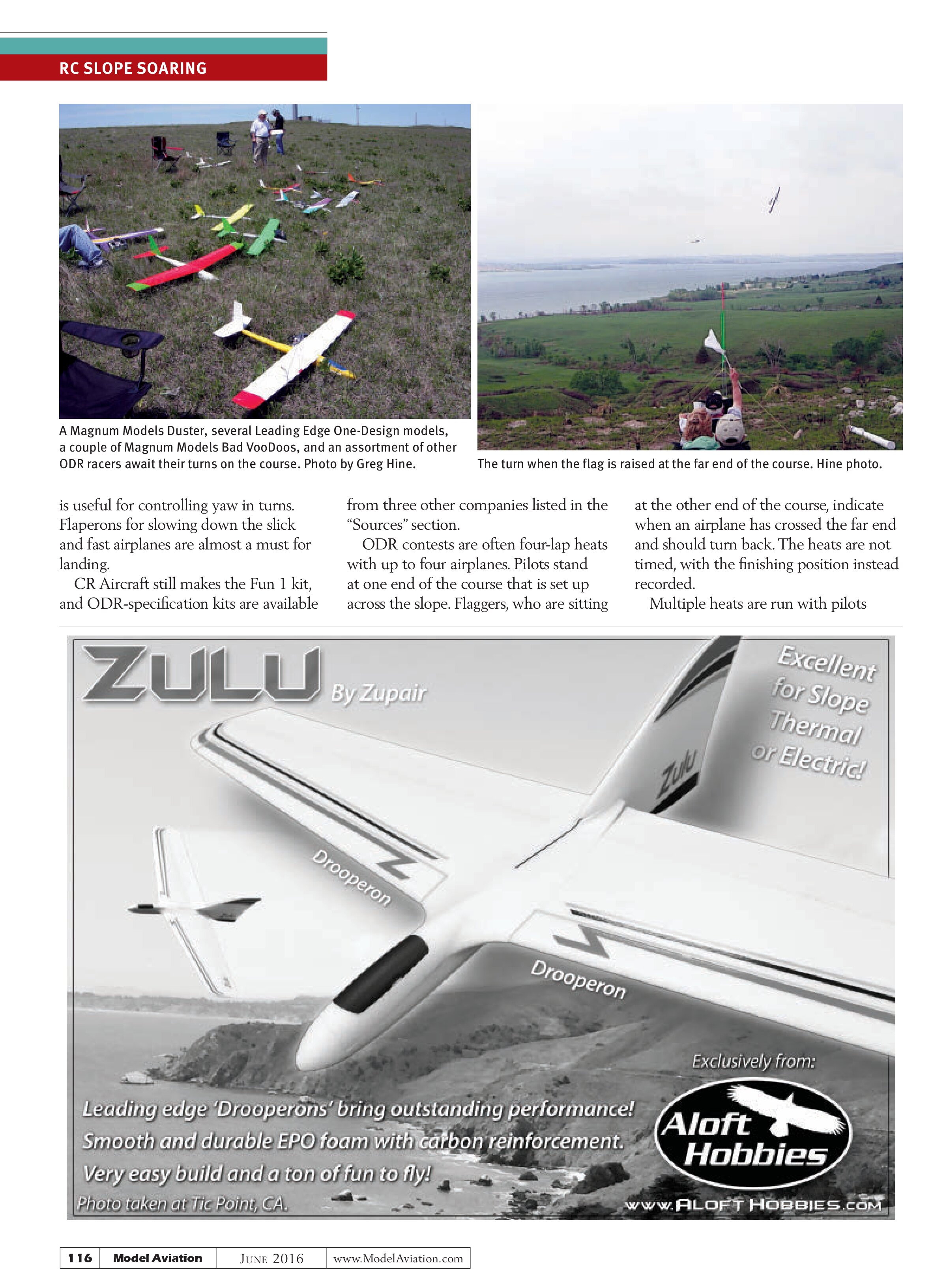
The Fun 1 and all airplanes in the ODR 60-inch class have a 60-inch wingspan, and must weigh between 25 and 35 ounces. All sailplanes have a similar wing planform (a 7-inch wing root and 5-inch wingtip), wing area (360 square inches), airfoil (originally SD-6060 with 9.5% minimum thickness), and fuselage (32 to 36 inches in length with a 6-inch girth, although many are slimmer).
ODR-specification sailplanes only have elevator and aileron control with a fixed rudder, so they need a maximum of three servos. This allows smaller receivers and less-expensive transmitters to be used. Snap-flap elevator-to-aileron mixing is not allowed, but aileron differential


is useful for controlling yaw in turns. Flaperons for slowing down the slick and fast airplanes are almost a must for landing.
CR Aircraft still makes the Fun 1 kit, and ODR-specification kits are available from three other companies listed in the “Sources” section.
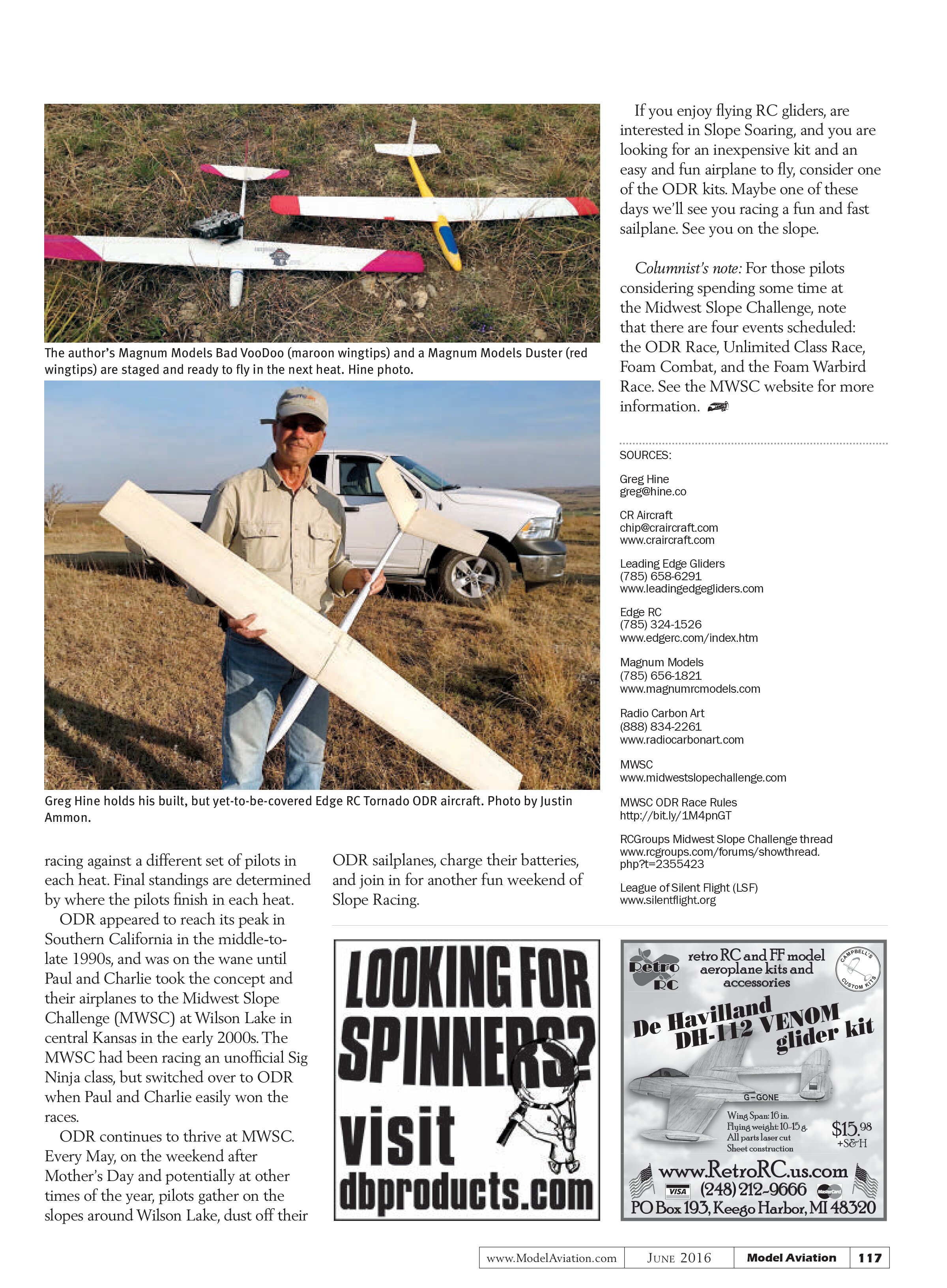
ODR contests are often four-lap heats with up to four airplanes. Pilots stand at one end of the course that is set up across the slope. Flaggers, who are sitting at the other end of the course, indicate when an airplane has crossed the far end and should turn back. The heats are not timed, with the finishing position instead recorded.
Multiple heats are run with pilots racing against a different set of pilots in each heat. Final standings are determined by where the pilots finish in each heat.
ODR appeared to reach its peak in Southern California in the middle-to-late 1990s, and was on the wane until Paul and Charlie took the concept and their airplanes to the Midwest Slope Challenge (MWSC) at Wilson Lake in central Kansas in the early 2000s. The MWSC had been racing an unofficial Sig Ninja class, but switched over to ODR when Paul and Charlie easily won the races.
ODR continues to thrive at MWSC. Every May, on the weekend after Mother’s Day and potentially at other times of the year, pilots gather on the slopes around Wilson Lake, dust off their


ODR sailplanes, charge their batteries, and join in for another fun weekend of Slope Racing.
If you enjoy flying RC gliders, are interested in Slope Soaring, and you are looking for an inexpensive kit and an easy and fun airplane to fly, consider one of the ODR kits. Maybe one of these days we’ll see you racing a fun and fast sailplane. See you on the slope.
Columnist’s note: For those pilots considering spending some time at the Midwest Slope Challenge, note that there are four events scheduled: the ODR Race, Unlimited Class Race, Foam Combat, and the Foam Warbird Race. See the MWSC website for more information.
SOURCES:
Greg Hine
greg@hine.co
CR Aircraft
chip@craircraft.com
www.craircraft.com
Leading Edge Gliders
(785) 658-6291
www.leadingedgegliders.com
Edge RC
(785) 324-1526
www.edgerc.com/index.htm
Magnum Models
(785) 656-1821
www.magnumrcmodels.com
Radio Carbon Art
(888) 834-2261
www.radiocarbonart.com
MWSC
www.midwestslopechallenge.com
MWSC ODR Race Rules
http://bit.ly/1M4pnGT
RCGroups Midwest Slope Challenge thread
www.rcgroups.com/forums/showthread.php?t=2355423
League of Silent Flight (LSF)
www.silentflight.org