Interview with speed pilot Chip Pairett
Chris Mulcahy
cspaced@gmail.com
Speed helicopters—they’re sleek, fast, and cut through the air like a hot knife does through butter. I wanted to know more about them, so I turned to Chip Pairett, who is one of the fastest heli pilots I know.
Chris Mulcahy: Can you tell me about yourself and how you got into flying helicopters?
Chip Pairett: I am a 28-year Navy veteran who works in the Norfolk, Virginia, area, refueling nuclear carriers. I have been involved in RC since I was 11 years old.
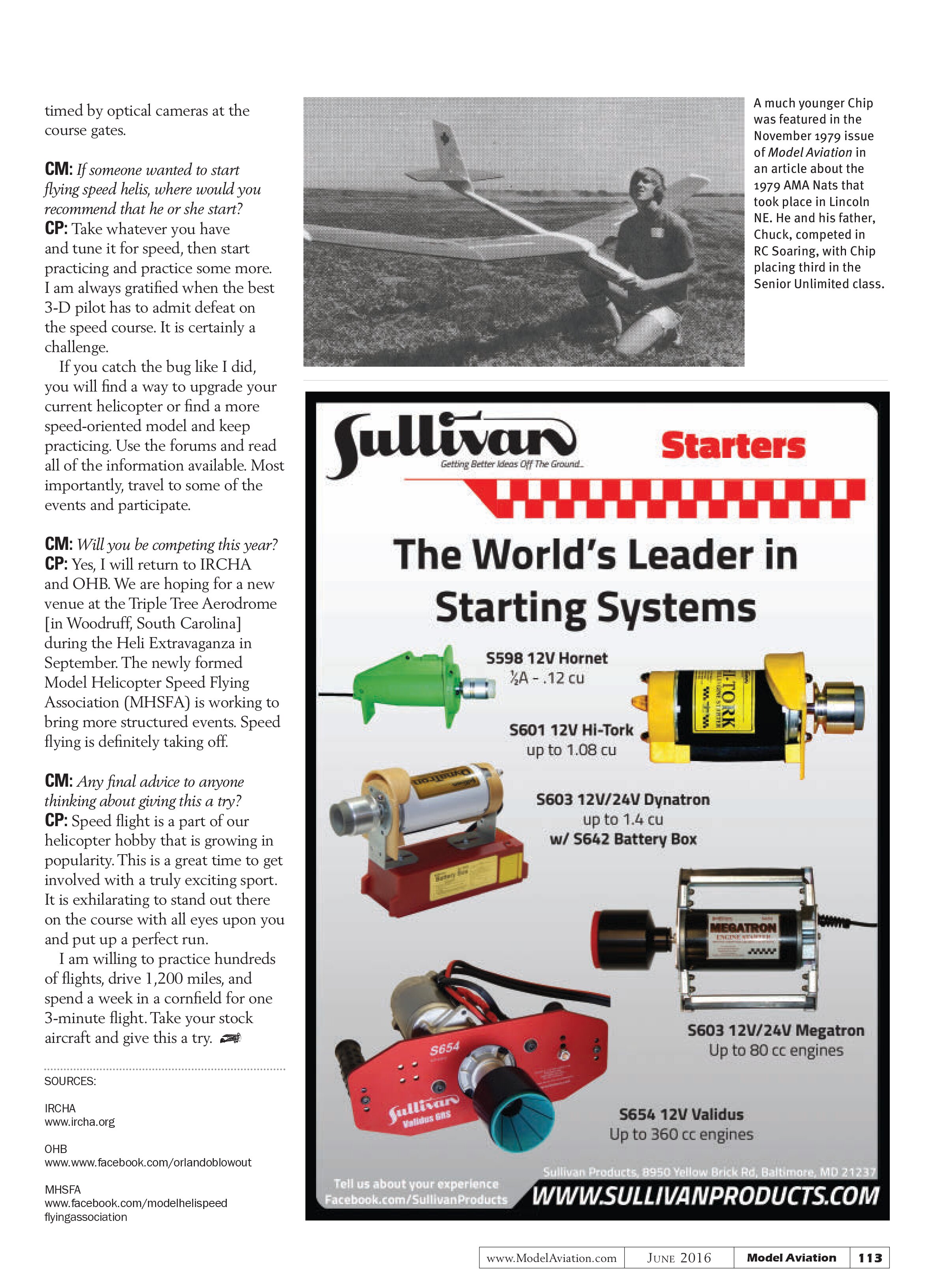
My grandfather and I ventured into this hobby in 1973. A few years later, I was traveling around the Midwest [and] competing in sailplane events with my father and finally I competed in the 1979 AMA Nats. Six years ago, I stopped by a local hobby shop and was astonished by a 3-D [helicopter] demo flight. I was hooked!
CM: What drew you to the world of speed helicopters?
CP: I have always enjoyed flying fast, overpowered, fixed-wing models, and it was a natural transition for me to be drawn into a fast, big-air flying style as I was learning to fly helicopters. After watching the IRCHA [International Radio Controlled Helicopter Association] Speed Cup four years ago, I was obsessed with the challenge of making a helicopter go fast.
CM: What is the difference between a regular 3-D helicopter and a speed helicopter?
CP: In its purest form (as an Unlimited-class speed helicopter), a full fuselage is utilized and the design is based on aerodynamics, particularly the width of the fuselage and [the] shape of the boom. They are truly works of art, but it can be difficult to install batteries and mount other components. Landing skids are as small as possible or retractable.
Stock and Pro-Modified classes are based on available pod-and-boom models that are 3-D capable. In the last few years, many manufacturers have produced speed versions of their 3-D models, with enhanced canopies
and smaller landing skids. Speed helicopters utilize high head speeds and extreme pitch settings. You have to overcome things like retreating blade stall porpoising, high amp draw, and heat. 3-D helicopters typically operate in bursts of power for short durations, keeping heat generation down.
The speed discipline involves full pitch and maximum throttle curves throughout the entire course. This takes careful matching of components and some finesse.
CM: How do speed flying and setup differ from 3-D flying?
CP: The majority of RC helicopters manage incredible amounts of power. [Flying] 3-D requires brutal transitions from positive to negative pitch while flying in multiple orientations with extreme stick movements. Most 3-D pilots would be able to navigate the speed course, but putting all of the elements of a good speed flight together is a challenge.
Speed flight requires carefully tailored setups, measured, smooth stick movements, and nerves of steel. You also need good eyesight. Most 3-D flying occurs relatively close to the pilot. Our speed courses put you up to 800 feet away, executing stall turns, reverse Cuban 8s, or other high-G maneuvers to enter the course.
Speed setups are not compatible with 3-D flight. We try to minimize tail gain and tail blade diameter to avoid unnecessary, power-robbing tail pitch. We run our head gains as low as possible and reduce sensitivities to minimize the dreaded porpoising or pop-ups. Once you start going fast, you will need to run main blades that are exclusively designed for speed or for FAI precision flight. Their balance points are different and they are typically heavier than normal flybarless 3-D blades.


Your motor Kv needs to complement your model’s available gear ratios so you can achieve head speeds of 2,500 to 2,600 rpm on a 700-size helicopter. You will need an ESC/motor combination that supports pulling more than 200 amps, and your batteries will need to be up to the task.
We are fortunate to have some dedicated speed professionals, such as Justin Pucci and Santiago Panzardi, who have provided a wealth of information on various forums and podcasts.
CM: What is your current setup?
CP: I currently compete in the Pro-Modified class with an SAB Goblin Speed. I have resisted searching for an Unlimited-class bird because of the limited availability. I am still not done finding those last few miles per hour in the Pro-Modified class.
I am running a Kontronik Cool Kosmik 200-amp [ESC] with a Kontronik Pyro 850 competition motor. I settled on this combo after trying just about everything else available. The logging capabilities of the Kosmik are vital to tuning your power system. I run a 14S [LiPo] battery combination to help lower amps and allow me to pull up to 12,000 watts.
Flybarless controllers are a personal preference. I have [tried] everything else and utilize an older BeastX controller. It is the easiest to tune and provides me with the confidence I need to make 150 mph passes.
I utilize BeastX XBlades x713S main blades because of their unique tip and airfoil design. I typically run 105mm Rail Blade tail blades.
My target head speed is 2,550 rpm. There are endless combinations of components to try. No two speed [helis] are set up the same.
CM: Have you competed in many contests?
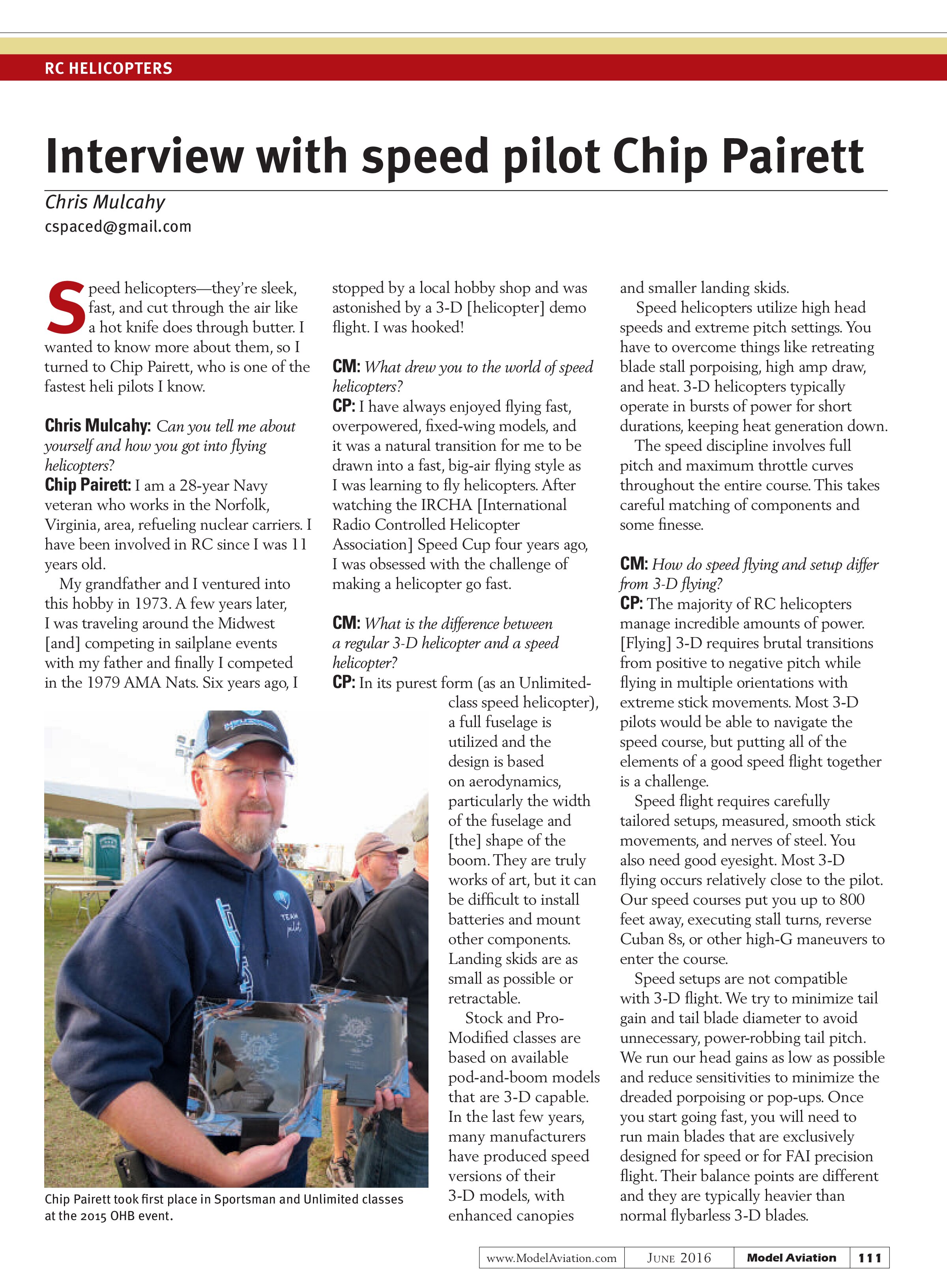
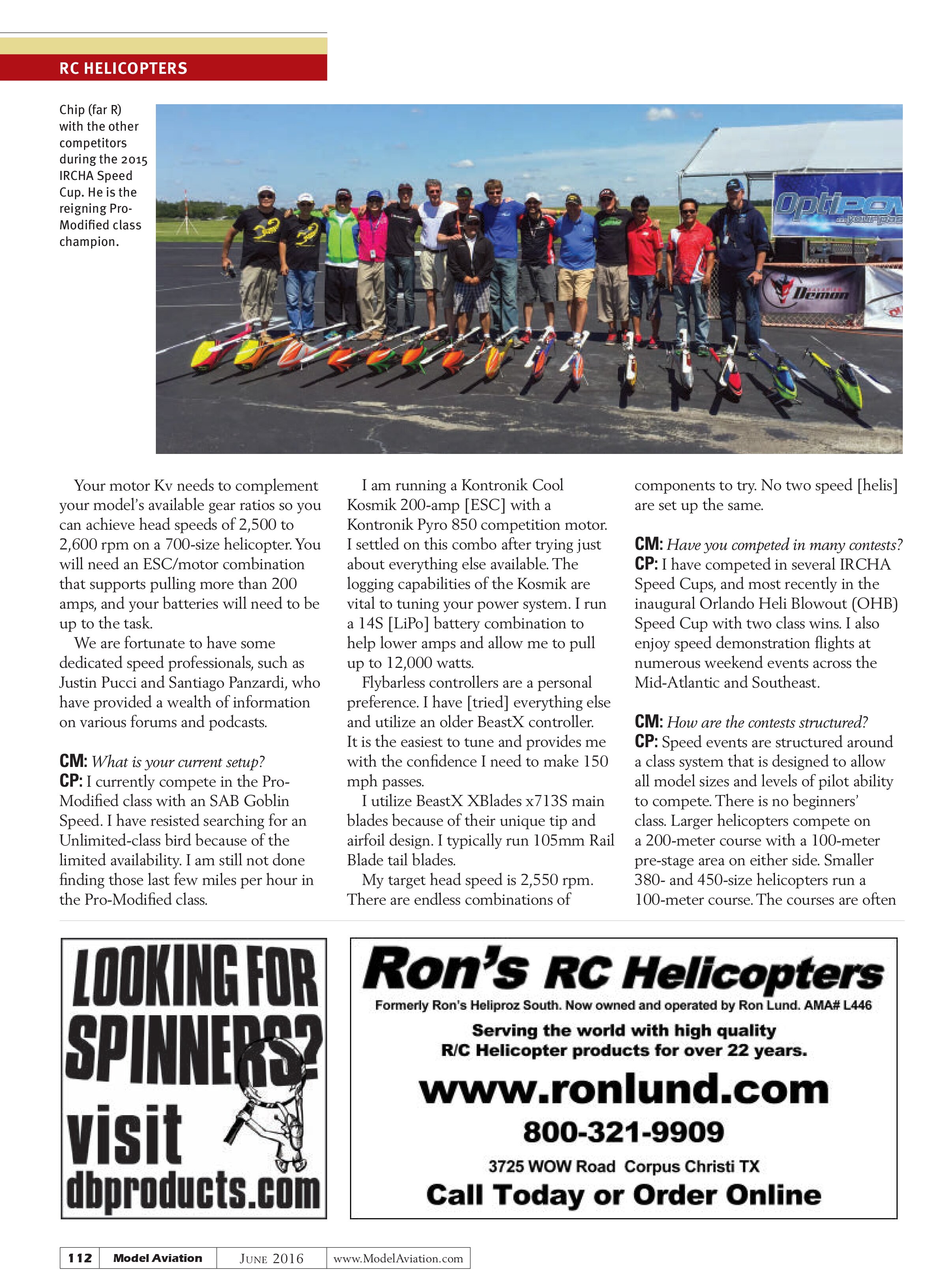
CP: I have competed in several IRCHA Speed Cups, and most recently in the inaugural Orlando Heli Blowout (OHB) Speed Cup with two class wins. I also enjoy speed demonstration flights at numerous weekend events across the Mid-Atlantic and Southeast.
CM: How are the contests structured?
CP: Speed events are structured around a class system that is designed to allow all model sizes and levels of pilot ability to compete. There is no beginners’ class. Larger helicopters compete on a 200-meter course with a 100-meter pre-stage area on either side. Smaller 380- and 450-size helicopters run a 100-meter course. The courses are often timed by optical cameras at the course gates.

CM: If someone wanted to start flying speed helis, where would you recommend that he or she start?
CP: Take whatever you have and tune it for speed, then start practicing and practice some more. I am always gratified when the best 3-D pilot has to admit defeat on the speed course. It is certainly a challenge.
If you catch the bug like I did, you will find a way to upgrade your current helicopter or find a more speed-oriented model and keep practicing. Use the forums and read all of the information available. Most importantly, travel to some of the events and participate.
CM: Will you be competing this year?
CP: Yes, I will return to IRCHA and OHB. We are hoping for a new venue at the Triple Tree Aerodrome [in Woodruff, South Carolina] during the Heli Extravaganza in September. The newly formed Model Helicopter Speed Flying Association (MHSFA) is working to bring more structured events. Speed flying is definitely taking off.
CM: Any final advice to anyone thinking about giving this a try?
CP: Speed flight is a part of our helicopter hobby that is growing in popularity. This is a great time to get involved with a truly exciting sport. It is exhilarating to stand out there on the course with all eyes upon you and put up a perfect run.
I am willing to practice hundreds of flights, drive 1,200 miles, and spend a week in a cornfield for one 3-minute flight. Take your stock aircraft and give this a try.
SOURCES:
IRCHA
www.ircha.org