WRAM Show 2016
by Sal Cavagna
rcgiants@optonline.net
Welcome back. Warmer weather is here and the flying season is in full swing for all 50 states in our grand union. I hope winter provided the impetus for new aircraft production or, at the very least, maintenance and repair for all of your existing fleet of RC Giants.
For those of us in the Northeast, the 48th annual Westchester Radio Aero Modelers (WRAM) Show was held February 26-28, and was the official start of the 2016 modeling year.
I won’t include the names of the vendors that were present. You can visit the event’s website to see a complete list; however, I will tell you what I found at the show.
There were kits present, lots of wood in myriad shapes and sizes, and plenty of glue for assembling those kits. If you needed tools or sharp blades, they were there too, as well as plenty of extensions and switches.
If you needed a gas engine or an electric motor system, they could be found, and you had a choice between military and civilian aircraft if you wanted a Giant Scale ARF. If you needed documentation, scale pilot figures, lighting, fuel tubing, batteries, propellers, spinners, clevises, or all sorts of other accessories, they were all available.
Delta Darts were built and flown during all three days of the event. If you wanted stick time on a flight simulator, there were plenty to choose from. If you wanted to operate a remote control boat, car, tank, drone, electric airplane—they were all there.
There were deals in the swap shop and classes to attend, and if you just wanted to gawk at beautiful models, they were there in abundance. Yes, there were plenty of IFOs (inexpensive flying objects) from which to choose, but these were not the focus or tenor of the show.
The organizers work hard to produce this annual show for your enjoyment. They do a great job, as do those who run the AMA Expo in California and The Toledo Show: R/C Model Expo in Ohio. So, the moral of the story is to support the shows. They are there for you!

Sullivan Products
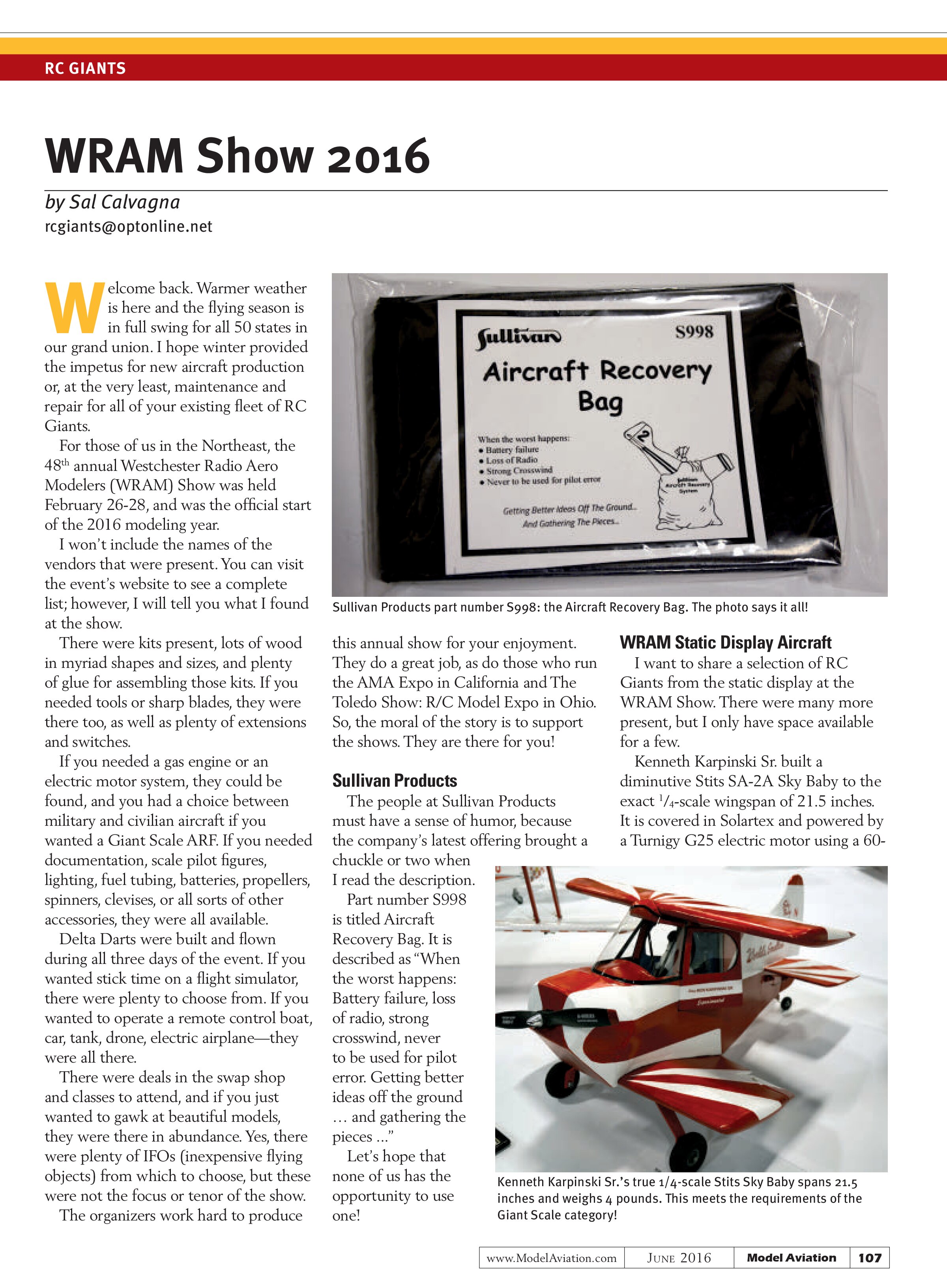
The people at Sullivan Products must have a sense of humor, because the company’s latest offering brought a chuckle or two when I read the description.
Part number S998 is titled Aircraft Recovery Bag. It is described as “When the worst happens: Battery failure, loss of radio, strong crosswind, never to be used for pilot error. Getting better ideas off the ground … and gathering the pieces …”
Let’s hope that none of us has the opportunity to use one!
WRAM Static Display Aircraft
I want to share a selection of RC Giants from the static display at the WRAM Show. There were many more present, but I only have space available for a few.
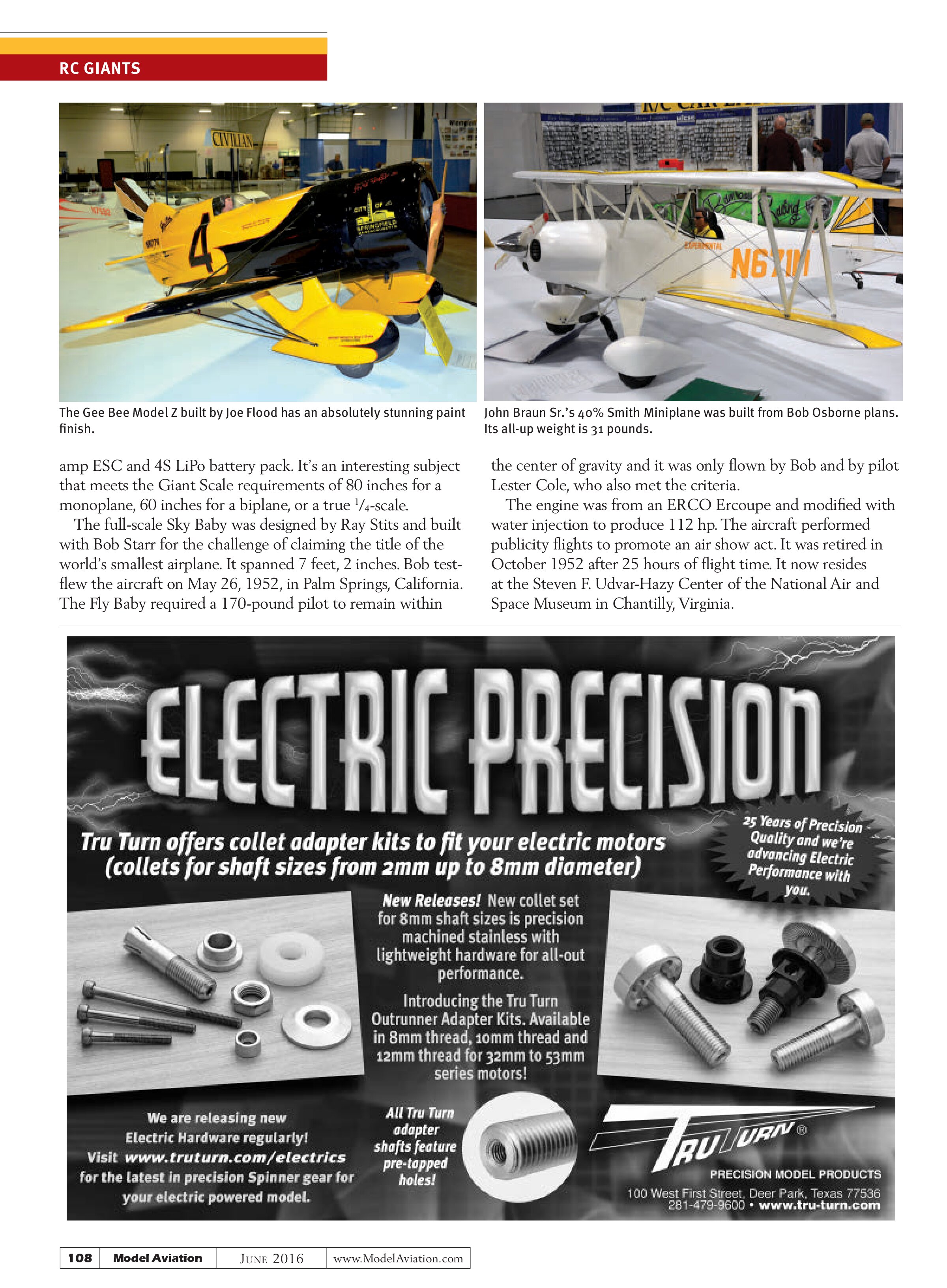
Kenneth Karpinski Sr. built a diminutive Stits SA-2A Sky Baby to the exact 1/4-scale wingspan of 21.5 inches. It is covered in Solartex and powered by a Turnigy G25 electric motor using a 60-


amp ESC and 4S LiPo battery pack. It’s an interesting subject that meets the Giant Scale requirements of 80 inches for a monoplane, 60 inches for a biplane, or a true ¼-scale.
The full-scale Sky Baby was designed by Ray Stits and built with Bob Starr for the challenge of claiming the title of the world’s smallest airplane. It spanned 7 feet, 2 inches. Bob test-flew the aircraft on May 26, 1952, in Palm Springs, California. The Fly Baby required a 170-pound pilot to remain within the center of gravity and it was only flown by Bob and by pilot Lester Cole, who also met the criteria.
The engine was from an ERCO Ercoupe and modified with water injection to produce 112 hp. The aircraft performed publicity flights to promote an air show act. It was retired in October 1952 after 25 hours of flight time. It now resides at the Steven F. Udvar-Hazy Center of the National Air and Space Museum in Chantilly, Virginia.
John Braun Sr. built a 42% Smith Miniplane from Bob Osborne plans. It spans 90 inches and is powered by a DLE-60 twin gas engine. John used Solartex fabric and Nelson paint to finish the model.
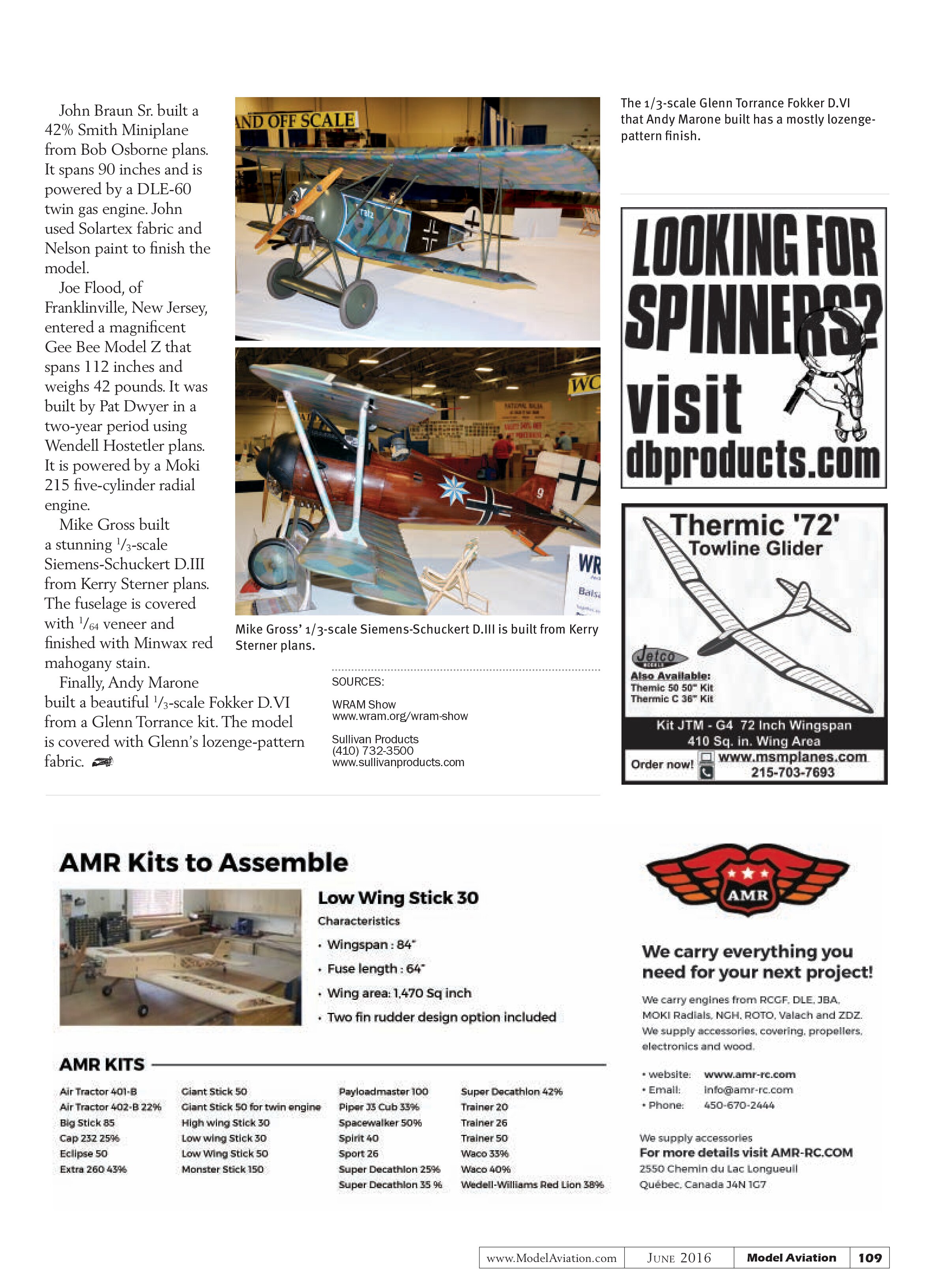
Joe Flood, of Franklinville, New Jersey, entered a magnificent Gee Bee Model Z that spans 112 inches and weighs 42 pounds. It was built by Pat Dwyer in a two-year period using Wendell Hostetler plans. It is powered by a Moki 215 five-cylinder radial engine.
Mike Gross built a stunning ⅓-scale Siemens-Schuckert D.III from Kerry Sterner plans. The fuselage is covered with ¹⁄₆₄ veneer and finished with Minwax red mahogany stain.
Finally, Andy Marone built a beautiful ⅓-scale Fokker D.VI from a Glenn Torrance kit. The model is covered with Glenn’s lozenge-pattern fabric.
SOURCES:
WRAM Show
www.wram.org/wram-show
Sullivan Products
(410) 732-3500
www.sullivanproducts.com