Product Spotlight
New products that are Worth a Closer Look
HITEC HG3XA 3-AXIS STABILIZATION SYSTEM
Greg Gimlick reviewed the Hitec HG3XA 3-Axis Stabilization System. Here is what he had to say:
Specifications:
Voltage range: 5- to 6-volt DC
PWM output: 50 Hz or 20 ms
PWM signal: 1,520 ± 500μs
Full-scale range: 970 to 2,070μs
Gyro sample rate: 1 kHz
Operating temperature: -40° C to 85° C
Dimensions (inches): 1.85 x 1.30 x 0.55
Dimensions (mm): 47.0 x 33.0 x 14.0
Weight (ounces): 0.39
Weight (grams): 11.0
It seems that we’re inundated with “the next big thing” in our hobby, and certainly flight stabilizers have become one. The field is crowded, but Hitec has stepped up with a functional three-axis gyro that doesn’t break the bank, and guess what? It works!
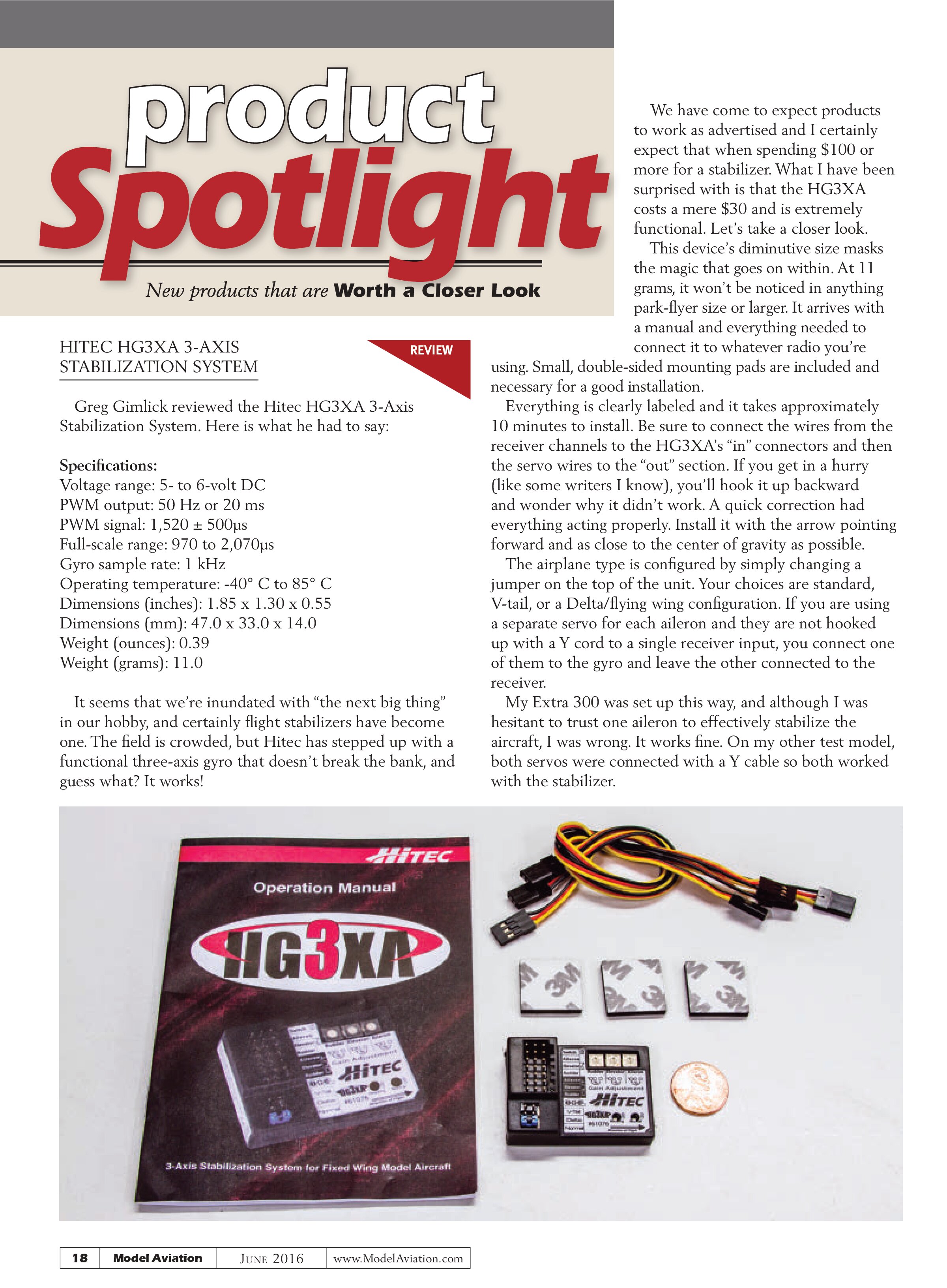
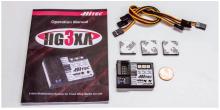
We have come to expect products to work as advertised and I certainly expect that when spending $100 or more for a stabilizer. What I have been surprised with is that the HG3XA costs a mere $30 and is extremely functional. Let’s take a closer look. This device’s diminutive size masks the magic that goes on within. At 11 grams, it won’t be noticed in anything park-flyer size or larger. It arrives with a manual and everything needed to connect it to whatever radio you’re using. Small, double-sided mounting pads are included and necessary for a good installation.
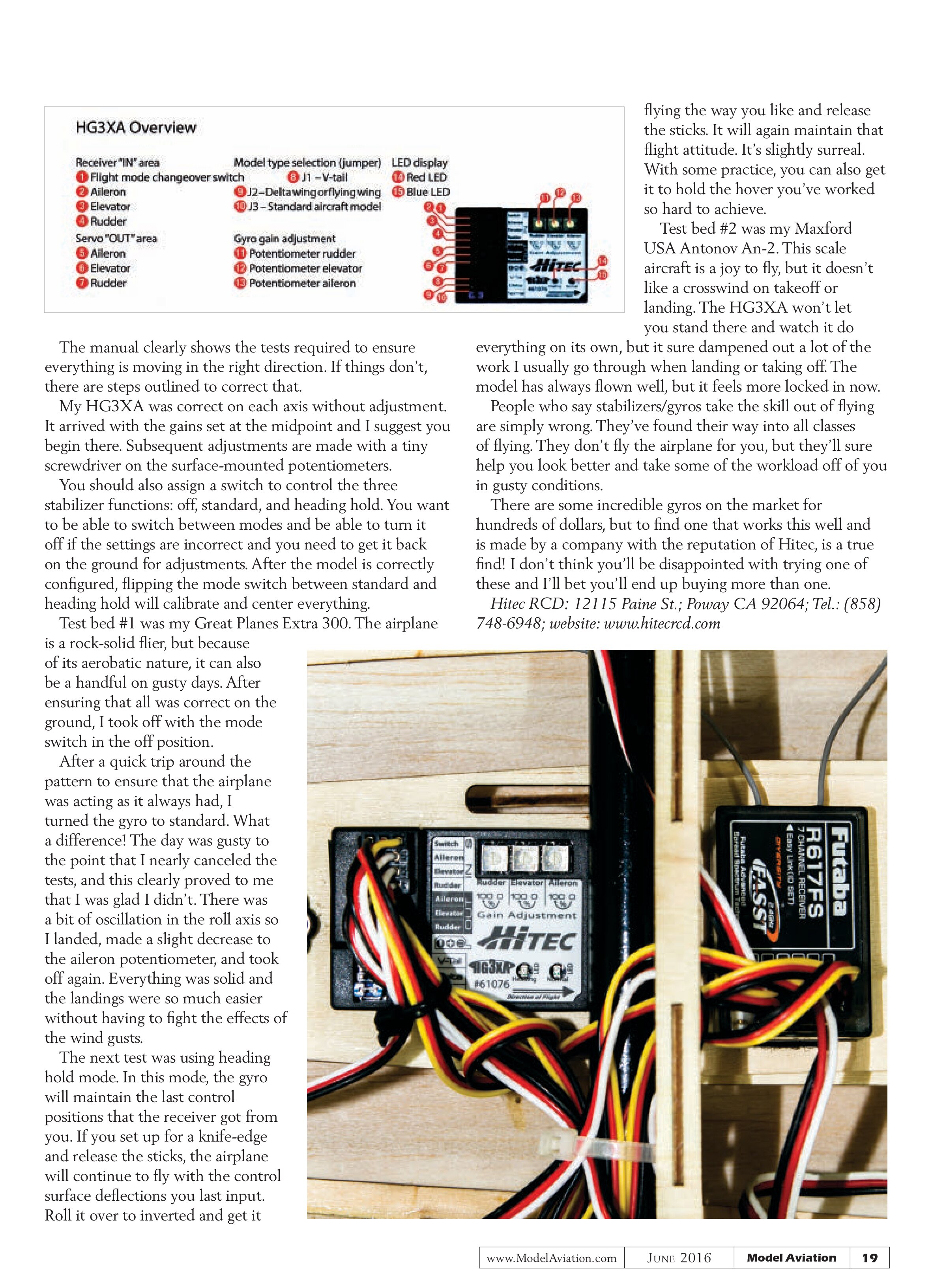
Everything is clearly labeled and it takes approximately 10 minutes to install. Be sure to connect the wires from the receiver channels to the HG3XA’s “in” connectors and then the servo wires to the “out” section. If you get in a hurry (like some writers I know), you’ll hook it up backward and wonder why it didn’t work. A quick correction had everything acting properly. Install it with the arrow pointing forward and as close to the center of gravity as possible.
The airplane type is configured by simply changing a jumper on the top of the unit. Your choices are standard, V-tail, or a Delta/flying wing configuration. If you are using a separate servo for each aileron and they are not hooked up with a Y cord to a single receiver input, you connect one of them to the gyro and leave the other connected to the receiver.
My Extra 300 was set up this way, and although I was hesitant to trust one aileron to effectively stabilize the aircraft, I was wrong. It works fine. On my other test model, both servos were connected with a Y cable so both worked with the stabilizer.

Hitec RCD: 12115 Paine St.; Poway CA 92064; Tel.: (858) 748-6948; website: www.hitecrcd.com

The manual clearly shows the tests required to ensure everything is moving in the right direction. If things don’t, there are steps outlined to correct that.
My HG3XA was correct on each axis without adjustment. It arrived with the gains set at the midpoint and I suggest you begin there. Subsequent adjustments are made with a tiny screwdriver on the surface-mounted potentiometers.
You should also assign a switch to control the three stabilizer functions: off, standard, and heading hold. You want to be able to switch between modes and be able to turn it off if the settings are incorrect and you need to get it back on the ground for adjustments. After the model is correctly configured, flipping the mode switch between standard and heading hold will calibrate and center everything.
Test bed #1 was my Great Planes Extra 300. The airplane is a rock-solid flier, but because of its aerobatic nature, it can also be a handful on gusty days. After ensuring that all was correct on the ground, I took off with the mode switch in the off position.
After a quick trip around the pattern to ensure that the airplane was acting as it always had, I turned the gyro to standard. What a difference! The day was gusty to the point that I nearly canceled the tests, and this clearly proved to me that I was glad I didn’t. There was a bit of oscillation in the roll axis so I landed, made a slight decrease to the aileron potentiometer, and took off again. Everything was solid and the landings were so much easier without having to fight the effects of the wind gusts.
The next test was using heading hold mode. In this mode, the gyro will maintain the last control positions that the receiver got from you. If you set up for a knife-edge and release the sticks, the airplane will continue to fly with the control surface deflections you last input. Roll it over to inverted and get it flying the way you like and release the sticks. It will again maintain that flight attitude. It’s slightly surreal. With some practice, you can also get it to hold the hover you’ve worked so hard to achieve.
Test bed #2 was my Maxford USA Antonov An-2. This scale aircraft is a joy to fly, but it doesn’t like a crosswind on takeoff or landing. The HG3XA won’t let you stand there and watch it do everything on its own, but it sure dampened out a lot of the work I usually go through when landing or taking off. The model has always flown well, but it feels more locked in now.
People who say stabilizers/gyros take the skill out of flying are simply wrong. They’ve found their way into all classes of flying. They don’t fly the airplane for you, but they’ll sure help you look better and take some of the workload off of you in gusty conditions.
There are some incredible gyros on the market for hundreds of dollars, but to find one that works this well and is made by a company with the reputation of Hitec, is a true find! I don’t think you’ll be disappointed with trying one of these and I’ll bet you’ll end up buying more than one.

Phoenix Model 1/4 Tiger Moth Gas GP/EP ARF @ $489.99 + S&H from Hobbico, 3002 N. Apollo Dr., Ste. #1, Champaign IL 61822; Tel.: (800) 637-7660; website: www.phoenixmodel.com

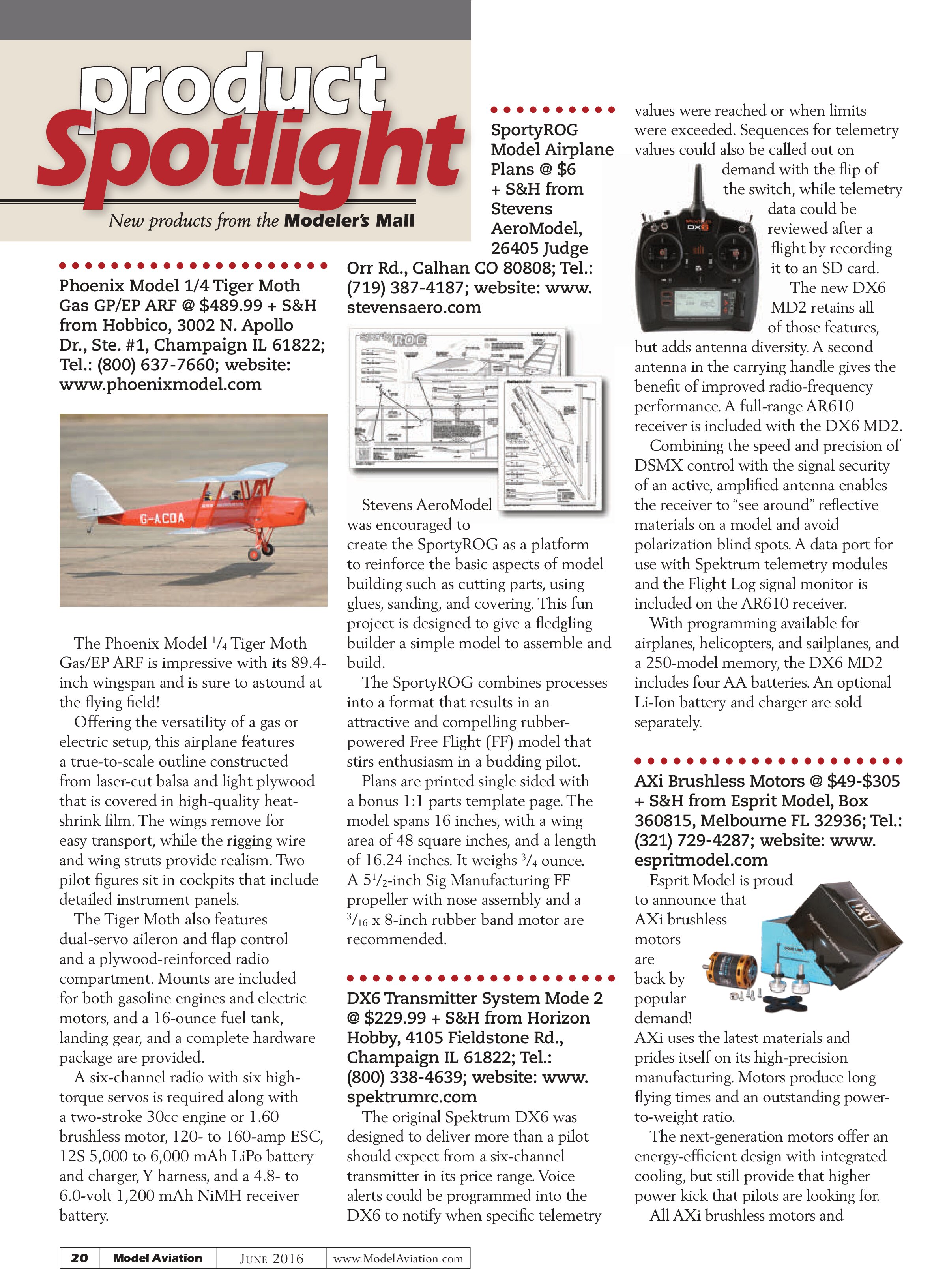
The Phoenix Model ¼ Tiger Moth Gas/EP ARF is impressive with its 89.4-inch wingspan and is sure to astound at the flying field!
Offering the versatility of a gas or electric setup, this airplane features a true-to-scale outline constructed from laser-cut balsa and light plywood that is covered in high-quality heat-shrink film. The wings remove for easy transport, while the rigging wire and wing struts provide realism. Two pilot figures sit in cockpits that include detailed instrument panels.
The Tiger Moth also features dual-servo aileron and flap control and a plywood-reinforced radio compartment. Mounts are included for both gasoline engines and electric motors, and a 16-ounce fuel tank, landing gear, and a complete hardware package are provided.
A six-channel radio with six high-torque servos is required along with a two-stroke 30cc engine or 1.60 brushless motor, 120- to 160-amp ESC, 12S 5,000 to 6,000 mAh LiPo battery and charger, Y harness, and a 4.8- to 6.0-volt 1,200 mAh NiMH receiver battery.
SportyROG Model Airplane Plans @ $6 + S&H from Stevens AeroModel, 26405 Judge Orr Rd., Calhan CO 80808; Tel.: (719) 387-4187; website: www.stevensaero.com

Stevens AeroModel was encouraged to create the SportyROG as a platform to reinforce the basic aspects of model building such as cutting parts, using glues, sanding, and covering. This fun project is designed to give a fledgling builder a simple model to assemble and build.
The SportyROG combines processes into a format that results in an attractive and compelling rubber-powered Free Flight (FF) model that stirs enthusiasm in a budding pilot.
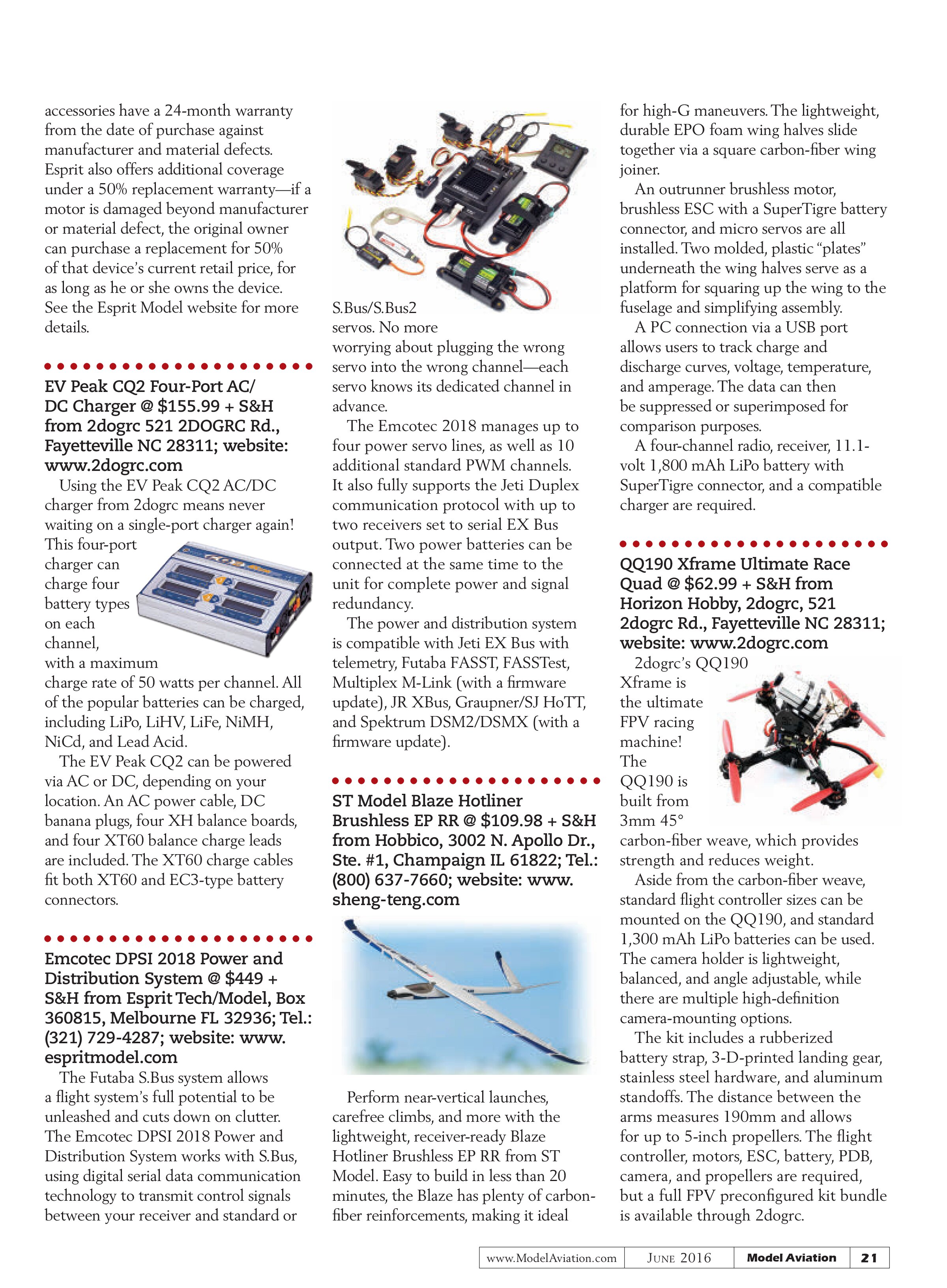
Plans are printed single sided with a bonus 1:1 parts template page. The model spans 16 inches, with a wing area of 48 square inches, and a length of 16.24 inches. It weighs ¾ ounce. A 5½-inch Sig Manufacturing FF propeller with nose assembly and a ³⁄₁₆ x 8-inch rubber band motor are recommended.
DX6 Transmitter System Mode 2 @ $229.99 + S&H from Horizon Hobby, 4105 Fieldstone Rd., Champaign IL 61822; Tel.: (800) 338-4639; website: www.spektrumrc.com
The original Spektrum DX6 was designed to deliver more than a pilot should expect from a six-channel transmitter in its price range. Voice alerts could be programmed into the DX6 to notify when specific telemetry values were reached or when limits were exceeded. Sequences for telemetry values could also be called out on demand with the flip of the switch, while telemetry data could be reviewed after a flight by recording it to an SD card.

The new DX6 MD2 retains all of those features, but adds antenna diversity. A second antenna in the carrying handle gives the benefit of improved radio-frequency performance. A full-range AR610 receiver is included with the DX6 MD2.
Combining the speed and precision of DSMX control with the signal security of an active, amplified antenna enables the receiver to “see around” reflective materials on a model and avoid polarization blind spots. A data port for use with Spektrum telemetry modules and the Flight Log signal monitor is included on the AR610 receiver.
With programming available for airplanes, helicopters, and sailplanes, and a 250-model memory, the DX6 MD2 includes four AA batteries. An optional Li-Ion battery and charger are sold separately.
AXi Brushless Motors @ $49-$305 + S&H from Esprit Model, Box 360815, Melbourne FL 32936; Tel.: (321) 729-4287; website: www.espritmodel.com

Esprit Model is proud to announce that AXi brushless motors are back by popular demand! AXi uses the latest materials and prides itself on its high-precision manufacturing. Motors produce long flying times and an outstanding power-to-weight ratio.
The next-generation motors offer an energy-efficient design with integrated cooling, but still provide that higher power kick that pilots are looking for.
All AXi brushless motors and accessories have a 24-month warranty from the date of purchase against manufacturer and material defects. Esprit also offers additional coverage under a 50% replacement warranty—if a motor is damaged beyond manufacturer or material defect, the original owner can purchase a replacement for 50% of that device’s current retail price, for as long as he or she owns the device. See the Esprit Model website for more details.
EV Peak CQ2 Four-Port AC/DC Charger @ $155.99 + S&H from 2dogrc 521 2DOGRC Rd., Fayetteville NC 28311; website: www.2dogrc.com
Using the EV Peak CQ2 AC/DC charger from 2dogrc means never waiting on a single-port charger again! This four-port charger can charge four battery types on each channel, with a maximum charge rate of 50 watts per channel. All of the popular batteries can be charged, including LiPo, LiHV, LiFe, NiMH, NiCd, and Lead Acid.

The EV Peak CQ2 can be powered via AC or DC, depending on your location. An AC power cable, DC banana plugs, four XH balance boards, and four XT60 balance charge leads are included. The XT60 charge cables fit both XT60 and EC3-type battery connectors.
Emcotec DPSI 2018 Power and Distribution System @ $449 + S&H from Esprit Tech/Model, Box 360815, Melbourne FL 32936; Tel.: (321) 729-4287; website: www.espritmodel.com

The Futaba S.Bus system allows a flight system’s full potential to be unleashed and cuts down on clutter. The Emcotec DPSI 2018 Power and Distribution System works with S.Bus, using digital serial data communication technology to transmit control signals between your receiver and standard or S.Bus/S.Bus2 servos. No more worrying about plugging the wrong servo into the wrong channel—each servo knows its dedicated channel in advance.
The Emcotec 2018 manages up to four power servo lines, as well as 10 additional standard PWM channels. It also fully supports the Jeti Duplex communication protocol with up to two receivers set to serial EX Bus output. Two power batteries can be connected at the same time to the unit for complete power and signal redundancy.
The power and distribution system is compatible with Jeti EX Bus with telemetry, Futaba FASST, FASSTest, Multiplex M-Link (with a firmware update), JR XBus, Graupner/SJ HoTT, and Spektrum DSM2/DSMX (with a firmware update).
ST Model Blaze Hotliner Brushless EP RR @ $109.98 + S&H from Hobbico, 3002 N. Apollo Dr., Ste. #1, Champaign IL 61822; Tel.: (800) 637-7660; website: www.sheng-teng.com

Perform near-vertical launches, carefree climbs, and more with the lightweight, receiver-ready Blaze Hotliner Brushless EP RR from ST Model. Easy to build in less than 20 minutes, the Blaze has plenty of carbon-fiber reinforcements, making it ideal for high-G maneuvers. The lightweight, durable EPO foam wing halves slide together via a square carbon-fiber wing joiner.
An outrunner brushless motor, brushless ESC with a SuperTigre battery connector, and micro servos are all installed. Two molded, plastic “plates” underneath the wing halves serve as a platform for squaring up the wing to the fuselage and simplifying assembly.
A PC connection via a USB port allows users to track charge and discharge curves, voltage, temperature, and amperage. The data can then be suppressed or superimposed for comparison purposes.
A four-channel radio, receiver, 11.1-volt 1,800 mAh LiPo battery with SuperTigre connector, and a compatible charger are required.
QQ190 Xframe Ultimate Race Quad @ $62.99 + S&H from Horizon Hobby, 2dogrc, 521 2dogrc Rd., Fayetteville NC 28311; website: www.2dogrc.com
2dogrc’s QQ190 Xframe is the ultimate FPV racing machine! The QQ190 is built from 3mm 45° carbon-fiber weave, which provides strength and reduces weight.

Aside from the carbon-fiber weave, standard flight controller sizes can be mounted on the QQ190, and standard 1,300 mAh LiPo batteries can be used. The camera holder is lightweight, balanced, and angle adjustable, while there are multiple high-definition camera-mounting options.
The kit includes a rubberized battery strap, 3-D-printed landing gear, stainless steel hardware, and aluminum standoffs. The distance between the arms measures 190mm and allows for up to 5-inch propellers. The flight controller, motors, ESC, battery, PDB, camera, and propellers are required, but a full FPV preconfigured kit bundle is available through 2dogrc.